'A new Simon Brett novel is an event for mystery fans!'P.D. James
'Simon Brett writes stunning detective stories. I would recommend them to anyone' Jilly Cooper
'Few crime writers are so enchantingly gifted' Sunday Times _______________________
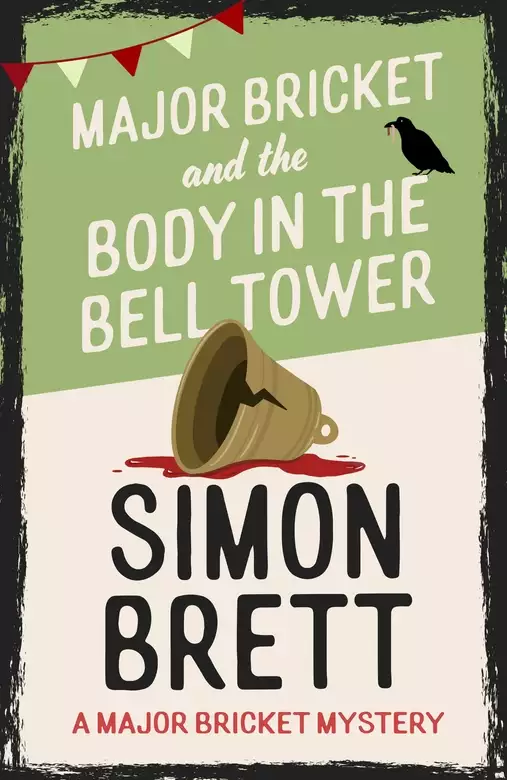
For Major Bricket, attending church in his village of Stunston Peveril in Suffolk is a good way to keep up with the village gossip. Having only recently retired from a career where he was privy to many international secrets, the Major likes to stay in the know.
Events take a turn one Sunday though when, after the morning service, Major Bricket notices the door to the bell tower open... and finds a body at the bottom of the stairs.
The dead man is dressed in a suit and dog collar. But who is he? And could someone in Stunston Peveril have killed him?
Perhaps predictably, most of the village residents seem more concerned with the Parish Council flower arranging rota than the mysterious corpse.
Major Bricket will have to rely on his long-nurtured detection skills, and his trusted friends Nga Luong and Rod, to solve the case.
Publisher:
Little, Brown Book Group
Print pages:
70000
* BingeBooks earns revenue from qualifying purchases as an Amazon Associate as well as from other retail partners.
Major Bricket had never committed himself to a specific faith. For his work, he had seen too much of the damage caused by religious extremism to be over-zealous in his own life. But, though technically unaligned, he was acutely interested in the mystery of faith. And how people could have it. At times, he almost felt envious of them, before logic brought him back on track.
So, in his home Suffolk village of Stunston Peveril, it seemed logical for him to make occasional Sunday appearances at the Parish Church of St Mary the Virgin.
For a start, it was an important gossip generator on the village network. Along with the village pub the Goat & Compasses, the Gingham Tea Shop, the Green Lotus Thai Restaurant and other minor substations, St Mary’s ensured that not even the smallest local rumour went unshared. Before services, over coffee in the Church Hall after services – and quite often in the course of services – other people’s dirty linen would be exchanged and later hung out to dry where the whole of Stunston Peveril could see it.
Major Bricket’s occasional appearance in the church also arose from a genuine interest in ecclesiastical architecture. It was a subject that had attracted him as a child and, if ever his foreign assignments allowed the time, he made a point of visiting the churches, mosques and temples of the locality. Back in his study at Highfield House, he had an extensive collection of books on church architecture, and it was a hobby he intended to pursue in the increased leisure time that, in theory, retirement should bring.
St Mary’s, anyway, was a fine church to have on one’s doorstep. It was one of the famous ‘wool churches’ of East Anglia, built from the profits of the booming wool trade. The farmers and merchants who had profited from this worldly business hoped that their lavish donations to church building would ensure for them the best seats in the heavenly realm that, they felt sure, lay ahead.
There had been intense competition between such benefactors to prove that they were richer – and so, automatically, holier – than their rivals. The result was that tiny villages like Stunston Peveril boasted churches of a size that wouldn’t look out of place in a major city. Their capacity had always exceeded the population of the villages they dominated, but in the twenty-first century their echoing vastnesses served only to emphasise the constantly dwindling congregations to which they played host on Sundays.
On that particular Sunday, numbers had been reduced further by the fact that it was raining heavily. Late September and the weather was definitely on the turn after a surprisingly good summer. Regulars in the Goat & Compasses, Stunston Peveril’s only pub, had had to get used to complaining, over their pints of Devil’s Burp, about the heat rather than the rain. For some of them to have their customary summer gripes removed had been quite a culture shock. It unsettled them.
They felt reassured, though, by the wind and a horizontal fusillade of rainwater, which seemed now to have clenched their hold around the village. All of the old tropes about ‘English weather’ – which had been somewhat devalued by the processes of global warming – could now be wheeled back out for the winter. Somehow, to the locals, that felt more natural.
Major Bricket, like many others in the congregation, had taken his umbrella to church with him that morning.
St Mary’s was a fine example of the wool traders’ competitive largesse. Its exterior featured some excellent fifteenth-century flushwork, a decorative practice where stone outlines were filled in with knapped flint. The best examples of this technique, the Major knew, were to be seen on the Holy Trinity Church at Long Melford, but St Mary’s Stunston Peveril was not far behind in quality.
The interior also boasted some exceptional features, of which the exquisitely painted rood screen was the most remarkable.
But that Sunday morning, seated at the back of the nave just by the door to the bell tower, Major Bricket was more interested in the congregation of St Mary’s than in the splendour of its structure. Though he had owned Highfield House for some decades, it was relatively recently that, in retirement, he had taken up permanent residence in Stunston Peveril, and the doings of the locals held endless fascination for him.
There weren’t that many of them in the church. Gaps between the bodies in the pews meant it was easy, from the Major’s perspective, to see most of the individuals who were there.
Attendance at church had never been a measure of piety. From the earliest times, being seen there had always been more important than just being there. Faith was very much a secondary consideration. And that truism was observable in St Mary’s that Sunday morning.
Take for instance, the Viscount and Viscountess Wintle, the top of whose heads the Major could see in the front row. Gregory would be dressed in a frayed tweed suit that had ‘done all right for his father’ over many decades. Visible on the head of his wife, Perpetua, was a hat. She would no more have appeared in church without a hat than she would have buttered her breakfast toast without using a butter knife. But Perpetua’s hat was not of the kind she might have sported to a Buckingham Palace event. It was the battered straw number she wore for gardening.
Many generations of Wintles had attended St Mary’s. Fincham Abbey, their ancestral home, boasted family portraits going back for centuries. Back in the day, there had been a Wintle Family Pew in the church, but such privileges had been ended by a democratising vicar in the 1980s. Gregory and Perpetua had borne their demotion with grace, though they had abstained from the same vicar’s suggestion that, at a certain point in his services, all congregation members should turn to the person on their right and say how much they loved them. (Obviously, had they obeyed, one of them would be addressing their spouse, whom they might well love. But people of the Wintles’ breeding did not indulge in public displays of affection.)
In the front pew, Gregory and Perpetua were, that Sunday, accompanied by a relative newcomer to Stunston Peveril, their butler, who gloried in the name of Virgo.
In the same way that they would have been a little surprised to be asked whether they loved each other, the Wintles would also think it bad form to be questioned about their faith. Wintles had gone to St Mary’s in Stunston Peveril every Sunday for many generations, without ever being asked what they believed in. Which was as it should be. That was all there was to say about the matter.
Gregory Wintle tended to be more vocal on the subject of hymns. Having had a traditional public-school education, begun by boarding at a prep school from the age of five, he had served time in chapel on a daily basis. Though this immersion in church ritual had had little effect on his beliefs, it fixed in his mind certain expectations of what should be demanded of a religion. And one of Viscount Wintle’s demands was that he shouldn’t be expected to sing any hymn that hadn’t featured in his school chapel order of service.
This led to a much more serious falling-out with the democratising vicar than the ending of the family pew privilege. Gregory frequently vented his spleen on the subject to his wife. (Having a lot of spleen vented towards you was just one of the duties that came with the job of being Viscountess Wintle. Over many decades, Perpetua had become adept at making appropriate soothing noises of agreement while not listening to a word of her husband’s diatribes.)
Gregory’s complaints about the hymns always took the same form. Perpetua could have joined in the words, had she been listening to them in the first place.
‘It all went wrong,’ the Viscount would begin, ‘with “Morning Has Broken”. When you can have a decent proper hymn like “O God, Our Help in Ages Past” or “Dear Lord and Father of Mankind”, who needs “Morning Has Broken”? That belongs in a Scout jamboree rather than a church service. Doesn’t anyone have any standards any more?
‘And then, even worse than “Morning Has Broken”, there’s “Lord of the Dance”! I mean, Jesus Christ’s job was being Saviour of Mankind, he wasn’t a blooming dancer! “Lord of the Dance” can’t hold a candle to “Praise My Soul, the King of Heaven” or “All Things Bright and Beautiful”. When you have people singing “Lord of the Dance” in a Church of England church, then you know the whole country’s going to hell in a handcart!’
And every time he finished that particular salvo, Perpetua would say, ‘You’re absolutely right, dear.’ Having not listened to a word. And preparing herself for his next tirade, against the ‘cloth-eared idiots’ responsible for the ‘total cock-up which is called “The New English Bible”’. His diatribe against new hymns was always just a warm-up for that.
Another hat in Major Bricket’s eyeline from the back of the church he recognised as belonging to Venetia Clothbury, a self-appointed mainstay of Stunston Peveril society. She was the perfect example of the truism that if you volunteer to be on one committee in a small village, you end up being on all of them. Some people might regard such duties as onerous, but not Venetia Clothbury. She felt her work on committees represented public service and they were all lucky to have her. Besides, the range of her local involvements gave her unique opportunities to keep up to speed on all the latest gossip. And when there was an insufficient supply of the stuff, Venetia Clothbury had no compunction about making some up.
She shared with many middle-class women of her kind the inalienable conviction that she was always right. And she was not inhibited about sharing her views, often over coffee from a table in the Gingham Tea Shop. Since it never occurred to her that anyone might not be interested in what she had to say, she spoke habitually at high volume.
She sang loudly, too, belting out traditional hymns in St Mary’s, blithely unaware of how flat she was.
The hat that the Major could see next to Venetia’s, and at a lower level, belonged to a woman who was frequently in her company, Mollie Greenford. It was arguable whether Mollie was a willing acolyte. As a fellow widow and relatively recent resident, she had realised that she might have to make some compromises in her choice of friends in Stunston Peveril. And when Venetia, in need of a sounding board to agree with her all the time, swept Mollie up in a smothering embrace, there had been little resistance. But Mollie Greenford had a lot more about her than her dominant friend realised. She was a worm capable of turning with devastating effect, when the moment was right.
She was actually rather a good singer, a thin pure soprano. But, since she always sang next to Venetia, her voice was rarely heard. She did, however, have her own area of dominance. At any church function, Mollie Greenford was in charge of the hot-water urns so essential to the making of tea and coffee. Heaven help anyone who tried to usurp her pre-eminence there.
Both widows, Major Bricket happened to know, were on the St Mary’s Parish Council. Venetia Clothbury had, needless to say, at one point been its chair (and behaved as if she still was).
The current incumbent of the chairmanship was also in Major Bricket’s eyeline. Reggie Charteris, like the Major himself, had retired to Stunston Peveril, in his case after what was said to be a highly successful career in insurance. Along with wife Fenella and son Julian, he had moved into one of the most splendid Georgian houses in the village, where the family set about, with characteristic single-mindedness, the business of ‘becoming part of the local community’.
Never people to let the grass grow under their feet, Reggie and Fenella Charteris set the pattern for their progress not by waiting for invitations to meet their neighbours, but by issuing invitations to them. Within a month of their arrival in Stunston Peveril, they had given a large party in the exquisite back garden of their home, Chevoir House.
Major Bricket, who had received an invitation, was intrigued as to how they had arrived at their guest list. Though a small village, Stunston Peveril had far too many residents for everyone to be invited. But, being in England, it did have a highly stratified social system. Though the Wintles were the sole genuine aristocrats, there were plenty of others who regarded themselves as part of an elite. And it was striking to the Major how many of those had been invited. The Charterises’ party was a distinctly upper-middle-class gathering. Around fifty attended, all of them the kind of people who reckoned they were the crème de la crème of Stunston Peveril society.
How had the Charterises figured out the village hierarchy in such a short time? They must have had inside help, someone who’d lived there for a while and was up to speed with all the nuances of the local pecking order. Major Bricket wondered who their insider spy had been.
Anyway, as a charm offensive, the party had been a big success. In such campaigns, money certainly helped. And though Stunston Peveril residents might talk of the vulgarity of splashing the cash, they found it quite acceptable when it was being splashed around in the form of champagne (and not the cheapest version available in special offers from Majestic or Lidl). Buying friendship, all the locals agreed, was an appalling idea, but it did work.
The enduring English principle of reciprocal hospitality ensured that, after their largesse, the Charterises received many invitations to the other upper-middle-class residences of Stunston Peveril. Within weeks, they very definitely had their feet under the village table.
They joined the Tennis Club, the Bridge Club and other social institutions (in many cases using local connections to speed up time-honoured membership procedures). Reggie Charteris, offering more lavish hospitality, invited the right sort of people to watch the Six Nations Rugby games on the wall-size screen at Chevoir House.
He also, with the full support of Fenella, targeted the church. An instinct, which had reportedly guided him to the top of the insurance business, told him that, despite dwindling congregations, St Mary’s remained one of the handles of power in Stunston Peveril. After less than six months, following the death of a long-serving member, he was voted on to the Parish Council. And, within a year of the family’s arrival, Reggie Charteris was its chair. And soon trying to extend his empire by taking on responsibilities which rightly belonged to the parochial church council.
Fenella, meanwhile, with appropriate meekness – ‘if you ever need a spare pair of hands … ’ – had offered to help out with the church flowers. Anyone who had known her for any length of time would have realised that this was the start of her planning for a coup. But nobody in Stunston Peveril had known Fenella Charteris for any length of time, so they were unaware of the threat. Which was good for the unbroken sleep enjoyed by Venetia Clothbury, whose fiefdoms included organising the St Mary’s flower-arranging rotas. Had she known the challenge that Fenella Charteris represented, she would not have rested so easy.
With his parents, and easily visible because he was a full head taller than Reggie, sat Julian Charteris. Around eighteen but apparently no longer at school, there was surprisingly little circulating on the Stunston Peveril gossip network about Julian. The rumour that he had spent the summer on a kind of ‘gap year’ in Asia had been substantiated. But what he had been taking a gap from was less certain. A lot of speculation but few facts.
This amused Major Bricket, because the same had happened to him when he first retired to spend all his time in the village. It seemed that every resident had a different version of what he had retired from. And, by never confirming or denying any of their conjectures, he had kept his mystery. Which was exactly what he had always wanted to do.
The vicar taking the service that Sunday morning in St Mary’s was not the regular incumbent, who had retired just before the Major took up permanent residence in the village. She had been a woman called Grace Truscott and the Major had heard nothing but good about her. None of the churchgoing residents of Stunston Peveril had wanted her to go, but the Church of England had strict rules about retirement ages and there had been no choice in the matter.
Though Major Bricket had an enduring interest in church architecture, he had never concerned himself much with church management. But the more he found out about how the allocation of clerical jobs worked, the more of a Looking Glass world of illogicality he found himself in.
Basically, it seemed to be the case that the Church of England did not begin. . .
We hope you are enjoying the book so far. To continue reading...

 Please log in to recommend or discuss...
