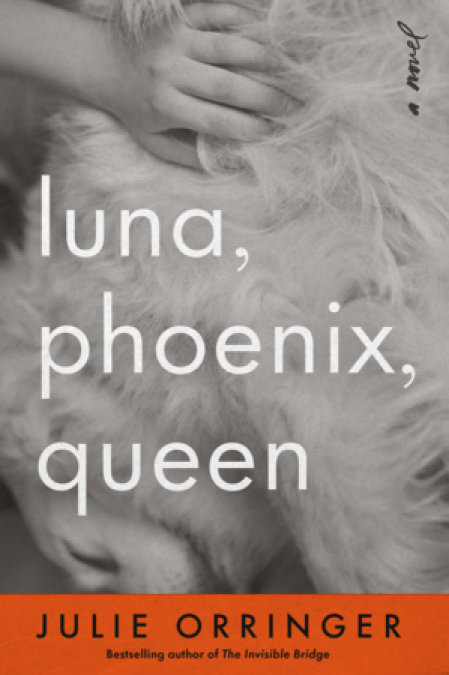
KIRKUS PRIZE FINALIST • A spellbinding tour de force from the bestselling author of The Invisible Bridge—a novel about varieties of infidelity, the provenance of a literary masterpiece, and the power of storytelling to shape identity and destiny.
"Luna, Phoenix, Queen reimagined what I thought a novel could do. My favorite kind of novel." —Caro Claire Burke, author of Yesteryear
Dava and Barr Pennington, professors at a Midwestern university, both harbor potent secrets. Fiction writing is his specialty, English literature is hers. But Dava is unhappy in their marriage, and secretly in love with a colleague, Svetlana White, who teaches in the Russian Studies department; spurred by their complicated liaison, she spends her nights working on a novel about two women who run a domestic violence shelter in coastal Maine. Though she loves the work and the refuge it provides, the writing becomes increasingly difficult as her memory begins to fail; tests reveal that she’s suffering from early-onset Alzheimer’s. After a precipitous decline, she moves to a memory-care facility in a neighboring town. Soon afterward, her husband, alone in the house at night, discovers her hidden manuscript, which he reads with envy, and then with anger, as he extrapolates his wife’s affair from the relationship described in the novel’s pages. Over the next two years he rewrites the novel and publishes it as his own, to wide acclaim. But persistent feelings of guilt lead him to confess his theft to an unlikely party, who leads others to the truth.
Luna, Phoenix, Queen tells its tale of artistic and marital betrayal in a chorus of voices. We hear from Barr as he becomes obsessed with Luna, a horrifically injured dog at a local shelter; from Dava as she meets Svetlana for the first time, on a transatlantic flight to Dublin; from Milo, Dava’s son, as he hides in the woods with Naomi, Svetlana’s daughter; from Svetlana, experiencing the loss of a relationship that ended before it could come to fruition; from Evie, Barr’s research assistant, who witnessed Dava’s last days at home with her husband; from James, the Penningtons’ younger son, who makes a startling discovery after his father’s death; and from Milo and Svetlana again, as they grieve the injustice of Barr’s theft and confront the devastation of Dava’s disease.
In a narrative that spans four decades and four thousand miles, Luna, Phoenix, Queen illuminates the power of storytelling and explores the terror of losing the ability to make sense of our world. It is a cry of rage against our vulnerability and helplessness; an acknowledgment of the mysteries beneath the familiar surface of our world; and ultimately, if unexpectedly, a radical testament to love in its many forms.
Release date:
October 13, 2026
Publisher:
Knopf
Print pages:
288
* BingeBooks earns revenue from qualifying purchases as an Amazon Associate as well as from other retail partners.
CAUTION: This email originated from outside of Penguin Random House. Please be extra cautious when opening file attachments or clicking on links.
WARRIORS
The plan had never been for Dava to go to Ireland alone. They were supposed to go together, the trip was for Barr, he was supposed to collect a prestigious international award for a short story he’d written about a man whose twelve-year-old son suffered from a rare form of progressive blindness. But here she was now, arriving at the airport alone, because Barr had the flu and couldn’t travel. His mother, who rarely got sick, was taking care of Barr and the boys. Because the father in the story resembled Barr so closely in every particular—his job as a professor of creative writing at a celebrated Midwestern university, his penny-colored hair, the mild speech impediment that softened his t’s into th’s—readers assumed that Barr had a twelve-year-old son who suffered from degenerative optic neuropathy. And he had never denied it outright. When interviewers asked how much of the story was drawn from life, Barr would laugh and say 63 percent. If they pressed, he told them he considered his family life a private matter. When Dava voiced the opinion, one night after the kids were in bed, that Barr was behaving unconscionably by implying that they had a child who was going blind, Barr had shrugged and said they could think what they wanted, it was none of their business anyway.
“But this is my business,” she said. “Those are my children.”
“Then you should thank me for not talking about them in public.”
“How is it violating their privacy to say they’re not going blind?”
“You’re pretending not to understand, Dava.”
“Of course I understand! You’re trying to capitalize on a misperception. It’s embarrassing. It’s an insult to every parent of a kid who actually has a disability.”
“My stories are stories. I’m not under any obligation to talk about my real life.”
“You’re under an obligation to the truth, like the rest of us.”
He leaned against the kitchen sink and looked at her with narrowed eyes. “Once again, my work is getting the attention. That’s what this is about.”
“Oh my god,” Dava said. “You want me to be jealous, is that it?”
“I’m just calling it like I see it.”
“I don’t do what you do. I don’t expect to be reviewed in the Times when I publish some article in the Journal of Modern Literature. I love what I do. Is that so devastating? I want your stories to win awards. That’s good for all of us. What I don’t want is to be married to a liar.”
“We call them fiction writers these days,” Barr said. “But use whatever term you want.” He went to his study and closed the door.
It wasn’t as though their real-life twelve-year-old was in perfect health. Right now, as Dava rolled her bag toward the security checkpoint, Milo would be using his nebulizer in the kitchen while James got ready for school. Milo had asthma and eczema and allergies to dust and mold and whatever else flourished inside the walls of their hundred-year-old house. He sniffled all the time and carried an inhaler. From the time he was three years old, his eyes had been purple-circled underneath. Sometimes his allergist prescribed a round of steroids, and for a few days Milo would become as bright and ebullient as James, who was allergic to nothing. Then the doctor would taper the steroids, and inevitably the effect would fade. Milo, who wanted only to be out in the woods, had been getting allergy shots for a year and a half now, with no change. Drifts of saffron-colored pollen from a stand of pines, pink cones of chestnut blossoms, wildflowers genuflecting in the neighbors’ unmowed yard: all of it was a misery to him. They lived with his misery day and night, knew everything about it. But an itchy, congested, slightly asthmatic child made for an unattractive literary subject. No elegant metaphor arose from his flaking skin; no poetry lived in his gritty midnight cough or in the single iamb of his sneeze.
Twice a year, Barr’s mother, Merrilee, would arrive to perform the duty she called “giving you two a little break,” which meant, in part, trying to substantiate her long-held theory that Milo’s allergies were a neurosis of Dava’s. Merrilee would encourage Barr and Dava to take a long weekend in Chicago, where they could get what she called a soupçon of culture. Merrilee lived in New York and considered the Midwest another chronic ailment that had befallen her son’s family. Because Dava had been a PhD student when she and Barr had met, because her fellowship kept them at the university long enough for Barr to be offered a permanent position there, Barr’s mother considered that ailment, too, to be Dava’s fault.
Barr’s flu was the same one from which Dava and the boys had just recovered. Merrilee insisted that Dava take the trip to Ireland as planned, that she could see to everything in the house. When Dava said she’d prefer to stay home, that the boys were still tender after their illness, what Merrilee said was “Too many cooks.” As if she, not Dava, were the one to whom the literal and metaphorical kitchen belonged. During this conversation, Milo and James sat at the table eating their grandmother’s banana bread and drinking the full-fat cow’s milk she bought them, instead of the soy milk the allergist recommended. Barr lay in bed upstairs, shivering through an Updike novel and sipping chicken soup. Her mother-in-law had made it clear that no one particularly needed Dava. They’d be better off without her, in fact, at least for the span of the trip, only a few days’ time.
Later that day, Dava told Barr she would go to Ireland in his place, that he could tell the prize committee she’d accept the award for him and read the speech he had prepared. He was happy to let her do it; he’d never liked international travel. He hated jetlag, and his back ached for days after an overnight flight. Dava told herself she deserved it: a solo trip to Ireland while her mother-in-law took care of Barr and the boys. Much of the time, she did every single thing in the household herself. And she’d edited draft upon draft of Barr’s prizewinning story, often at the expense of her own work.
Milo had been quiet and downcast this morning when she’d said goodbye, and James was uncharacteristically clingy. Barr, still feverish, had been sleeping when she left. She’d felt guilty all the way to the airport, thirty-five miles through slanting gray sleet. As she waited in the security line, she watched the woman and child ahead of her, the child singing to herself, the mother adjusting and readjusting the duck-shaped plastic clip in her daughter’s hair. When Dava traveled with the children, she found herself eyeing the women who sat alone with their magazines or sipped drinks at the airport bars: creatures from another world, idling in quiet luxury, subject to no one’s needs but their own. Now here she was, wishing she could put a hand through James’s hair, hoping Merrilee would remember to replace Milo’s expired inhaler before he left for school. She kicked her shabby rolling bag with the toe of her boot. Years ago, when she traveled alone more frequently, Barr had been in the habit of putting notes into her bags. Funny notes. A cartoon vampire saying, It’s veird how much I vant you. A miserable-looking camel on a dune, saying, Don’t desert me. She’d been looking forward to the privacy they would have on this trip, the chance they might have to talk without arguing, to have sex that wasn’t reconciliatory, to fuck unquietly in a hotel room on clean white sheets she would never have to wash. No one waking in the night needing Tylenol or albuterol. No one asking for a buttered waffle at six in the morning. Come to think of it, she couldn’t remember the last time she and Barr had had sex at all, reconciliatory or not. But then there were more and more things she couldn’t remember. A fog-laced wind seemed to blow through her brain with increasing frequency these days, unhinging things, sleight-handing them away.
Above her, near the ceiling of the terminal, a sparrow tested the permeability of a skylight. Two more sparrows sat on a metal bar that transected the peak of the roof. Why did birds always get trapped in airport terminals? There should have been some easy means of egress for them, but there never was. Egress: the first time she’d seen the word, she had assumed it referred to the female of the species, like lioness or tigress. She’d read it on the wall of a cruise-ship cabin when she was eight years old, on the safety poster beside the stateroom door. This room has an emergency egress in the event of fire. She knew egrets; they lived in the marshlands near her grandparents’ house. What good, she had wondered idly, would an egress do in the event of fire? Why a female in particular? Where, in that small room, could it be kept? As her parents argued in hushed voices in the hall, she drew it on the cruise ship’s monogrammed notepad: the egress, white and sharp-beaked, standing at bowstrung attention, ready to give aid in a crisis.
Ahead of her now was the Chicago gate, the same one that always took her out of here. Sitting near the bank of windows was one of her colleagues from the university: Svetlana White, of Slavic Studies, who specialized in the Russian short story. Dava took a seat some distance away and watched her, because Svetlana had interested her for some time: she was rumored to have dressed down a male colleague who was famous for ass-pinching at parties and whose work had lately edged toward plagiarism. She was also known to have had a public blowout with a longtime girlfriend, a neuroscientist, conducted at a restaurant near campus; everyone talked about it for weeks afterward. An acrimonious breakup followed. Or at least that was the gossip between the departments, which was not always reliable. Svetlana had a book open on her knee and was eating a bagel. Dava’s mother-in-law believed that a grown woman should never be seen eating in public except at a restaurant table. She had offered this opinion on a walk with Dava a few months after Milo’s birth. Dava, desperate with lactational hunger, had bought a chocolate croissant at a bakery and was eating it as they walked, cantilevering it over Milo’s head as she carried him in the baby carrier; a rain of golden flakes drifted into the pale cumulus of his curls. As far as Dava was concerned, a scattering of butter-laced crumbs only added to Milo’s appeal. But then Merrilee had said what she’d said, and Dava had thrown the rest of her croissant into a rosebush—pointedly, she’d thought, relishing her own Tom Swifty in place of the pastry.
Now someone was standing over her, casting a shadow. A man in a pink polo shirt, fiftyish, a blocky gray laptop in his hand.
“Would you mind moving?” he said. “You’re sitting in front of the outlet, and I see you’re not using it.” He stared openly at her breasts as he spoke, and she resisted raising her hand to cover them.
“How do you know I wasn’t about to use it?” Dava said.
“I didn’t see you using it, that’s all.”
“But what if I was about to?”
“Look, never mind, I can find another one.”
“No, no,” Dava said, getting to her feet, gathering her things.
“Be my guest. I was just leaving.” Across the waiting area, Svetlana White crumpled her bagel wrapper and sank it cleanly into a nearby garbage can, then shifted in her seat and settled again. Dava balanced her handbag on her rolling suitcase and pulled it across the silent carpet toward Svetlana.
The movement caught Svetlana’s attention. “Well,” she said, looking up from her book. “Professor Pennington. How’s the English department?”
“Fine. How’s Slavic Studies?”
“Contentious as ever. But wait, didn’t I see you someplace else recently?”
“The kids’ school. Election-day bake sale. You were there with your—son?”
“Daughter,” Svetlana said. “She likes her hair cut short.”
“Oh,” Dava said. “Sorry.” Why had she broken her own privacy and someone else’s, another mother’s? It was nearly always a mistake. She opened her bag and took out a novel to signal that Svetlana need not feel obligated to engage.
“I read that,” Svetlana said, glancing at the cover. “The male-specific equivalent of postmodern navel-gazing. Penis-gazing. To put it kindly.”
Dava laughed. “It’s homework. He’s going to be the Exley Lecturer in a month. I’m introducing him.”
“Oh! Lucky you.”
Dava glanced down at the book in Svetlana’s hand: Chekhov’s stories. “Are you teaching that?”
“No. Just fond of it.”
“Imagine,” Dava said. “Reading for pleasure.”
“Didn’t you bring anything you actually want to read?”
In fact, the idea hadn’t occurred to her. She shrugged, vaguely ashamed.
“Okay,” Svetlana said, and smiled. “We’ve got twenty minutes until boarding. The bookstore’s right there. Why don’t you go get something you want?”
The note of challenge in Svetlana’s tone sharpened Dava’s attention, made her look at her more closely. Svetlana was wearing an asymmetrically cut black silk shirt woven with a pattern of tiny plus signs, a rolling field of increase; the plus signs looked as if they were executed in threads of actual gold. The skin of Svetlana’s hands was pale and clear, her fingernails clipped short, suggesting the effort of someone who had conquered the habit of nailbiting but struggled to remain abstinent. It took Dava a moment to remember that Svetlana had just addressed her. What had they been talking about?
“Buy a book,” Dava repeated. “Any book?”
“No,” Svetlana said, with half-serious impatience. “One you want.”
“All right,” Dava said. Why not? She stood and headed for the bookstore, dragging her suitcase. She had not, she realized, asked where Svetlana was going after Chicago. No one who lived in their town took a flight just to Chicago; you only flew there to go farther. Why hadn’t she asked? Motherhood, she thought: it had stripped her of the nicer impulses, had reduced her exchanges to what was essential. But her children weren’t here right now. What was she saving her energy for?
The bookstore was not of the usual airport type. A revered bookseller named Wolf Heisenberg, who had for decades owned a large used bookstore in Cedar Rapids, now occupied this space too, an outpost. He had everything and claimed to have read it all. She thought of an old sci-fi book she meant to get for James and Milo, about a robot who gets separated from his beloved boy when the boy’s family is sent back to Earth from Mars; she was sure it would be on the shelf if she looked. But that book wouldn’t meet Svetlana’s single criterion. She felt the weight of the challenge: she would, in essence, be representing herself to Svetlana by her choice. Of course, Svetlana’s opinion was a thing of purely abstract value: the opinion of a colleague but not of a member of her department; an acquaintance, not an intimate friend. She cared what Svetlana thought, but not too much. She could choose the book she really did want. She drifted into the fiction aisle and did what she always did in a place like this: surfed the waves of memory that came with the familiar spines. There was The Crying of Lot 49, which, as an undergraduate, she’d read with hunger and then thrown across the room. Here was Kafka’s Metamorphosis, which a college lover had once, unaccountably, wanted her to read to him while he masturbated. The Plume edition of Sula, with its stemmed rose and burning interior. The Moviegoer, which she’d worn nearly to shreds the summer after graduate school. And now here was a book she’d never read: Night and Day, the novel Virginia Woolf had written before Mrs. Dalloway. Scholars called it lesser because it shared more literary DNA with the nineteenth century than with the twentieth. Should that prevent her from reading it? Was there any word of Woolf’s she should fail to read? Taking the book into her hands, she opened the cover and inhaled the must of the endpapers. Six dollars, for whatever Woolf had chosen to put between those pages. She held the book in her hands as though she owned it already, then sat down on a rolling footstool and began to read.
___
Someone was calling her name. Svetlana stood at the entrance to the bookstore, suitcase in hand. “We’re boarding,” she said. “They just called the fourth group.”
“Oh!” Dava said. “Hold on.” She’d lost track of time entirely; she’d forgotten she was at the airport. She went to the desk and opened her wallet, but of course she never carried cash; who did anymore? Heisenberg, that Luddite, didn’t take a credit card, not even here at the airport.
Svetlana rolled her bag into the bookstore, took a ten-dollar bill from her own wallet, and laid it on the counter in front of the draggle-haired clerk, one of Heisenberg’s nephews. The lesser Heisenberg smiled at Svetlana like they were friends, exchanged a few words with her, and nodded approval toward Dava’s book. Then Svetlana hustled Dava out into the terminal.
“You can’t just buy that for me,” Dava said.
“Too bad, I already did,” Svetlana said. “You’ll get me back sometime.”
The line of passengers had disappeared into the jetway, and the flight attendant was standing alone, dislodging the magnetic latch that held the door.
“Wait!” Svetlana called, and the flight attendant looked up. Svetlana offered her boarding pass, and Dava, after some fumbling, found her own. A moment later they were hustling down the jetway toward a plane that would transport them to Chicago, and then onward, elsewhere.
We hope you are enjoying the book so far. To continue reading...

 Please log in to recommend or discuss...
