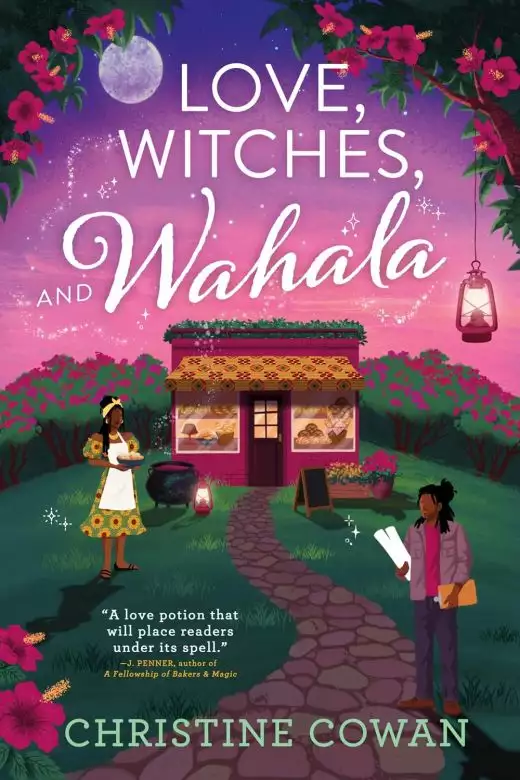
In this romantic, cozy fantasy debut a Nigerian witch must grapple with an ancient curse that will erase her family's magic and doom her beloved bakery forever unless she finds her soulmate. Perfect for readers of The Very Secret Society of Irregular Witches.
In Kamalu Lane, Nneka is a witch grappling with an ancient family curse: find her soulmate or risk all the witches of Kamalu Lane losing their powers forever.
In a desperate attempt to force fate's hand, Nneka brews a love potion, but chaos erupts when the potion is accidentally added to Nneka's famous puff puffs, causing every man who eats them to fall in love with her, except Dakoru, the handsome architect determined to reshape Kamalu Lane.
Though Nneka feels an undeniable connection with Dakoru, she knows falling for a human could doom them both. But Dakoru is no ordinary man and it's clear he is connected to magic in some way.
As their connection grows, Nneka needs to figure out if Dakoru is the key to breaking her curse and restoring balance to Kamalu Lane before its future is lost forever.
Release date:
November 17, 2026
Publisher:
Orbit
Print pages:
336
* BingeBooks earns revenue from qualifying purchases as an Amazon Associate as well as from other retail partners.
The first rays of dawn seep through the lace curtains of my pastry shop, casting ethereal patterns on the tiled floor. Kamalu Lane is still silent, the day’s hustle and bustle yet to come alive. I stand in the center of the shop, filling my lungs with the comforting aroma of baked meat pies and lingering traces of yesterday’s cinnamon rolls.
“Alright, let’s do this,” I mutter to myself. My hands glide over an array of herbs and trinkets spread across a small round table in the corner—sage for wisdom, rosemary for remembrance, and a sprinkle of salt for protection. With a whispered incantation, I release the energies, watching golden dust bless every nook and cranny of the space. For a fleeting moment, my braids glow a rich, hopeful gold.
This is your sanctuary, Nneka. Whatever the day throws at you, this is where you belong.
I shake my head as I reach for a lavender-scented candle. Lighting it, I set it next to an image of my late grandmother. Her eyes in the photograph meet mine, filled with warmth that still reaches me from the other side.
Mind your gift, my love, she’d always say. Mind it, but never let it define you.
The quietness of the morning amplifies the flame’s crackling. Another day, another chance to break this curse hanging over me like a knife meant for rituals.
The shop’s door swings open, and Ebele strolls in, laden with bags of flour and sugar. She spots me and rolls her eyes dramatically, breaking my contemplative mood.
“You and your morning rituals,” she says, her voice tinged with playful sarcasm. “Ever considered just using an air freshener like normal people?”
“Ebele, we’re witches, so it’s not the same,” I reply. “An air freshener won’t protect us from bad energies—or nosy customers.”
She chuckles, setting down the bags with a huff. “Well, our magical juju better prepare us for Mrs. Azuka. You know she’ll be here right when we open, looking for something to gossip about.”
“I wouldn’t expect anything less.”
I look at my phone, and it’s eight. As if on cue, Ebele turns the OPEN sign with her customary flair, a sparkle in her chocolate-brown eyes. “And we’re live!” she announces. Her curly Afro bounces as she moves to adjust the floral arrangements on the tables. She’s a vision in a bright green neck scarf and bold Ankara-print dress.
I wonder where Chinwe is, and then the door bursts open as if propelled by an unseen gust of wind. Chinwe rushes in, panting and disheveled. “Am I late? Please tell me I’m not late!”
“By the skin of your teeth,” I reply, unable to hide my smile. She’s always in a rush, but her energy is infectious.
Chinwe’s long wavy hair, a stark contrast to Ebele’s Afro, is pulled back into a messy bun. She wears a simple, elegant brown tunic and black leggings, her eyes a calming shade of hazel.
It is fascinating to see the striking differences between Ebele, who is introverted and thoughtful, and Chinwe, who is energetic and full of life. Yet, both are unapologetically themselves and make my world whole together.
“You’re just in time for Nneka’s morning walk down memory lane,” Ebele says, gesturing toward me as I finish setting the counter.
Chinwe joins the conversation as she rearranges the pastries she baked this morning at home. “Let me guess, you are about to remind us about your nine lives and the annual witches’ council meeting—for the umpteenth time. The dreaded Nzukò Nné Mùó.”
My braids darken to a shade of gray at the mention of the witch council, whose name translates to Meeting of the Mothers. They’re a throwback to ancient traditions, elders governing the magical community with an iron fist. “This is my last life, you know; it’s not a joke.”
“We know that, and that’s why we have been begging you to at least go on dates to find your man. Besides, times may change, but we know the Nzukò Nné Mùó stays the same,” Chinwe says. “Archaic, judgmental, but sadly unavoidable.”
“Chinwe, you know why,” Ebele interjects. “They keep the order and make sure we do what’s needed to live in harmony with the humans.”
“At the expense of cursing one of their own?” Chinwe scoffs. “They are the infamous council of elder witches, Ebele. Where progress goes to die.”
My fingers graze over the tray of freshly baked puff-puff as I carefully place them on the display shelf. Ebele catches my gaze and seems to read the thoughts lingering in my eyes. She’s always had a knack for that.
“Don’t start feeling bad now. We’ll figure something out before the meeting,” Ebele adds.
I nod. It’s hard not to worry. The dreaded meeting happens at the end of every Harmattan season, along with the Festival of Lights, where the elders are like uninvited guests who overstay their welcome. “The elders will scrutinize my life and whether or not I’ve broken the curse because it, in fact, affects every witch—including you two.”
I don’t know how else to channel my frustration toward the rigid, age-old institution, an assembly whose magical and moral decrees can wound as easily as they claim to protect.
Chinwe chimes in: “That’s why I suggested the love—”
“Don’t bring it up, Chinwe, please. I don’t even know why you’re so against them. I’m worried about the curse—the reason I’ve been through nine lives. And now on my last, the tenth.”
They both look down and go on with their work. The curse. A spell so old, its origins are lost to time. I clearly remember the day my grandmother told me about it.
My late mother fell in love with a human and conceived me, a child who should have never existed in the eyes of the elder witches. Back then, it was considered a betrayal, an unforgivable sin. It still is. To make an example of her, the oldest elder laid a curse before I was born. I have to find my soulmate and make them fall in love with me, and I need to do it within ten lifetimes. Or else everyone’s magic disappears. No pressure, right?
If the curse isn’t broken before my current life, the tenth and last one, runs out, I’ll die, and every witch in Kamalu Lane will lose their powers. The land itself will strip them away, unable to sustain its magic without the strength of my bloodline.
And that strength is undeniable.
It’s a bit cliché, like something from a tragic romance novel, but its effects are terrifyingly real. I’ve experienced it firsthand—nine lives filled with love, loss, and inevitable solitude.
Despite years of witches like myself poring over ancient tomes and casting countless spells, no solution has been found. And here I am, in my tenth life, the weight of my mother’s actions pressing against me like the humid air of Port Harcourt. There’s no time to even find said soulmate.
Ebele’s voice jolts me back to the present. “Whatever happens, we’re here for you, Nneka—council or no council, curse or no curse. I know you feel like every witch in this town is counting on you, but you’ve got to live your life. Even while looking for a way to break the curse.”
I meet her eyes, and for a moment, they’re the anchor pulling me back from a swirling sea of doubt and fear. My braids shimmer a lighter shade of blue, and I breathe, allowing myself this small sanctuary, a respite from the burden of maternal woes.
“I agree,” Chinwe adds, grinning. “Besides, you’ve survived nine lives, so one more council meeting should be a piece of cake.”
The doorbell chimes, and we turn as one, putting on our brightest smiles for our first customers of the day.
“Showtime,” I whisper. We each slide into our well-practiced roles: me baking, Chinwe working on the zobo, and Ebele serving customers—an orchestrated dance of friendship and business.
Yet, even amidst the rhythm of opening bottles and laughter, a whisper of dread lingers in the back of my mind: Nzukò Nné Mùó, the council, the curse.
The wind hustles outside, sending dry Harmattan gusts that rattle the shop’s sign. The mouthwatering scent of frying puff-puff wafts through the air, merging with the distinct aroma of spices, of oven-baked chicken and meat pies.
The late-afternoon sun casts a muted glow through the back window of the kitchen, the light dancing across the counters in thin slants as a storm gathers somewhere in the distance.
I pause, glancing toward the window. A storm? That’s strange. There shouldn’t be any rain now; it’s the Harmattan season.
Though Harmattan isn’t just a season—it’s a force, a stretch of months where the air turns dry and brittle, the winds sweeping in, leaving cracked lips and dust-coated skin in their wake. It’s a time of clear skies, cool mornings, and scorching afternoons. Rain? That doesn’t happen.
I shake my head and continue to work. Baking keeps me grounded and allows me to channel my magic in small, safe ways. But lately, even that has become unpredictable. My powers have been slipping for weeks now, and each day makes me feel like I’m teetering on the edge of something dangerous.
I move quickly, preparing the dough for the next batch of puff-puff. As I work, I mutter a small spell over the dough, imbuing it with protective energy for my regulars. It’s something I’ve done hundreds of times before, now a habit, and the magic flows through my hands as easily as breathing.
Once the new batch is done in the fryer, I make another dough while Adaobi, the young witch in training, sends the other out. My concentration cracks for just a moment, long enough for my innate magic to seep out and blend with the batter. “Be open, be free,” I mutter absently, and my eyes snap wide open. Oh no.
I speedily finish up the batter and start frying it. Just in time, Chinwe and Ebele waltz in, their laughter echoing through the room.
“Something smells extra good today.” Chinwe grins, her eyes twinkling like she knows a secret.
My heart does a quick somersault. “You might say this batch is particularly… enlightening,” I manage to say, eyeing the bowl as if it might spontaneously combust.
Ebele raises an eyebrow. “Enlightening how?”
Before I reply, Chinwe snags a finished puff-puff from the cooling rack and bites into it. “Mmm… why do I suddenly feel the urge to admit I’ve been hoarding zobo in my secret fridge at home so I don’t have to share?”
Ebele bursts into laughter. “You’re what? I knew it! No wonder you come to the shop with big bags.”
A surge of relief washes over me, quickly followed by a ripple of dread. “It might be because I accidentally enchanted this batch with an honesty spell. I was distracted and—”
What have I done? I quickly mutter a counterspell under my breath, focusing on the words. The air shimmers briefly around the rest of the puff-puff as the spell fades away.
Chinwe wipes her mouth before interrupting. “Nneka, you need to take a deep breath.”
The words hang heavy, the joyful atmosphere dimming for a split second.
Then Ebele reaches for my hand. “Hey, we’ve all been there. Sometimes, the magic does what it wants. At least you’re able to counter it.”
“You know my powers are dwindling slowly. What if I hadn’t been able to counter it, Ebele?” I ask. “What then?”
They don’t say anything. Magic bends to my will, shaping the world around me in ways no other witch can. My spells leave no trace—no shimmer in the air, no hum of power that others can sense. It’s as if the magic belongs to me, a quiet storm waiting beneath the surface. My magic flows through my hands as easily as breathing, a natural extension of who I am: the only witch aside from my mother to have lived more than one life.
I wipe my hands on my apron, trying to stay composed. The magic that was once an aspect of who I am now seems foreign.
Chinwe clears her throat. “Let’s all take a deep breath. Besides, I have news.” Her voice drops into that conspiratorial tone she always uses when she’s about to drop some juicy tidbit. “So, have you guys heard about the big redevelopment project?” she asks, raising an eyebrow like it’s the most shocking news we’ve heard in years.
“Redevelopment where?”
“Here on Kamalu Lane!” she says, her eyes widening like she’s waiting for us to gasp.
I snort, nearly choking. “Please, Chinwe. They’re not changing anything here.”
Ebele leans in. “No, seriously. Word is, some hotshot architect has aligned with a construction company and they want to modernize the whole area. New businesses, fancy shops, maybe even some of those overpriced high-rise apartments.”
“No!” Chinwe adds. “That’s not good, o!”
I roll my eyes. “Of course it isn’t, Chinwe. The shop is fine the way it is. We don’t need a bunch of rich folks coming here to disrupt everything we’ve built. And trust me, the elders won’t agree to it.”
Kamalu Lane has too much history to let some random developer waltz in and change it all. It’s steeped in tradition; every building, every crack in the sidewalk holds stories. My nine lives were here in this small town of Choba.
Things don’t change easily.
“I don’t know, Nneka,” Ebele says. “If this redevelopment project is real, we need to let the other witches know.”
I wave her off. “The same way we’ve heard the rumor, they’ll hear it too.”
Chinwe shakes her head, clearly unconvinced. “You know how things go around here. One minute, it’s a rumor, o, and the next thing you know, there’s a bulldozer outside trying to tear down our favorite suya spot.”
I smile, but I’m barely listening. I look out the window; the street outside is now shrouded in a thick fog. It’s strange—unnatural. The hairs on my neck stand up, and I sense a slight shift in the air. Like something important is happening, or someone is here.
“Do you guys see that?” I ask, nodding toward the window.
“The fog outside?” Ebele asks.
“Yeah, what else?”
“Maybe it’s the developer arriving in style.” Chinwe laughs.
I laugh too. “If they’re coming, they better stay far from my shop.”
The kitchen’s sweltering heat and the aroma of fried delicacies fade into the background as I carry the fresh batch of puff-puff to the front counter. My eyes skim the little shop, decorated with earth-toned textiles and glass jars filled with dried hibiscus for our zobo. The chatter from the locals is a warm, familiar cacophony, but now something shifts.
A strange sensation crawls up my spine. I glance around, trying to figure out why the room looks clouded. Yet everyone else goes about their business, laughing and chatting, oblivious to the haze thickening in the room. A sudden cold snap? It’s impossible in this heat. It must be part of the Harmattan wind, I reason.
And then, when I step out of the kitchen, an unfamiliar feeling sweeps over me—a foggy sensation, like a drifting wisp of wind, has snuck into the shop. Chinwe and Ebele continue chatting with customers, oblivious to the misty atmosphere. A shiver trickles down my spine. What the hell is happening?
The doorbell jingles, and that’s when he walks in.
I swear it’s like an eclipse: a sudden, arresting event that blocks out everything around it. He’s tall, wearing dark, tapered jeans that hug his legs just right, leading to a tailored, slate-gray shirt accentuating his broad shoulders. His shirtsleeves are rolled up to his elbows, exposing forearms that speak to a hidden strength. Black leather boots add to the look, lending him an air of rugged yet cultured charm. A single gold chain rests against his shirt, understated yet eye-catching.
His eyes lock onto mine as if a magnetic field engulfs us. Time slows, and the background noise fades away. His skin is the shade of rich, sun-kissed earth, and his locs fall effortlessly, framing a face with eyes so piercing that they almost look into my soul. A few loose strands fall forward, drawing my eye to his sharp jawline.
He saunters up to the counter, the fog seemingly parting for him.
Six hours earlier…
The air that rushes to meet me the moment I step off the jet is heavy and thick—familiar.
Nigeria’s heat isn’t like some foreign cities’ dry, baking warmth. No, it’s more like the warm hug of an old friend. I pause for a moment on the steps as I take in the sight of Port Harcourt International Airport.
As I walk through customs, I tug at the collar of my slate-gray shirt, the fabric sticking to my back despite the slight breeze from the air conditioners. I head out through the private exit with my luggage and scan the parking lot for the driver.
“Sir, your car is waiting. I’m Yusuf.” A voice interrupts my thoughts. He’s holding a placard from the firm, close to a waiting black-tinted SUV, and he opens the door.
I nod. I’m eager to dive into work, and my mind is already running through the details of the redevelopment project.
Once inside the car, I settle into the leather seat. My iPad sits beside me, filled with blueprints and proposals for Kamalu Lane—my father’s lane, as my mother calls it. He called it the future center of commerce and progress. Pa spent so much time working on the vision, never truly bringing it to life before he passed. And now it’s my responsibility.
The car pulls out of the airport, merging onto the road. And after thirty minutes of driving freely, we hit traffic, an endless stream of cars honking and weaving in ways that defy logic. I drum my fingers against my knee as my thoughts drift not to the blueprints on my iPad or the endless meetings lined up, but to my father.
Six months ago, I stepped into his study for the first time since I came back for his burial, expecting dust and silence, but I found his legacy waiting for me in neat, methodical stacks: blueprints, proposal templates, detailed sketches of what Kamalu Lane could become. The dream he’d mentioned to me two years ago but never gave specifics, saying he wanted to wait until he was certain.
I remember standing there, staring at the papers spread across his desk, a glass of untouched whiskey in my hand. Back then, I didn’t know what to do with it. I was grieving, still am, and drowning in responsibilities while trying to hold myself together for my mother’s sake. I ignored it, convincing myself it wasn’t my burden to carry.
That was a lie.
Here I am, staring at the streets with his vision sitting beside me in digital form, waiting for me to bring it to life.
The car slows to a stop at a red light, and my gaze drifts to the sidewalk, where an elderly man pushes his cart, weaving through streetlights. I stare out at the chaos of the streets. Vendors slip between lanes in traffic, selling everything from boiled corn to cheap sunglasses. The rusted zinc roofs of old buildings stand alongside shiny new ones. This city is constantly evolving. It is a place caught between tradition and progress, just like Kamalu Lane.
The light turns green, and the car rolls forward. I exhale, pressing my head back against the seat.
“Take me straight to the office,” I tell the driver. “No need to stop at home first.” I’m not ready to deal with home yet. The weight from these past months—my father’s passing, the silent grief clinging to my mother, the expectations—settles on me.
The iPad’s screen flickers to life again with an email notification, pulling me back to the blueprints. We’ve got meetings lined up, zoning approvals to finalize, and contracts to sign.
My mind drifts to my father’s stories, those ridiculous tales he used to tell me about Kamalu Lane—stories of witches, magic, and hidden forces that controlled more than just the physical world.
I shake my head. Superstition. That’s all it was.
My father was a great man, but he let those fantasies get into his head and shape his perspective. He used to talk about it as if the place were alive. He’d go on and on about its history, the people who lived there, and, of course, the witches. I’d listen, humoring him, even as a part of me wanted to believe that there was more to the lane than just another redevelopment opportunity.
Kamalu Lane isn’t magical. I saw the place when I came for Pa’s funeral; it’s an untapped market ripe for development. The witches? Folklore.
“Sir, we’re almost at the office,” Yusuf says, his voice breaking through the fog in my mind.
I nod.
We pass a cluster of banks, and the entry to the office parking lot comes into view. The building—Williams and Associates—stands tall and imposing amidst the corporate buildings.
Yusuf pulls to the entrance, tires crunching over the gravel. The building’s exterior is all steel and glass, a clean, minimalistic design. The logo—two interlocked w’s—rests proudly above the entrance, a reminder of the empire I helped shape, even from across the ocean. Working abroad helped the company go global through new partnerships and projects.
I take a deep breath before stepping out of the car. The glass doors slide open with a faint whoosh, ushering me into the cool embrace of the lobby. Polished marble floors gleam beneath the recessed lighting, and the sleek furniture adds to the space’s clinical precision.
“Mr. Dakoru!” The receptionist’s voice is bright, like she’s trying to compensate for the tension in the air that seems to follow me. “Welcome back. Mr. Ovundah is waiting for you in the conference room.”
Her hands are poised above her keyboard, ready to direct calls or schedule meetings. Everything here runs like a well-oiled and efficient world of spreadsheets and blueprints.
I nod, murmuring a quick thanks, and take the elevator to the conference room. It’s just as I remember it—clean lines and floor-to-ceiling windows that offer a sweeping view of the city.
“Dakoru!” Ovundah’s voice booms as I step inside. His smile is wide, welcoming, the kind of grin that can charm an entire room without trying. He stands tall, impeccably dressed as always, in a navy-blue suit that costs more than some people’s monthly income.
“Ovundah, my man!” I say, shaking his hand. “Thanks for holding down the fort.”
He lets go and waves his hand dismissively, walking over to the large table in the center of the room. “No thanks necessary. Besides, this is your baby. I’m just the trusted second-in-command.”
We sit, and I flip open my iPad, pulling up the latest reports on the redevelopment project. Ovundah slides a stack of papers toward me, blueprints and zoning updates scrawled with annotations in his neat, precise handwriting.
“I’m telling you, this part of the plan needs a rethink, o.” He taps one of his notes on the blueprints.
Technically, Ovundah is a building contractor, but if you ask him, he’s a businessman—his words, not mine. Something about contractor doesn’t sit well with him, like it undersells what he does. To be fair, he’s not just overseeing construction; he’s securing deals, managing logistics, and ensuring none of our investors get cold feet. It’s all the same thing in his mind: building, business, making things happen.
“Aside from all that, where do we stand?” I ask.
“As you already know through my email last week, the zoning laws are in place. We’ve gotten approval from the local council for the first phase of construction.” He leans back slightly. “Some financial backers are interested, but some are a bit… hesitant.”
“Huh?” I look up from the screen. “Why?”
He shrugs. “Kamalu Lane isn’t your average redevelopment project. It’s got history, Dakoru. Mystique. Some people are wary of that.”
I scoff. Not him too. “History is one thing, but this is about progress. Transformation. We’re turning Kamalu Lane into a center for the future, just like my father always wanted. Not a monument to the past.”
Ovundah smiles, but it’s that smile I’ve come to recognize over the years—like he knows something I don’t and he’s waiting for me to figure it out. “I hear you, but Kamalu Lane is different. It has… a vibe. And your father understood that.”
I raise an eyebrow, leaning forward slightly. “A vibe? Come on, Ovundah. This is business, not a spiritual retreat.”
He chuckles softly, folding his arms. “Still, it wouldn’t hurt to pay attention to the stories. After all, sometimes they hold a grain of truth.”
The room falls quiet, his words hanging in the air between us. Stories like the ones my father used to tell me? I mean, come on. Is there magic in today’s world? Sitting across from Ovundah, hearing the faint edge of seriousness in his voice, a strange discomfort settles in my chest.
“Look,” I say after a moment, “I’m not here for vibes or folklore. This project is about urban renewal. It’s about creating something tangible. Jobs, infrastructure, progress. We can’t afford to get distracted by old myths.”
He leans forward, his eyes locking with mine, and for a brief second, I swear there is something unsettling in them. “That place has seen things most people couldn’t even dream of, Dakoru. It’s not just about bricks and mortar. There’s energy there, something you’d do well to respect.”
I want to brush it off and tell him he’s being ridiculous, but the words stick in my throat. Instead, I sit back, letting out a slow breath. “I’ll keep that in mind,” I say, my voice more measured than intended.
“Good.” Ovundah’s smile softens, and the tension in the room seems to ease. “Now, about the financial backers we have lined up. I’ve scheduled a meeting with one of the bigger investors next week. He’s a local councilman. He’s cautious, but the others will follow if we can get him on board.”
“Fine,”. . .
We hope you are enjoying the book so far. To continue reading...

 Please log in to recommend or discuss...
