
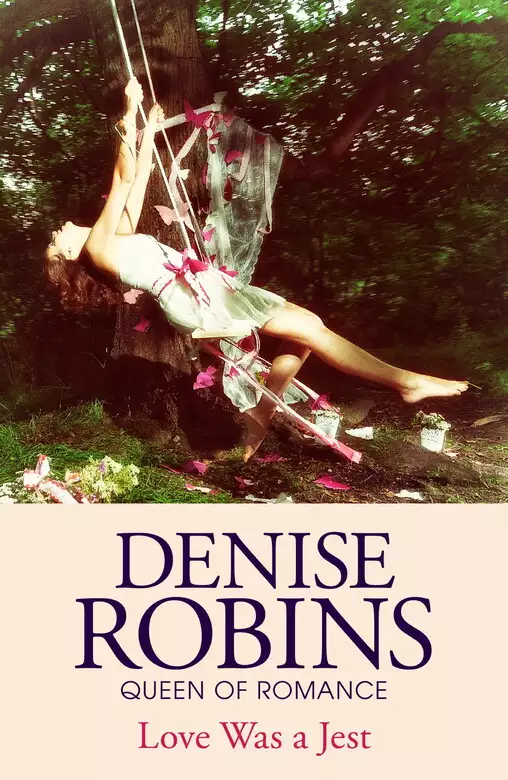
Love Was a Jest
- eBook
- Paperback
- Hardcover
- Book info
- Sample
- Media
- Author updates
- Lists
Synopsis
Scharlie was pushed into marriage by her mother when she was only eighteen. For four years, her middle-aged husband restricted her social life - so much so that, within hours of her first escape, she had fallen passionately in love with handsome, suave, already engaged Hugh.
Release date: June 26, 2014
Publisher: Hodder & Stoughton
Print pages: 400
* BingeBooks earns revenue from qualifying purchases as an Amazon Associate as well as from other retail partners.
Reader buzz
 Please log in to recommend or discuss...
Author updates
Love Was a Jest
Denise Robins
Scharlie—Mrs. Alec Mason—with one hand on the banister and one small foot on the first step of the oaken staircase, turned and looked at the man who spoke to her.
‘Yes, I am. Aren’t you?’
‘Yes. But, Scharlie, it’s early; none of the others has gone up yet. By the time we’re dressed, they’ll be just going up. Will you hurry and meet me down in the drawing-room?’
‘I oughtn’t to,’ she said.
‘You must,’ said Hugh Ellerby in a slow voice. His hand closed over hers. ‘I haven’t said a word to you alone for days. It’s driving me mad.’
‘Oh, Hugh!’ said Scharlie, and caught her lower lip between her teeth, which she only did when she was very stirred and excited. It was a very exciting and stirring thing to be looked at the way Hugh Ellerby was looking at her; talked to, the way he talked. A very dangerous thing, because, if he was in love, she was more so.
‘My dear,’ he said. His fingers pressed hers down on the banisters so tightly that they hurt. ‘I wonder if you know how adorable you look!’
‘Oh, Hugh, don’t be so silly.’ Scharlie laughed. ‘I’m all hot and flustered after my tennis.’
‘You look adorable,’ he persisted.
‘You’re rather a nice person to look at yourself, Hugh Ellerby.’
‘Rot!’ he said.
But they looked at each other after the manner of a man and a woman who are desperately in love and were satisfied in their taste. They made a very attractive couple. The man, tall, lithe, with a fair boyish head, very blue eyes and a fresh complexion tanned by the sun and wind. Weakness lay in the rather spoiled, sulky curve of his well-shaped mouth, but on the whole Hugh Ellerby was an extremely good-looking man with the charming, facile manner which women like. Scharlie Mason, whose curly brown head barely reached his shoulder, was as slender as a girl in her teens, and looked nowhere near her twenty-two years and not at all like a married woman.
An exquisite skin of the transparent quality that flushes easily; a small, tip-tilted nose and large, grey eyes, which seemed to alter rapidly to green when she was in one of her excitable moods, fringed by ridiculously long lashes, gave Scharlie that air of extreme youth which women from all generations have coveted. The youthfulness was intensified in Scharlie’s case by the modern dress. Hugh Ellerby, looking at her with the hungry eyes of a would-be lover, thought how fascinating she was; like a child in her short straight tennis-frock of white linen; with long slim legs and really lovely ankles; cheeks burnt red, half from the exertion of her match, half from the thrill of his flattery. He loved the way her hair curled, short, brushed boyishly back from her forehead. He was never tired of looking at her narrow, pretty hands with their glistening nails. She had an almost foreign trick of gesticulating with them when she spoke. She was wide-awake, vital; a creature of fire. Yes, Scharlie looked like a slender child of fifteen, but Hugh, not without experience of women, saw passion in the curve of her lips and he was intrigued. The amorous, rather disillusioned young mouth of Scharlie challenged him.
‘Say you’ll come down and talk to me,’ he begged.
‘Very well,’ she said.
‘You darling!’ he whispered.
She ran up the stairs very quickly. He turned and strolled back to the drawing-room, where his hostess and three other members of the house-party at Gateways were finishing a game of bridge. He opened his cigarette-case and tapped a cigarette upon it thoughtfully. He wondered if he was a fool to let Scharlie Mason intrigue him to this extent. Certainly he was a knave. He admitted that. She was a married woman and he was engaged to be married. His fiancée, Eleanor Gorring, was also a member of the Wilberforce house-party. It was rather low and beastly of him to make love to Scharlie behind her husband’s back—not that he had ever met the husband or cared a damn about him, for, from what people said, he was a swine. But he was her husband. And there was Eleanor. The whole situation was trying.
Nevertheless, the game was exciting, and perhaps all the more so because it was perilous. From the beginning of time, man has wanted what he cannot have. From the moment Hugh had arrived at Gateways and been introduced to Scharlie Mason he had been attracted—found her most disturbing. She was disillusioned in marriage and unhappy, but at the same time she was rather brave and gay and insouciant, which Hugh found praiseworthy. He hated women who whined.
He had never heard Scharlie whine. Only from time to time he caught a tragic look of discontent in those wide, grey-green eyes of hers; and caught a smile that plainly said: ‘I am so bored; come and be nice to me.’
Hugh, weakest of men with pretty women, couldn’t have helped responding to that. And, anyhow, most men wanted to be nice to Scharlie Mason.
‘It’s the devil,’ said Hugh, and leaned over the chair of a middle-aged widow at the bridge-table, who called ‘Two hearts’ in a luscious voice, then looked coquettishly up at Hugh and added: ‘Beating as one. What do you say, dear Mr. Ellerby?’
‘Oh, lord!’ he thought, smiled at the widow, and moved quickly away. He stood by the tall windows looking out at the sunlit garden and smoked gloomily. ‘It’s the devil,’ he said again, and thought of the curve of Scharlie’s upper lip and the way, sometimes, she broke from a solemn speech into a sudden ripple of laughter.
Scharlie ran upstairs to change for dinner and walked straight into a tall girl who was on the landing. She was about two years older than Scharlie and looked twice Scharlie’s age. A good-looking girl; typically English; eyes gravely blue; fair hair parted in the middle, plaited, and worn in coils over both ears. She had a charming sympathetic expression. She was Eleanor Gorring—Hugh’s fiancée. She laughed at Scharlie.
‘You’re in a hurry, Mrs. Mason,’ she said.
‘I’m so awfully sorry—did I hurt you?’ stammered Scharlie.
‘Not a bit. You’ve been playing tennis?’
‘Yes. Major Croker and I have just whacked Mrs. Austin and young Pole Hays six to four.’
‘Good work,’ said Eleanor. ‘You play rather a nice game. I’ve been watching you. I don’t know how you get that smashing service of yours over the net—you’re such a slip of a thing.’
‘Oh, I’m very strong,’ said Scharlie. ‘See you at dinner,’ she added, lowering her lashes, and hurried on.
Eleanor Gorring was a nice, amiable creature—so generous in her praise. She made Scharlie feel guilty and unhappy.
Scharlie’s face was gloomy—all the radiance wiped from it—when she entered her bedroom. It was a big, sunny primrose room in the west wing, with oak beams and diamond-paned casements like most of the rooms in Gateways which was one of the loveliest old Tudor houses in Sussex.
Scharlie threw her racquet on the bed; stripped off the tennis-dress and slipped on a green satin wrapper. She was hot and tired. She had been playing tennis the whole afternoon. She wanted a bath.
She lingered a moment to light a cigarette and stood by the open casement. She stared over the beautiful, formal gardens with their magnificent clipped yew hedges which were hundreds of years old, and famous; beyond to the dark shadow of Ashdown Forest.
While she smoked and stared, some of the hot colour faded from her cheeks. She looked suddenly pale and even pinched. She was worried. She realised that she was very much in love with Hugh Ellerby and that her passion for him was rapidly getting out of her control. And his passion for her appeared also to be too much for him.
She knew that if she dressed quickly and went downstairs and found him alone, he would kiss her. He had not kissed her yet. They had contented themselves with a look; a look as significant, if less satisfying, than a kiss. A flash of the eye; a pressure of the hand. In other words, a flirtation.
But the thing which had begun as a flirtation had developed into something more harmful; much more dangerous.
Scharlie had fallen in love. And she was married; had been married for four years. And Hugh was going to marry Eleanor Gorring.
‘What a rotten mess,’ Scharlie thought as she smoked, and a wave of profound melancholy engulfed her and grew deeper as she reviewed the situation.
It was a rotten mess … yes, that was slang, but it described it. Life was rotten. Unfair. And love—if one loved without hope, without promise—was crueller than the grave—a sort of death in life.
So far, she had had little happiness in her life. At seventeen, she had left school to take up a difficult existence with a widowed mother who was very pretty and youthful and absurdly jealous of Scharlie. A stupid, vain woman who was the complete egotist, taken up with her own ideas and pleasures and annoyed that she had a young daughter to launch; a daughter with so much beauty and vitality and charm. Men pursued Scharlie at once. Scharlie, straight from a modern school with modern views, could take care of herself, but she was too pretty to be safe, in her mother’s estimation. She had been brought up in a post-war hysterical atmosphere. She had seen her pretty, widowed mother indulge in half a dozen flirtations. She had nobody to give her advice or start her on a normal, sensible course of existence. Only the mother who bickered with her and who deplored and tried to alter the shape which she herself had moulded.
Scharlie threatened to be a nuisance. On her eighteenth birthday, Mrs. Croft gave a party and introduced to Scharlie Alec Mason, a stockbroker twice her age, a bachelor of somewhat set habits and old-fashioned views. Mrs. Croft hinted that Scharlie, married, would soon ‘tone down’ and make an excellent little wife. Also Mason was more interested in finance than women. He did not understand them. But he found himself as wax in the hands of a clever woman. He proposed to pretty Scharlie within a month.
Scharlie refused him four times, and was bullied and cajoled and hustled into accepting him the fifth. It was pointed out to her that Alec, if not the romantic hero of her dreams, was a sound, dependable person: making money, and able to give her a good home. Scharlie, not having met the man she wanted to marry and only a child of eighteen, succumbed to the elder woman’s influence. Besides which, by then Alec Mason was physically, if not mentally, very much in love with the gay, insouciant girl. He spent a lot of money on presents for her; flattered her, and gave her, erroneously, the impression that she could do much as she liked once she was married.
Scharlie was married to Alec Mason with due pomp and ceremony, after which her mother gasped with relief and departed for South Africa with every intention herself of getting married again out there.
Poor little Scharlie, really very ignorant when Alec Mason met her, woke up, suddenly, after her marriage, and discovered that she loathed her husband. She was violently miserable and disappointed in life.
As soon as the honeymoon ended, Alec returned to the normal; a selfish, self-centred, narrow-minded man, who lacked generosity and kindliness. Unfit to be any woman’s husband, still less the husband of a sensitive and excitable young girl, he killed what affection she had for him long before that honeymoon ended. He was hurt and annoyed by her lack of response to his passion. He failed to understand why she should dislike him for lecturing her about expenditure, or upbraiding her for wanting amusement, in one breath; and, in the next, saying in his pompous manner: ‘And now, my dear, come and kiss me.’
Oh! how she hated Alec’s pomposity; Alec’s meanness—his spiritual rather than his mercenary meanness, because generosity of spirit meant so much more to Scharlie than an allowance. How she hated him when he was in his hectoring, lecturing moods! And how much more did she hate him when he was amorous; when he came towards her with that self-satisfied smile and said, ‘Now, my dear, come and kiss me.’ One day, she thought, she would hit him when he said that.
Four years of Alec and such a marriage had been a strain for her almost beyond her endurance. And now, at twenty-two, she was still pathetically young; still enthusiastic about life; yearning to wring the beauty, the passion out of it. She was like a starved thing; hungry for romance.
Alec was, of course, jealous. He was forty, now, and old for his age, bald-headed and aware that he cut rather a sorry figure beside his wife, with her youthful loveliness, which was like a flame; her natural gaiety, which even her association with him had not entirely quenched. In consequence he rarely allowed her to leave his side, and could not tolerate any young men among her friends.
When Scharlie, a week ago, had received an invitation from Dorothy Wilberforce, who had been at school with her, to join their house-party, Alec had at first refused to let her go. He was busy in the City. He could not get away. He did not see why he should be left alone in their London house ‘at the mercy of servants,’ as he put it, though in Scharlie’s estimation it would be the other way round—leaving the servants at the mercy of Alec. However, for the first time, she openly rebelled.
‘Dorothy and I were pals at school. I haven’t seen anything of her since she married Tim, and I don’t see why I shouldn’t go and stay with her for a week,’ she had said.
They had had a row about it. Then Alec caught a cold. When Alec had a cold everybody in the house suffered. He was a tyrant and a nuisance. Nothing was right. Alec retired to bed with aspirin and hot-water bottles and ranted at the household. Scharlie left the house.
‘I won’t catch your beastly cold,’ she had said. ‘I’m going down to Gateways.’
She went. And Alec, pained and resentful that she should disregard his wishes, remained in bed and sniffed to himself.
The week had developed into a fortnight. Mrs. Wilberforce, very fond of Scharlie, prevailed upon her to stay on. Scharlie felt deliciously wicked away from Alec, and stayed. She was like a bird out of its cage. She had never looked so lovely or been so amusing. She played excellent tennis and she was popular with the men, even if some of the less attractive women had catty remarks to make about her.
It was inevitable when she came in contact with Hugh Ellerby, who was so handsome, so young, so charming, she should fall head over heels in love with him. And at first Eleanor had not been there. She had only joined the house-party yesterday. Without her it had not seemed so ‘rotten’ to flirt with Hugh. And now, when the whole thing seemed thoroughly rotten, and futile into the bargain, Scharlie could not pull in the reins.
She was frantically in love. After the misery, the repression of her life with Alec, she was greatly in need of Hugh: of his sympathy, his charming tendresse: all that Alec Mason lacked.
She stared at the woods which were sombre and lovely against a sunset sky, and the tears came into her eyes.
‘How can I go back to Alec?’ she thought. ‘Oh, Hughie … how can I … loving you so much!’
She bit fiercely at her lower lip, but the tears would well over and trickle down her cheeks. She picked up her towel, a sponge, and some bath-salts, and marched to the door; her slender, childish figure erect; head flung back as though in defiance of fate.
WHEN Scharlie went downstairs, Hugh was waiting for her, alone in the drawing-room; a lovely long room with many windows; bookcases let into the walls; old rugs on an oak floor, old prints against a wheaten-coloured wall. On a June evening like this it was full of the slanting red and amber shadows of the sun, which shed a last blaze of glory before it sank behind the dark rim of the forest.
Scharlie hated wearing evening dress on these summer evenings. It ‘showed up her war-paint,’ as she called it. But there was really very little paint to show up on Scharlie’s face—the merest touch of vermilion on the lovely mouth that challenged Hugh so irresistibly. She was fresh; charmingly slim in a green and white dress of flowered georgette; long at the back and short in the front; sleeveless, showing the white beauty of slender arms and throat and sloping shoulders.
She came across the long room conscious that she had a high, nervous colour and that her heart beat with an excitement, a thrill to which she had no right. The man—as fresh, as attractive in his dinner-jacket as only a fair-haired Englishman can look—watched her come. His own pulses were thrilling. Without a word, he held out his arms.
Scharlie walked straight into them. But she hung back in his embrace.
‘Hugh, we’re being mad.’
‘I can’t help it. I must kiss you, Scharlie, or I shall go crazy.’
‘If you do kiss me, I might go crazy.’
‘I don’t care. I love you.’
‘Oh, Hugh!’ She shut her eyes, tilted her head backwards. He looked at her hungrily. She was a bewitching creature; a flame a torment, in his arms. The sun caught the close-cut ripple of her hair. It was the colour of chestnuts. And there was a provocative tinge of red in the tips of her lashes. He had never seen such lashes as Scharlie’s. They curled straight back, and looked almost too stiff, too thick to be real.
‘What a lovely thing you are, Scharlie,’ he said.
She felt him shaking. She opened her eyes. She put up a hand and touched the smooth, warm bronze of his cheek. If he found her lovely, his physical appeal was equally fascinating to her.
She thought of Alec; his short, pompous figure and high, bald forehead; and she loathed the memory of him. It wasn’t fair of her mother to have pushed her into marriage with Alec when there were men like Hugh in the world. A yearning to know even one moment of happiness with Hugh overwhelmed her. She curved an arm about his neck.
‘Kiss me,’ she whispered.
He tightened his arms about her. They were lost in the ecstasy of that kiss. Scharlie, with a rapt, white face and closed eyelids, under the fierce pressure of his lips felt that she was blinded by the sudden vivid beauty of love; of life. This was living—feeling—as a woman was meant to live, to feel. This was revelation. The beginning and the end.
Being a woman and very young she was just a little more lost than the man who—half drunk with the sheer intoxication of Scharlie’s whole-hearted surrender—soon grew sober and knew he must regain control or court disaster. At any moment one of the guests or the servants might enter the room.
He raised his head; looked quickly over Scharlie’s at the closed door. He framed her face with his hands, kissed her swiftly, on the eyes and cheeks and lips, and under her chin.
‘Dear, adorable little thing,’ he said.
‘Hugh, what are we going to do?’
‘Do you really love me, Scharlie?’
‘Would I have kissed you like that if I hadn’t?’
‘I suppose not.’ He laughed and reddened slightly. ‘Well, I can only tell you that it will be wise if you don’t kiss me like that again, darling.’
‘Hugh——’ She was flushed and distressed now. ‘Am I frightfully bad? Do you think I am?’
‘“Frightfully bad” is putting it a bit strong, sweetheart. One kiss——’ He shrugged his shoulders. Then he dropped a swift kiss on her hair, and let his arms fall away from her. ‘I must have a cigarette,’ he added.
She stood very still while he lit his cigarette. His hands were not steady. He had very nice, long, brown fingers.
Oh, the difference between those fingers and Alec’s white, podgy hands!
‘I’m so sorry, my dear.’ Hugh offered his case. ‘Have one.’
‘No, thanks.’
He took one or two breaths of his cigarette, then smiled down at her.
‘Don’t look so tragic, darling.’
‘But, Hugh——’ She stared. The grey of her eyes had changed to green, and the pupils were very large. ‘It is a tragedy. You men are so funny—you take things so coolly. A moment ago, when you were kissing me … we were both crazy. I am still. But you’re absolutely different.’
‘I assure you I’m not. I’m feeling right off my rocker, Scharlie. Your lips, my dear——’ He laughed self-consciously. His fresh complexion was bright pink to the roots of the fair hair. ‘You’d send any fellow crazy. But we must keep our heads.’
Now there was not a vestige of colour in Scharlie’s cheeks. She clasped her hands tightly together. She was trying to find her control, and it was not as easy for her as for the man. To him it was all ‘damned awkward and maddening.’ He was engaged to one woman of whom he was extremely fond and he was for the moment infatuated with Scharlie. He had been infatuated in his life before. But to Scharlie it was all new; a terrific upheaval; a kind of mental and physical explosion. Life could never be quite the same again. Hugh was the first man about whom she had ever really felt like this. If it was, also, infatuation on her part, it seemed real enough tonight.
‘Hugh, what are we going to do?’ she asked again.
‘What can we do? You’re married. I’m engaged.’
Scharlie put a hand to her forehead.
‘I don’t feel I can possibly go back to Alec now.’
‘Oh, my dear—you must,’ he said hastily. ‘Good lord, we must behave sensibly. We can’t muck up the whole show just because we—we care for each other.’
‘No,’ said Scharlie in a very low voice, ‘I suppose we can’t.’
‘You see, there are so many of us involved. You—your husband—me—Eleanor. Eleanor’s such a dear——’ He bit his lip and stared gloomily out of one of the windows. ‘I’m tremendously fond of her.’
‘I know. I like her too. She’s a dear.’
‘She—she’s damn’ fond of me, you see, Scharlie.’ Hugh’s colour was a hotter red now. ‘I couldn’t let her down, could I? We’ve fixed our wedding for August.’
Scharlie nodded. She made no effort to touch him, to deviate him from his line of argument. She just looked at him with a white, set young face. The man felt suddenly ashamed of himself. He picked up her right hand and put his lips to the palm.
‘Scharlie, this is all my fault.’
‘It isn’t—it’s just as much mine,’ she said miserably.
‘No, I’ve been pursuing you. I know it. I made you come down here like this and—kiss me. I ought to be shot.’
She shivered as she felt his lips on her hand, but she shook her head at him.
‘No—please! It’s my fault, too. I’ve been—fooling round with you. I—I just couldn’t help falling in love with you.’
‘I couldn’t help it either, darling,’ he said huskily. He kept her hand, and kissed every finger with returning passion. ‘It’s the most damnable thing, for both of us to be so tied up. But we aren’t in a position to do anything. I mean, even if I let Nell down there’s your husband to consider. You couldn’t leave him—have a beastly divorce.’
‘A divorce couldn’t be as beastly as my marriage with Alec has become to me,’ said Scharlie.
‘Why you ever married the fellow——’
‘You know. I’ve told you. I was coerced—made to.’
‘A mere kid—your mother ought to have been shot!’
‘I know. But it’s too late to worry about that now. Only, Hugh, I can hardly bear to go back to him.’
‘You’ll have to try to, darling. It’s impossible to think about a divorce, for you anyhow. We’d never be happy feeling we’d given everyone a dig in the back. Mason doesn’t sound a very attractive fellow and he ought never to have married a child of eighteen, but I suppose he’s fond of you?’
‘Yes …’ she shivered.
‘Probably damned jealous,’ added Hugh gloomily.
‘Yes, and possessive; he would refuse to divorce me.’
‘There you are. Well, you aren’t the sort of girl, darling, to stick the sort of life we’d have to lead if we ran off and he refused to set you free.’
‘I suppose not. But I don’t think I can be very good or religious, Hugh,’ she said wretchedly. ‘I just feel I wouldn’t mind what I went through—so long as I could be with you.’
‘Oh, Scharlie … dear …’ He closed his eyes and put his cheek against her hand. ‘Why should you care so much for me?’
‘I just do.’
He felt unhappy and very troubled. He didn’t really want little Scharlie to become too serious about him. It would make life so complicated. He was quite crazily in love with her. He didn’t want to lose her altogether. But what could he do? There was Eleanor. The thought of marriage with Eleanor seemed a little flat—after this. She was a darling but quiet and reticent. A man couldn’t always tell what was going on in her mind behind those grave blue eyes of hers. When they had first met, six months ago, Eleanor’s reserve had intrigued him. He admired her character—she was rather a fine person—dependable and sweet. Physically attractive, too, with her tall, straight figure and blonde hair. She rode well, danced well; and she was an excellent hostess. Since the death of her mother she had made a success of entertaining for her father, Walter Gorring, who was one of England’s leading book-publi. . .
We hope you are enjoying the book so far. To continue reading...
