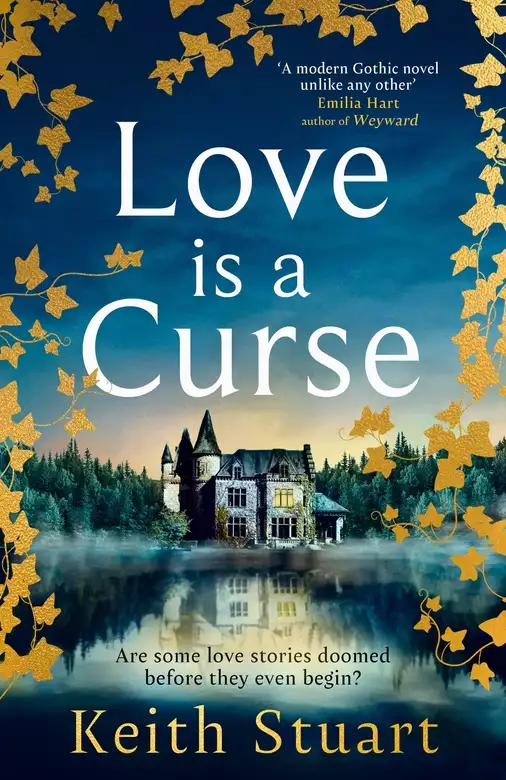
, about love and loss echoing through the ages. Sad, sweet, funny and hopeful' --- Emilia Hart (author of Weyward)
From acclaimed author Keith Stuart, author of A Boy Made of Blocks and The Frequency of Us, comes a daring and unique story of heartbreak and hope.
A single sentence was all it took to define Cammy's life. They came as her beloved artist aunt was dying, a teenage Cammy standing by her bedside: 'Did your mother ever tell you about the curse?'
Cammy is warned that the women in her family are destined always to lose the one they love. She thinks nothing of it - until the day when, in her late twenties, her new boyfriend is hit by a car. Convinced she is to blame, Cammy begins to investigate the one-hundred-and-fifty-year story of a family that is both ordinary and remarkable, tragic and beautiful.
But is the curse real, or is there an answer lurking in the letters, diaries and paintings of generations of women whose hearts were broken?
'An original yet entirely universal story - sweeping in its scale, yet sweet-tempered, moving, and just the right amount of spooky. I loved it' --- Samuel Burr (author of The Fellowship of Puzzlemakers)
'Love Is a Curse uses Gothic so cleverly. I binged the ending in one sitting and was absolutely gripped (and may have had a tear or two in my eye!)' --- Sarah Brooks (author of The Cautious Traveller's Guide to the Wasteland)
READERS ARE IN LOVE WITH
LOVE IS A CURSE
'One minute I'm on the edge of my seat and the next I'm reaching for tissues. Love, love, LOVED IT!' READER REVIEW ⭐ ⭐ ⭐ ⭐ ⭐
'Full of twists and drama and all you need from a good book, a fantastic novel once again bravo!!!' READER REVIEW ⭐ ⭐ ⭐ ⭐ ⭐
'This has to be my favourite of Keith Stuart's novels so far. It is an absolute celebration of the pursuit of love through adversity' READER REVIEW ⭐ ⭐ ⭐ ⭐ ⭐
'This whole book is an entire feeling. It's raw, gothic, suspenseful, thought provoking and an emotional read. Loved it' READER REVIEW ⭐ ⭐ ⭐ ⭐ ⭐
'Stuart has a gift for storytelling. Not a word is wasted and it reads beautifully.' READER REVIEW ⭐ ⭐ ⭐ ⭐ ⭐
'I loved this book. It had everything, suspense, horror, love. You name it this book had it!' READER REVIEW ⭐ ⭐ ⭐ ⭐ ⭐
'What a fantastic read, everything you'd expect from Keith Stuart and more' READER REVIEW ⭐ ⭐ ⭐ ⭐ ⭐
'Very well written, with great characters, in whom you become fully invested' READER REVIEW ⭐ ⭐ ⭐ ⭐ ⭐
Release date:
September 16, 2025
Publisher:
Little, Brown Book Group
Print pages:
100000
* BingeBooks earns revenue from qualifying purchases as an Amazon Associate as well as from other retail partners.
As soon as I heard the voice, I knew something terrible had happened. Even on a crackly mobile phone connection, with the background noise of my hi-fi blaring out the Jesus and Mary Chain, there was something in the tone, some hint of highly practised professional empathy.
‘Hello. Is that Camilla Piper?’
‘Yes?’
I reached over and switched off the music. There was a bustling in the background on her end. Urgent voices but also a shriek of laughter somewhere distant. I was already running through the possible scenarios. Had my mum fallen ill? Had my sister’s house burned down? A gruesome montage of family disasters swam into view.
‘Miss Piper, I’m phoning from Southview hospital in Bristol. Do you know a Benjamin Jones?’
For some reason, it was the last name I expected to hear.
‘Um, yes I do?’ I said it as a question because, in that critical moment, there was a small part of me thinking, Do I? Really, do I?
‘He’s my boyfriend.’ I said the last part as though reassuring myself as much as informing the woman on the other end of the line. It still felt weird to say that word. I’d never really done relationships before.
There was a crackle on the line.
‘Miss Piper,’ the voice replied. ‘There’s been an accident.’
Wait, let’s go back a little bit. My name is Camilla Piper, I’m a jewellery designer and I live in Bath. After my aunt died, I stumbled through the rest of my teenage years, failing all my GSCEs first time round, then doing them again. A-levels and a gap year followed, then I studied art at Birmingham University. When I graduated, I did not know what to do with my life, so I began to unravel. I relied heavily on my sister, Nikki. She was always the sensible one, the clever one. When she was six she told her teachers she was going to design spaceships for a living, which made them laugh; then she graduated from Bristol University with a double first in computer science and was immediately snatched up by an aerospace firm based in a converted warehouse on the Bath waterfront. She is now coding rocket guidance systems. When I left uni, she offered me the garden flat beneath her house on Widcombe Hill, until I got on my feet. I insisted on paying rent, but she knew I couldn’t afford to, so she charged an insultingly small amount just so that I could feel better about myself.
On the positive side, I always knew I had an escape route thanks to my aunt’s will. While she left Nikki enough money for a mortgage deposit, she left me the church. I wasn’t old enough to drink or drive, but I owned a listed building and two acres of land including a decommissioned burial ground. That was weird.
For a decade, I couldn’t face going in there; the memories of my aunt were too raw, and, to be honest, without her there to protect me, I was scared of it. So, after uni, I lived at my sister’s for eight months. It was a difficult time. To say the least. I’d gone from being part of this vibrant, edgy art scene with lots of friends and events and exhibitions, to a hermit-like existence in the suburbs. While Nikki’s career was booming, I was in a total creative slump. While she was building a life upstairs with her brilliant job and her new boyfriend Justin, a marketing executive at her firm, I was bingeing on takeaways and Korean horror movies, sinking into despair. I have always had this horrible feeling of impending doom. Even as a toddler, I felt it skulking about at the back of my mind. But in those post-university weeks it started to eat me alive. Nikki tried to pull me out. She knew I’d done well on my jewellery design course at uni, so she converted her garage into a workshop and had a beautiful jeweller’s bench installed. She loaned me the money for second-hand tools, and never expected to be paid back. But I had no ideas, no inspiration, nothing was coming in. I don’t want to get into it, but I became utterly miserable. Then my sister went away on a dream work trip to NASA in Washington, DC and my nosedive culminated in one idiotic, destructive weekend that I have blanked completely out of my mind. I stuck it out in the flat for a month after that, but it became unbearable to be in that space. I couldn’t go to Mum’s because she’d moved from Bath to London while I was at uni and her chic new apartment was too small. We’d end up killing each other. I also knew she would interrogate me about why I’d left Nikki’s. Then one night I came up from the garden flat to borrow some milk. Nikki’s back door was open, so I knocked and went in and heard Justin and Nikki talking in the kitchen. ‘Come on,’ he said. ‘It’s time she moved out. Think of the rent we could get on that flat.’ I knew eventually he would do this. The next day, I packed up my things, arranged for my tools and workbench to be collected by a moving firm, and told my sister I was going to live in the church. It was time.
I remember the day of the move so well. It was a frosty December morning – the solstice – the darkness only just lifting as Nikki drove us up the narrow lane from Batheaston. I hadn’t made this short journey for a decade, but it was imprinted on my memory. I knew I would see the tower first, solid and dark, rising above the gnarled old oak and ash trees. We turned a corner and there it was in the near distance, like a warning. I shivered at the sight of it.
‘Are you definitely sure about this?’ Nikki asked for the tenth time that morning.
‘I’m sure,’ I said, and tried a weak smile. ‘In for a penny, and all that.’
‘You can work here for a few days, see how you get on. You don’t have to move straight in. We’ve no idea what it’s like inside.’
‘I’m sure it’s fine. Roland has been looking after it.’
We reached the boundary wall that circles the graveyard and followed its jagged curve to the small dirt layby on the north side of the building. There was a shiny red Jaguar XJS parked there already – Lorna’s manager Roland Jeffs was here. We pulled up next to it and got out of the car. The sky was a grubby white, a great silence hung in the cold air. Nikki opened the rusted iron gate, beckoning me in. ‘Your mansion awaits,’ she said.
Looking up at the building that morning was like seeing a ghost from my past. Beyond the stretch of overgrown lawn was St Cyprian’s Church, its Bath stone walls seeming grey and cold in the shadow, its dark arched windows revealing nothing of the interior. There it was again, that tremor through my bones. The last time I had been here was to say goodbye to my aunt. Now I was here to stay. To somehow make it my own. Nikki opened the boot of her car and dragged out my backpack, then handed it to me.
‘Do you want me to come in?’ she asked.
‘I’ll be fine.’
‘You can always change your mind. Text me if you want to come home.’
I looked back at the building, and then saw Roland coming out of the small doorway.
‘This is home,’ I said.
Roland waved and I waved back. He pointed towards the building and then disappeared inside again.
‘Just … ’ Nikki paused for a second. ‘Just be careful. It’s an old building, the electricity and heating might be dodgy. And what if there’s a thunderstorm?’
It was a family joke, how terrified I was of storms. I always have been. When I was a child, I’d climb into Mum’s bed and cry and shake all the way through. At university, I got friends to stay up with me all night playing music – anything to avoid the sound. I even had recurring nightmares about it. I’d see images of lightning, burning trees, women screaming. If I was left alone, I’d have panic attacks so bad I thought I was dying.
‘I’ll be fine,’ I said. I hugged her, took up my bags and walked through the gate towards the entrance. I could smell the mud and rot from the woods beyond.
Inside, the first thing that hit me was that it seemed smaller than I remembered. The arched windows were not as grandiose, the wooden beams that supported the roof looked lower. But otherwise, this was the St Cyprian’s of my childhood. The chilly nave with its flagstone floors darkened by dirt and wear, the line of memorial stones down the central aisle. The whitewashed walls, the plaster scarred and pockmarked, covered with ancient brass plaques. My aunt’s metal shelving units were still standing, filled with her books and records. There was a smattering of Lorna’s furniture – her old sofa, two battered armchairs. I threw my bags onto them. The four-poster bed was gone. She had asked for it to be smashed to pieces and burned in a sort of pagan death ceremony on the lawn. Her sculptures and sketches were all gone: some she sold, but the rest? Maybe she burned those too.
‘You’re early,’ said Roland, emerging from the chamber below the tower, which had been Lorna’s bedroom and would now be mine. ‘I was just making the old place feel a bit more homely. Had a new bed put in there, fresh duvet, the works – a little welcoming present.’
He was a stocky man in his early seventies, weathered, but still imposing, his face like a block of granite. He’d been a boxer as a young man, then a nightclub bouncer, then he was employed as a minder for a 1970s rock star. The whole time, he studied arts management at a local college – when he was too old to protect people with his fists, he did it through shrewd business acumen. There were always whispers of gangland connections, which Lorna loved. She trusted him implicitly. ‘We had a survey done last week,’ he continued. ‘Building structure, electrics, damp. The works. The place is in decent nick for its age. The heating can be a bit temperamental, but it should keep you from dying of hypothermia. You’ll need to keep on top of garden maintenance: you’ll find tools and a petrol mower in the big outbuilding just down the path among the trees. Oh, and the surveyor said you should look into getting some sort of lightning conductor on that tower.’ I felt a wave of nausea at the thought of being here during a storm. ‘Your aunt left a small fund to cover the bills and minor repairs, so call me if you have any problems.’
We stood for a few seconds looking about, not sure what to say.
‘Oh, I almost forgot,’ he said, reaching into his coat pocket. ‘She insisted I give this to you in person.’ He handed me an envelope.
I opened the envelope carefully. There was a single sheet of paper and a short handwritten note.
My darling Cammy. Welcome home. Be careful - this building has a history. But then don’t we all? I hope you are productive here. If you are lost, look for the truth, it’s deep inside.
It was typical of my aunt to be thoughtful, strange and terrifying all at the same time.
‘All good?’ asked Roland.
‘Yeah.’
‘You’re brave,’ he said. ‘I’m not sure I’d sleep here. Place gives me the creeps. Always did.’ He held out a bunch of keys, most of them old and rusted. ‘Good luck, love.’
With that he sauntered off towards the door, before turning again.
‘You remind me of her,’ he said.
‘That figures, I stole her whole look.’
‘No,’ he replied. ‘It’s not that.’
After I heard the faint sound of his car pulling away, I stood for a minute, allowing my ears to adjust to the silence. Noises started to filter through – a tapping coming from somewhere in the walls, rooks cawing outside in the trees. Then one of my bags fell off the chair and crashed loudly to the ground.
I took my phone out of my pocket and called Nikki.
‘Do you want me to come back after work?’ she asked.
‘Yes.’
‘Do you want me to stay over tonight?’
‘Yes.’
‘I’ll bring some wine.’
While waiting for her, I took my stuff through to the tower chamber and filled the wardrobe with my clothes – black jeans, black shirts, a few dresses. There was a large antique mirror on the wall and when I looked into it, I saw her. Her hair, the smoky eye make-up she taught me to apply, the multiple ear piercings she convinced Mum it was okay for me to get, the septum piercing she paid for the day she told me about the cancer. I was her niece, but sometimes, looking back, I was one of her sculptures too.
When Nikki arrived, she stood in the entrance for a while looking around.
‘Jesus,’ she said. ‘Are you sure about this?’
‘Just give me the wine,’ I replied.
Our glasses filled, Nikki wanted a tour, so we walked through to the cloister, which Lorna had converted into a kitchen, with the altar as a worktop – a feature that she thought was amusingly sacrilegious considering how awful her cooking was. She had also had an AGA fitted at great expense, just beneath the stained glass window, which depicted a woman in a red shawl holding the decapitated head of John the Baptist. We walked through the narrow door to the little private chapel that Lorna had used as an office. Her desk was still there, as was her computer and two filing cabinets. I checked all the drawers hoping to find some stack of her undiscovered art, but it was all letters, bills and other boring paperwork. Back in the nave, as we walked along the shelves, Nikki ran her finger across the spines of Lorna’s books on the occult, demonology and robotics, her sci-fi and horror novels, her art monographs. We browsed through her records and found the Cure’s Staring at the Sea album, so we put that on and sat together on the old sofa, looking around, taking in our surroundings.
‘Do you think you’ll be able to work here?’ she asked.
‘I’ll let you know. I might need a few more bottles of this.’
‘It’s a shame all her art is gone – that might have helped.’
‘Oh God, no. That would have been completely intimidating.’ I took a deep sip of wine. ‘What’s happening in the space travel business?’ I asked.
‘I’m doing a lot of very complicated maths at the moment.’
‘Can I help?’
‘That depends. How are you on computational fluid dynamics?’
‘I like to think I can hold my own.’
She laughed. We sat in silence for a while as ‘Charlotte Sometimes’ played.
‘I’m sorry I was such a terrible lodger,’ I said. And I suddenly felt like crying.
She put her hand on my shoulder.
‘I don’t think that person was you,’ she said. ‘I think it was … just a sad lonely ghost.’
I kicked her in the shin. She kicked me back.
I gritted my teeth, and asked, ‘How are things with Justin?’
‘Yeah, all fine. He was on TV last week, being interviewed by the BBC about the aerospace industry in the southwest. He looked pretty good on camera.’
‘I thought the camera never lied?’
She kicked me again. ‘I’m tired,’ she said.
We shared the big bed in the tower chamber. When I switched all the lights off we were plunged into the blackest darkness I have ever known.
‘Jesus,’ I said. ‘I might need to leave a lamp on.’
‘How will you cope when you’re sleeping here alone?’
‘I’m just going to have to lure someone here.’
‘Oh yeah? Have you got a victim lined up?’
‘You know I haven’t.’
‘It’s not Auntie’s whole curse thing, is it?’ She grabbed me by the shoulder and made a spooky noise. ‘Wooooooh! You must never fall in love! Never!’
‘Get off me!’ Nikki let me go and turned over. The sound of an owl in the trees somewhere. ‘You don’t believe in it at all, do you?’ I said.
‘No. The universe is weird enough as it is.’
‘But that’s exactly it. The universe is weird.’
‘Good night, Cammy.’
For the next few weeks I was busy settling in. I bought a knackered old Land Rover, so I could bring all the rest of my tools, and an old oak dining table and some chairs from a house clearance auction, so I could eat meals like an adult. I cleared some space in the centre of the nave and had the removal men put my workbench where Lorna’s had been. I unpacked my charcoal block, my motor polisher, my soldering kit, a new rolling mill for shaping rings and bracelets, a whole box full of pliers, burrs and hammers. It began to feel like my place.
At first, I found it hard to sleep – the total darkness, the thought of its history, the people who had passed through; the graves outside just metres away. On the second night, I was awoken by a creaking sound coming from the tower above me. I tried to open the little trapdoor that led up there, but it was nailed shut. There was a flutter of wings and a loud cawing. The next night, the pipes gurgled and the sound was like demonic laughter. I started to realise the church had … an atmosphere. It wasn’t really something I could explain, just an odd feeling, like when you know somehow that you are being watched. I told myself it was Lorna. Often, I caught the scent of her favourite perfume on the air, the old notes of ylang ylang and patchouli. It seemed to follow me around the church. I found that weirdly comforting.
The uncanny feel of the place was inspiring too. I spent hours flicking through Lorna’s books on the occult and folklore, looking for jewellery design ideas. Goth was in again, so it made sense. I learned about the witch marks carved on to the door of the church. I sketched symbols, skulls, totems, and figured out how they might be crafted into rings and necklaces. Within a month I’d made up some rough prototypes, launched a website and an Instagram account. I messaged Lorna’s old agent and she got me some press coverage. As soon as people knew I was Lorna Piper’s niece, the orders started coming in.
Over the coming months a routine developed. Every day I worked into the evening listening to records, then I read or watched movies. I started to clean the windows and scrub the floors. When the graveyard and lawns got overgrown, I ventured into the outbuilding. There was a short ladder, a range of gardening tools, metal buckets. Against one wall was propped a large dangerous-looking sledgehammer. I found the petrol lawnmower among piles of empty wooden storage boxes. A few YouTube videos later, I’d taught myself how to use it. Occasionally on a Friday afternoon, Nikki would drive over from the city centre and we’d have a drink at the Black Dog Inn down the lane. The locals called us the odd couple: she wore her smart work clothes, I was always in black. But they accepted us; it was nice in there.
That was where I met Ben.
The afternoon the hospital called, I had this weird thought that it might be the police. Ben and I had been seeing each other for several weeks, but I had this sudden idea that maybe he was some sort of conman. What if he’d just cleared out my bank account and flown to Brazil? (Although on my bank account he’d be lucky to make it to Brighton.) But then I pictured him with his floppy fringe and baggy jumper and his work boots not done up properly, the laces trailing behind, and felt a twinge of guilt and compassion. No, that wouldn’t be it. I’d experienced selfish psychopaths – Ben did not fit the mould. And we had been texting each other, barely an hour before, flirting, joking, messing about. I tried to remember the last text I’d sent him. It was something soppy, I knew that.
‘Miss Piper,’ the voice said. ‘Did you hear me? There’s been an accident.’
I snapped back into the room.
‘What’s going on?’ I asked.
‘I’m afraid Benjamin has been involved in a car crash. We’re trying to contact his family, but we’ve been unable to reach anyone. Yours is the number he’s called most.’
For a microsecond, I was kind of pleased by this confirmation of our relationship, but that was quickly replaced by a flood of shock and fear.
‘Is he all right?’ My voice had gone weirdly high pitched. I became hyper aware of my surroundings, the bare stone walls, the tools spread out across my work desk, everything within reach and ready. Everything normal.
‘I’m afraid he has sustained a serious head injury. He had to be airlifted to Southview.’
My brain began to sizzle and splutter like a cheap firework. The words were not making sense.
‘Ms Piper?’
‘Yes, I’m here.’
She said a few things that just didn’t go in, and then, ‘ … so if you report to A&E someone will help you.’
‘Yes,’ I said again and ended the call.
For a few minutes, I sat staring at the phone screen, wondering how, in a matter of moments, my life had just completely capsized. Then I grabbed my car keys.
The Accident and Emergency room was eerily quiet. I expected chaos and carnage everywhere, but instead there were rows and rows of empty seats. A mum was sitting with two small children, one with a hand wrapped up in makeshift bandages, the ghost of a bloodstain showing through. Two middle-aged men were sitting three seats apart both huffing and sighing, telegraphing their impatience to each other. I walked slowly towards the reception desk, feeling dreamlike and distant.
‘Can I help you?’ a woman behind the counter said. She was wearing over-sized glasses, which cruelly magnified her poorly applied eye make-up.
‘I got a phone call. My boyfriend has been brought in. His name is Ben … Ben Jones. He was in an accident?’
The woman jabbed at her computer keyboard.
‘We’re trying to track down his family. Do you have any contact details for them?’
‘No, I’m sorry. I mean, I know they live in Abu Dhabi. Is he okay?’
‘Someone will come through and help you. Just take a seat.’
I sat a few seats down from the mum with the two kids and I gave her a pained smile. She turned away. The waiting area was cold and white and smelled of chemicals.
‘Camilla Piper?’ a voice called. It was a woman in a navy-blue uniform, hugging a clipboard to her chest. Her short dark hair was flecked with grey, and her smile was kind and indulgent in a way that made me feel scared for what might be coming. I stood up too fast and my head swirled for a second.
‘Follow me,’ she said.
She took me through a set of double doors, along a bright corridor then into a small warm room with a window, three plastic chairs and a framed photograph of some sunflowers – I wondered to myself how many lives had been quietly ruined in here. ‘Sit down,’ she said. And I did. She glanced at her clipboard, flicking through some pages and what looked like an X-ray. I watched, feeling a horrible sense of impending doom, the clock ticking ever louder on the wall behind me. Through the window, I could see a stretch of lawn, shady beneath dotted trees, and people going about their lives. A young couple hugging, a man in jeans and a dressing gown smoking on a bench, a woman in a long red dress standing amid the trees, seemingly looking up at me.
‘Now, I don’t know how much you’ve been told,’ the nurse said, drawing my attention back into the room. ‘But it seems Ben’s car veered off the road and hit a tree. He sustained significant head injuries in the impact. He was stabilised in A&E then had some tests, including an MRI. Thankfully, it looks like there is no significant bleeding so we’re not looking to operate at this time, but he has swelling and contusions on his brain.’
She looked up at me, and I knew I was supposed to ask a question, or just react in some way, but I had nothing. My mind was blank, my foot tapped fast against the leg of the chair.
‘Okay, but … ’ I was trying to form the words into a question, but they wouldn’t go. How did I get here so quickly? Why was time moving so fast all of a sudden? I felt tears on my face before I understood that I was crying. ‘Will he get better?’
The woman took a packet of tissues out of her pocket and handed me one.
‘We have to see how he does in the next twenty-four hours. We’ve put him in a medically induced coma to give his brain a bit of time to recover. I have to warn you that there is a chance of lasting damage. We won’t really know the extent until he wakes up. There may be quite a long, difficult road ahead. You need to be prepared for that. He seems strong though.’
‘He is.’
‘Now, Camilla.’ She paused. ‘Can you tell us anything about where he was today? Where was he driving back from?’
‘Um, some sort of festival.’
‘Had he been drinking? Had he taken anything at all? Any drugs?’
‘No, it wasn’t that sort of festival. It was a horticultural show in Cheltenham.’
‘What about medication? Anything that could make him sleepy?’
‘No. I don’t think so. No.’
‘Does he have any health issues? Is he epileptic?’
‘I don’t know. He hasn’t told me.’
‘We’re just trying to establish what happened, you see. Because he was travelling at speed when he came off the road and, according to the police, there’s no evidence that he applied the brakes. So either he was incapacitated somehow or … he got distracted.’
And in that moment, my stomach felt like it was dropping through my body.
Because I’d sent him a string of texts. I wanted him to know I was looking forward to seeing him. Because it was so nice to have found someone like him. Because even though we’d only been going out for a few months, I thought I might be falling for him. In fact, I was sure of it. I texted him that much. Did I send it?
Was it right before the crash?
‘Can I see him?’ I whimpered.
‘Not right now, there are more tests to do. Go home, get some rest – you’ve had a shock. Come back tomorrow. We’ll let you know if anything changes.’
I left the hospital in a daze, the shock submerging me like quicksand. As I stood near the main entrance, I had a flashback to the memory I had managed to turn into a silly story, a myth, a joke. That day my aunt died. Her final warning to me as she faded.
And, with a horrible certainty, I took out my phone and looked at my outgoing messages. The last one I sent to Ben.
I think I might be accidentally in love with you just a little bit.
They came to me in a flash, the words Lorna had whispered to me on her deathbed. ‘Us Piper girls, we can’t have the things other people have … ’ The phone dropped from my hand, the screen shattering on the cold dead concrete.
*
All the years I’d spent trying to take the sting out of that moment, that weird revelation. I’d got through university hardly worrying about it. Or so I thought. Wasn’t it odd how I’d never had a proper relationship while I was there? Was it just a coincidence I’d never wanted to?
‘When we fall in love, something terrible comes for us.’
Now, finally, was it here for me?
Usually, the Black Dog pub was deathly quiet on a Friday afternoon – just a couple of old locals nursing half-pints of bitter over a game of chess or a crossword puzzle. But on that particular Friday, a few months after I moved to the church, Nikki and I walked in to find a rowdy table of twenty-somethings all wearing green polo shirts emblazoned with the logo of a landscape gardening firm, clearly very excited that work was over for the week. We had to squeeze into a small nook beside them and it was difficult to hear each other amid their jostling and laughter. For a while we sat in comfortable silence, sipping our drinks, checking our phones until Nikki got a message notification.
‘Oh, Justin’s home,’ she said.
I pretended not to be listening. Recently, during a surprise weekend in Paris, he’d got down on one knee and proposed to her at the top of the Eiffel Tower. I felt sick when she told me the details.
‘I gotta go.’ She finished her drink and stood up. ‘Hey, you should come, too. I’ll make supper, open a bottle of wine, you can stay over.’
‘Three’s a crowd,’ I said.
‘Come on, Justin would love to see you.’
A memory played in my head. And then some words. It’s time she moved out.
‘Oh, we both know that’s not true,’ I said.
I stayed, reading a book of Vernon Lee’s ghost stories, which I’d found in my aunt’s library and had become obsessed with. Eventually, the guy next to me, who I’d barely noticed, turned around and said, ‘I’m sorry for all the noise. Did we scare your friend off?’
He was quite tall, with a broad face and a long fringe that flopped over his eyes, like a public schoolboy in a Merchant Ivory film. However, there were also streaks of mud on his face, shirt and hands, which offset the look quite effectively. He seemed self-assured and engaged with life. Not my usual type at all.
‘No, it’s fine, she had to go anyway.’
‘Do you guys live nearby?’
‘My sister lives in Bath but I’m at the old church down the road.’
‘You live there? I thought it was derelict.’
‘Nope, it’s mine. I inherited it from my aunt. She was an artist.’
He nodded, knowledgeably. ‘We’re working just behind there, at the Coach House.’
There was another peal of laughter from his table and he turned towards them again. I figured that was the end of our conversation, but as I looked down at the page I was reading, he said, ‘I’m Ben, by the way,’ and he was back.
‘I’m Camilla.’
It looked like he was about to try and shake my hand, but then had second thoughts.
‘What’s the church like? It looks kind of rundown from the outside.’
‘Yeah, it’s like that inside too.’
‘So what do you do?’
‘I’m a jewellery designer.’
‘Oh, what sort do you make?’
Now he had turned almost completely around, his back to his friends.
‘Mostly silver stuff – rings, bangles, quite chunky and sort of gothic, I guess.’
He noticed the ring I was wearing, a thick silver band with a winged skull at its head.
‘Is that one of yours?’ he asked.
‘Yeah. The skull is inspired by a carving on one of the headstones in the graveyard. The wings are meant to
We hope you are enjoying the book so far. To continue reading...

 Please log in to recommend or discuss...
