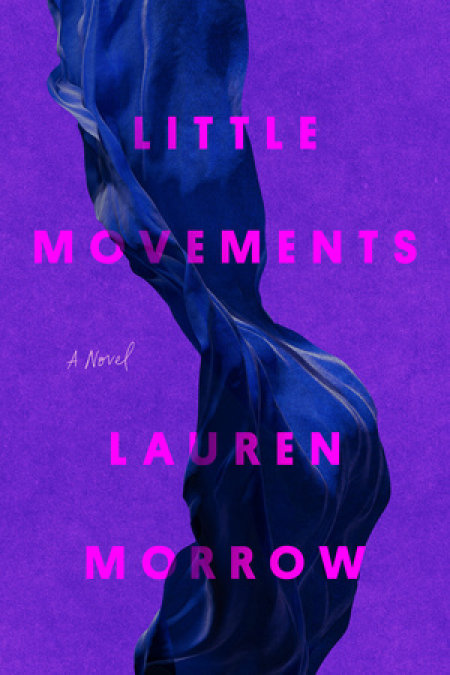
A page-turning, tenderhearted debut about a Black woman who is finally given a chance to pursue her dream of becoming a renowned choreographer, only to find that it comes at a tremendous personal cost
ONE OF THE BEST BOOKS OF THE FALL: People, Oprah Daily, Los Angeles Times
“Lauren Morrow’s smart, incisive and hilarious debut is an ode to the creative process and to people everywhere who feel the pull to take a risk and try something new.”—Minneapolis Star Tribune
Layla Smart was raised by her pragmatic Midwestern mother to dream medium. But all Layla’s ever wanted is a career in dance, which requires dreaming big. So when she receives a prestigious offer to be the choreographer-in-residence at Briar House, an arts program in rural Vermont, she leaves behind Brooklyn, her job, her friends, and her husband to pursue it.
Navigating Briar House and the small, white town that surrounds it proves difficult—Layla wants to create art for art’s sake and resist tokenization, but the institution’s director keeps encouraging Layla to dig deep into her people’s history. Still, the mental and physical demands of dancing spark a sharp, unexpected sense of joy, bringing into focus the years she’d distanced herself from her true calling for the sake of her marriage and maintaining the status quo.
Just as she begins to see her life more clearly, she discovers a betrayal that proves the cracks in her marriage were deeper than she ever could have known. Then Briar House’s dangerously problematic past comes to light. And Layla discovers she’s pregnant. Suddenly, dreaming medium sounds a lot more appealing.
Poignant, propulsive, and darkly funny, Little Movements is a novel about self-discovery, about what we must endure—or let go of—in order to realize our dreams.
Release date:
September 9, 2025
Publisher:
Random House
Print pages:
256
* BingeBooks earns revenue from qualifying purchases as an Amazon Associate as well as from other retail partners.
I thought about giving up before I’d even begun. After the five-hour drive, I found the key beneath the doormat and shimmied it into the hole. But the little blue house wouldn’t let us in, no matter how cleverly I twisted the knob or torqued the key. It wasn’t until Eli shoved his body against it three violent times that the door popped open with an exhale.
He fell inside, but I just stood there, hesitating still. It would have been easier had the door never opened. We could have gotten back in the rental, driven home to Brooklyn, and when people asked what happened with that big thing I was supposed to have done, I’d shrug and admit I simply couldn’t figure out the door key.
But easy was the opposite of the point. And now that I was inside the house, really taking it in, I felt that tickle in my belly I’d felt all my life at the start of something new. That first-day-of-school feeling. That glance-from-a-crush feeling. This felt so much bigger than all those other firsts. Big enough to silence me for the last half hour of the drive through those rural, winding roads. Big enough to change everything.
The house had an incoherent mix of art styles and trinkets sprinkled throughout. Clashes of color and texture. A cute that teetered just this side of tacky. From the entryway, I saw the living room to the left, the kitchen at the end of the long hallway, a small washroom just to its right, and the stairs that led to where we’d later find the bedroom and bathroom. More than enough for one person accustomed to New York City living.
“This whole place is ours?” asked Eli, walking up the staircase, looking around.
“Just this half. It’s a duplex. The landlord, George, is on the other side.”
Eli had been saying we and ours all day, but I was the choreographer-in-residence. Technically these things were mine. He’d only be here for a week, to help me settle in. After that, I’d be alone to create—there was no prospect more thrilling and terrifying. We hadn’t been apart for more than two weeks since we’d started dating eight years ago.
At the top of the stairs, Eli placed his butt on the wooden banister for a moment before thinking better of it and simply running back down. This was a glimpse into the sort of child he’d been—an unruly, bone-breaking boy. He still looked like the childhood photos scattered across his parents’ Iowa home, only his hair was more brown than blond now, his green eyes newly puckered by crow’s-feet but still twinkling with mischief.
I’d been the opposite sort of child in every way. Careful, introspective, anxious from the start. My coarse curls had been relaxed for years, pulled back into a bun, an attempt to go unnoticed. To disappear. Now, decades later, I was finally letting my natural hair out—tight curls and twisted updos. I was finally ready—willing—to be seen.
But I was overwhelmed by it all—the house, the responsibility, the attention, the solitude.
Eli wrapped his arms around me and kissed my forehead.
“Why don’t you lie down? I’ll start bringing stuff in.”
“There’s too much to do,” I said. “I don’t want to lose momentum.”
“I’ll take care of everything,” said Eli. “Stretch your legs. Rest your eyes.”
I appreciated the permission, though I knew I wouldn’t be able to relax, so I made my way to the living room. Unlike the cream walls of the entryway, these were covered in an awful wallpaper, yellow and green stripes. A tan, crushed-velvet camelback sofa was pressed against the far wall, beneath a window. I tried to get comfortable, but this wasn’t the Midwestern La-Z-Boy furniture of my childhood. I closed my eyes and listened to the sounds of Eli moving around outside, then entering the house, grunting with each drop of a bag, each stack of a box.
Packing light had never been my forte, and the fact that I’d be here for nearly nine months hadn’t helped. There was so much I didn’t know about this place, these months—when the weather might shift, where the nearest Black beauty-supply store was, where I might find an 80 percent dark chocolate bar flecked with chili, what events I might attend. I had to be ready for anything, to bring as much of myself here as possible.
Finally, Eli closed the front door and sighed, sounding more sad than exhausted. Now that everything was inside, I was one step closer to having an existence far away from home. He was having a harder time with the change than anticipated. That much was clear from the last few weeks in New York—sullen, prickly, tainted with misplaced spite.
His feet padded my way, and he crawled on top of me, said, “Make room.” I scooted, and he slipped an arm beneath me, the other around. His chest beat against my back. I began to drift, but never reached sleep, just felt our bodies sync until it was impossible to tell whose breath was leading whose.
The summer had started with a bang—the offer from Briar House such a jolt to our lives that I was sure they’d made a mistake.
“What if they meant to invite Leela Smark or something?” I said, rereading the email from my phone as I sat on our living room couch.
“No one is named Leela Smark,” said Eli. “They want you, Layla Smart. You’ve worked so hard for this. Everything is finally coming together.”
Then came the question of long distance. It didn’t make sense to give up seven hundred square feet of rent stabilization, for both of us to uproot our lives, including his job, for nine months, only to start over again in Brooklyn. When you had a good thing going in a city so expensive and competitive, it was best to hold on.
By July, Eli was smothering in his affection—kissing me as I finished work assignments, squeezing my hips in the night, our skin sticky with sweat. I’d inch away, he’d inch closer.
The trouble came in the last two weeks. I had begun to stash things in piles, small collections of my life accumulating in corners of the apartment. Shoes, clothes, books.
He’d already lost so much. We both had. The little thing we’d rested our hopes on last winter. The tiny life we would build our world around, gone before it even arrived. Before we’d told a soul. Better that way. It happened all the time, I told him, partly to convince myself. But Eli couldn’t grasp the normalcy of it. Couldn’t understand my swift, tidy mourning. The way I refused to let it halt my life. The way it only made me want to live more.
We’d created this home together—Wayfair chic, peppered with flea market finds, cluttered with books and plants. Now that I was leaving, it didn’t matter how homey the place was. The piles were monuments to my imminent departure. Eli was hurting, and his sadness looked a lot like anger.
By August, my words and actions were all wrong in his eyes. Shoes left in the doorway; a bell pepper sliced in the wrong direction; a jar of pasta sauce made with high-fructose corn syrup; LaCroix mispronounced; a purchase from Amazon rather than a local business.
The night I changed our dinner plans was when Eli lost it. He claimed we only ever did what I wanted. But hadn’t he always liked what I’d wanted? What I wanted was what we wanted. After eight years together, two years of marriage, I’d suddenly become a sitcom nag, a stand-up punch line. Wives, amirite?
He stormed to the bedroom, pulled off the kerchief he’d just tied around his neck—the kerchief I’d insisted several times over the years was a lot—and slammed the door.
Maybe I should have left him alone. When I met him in the bedroom, he spewed anger like I’d never heard from him. He stared at me, something hard inside of him—shards of it had crumbled off sporadically over the years, but now it was breaking off quickly, in chunks.
Anger and fear tangled inside of me.
“Just tell me if this isn’t what you want,” I said. “Say what you’re really getting at. ‘Don’t go or else go for good.’ ”
He looked into my eyes. “Why would you even say that?” His voice was soft before it broke into sobs. His tears flowed, his shoulders shook.
“It’s what you were thinking! It’s what you want!” I said.
“How could you possibly know what I want? When did you ever even ask?”
We’d never been so cutting with each other. So cruel. While Eli cried, I refused to. My throat, nose, and head were tight with the tension of holding it all in.
Eventually, I went to the kitchen and drank glass after glass of water from the tap as though rehydrating for the tears I hadn’t let come.
Eli came in to drink too, his eyes red rimmed, glassy.
“I don’t want you to go,” he said. “But I know you have to.”
We held each other then, for what felt like hours. Until the sun went down. Until the night went quiet.
We hope you are enjoying the book so far. To continue reading...

 Please log in to recommend or discuss...
