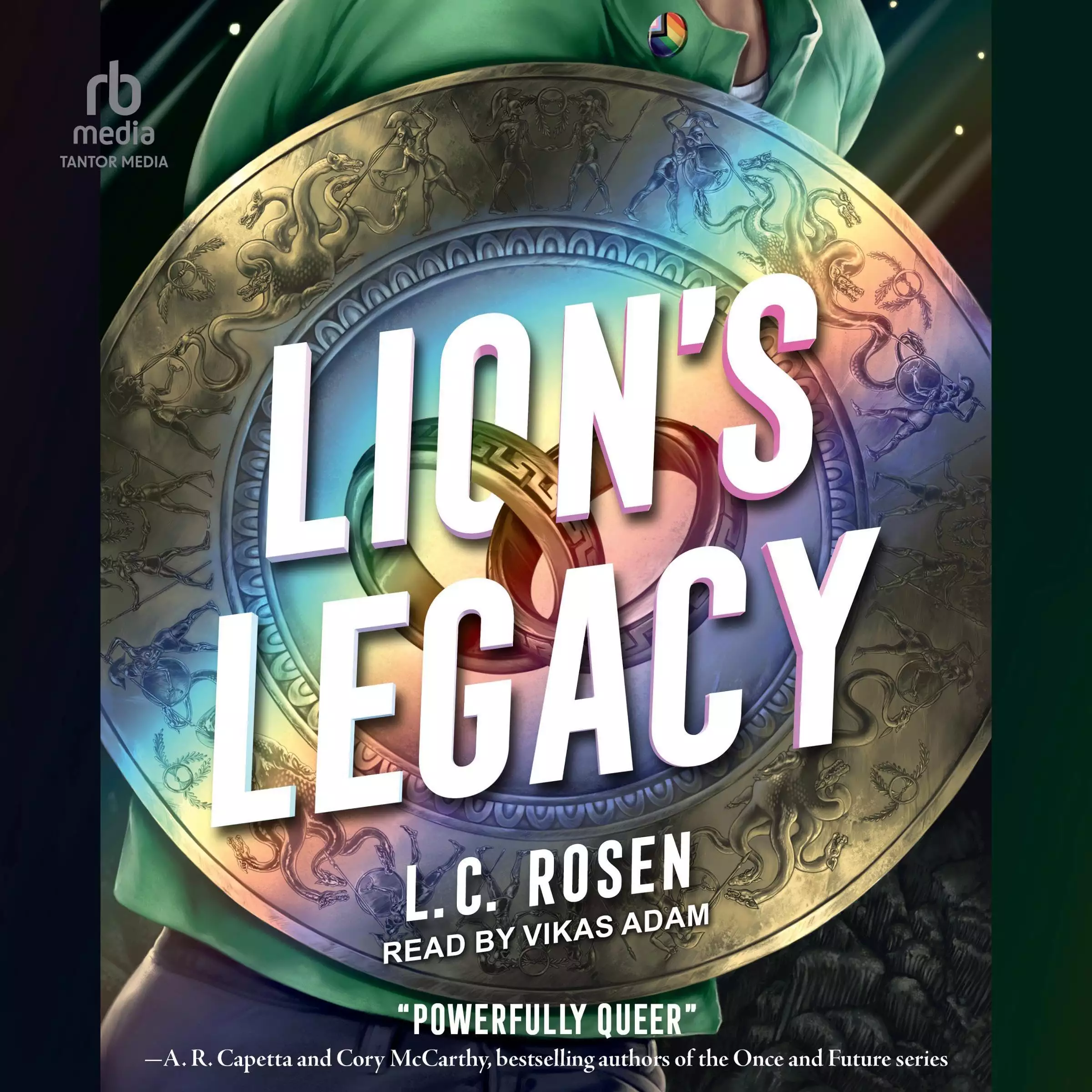
Seventeen-year-old Tennessee Russo’s life is imploding. His boyfriend has been cheating on him, and all his friends know about it. Worse, they expect him to just accept his ex’s new relationship and make nice. So when his father, a famous archaeologist and reality show celebrity whom he hasn’t seen in two years, shows up unexpectedly and offers to take him on an adventure, Tennessee only has a few choices:
1. Stay, mope, regret it forever. 2. Go, try to reconcile with Dad, become his sidekick again. 3. Go, but make it his adventure, and Dad will be the sidekick.
The object of his father’s latest quest, the Rings of the Sacred Band of Thebes, is too enticing to say no to. Finding artifacts related to the troop of ancient Greek soldiers, composed of one-hundred-and-fifty gay couples, means navigating ruins, deciphering ancient mysteries, and maybe meeting a cute boy.
But will his dad let Tennessee do the right thing with the rings if they find them? And what is the right thing? Who does queer history belong to?
Against the backdrop of a sunlit Greek landscape, author L. C. Rosen masterfully weaves together adventure, romance, and magic in a celebration of the power of claiming your queer legacy.
Publisher:
Union Square & Co.
Print pages:
304
* BingeBooks earns revenue from qualifying purchases as an Amazon Associate as well as from other retail partners.
The skeletons stare at me from across the moat, waiting. If you’d asked me, even two days ago, if I believed that reanimated skeletons, their joints tied together with ribbon, were possible, I would have said no. Even with everything I’ve seen—the pit traps and rolling boulders, the ancient mechanisms that somehow still functioned, the scepter that controlled fire—I would have drawn the line there. But now I have to say, I’m a believer. You sort of have to believe in a thing after it spends hours trying to kill you.
“Dad . . . the bridge is getting lower,” I say, trying not to sound too panicked, and failing. We’re currently on a man-made square of an island. On one side, across the water, is the rest of the lost temple we’ve come through to get there—and the skeletons. They make strange hollow clanking noises as they bang together, teeth chattering, their hands reaching out for me. I have a gash on my shoulder where one got too close. They can tear us apart. The ribbons waver along with their movements, making them blurry, as if they’re covered in rags. They don’t go in the water, though. The water dissolves their ribbons, and the skeletons fall apart.
We came out here via a big wooden bridge that drops down from a device in the ceiling. It lowers for a few minutes, then rises for a few minutes, back and forth, like a pendulum. And right now, it’s not swinging in our direction: it’s lowering. We just made it across last time it came down, but the skeletons were far enough behind they didn’t make it. But this time there’s nothing stopping them.
“Dad . . . ,” I say again. I turn around, focusing the camera I’m holding to film him instead of the skeletons. He’s kneeling in front of an altar, a brightly colored lacquer box on top of it.
The box has a puzzle wheel for a lock—a complex image broken into different rings he needs to rotate into place to make the image line up and open the box. But he doesn’t know what the picture is supposed to be.
“Almost, Tenny . . . ,” Dad says, carefully turning one of the rings into place. “Almost . . .”
There’s a small click, and he pulls the top of the box open. Inside, laid in an indentation, is a katana. It gleams in the dim light of the torches. It has a white enamel sheath and an intricate hilt, but we don’t have time to admire it as the bridge has now reached arm height and the skeletons are clamoring onto it and toward us.
“We have to go,” I say to Dad.
Dad looks behind us and sees the skeletons and nods. He grabs the katana and unsheathes it, tossing me the scabbard. “Let’s hope the legends are true,” he says. On the side of the small island opposite the bridge are stairs that lead down into the water. We don’t know how deep the water is, but it’s nearly black, and if there’s a shore on the other side, we can’t see it.
Dad runs down the stairs and holds the katana in front of him, then cuts into the water with a few quick strokes. There’s no splashing, though. Instead, the blade carves, like a knife into soft wood. The water freezes like cut glass where the katana has sliced it. Pieces of it go flying and hover in the air, crystals rotating. And in front of us, a small valley through the water. It’s clear, but too dark to see to the bottom. It must go very far down. Dad has made a path in the water. Carefully, he puts a foot on it.
Behind us, the bridge falls into place. I hear the hollow beats of the skeletons’ footsteps charging us.
“Come on,” Dad says, now stepping fully onto the path he’s carved through the water. It holds him. It shouldn’t be possible, but then, neither should the skeletons. I run forward and step onto the water with him. It feels like walking on Jell-O that bounces under my boots. Dad slices through the water again, carving us a path farther and farther forward, away from the skeletons. I film it all, then turn around to film our pursuers. They’ve stopped at the water’s edge. They don’t know if they can use the path. Neither do I. But I don’t want to find out.
“Faster,” I hiss.
We keep walking forward as Dad carves the water. Around us, the room is made of old brick, covered in moss, low enough to see the ceiling but with the walls far enough out they’re hidden in darkness. Carefully, I reach into the water on either side of us, the parts Dad hasn’t carved. Still liquid. Still deep. And freezing cold.
I look behind us. A skeleton is mimicking me, carefully placing its hand on the carved water. It doesn’t go through. It doesn’t dissolve the little ribbons holding its bones together. “Dad,” I say.
The skeleton steps onto the path. It holds him.
“Dad, they can walk on it, too. Faster!”
Dad glances back and sees the skeletons on the water. He starts carving faster. The strange, crystalized bits of water fly out as he keeps running forward. We don’t know where we’re going, but we know what we have to get away from.
Dad keeps slicing and I stay close, sometimes turning back to check how near to us the skeletons are. Closer every time. This could be it. Our last adventure.
“Dad!” I scream.
“I see land,” Dad says, and points. In the distance is another stone shore, stairs leading out of the water onto an island like the one we were on. He starts carving faster, heading toward it. Behind us, the hollow clanking of bones is closer.
“We need to jump,” I say.
“What?” Dad says.
“We’ll swim. They can’t follow.”
“Tenny, how can I swim with this katana? It’ll cut the water up. You know physics well enough to tell me what’ll happen?”
He knows I don’t. I’m a high school freshman. I haven’t even had physics yet. “Then carve faster!”
“I am!”
The skeletons are quicker, though. I look behind us. They’re a swarm of bone and ribbon nearly on us. But then I hear something. The sound is growing quiet. I tilt, looking behind the pursuing skeletons. There should be dozens of them, but there are only ten now. Enough to tear us apart, but where did the others . . . behind them, the path is gone. Water again. Okay, that’s something. We have options now:
1. Hope Dad carves fast enough that we reach the end and can climb up those stairs, then push the skeletons back into the water. Hope they don’t kill us before or during that particular battle.
2. Swim to shore. Sword might cut the water, Dad might sink lower on one side, lower and lower as he keeps swimming, cutting, until he’s at the bottom and the water above him turns liquid again.
3. Turn and fight the skeletons now. Not my favorite.
4. Something that uses the best of everything.
I shrug my backpack off, put the camera around my neck, and dive into the water.
“Tenny!” Dad shouts. “What are you doing?”
“Keep carving!”
Dad keeps slicing into the water as I swim. I can hear the skeletons rushing closer and closer to him. Shore isn’t far now, though. I’m a good swimmer, I made sure of that after that water trap in the Mayan temple. I reach the stairs and turn around. The skeletons are practically on top of Dad.
“Throw the katana!” I shout.
“What? We’ll lose it!”
“Throw it! At the water! Then dive in!”
Dad looks behind him as a skeleton grabs at him and pulls his backpack off. He shrugs out of it before it can pull him back. Then, his face grim, he throws the katana at me and dives into the water in one motion. The katana spirals through the air like a comet, coming closer, closer . . . Finally, it lands in the water near me, the blade hardening the water as it hits, the hilt clinking as it reaches the surface. It stays. I reach forward and pull it out, like King Arthur.
Dad is swimming for me, and the skeletons are standing confused on their little crystal island. I film it as the carved water gradually turns back to liquid, and the skeletons silently fall into it.
Dad walks up the stairs, sighing, drenched. He cocks an eyebrow at me.
“If you knew the katana would hold in the water like that and not sink, why’d you dive in first?” he asks. “I could have thrown it and we could have dived in together.”
“So I could film it,” I say.
Dad grins, then starts laughing. He puts his arm around me and hugs me close. “I love you, Tenny,” he says. “You’re a genius.”
I laugh. “I love you too, Dad.”
Relief floods over me. We have the katana. We are out of immediate danger. We did it! We found the legendary Misumune katana, the water-carver. We navigated a lost temple filled with traps, riddles, and supernatural monsters. And we had a damn good time doing it. I keep laughing, and so does Dad. I know it’s a release for both of us, all the anxiety flying out of us in the sound of joy. He keeps hugging me. I keep hugging him.
“We gotta find a way out of here, though,” Dad says.
“I just hope there are no more skeletons,” I say. “That’s all I want.”
“Same here, Tenny.” He takes the flashlight that hangs from his belt and shines it forward. “Hopefully this isn’t long. Our rations were in my bag.”
“And the extra flash drives were in mine,” I say. “We only have, like, an hour of time to film left.”
“Camera okay?” Dad asks.
“Yeah,” I say, holding it up. It’s small, waterproof, shockproof. Good quality. There were a few more in my backpack just in case, but this one seems to have held up.
“Lose any footage?” he asks.
I check my jacket pocket. The memory card is still there, enclosed in a watertight plastic case.
“Nope,” I say.
“Okay, then let’s see where this leads.”
He shines his flashlight ahead of us. The stone platform we’re on narrows into a hallway leading forward. Only one way. We march ahead.
It’s a short walk, only twenty minutes, and no traps or skeletons on the way. We’re wet, and shivering, but I don’t mind it because I can feel we’ve reached the end. We found the sword. We just need to follow this path to the exit. But at the end of the tunnel, the hallway is blocked by a waterfall. A waterfall with an odd smell.
Dad stops before walking through it, holding out a hand to block me. “Acidic,” he says. “We walk through that, our skin melts off.”
“Great,” I say.
“It is,” Dad says, holding up the katana with a grin.
I smile and lift the camera. Dad poses, showing off, before slicing a door through the waterfall. The water—greenish now, I see—solidifies under the sword’s touch, creating an arc of solid water. Dad kicks it down and it shatters like glass. In front of us is a way out.
“Quick, before it goes liquid again,” I say. We rush through the open space and find ourselves in a large circular chamber, the walls carved with beautiful patterns. Above us is a slatted roof that lets in fresh air and moonlight. I look back at the waterfall, which comes out of a slit in the wall. Where the water was carved it just stops, the flowing water curving around it into the rest of the liquid parts. The waterfall ends at the floor and then seeps into two metal drains on either side. It’s beautiful. I make sure to get a slow shot of it. Then I turn around and get the whole room. The producers are going to love this.
At the far end of the room is a ladder, bolted to the wall, leading to freedom.
“We could have just come in this way?” I ask.
“Well, we would have had to get through that acid bath somehow,” Dad says. “I guess with modern technology, we could have . . . but what would be the fun in that?”
He turns and winks at me—well, at the camera—then heads for the ladder. We climb. It’s pretty high, and at the top is a grate. But, of course, it’s locked. There’s a wide opening, too large for a key, in the wall. I carefully film, clinging to the ladder.
“I know this one,” Dad says. He takes the katana and inserts it hilt first into the opening.
There’s a click, and the grate above us pops open.
And then we’re out. We climb up and into fresh air. The breeze smells so much better than the stale air of the temple below us. I look out over the tiny island we’re on. It’s so small it doesn’t have a name, barely five miles in any direction. No one has lived here in centuries. No one wants it, either. It’s mostly rock and some wild sheep. It’s miles west of Nemuro, just outside Japan’s borders. International waters. Dad had liked that for some reason.
“Let’s go find Toma,” Dad says. “I feel like we’re south of where we went in.”
“That feels right,” I say.
We start walking. The ceiling of the room below us is underfoot, but it’s covered with grass and leaves. I would never have noticed the holes in it until we were on top of it. And besides, all the clues led to the entrance of the temple. No shame going in the front door, I guess, since we made it out. But it feels a little silly that we probably could have avoided the skeletons if only we’d done a full survey of the island when we landed this morning.
We walk for about twenty minutes before we spot Toma and his boat, right where we left them. Toma is sitting in a folding chair on the shore, his small yacht parked out in the deeper water, an inflatable motor raft next to him onshore. He has a fire going and a portable speaker out, smooth jazz playing from it. When he hears our footsteps, he looks up and grins when he sees us.
“You got wet,” he says.
“But we found it,” Dad says, holding the katana aloft.
Toma whistles. “I didn’t think it was actually real,” he says. He stands up and walks over to Dad, staring at the katana. I step forward and look too, filming it. I hadn’t really had a chance before, but now I can see it up close. The Misumune family crest is on the sheath, and the handle is carved bone or ivory, made to look like waves. It’s beautiful. Mrs. Misumune is going to be so happy when we give it to her. She’s this nice old lady whose ancestor owned the sword, and she helped us find it by letting us go through all her stuff while she brought us cookies and tea. She told us stories too, about her ancestor, and how supposedly he held off an entire flood that would have destroyed their village. Now we know how.
Though that part won’t make it onto TV. Dad always says no one would believe the magic we’ve found, and if they don’t believe the show, then they won’t believe the history. I mean, we leave some of it in—the cut waterfall will probably stay. Stuff that people might think is weird old mechanisms or tricks. People believe in that. Not so much the magic. He’ll probably say the skeletons were mechanical, and only show their shadows. He’s good at that, been doing it for years. He started out with just a little handheld camera and videos uploaded to YouTube, but his know-how propelled it bigger—now we’re on a streaming service with fancy network producers. Dad is careful about what he sends them, though. Always at the edge of believable. And he makes sure not to bring a crew along—they can’t be trusted. Plus, the unpolished handheld style is the show’s trademark.
“It sliced through water, too,” Dad says to Toma, rotating the blade in the light. “Just like the legends.”
Toma laughs. “No way,” he says.
“Tenny’s got the footage,” Dad says, walking past him to the raft. “We were chased by living skeletons.” That’s Dad testing, seeing what people will believe, what to put in the show, what to keep just for us.
Toma turns to me, his face skeptical.
“They weren’t very welcoming,” I say. Later, Dad will probably leak some of the real footage online, get people talking, theorizing. “Keep the truth illusive,” he says, “and people will watch to find it.” I don’t love that part, but I think he’s right about the magic being too unbelievable. Even if it is real, it never feels it. Like right now, I feel like I’m in on a joke. Skeletons held together with magic paper. It’s absurd. But the katana is real. Its history is real. And I want people to see that more than I care about whether they believe in magic skeletons.
We load the chair and boom box onto the raft and take it out to the yacht, where Dad and I shower off and change into the clean clothes we’d left there with our regular phones and wallets, while Toma pilots us back to Nemuro. I use a satellite uplink to set up my computer and upload all the footage from the camera into the cloud. Dad can cut stuff later and organize it to send to the producers. They have editors who will turn it into a good show.
And then I lie down. I’m so tired I can feel it in my bones . . . no, no, I don’t want to think about bones now. I just want to . . .
I wake up when Dad shakes me. We’re docked in Nemuro city. I rub my eyes as we step off the boat. The sun is just rising and the fish markets along the docks are all opening up, men bringing in their haul. It smells like the sea.
It’s not a big city, not by my native New Yorker standards, but it’s got the vibe that small coastal cities have. Big sky, ocean everywhere, people who look gruff but are actually friendly. We spent a day here before we left. There are some beautiful views and this cool arch sculpture. But I’m glad to be going home. I miss New York. I miss Mom.
Dad pays and thanks Toma and then we start walking back to the hotel. As we walk, Dad takes out his phone and calls someone. Probably one of the producers.
“Yeah, we got it. Oh yeah, it’s a beauty. People are going to want to study this, draw it, absolutely worth a whole touring exhibition, like last time. Same deal, I go where it goes, talk about the find.”
I frown. It sounds like he’s talking to his broker. I’m never involved in this part of it, but I know Dad has a guy who reaches out to collectors and funders who will buy the stuff he finds for museums and helps set up exhibitions. Dad never talks to me about all that, it just sort of . . . happens? But this sword belongs to the Misumune family. We met them. They helped us find the temple by showing us some old scrolls and one gorgeous kimono that had a secret message in the pattern. We shouldn’t be selling it through a broker. We should be giving it back to them.
“Dad,” I say. He ignores me, keeps talking.
“Well, yeah, whoever is willing to pay the most,” he says into the phone, holding up a finger at me, telling me to wait.
It’s not like with the scepter we found in the treasure cave outside Paris. There was no family there. I mean . . . it should have stayed in France. And it did. The Louvre found an investor who bought it.
I stop walking. Dad keeps going.
I’ve never thought about it before. What we find. I’ve always just loved the adventures, the thrill, being with Dad. And yeah, it’s kind of fun being on TV. It’s not a big show, but it has fans. I get fan mail. Hate mail since I came out, too, but more fan mail.
But . . . the stuff we find. I stare at the katana. Dad has it slung over his shoulder. The Misumune family crest gleams on the sheath. The mask we found in the Mayan temple in Guatemala—our first adventure—where did that end up? I take out my phone and search. It’s in the Smithsonian, in DC. That isn’t right. It should be in Guatemala, shouldn’t it? It’s their mask, after all, their culture. Did they sell it to the Smithsonian? Is it on loan? I check the website, but there’s no information.
I look up. Dad is way ahead of me, still on the phone, and I hurry to catch up.
“That much?” Dad is saying. “Wow. Yeah, that’s a nice profit.”
“Dad,” I say. He holds up a finger again. “Dad!”
“Hold on.” Dad sighs into the phone. “Tenny, you’re fifteen, you ought to have better manners.”
“Why are you talking about selling the katana?” I ask. “You told Mrs. Misumune we’d bring it back.”
Dad raises his eyebrows. “Well, sure, back to the world. Back into the light. This way she can see it. I’m sure whomever ends up with it will want to talk to her, maybe borrow that kimono, have her talk—”
“But it’s hers,” I say. “It belongs to her family.”
Dad scrunches his eyes like he’s going to laugh. “Maybe hundreds of years ago, but you can’t expect me to give it back to her because she has, like, a few genes in com. . .
We hope you are enjoying the book so far. To continue reading...

 Please log in to recommend or discuss...