'[A] thought-provoking . . . examination of damaged psyches and the consequences of secrets' Times
REAL READERS LOVE LIGHTS OUT: 'Louise Swanson's writing is so powerful that I was dragged, kicking and screaming, into this world that she has created so precisely and with so much atmosphere and I couldn't let go . . .' ⭐⭐⭐⭐⭐ 'I was totally absorbed in this book. Louise is one of my favourite authors' ⭐⭐⭐⭐⭐ 'A 5 star read, shining brightly through the dark' ⭐⭐⭐⭐⭐ 'This whole book is filled with layers upon layers of mystery . . . very cleverly told' ⭐⭐⭐⭐⭐ 'Lights Out has several layers and I loved being able to peel each one back' ⭐⭐⭐⭐⭐
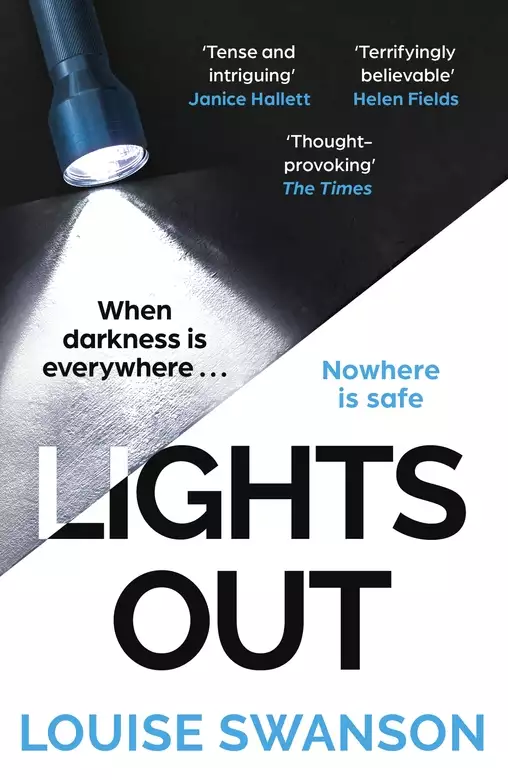
When darkness is everywhere, nowhere is safe...
A state of emergency has been declared in the UK. From now on, at 8pm every night, all electricity cuts out. The Government promises it's a temporary measure. They promise they are always thinking of your safety.
But for Grace, the darkness is anything but safe.
Someone is coming into her house under its cover every night while she lies in bed upstairs, too terrified to sleep. Someone who knows her past, who knows why she has more reason to fear the dark than most...
And every morning she wakes to a new message from the intruder:
I have you in my sights. Love, The Night
But how can Grace escape, when there's nowhere safe left to hide?
'Tense and intriguing, creeping paranoia oozes from every page . . . Louise Swanson is a talent that shines in the dark' Janice Hallett
'The most zeitgeist thriller of 2024 . . . Terrifyingly believable and horribly real. I'd say I devoured it, but I think the truth is that it devoured me' Helen Fields
'Chillingly convincing, this is a novel that echoes around your head for a long time after reading' B.P. Walter
Publisher:
Hodder & Stoughton
Print pages:
416
* BingeBooks earns revenue from qualifying purchases as an Amazon Associate as well as from other retail partners.
I wrote this cold, during the Cost of Living Crisis winter of 2022/23, wearing a coat inside and often a hot water bottle on my feet, my fingers chilly as I typed, my breath visible inside the house, afraid to put the heating on during the day.
Many had it much worse. I read stories about children dying in mouldy, damp houses, and the elderly dying of hypothermia. This, naturally, influenced the book. As did what the nurses were going through, with the strikes. These circumstances – much like the pandemic with End of Story – had me wondering what it would be like if the lights really did go out.
If it was dark at night, and cold all the time.
Thanks as always to my early readers: Madeleine Black, my sisters Claire and Grace, and John Marrs. Also, thank you to Claire and Grace – a support worker in a palliative care unit and a Nurse Practitioner – for all the help with research on working in end-of-life care. Thanks to Joe for encouraging me to ‘keep the things I loved’ in it. And to my Katy for being my ‘bouncing board’ when it came to ideas, and to my Conor for the common sense.
Thank you to all the early readers, reviewers and bloggers, to the book lovers who came to my launches and events, and to the TBC gang, and the many helpful private author groups that kept me going. Thank you to the indie bookstores (the Grove Bookshop, the Rabbit Hole, Imagined Things, JE Books, Tea Leaves and Reads, Goldsboro Books, Beverley Bookshop and Hessle Bookshop, to name but a few) for the endless support. Thanks to the librarians and festival organisers and supportive authors. We writers love and need you all.
Thank you, Lily Cooper, for the incredibly incisive and thought-provoking early edits. You knew what needed pruning, and your vision was spot on. Also thanks to Caroline Hogg for your later, equally helpful edits. And thank you, Lucy Stewart, for making me dig even deeper, making me find those final nuances, and making this the book it is now, one I’m so proud of. Thank you Kay Gale for making it all ‘reader ready’ with your great copy edits. Also, Kim Nyamhondera for being my publicity girl, and for sending my books (and me) to all the places where they can shine best.
Huge thanks too to my Emily Glenister, for all your love and support, always, unconditionally. I’m so proud to be part of DHH Literary Agency.
Chapter 1
Death Favours the Dark
Death calls most frequently at night. He sneaks in while the lights are off and his victim sleeps, vulnerable but not always oblivious. Hospice residents are mostly taken by him between three and four a.m. Some victims are ready, welcome him; some, recognising his icy grip, ardently resist.
It makes no difference.
A serial killer on a mission; when he enters a room, Death won’t leave until the deed is done. If it’s time, it’s time.
Grace had been waiting for Giles’s death for hours.
She spoke softly to him while she did; it was her way. Conversation was one-sided. But still, as she did with all of them, Grace asked Giles questions, queries that lingered in the air, never to be answered.
Despite working in a hospice, she didn’t always get to see them out, as she called it. But she was there in the lead-up. End-of-life carers try and anticipate the moment of death, but it’s futile. Patients sometimes look deceased, perk up unexpectedly, and then flag again. There’s a papery translucence to the skin, like they’ve adopted a premature ghostly form, and their breathing slows, slows, slows.
‘Shall I sneak you a gin and tonic later?’ Grace joked, knowing it was Giles’s favourite tipple.
Quiet.
After a while, she said, ‘It’s happening now. Lights Out. Can you believe it?’
Quiet.
‘I’m nervous about it,’ she whispered.
She couldn’t imagine it. Didn’t want to. What would it be like, swinging a torch around the house, trying to illuminate every dangerous dark spot? Because, for Grace, darkness was always danger. Without light, there was peril.
After a while, Grace slipped out of the room to strip empty beds for new patients.
When she returned to Giles his facial muscles had slackened and his jaw had dropped, full surrender. His breathing was shallow, irregular. There’s rarely the romantic, movie-esque last scene, no wailing around a tidy bed, no delicate, poetic sigh from the one passing over. The dying prefer to go alone; they’ll wait until husbands and wives have gone home to rest, until siblings pop out for a cheese baguette, until children have said they need to make a call, they’ll be back in a tick. Death loves an empty room.
With little fuss, Giles passed. Grace had witnessed many deaths in her five years here and, in her experience, most people departed in peace, features softened as pain ended. Death at the end of a long and dreadful illness was a relief.
And this was why Grace loved being a health-care support worker at the hospice, providing both palliative and end-of-life care. Palliative care is when no further treatment for your illness remains. End-of-life care is provided when you’re closer to death. ‘Why would you do such a job?’ her husband, Riley, asked when she first applied. But Grace didn’t feel that ‘job’ was the right word for it. If you were drawn to something, it was more. A vocation. People found it morbid when she told them where she worked, asked if it was horrible, traumatising. But she could honestly say that it wasn’t. Life might sometimes be those things, but death was kinder.
‘Sleep well, Giles,’ said Grace. ‘Glad I got to see you out.’
She made a note of the time. Three thirty-two.
Then she got Claire, the nurse on duty – the person in charge on that shift – who would be able to verify the death. After leaving the body for one hour as a mark of respect, they commenced with last offices. This was a procedure where the deceased was positioned, arms by their sides. They were then washed, dressed in clothes chosen beforehand, and labelled with an ID bracelet on an ankle in preparation for transportation to a mortuary.
As they worked, Grace wondered, as she often did, where humans went when they died. Giles’s body was empty, a disintegrating vessel, but where had his soul gone, his essence, the vibrancy that had lit up his eyes? How could it disappear after a life of animation?
When they’d finished, the night had settled. Claire suggested Grace leave her duties and sit with another patient, Gloria. ‘I know you’ve got quite attached to her,’ she said.
There wasn’t always time to sit with patients, though extra effort was made if they were feeling low or had few visitors.
Gloria, a delicate lady in her late eighties, had no one.
Grace went to her room and pulled a visitor chair up to the electronic hospital bed with protective sheets on the mattress. There was a huge clock opposite the bed so patients could easily see the time and date, orient themselves, keep track when long days blurred into one. The room was dressed to appear homely – lilac curtains, matching cushions, a smart TV, coffee table and a lamp, now on low so carers could see, and patients didn’t wake afraid. Grace often thought of Changing Rooms episodes where a tired room got ‘transformed’ into a boudoir with a bit of gold stencilling, but you knew it was still just an old bedroom.
She entwined warm fingers around Gloria’s chill hands as though to infuse her with life. She slept most of the time now, even during the day; strong pain medication meant patients were often drowsy near the end.
‘It’s dark and it shouldn’t be.’
Grace jumped.
Gloria’s words were clear when her throat must be dry, and she had been unconscious a while. The lamp was low, but the room wasn’t dark. Grace would never have gone in if it was. Of course – Gloria’s eyes were shut.
‘It’s bright here,’ said Grace.
A croak then that she couldn’t make out.
Quiet again.
Another croak.
Grace squeezed Gloria’s hand. ‘I’m right here.’
‘Why is he here?’ Gloria’s words were weaker but still Grace started.
‘Who?’ she asked.
‘Him.’
‘Who?’
‘The man in the corner.’
Grace spun around, heart hammering. But when she faced the wall, there was no one. She unclenched her fists. The dying often hallucinated, but Gloria seemed lucid.
‘Don’t let him come any closer,’ she begged, eyes still closed.
Grace tried to breathe slowly, not panic.
‘It’s just us.’ She squeezed Gloria’s hand, heart staccato despite her efforts. ‘You’re safe with me.’ Was she remembering someone terrible from her past? Patients often spoke to someone the carer couldn’t see.
‘He wants . . .’
‘Yes?’
‘He wants to tell me . . .’
‘Yes?’
‘A message for you . . .’
‘For me?’ Grace let go of Gloria’s hand in surprise. She picked it up again, quickly. Perhaps Gloria thought she was a family member and Grace should remember these words, pass them on. But there was no family.
‘Something . . .’
‘Yes?’ Grace felt sick.
‘Something terrible is going to happen when the lights go out.’
‘What?’ Grace shivered.
‘Something . . .’
‘Yes?’
Grace waited for Gloria to finish. But she said no more, leaving Grace alone with words crawling over her skin. She looked towards the corner of the room again. For a moment, a man, grinning. Grace gasped, shook her head.
Nothing. No one.
Perhaps Gloria had been voicing the things heard in recent weeks, she reasoned to herself. After all, the Lights Out scheme had been discussed a great deal.
Then the lamplight sputtered.
Something terrible is going to happen when the lights go out.
Grace didn’t want to be in the room any longer. If the lights went out – suddenly, violently – she wouldn’t be able to breathe. She would collapse, she would scream until her throat was on fire. She would die.
She ran into the corridor and didn’t look back.
Chapter 10
Burn Me and I Will Fire
Grace ran from the house, heart pounding, leaving in her wake the strange note, the two ominous candles, a broken egg, and a still sleeping Riley. The words in the note wouldn’t leave her head; they stuck there like a yellow Post-it. Burn me and I will fire. She had to escape them, run hard.
She crashed into Stacey, walking alone to school, knocking the poor girl over on the ice.
‘Oh, my word, I’m so sorry,’ gushed Grace, helping her up.
‘It’s OK,’ said Stacey breezily.
‘Are you hurt?’ Grace knelt down to check. A hole in Stacey’s black tights revealed a bloody scrape. ‘Oh, gosh, you are. We need to clean it, get a plaster on you.’
‘Oh, I can do that at school.’ Stacey shrugged, not fazed. Grace remembered all the tumbles Jamie had as a kid, how as he grew older, they came harder but he cried less. Kids were resilient.
More than I am, thought Grace. I could learn something from Stacey.
They had to part ways at the end of the street, Stacey going left and Grace going right. ‘Can I walk you to school?’ asked Grace. Thinking of it, she asked, ‘Where’s Jack?’
‘He’s ill,’ said Stacey. The girl looked sad for a moment. For her brother? Something else? Should Grace ask? Did she know her well enough? The look passed, and Stacey smiled. ‘And it’s OK. I’m meeting my friend Abbie on the corner.’
Grace watched her go, suddenly protective. It was a dangerous world, and not all those perils lurked in the dark.
She hurried on to work, cursing herself for not driving, and arrived, back sticky with sweat despite the cold.
She would never have read a report that the Feather Man had struck in Hull if someone in the staff changing room hadn’t left a newspaper open. She skim-read the piece, barely noticing other staff getting changed into their uniforms. An elderly woman had been targeted but her son intervened, chased him away.
No. He was in her city now.
It reignited anxiety about the words in the note: Burn me and I will fire.
Steve.
He had always bought candles for the bedroom, spoken heatedly of his desire.
Put him out of your head. He’s history. It’s not him.
But there in the staff changing room, newspaper in hand, a flashback came hard. Eyes as dark as her fears. In her kitchen, a basic room back then when life as a single mum meant budgeting carefully. What kind of mother are you? Words he often said, making her believe she was a failure. She had sent Jamie to school with a sparse packed lunch, having run out of bread. The guilt was acute. Steve played on it. Promised life would be better with him.
Then you’ll be a better mother . . .
‘Grace?’
She jumped, dropped the newspaper. Claire. Face concerned.
‘You’re as white as a sheet.’
‘I . . . yes . . . I . . .’ Grace tried to focus.
‘What is it?’
She gathered the pages from the floor. ‘This Feather Man. He’s here, apparently.’
Claire looked around. ‘I can’t see him.’
‘Ha.’ Dark humour was the way of staff. ‘I didn’t know you were working today.’
‘I’m covering. Can’t refuse when I’m still paying off Christmas.’
The morning was busy, kept Grace from thinking. She stripped beds, aided those who couldn’t feed themselves, and helped a patient called Sheila into the small garden so she could enjoy the winter sunshine and the snowdrops blooming in large tubs, despite the chill. Grace listened, letting Sheila get worries off her chest about how her family would cope when she passed; patients often offloaded secrets.
She returned to the room that had been Gloria’s.
It was unnerving to go into the space where she had said those curious things. Where she had imagined a man in the corner. It was impossible that she could have foreseen the notes and gifts left in the dark, but odd that she seemed to have predicted an intruder with her dying words.
Something terrible is going to happen when the lights go out.
There was a new patient in the bed. Musical beds – as they referred to it – was part of the job; they were on loan like library books, read and returned for someone else. Some slept for six months in them, some just days. There were twelve in total, enough for ‘each of the disciples’ a nurse called Sam often joked.
Martha was in Gloria’s bed now, fifty-one, with advanced lung cancer. Grace introduced herself cheerfully and listened when Martha got upset that no one would be visiting until the weekend. Visitors were welcomed all through the day; patients’ families were as much at the heart of the hospice staff’s care. Unlike in a hospital ward, these residents were on limited time, so structured visiting hours didn’t exist. Grace always rustled up tea and biscuits if families wanted them, and if there was a birthday or anniversary, extra treats would be found.
Later that morning, Grace and Claire took their lunch break in the staffroom. There was a new tin of biscuits – probably a gift from a family member – but the Grateful Table looked bare. Sadly, few had much to donate. Grace had some tins and nappies put aside but had left them at home in her rush.
‘God, Richard, the new guy in Room Four, he certainly hasn’t lost his sex drive!’ Claire was chattering away happily while eating a sandwich she’d brought from home. ‘He might have days left, but he finds the strength to leer down your top when you lean over.’ Claire paused when Grace didn’t respond; they often shared inappropriate jokes as a way to cope with long shifts and sad deaths. ‘You sure you’re OK?’
‘I forgot to bring any lunch.’ Grace avoided answering. She liked to listen to problems rather than share them. It had always been her way; was why she enjoyed this work so much.
‘Have one of my sandwiches.’
‘Then you’ll be hungry.’
‘For God’s sake, it’s just a cheese and onion bap,’ cried Claire, passing another sandwich over to Grace, who took it gratefully.
‘Anyway, I should marry him. He’s loaded,’ continued Claire.
‘Who?’ Grace frowned.
‘Richard in Room Four.’ Claire sighed, shook her head.
Grace tried to think up a jokey response but couldn’t. ‘Did you sleep any better?’
‘Have you been raiding the drugs cabinet?’
Grace laughed now. ‘You said the other day that we’d sleep better with Lights Out.’
‘No. It’s so bloody cold. We daren’t leave the bed. I’ve got all the kids in with me. Ralphie has a cold, bless him, and then Mikey threw up. Not his fault, but it was a pain in the arse cleaning up with a torch. And try heating baby formula without electricity! I managed to get a battery-operated warmer but I know a few mums who are having to give their babies cold milk. It’s barbaric.’
Grace tried to concentrate on what Claire was saying but kept seeing the note.
Burn me and I will fire.
Saw Steve, eyes lit by the glow of rows of tiny candles.
‘That’s terrible about babies and cold milk,’ she managed to say.
Claire nodded, now devouring a yogurt. Then she stood. ‘Anyway, shit to do, and Richard can’t leer on his own.’
As they returned to the ward, Grace got a message from Riley:
Why did you leave without saying goodbye this morning?
She saw the candles in their kitchen. She might have picked similar for the living room when it was finished. But she hadn’t. Whatever Riley might say, she hadn’t bought them and forgotten.
She. Had. Not.
She couldn’t admit the real reason she’d been so spooked earlier – about Steve. She never had. What happened back then, she had been too humiliated to admit. Too ashamed to say that she had chosen a man like that, let him into her life, into her son’s. Too embarrassed to describe how he slowly made her believe she needed him so much she let go of friends, let him take over her finances, her life.
As she walked along the corridor, Grace saw Steve, a surprise visitor, walking towards her, flowers in hand. No. She shook her head. Not him. A family member for a patient. But his face lingered in her mind. Was it possible that after all this time he was back?
She typed a message to Riley:
Talk later. You need to turn the lights out tonight and get the lamp on. Meet me at the door with it. I’ll message when I’m leaving. X
Riley responded: OK.
The afternoon passed as swiftly as morning had. Grace wanted the clock to slow, to keep her here, afraid of the night.
She returned to check on Martha and found her sleeping, oxygen cannula in place above her mouth like a second smile.
Grace tried to concentrate on her job. On Martha.
‘I’m lonely,’ Martha said, as Grace sat down by her bed.
Such simple words that had Grace reaching for Martha’s hand.
‘I’m scared of death.’
Poor Martha. It was frightening for many when they first came here, knowing that this was the end of their journey. Some had made peace with this idea. Grace often wondered how she would feel if it were her. Or a loved one. Only if that happened did she think you’d ever truly know; witnessing others going through it simply wasn’t the same. Still, she was happy that she got to see them out. That she made some small difference, perhaps, to ensure they passed peacefully.
Chapter 11
The Lights Out Casualties
At eight thirty, after a long handover, Grace left the hospice.
Outside, a different kind of dark to usual: layered, multiple shades of deepening greys, depending on where you walked. Grace often graded the dark, absolute blackness being the most terrifying, a ten, twilight being tolerable, a six. This one was an eight on that scale of fear. She wished she had driven to work instead of running from the house so she was safe within the confines of a vehicle right now.
She lingered in the security of the hospice hallway’s orange lighting. Rummaged for her phone, switched on the torch; it illuminated the immediate way, but this meant even darker patches on the perimeter of light, patches where anything could hide. She switched it off, let her eyes get used to the night. Now it scored a more manageable seven.
It was cold; cheek-numbingly, eye-wateringly cold. Grace braced herself. She would run, not only to escape the dark, but to get warm. Pounding the pavement, stumbling twice over uneven slabs, she stayed on the main roads, hating how few people there were. She was the only person in the world. Pubs, restaurants and supermarkets shut at eight now.
Eventually, it was impossible to avoid quieter streets. Then she could run no more. Her heart was bursting out of her chest. She walked fast, grateful that her black trainers were soundless. But she could have sworn there was a soft footfall a second after hers, like an echo . . . was someone else on the street? Foolishly, she stopped.
Someone standing. A few metres away. Not moving. Grace gasped, shut her eyes.
Opened them.
Still there.
‘Hello,’ she said, nervous.
Was it Steve? The Feather Man?
No, God, no.
But of course, nobody answered her. She squinted. The shape hadn’t moved. She started running, and didn’t stop until she was home. She had never been so glad to see the house, gloomy as it was, a silhouette against the stars.
Except . . . there was no lamplight in the hallway. She had asked Riley to wait there with it. He must still be at work.
Shit.
If the camping lamp was upstairs, she would have to locate it in pitch black. Her phone. She’d have to use her phone’s torch now, risk those dense, dark shadows beyond the beam. She found it in her bag.
‘You OK, love?’
Grace screamed, dropped the phone, scrambled for it.
‘I’m sorry, it’s just me!’
She couldn’t see who, backed away, switched on the torch.
‘Ben, number seventeen.’ Grace’s eyes adjusted to the light that now illuminated his face, seeing the numerous chins, ruddy cheeks and kind eyes of her neighbour. ‘I’m doing the Night Watch.’
‘Shit, yes, of course.’ Grace gulped, tried to pull herself together.
‘Need me to help in any way?’ Ben’s words were gentle, full of concern.
‘No, I’ll . . .’ She paused, then decided to launch in. ‘Last night, did you see anyone near our house?’
‘No. It was all very quiet. Boring. Hard to stay awake. We might have to pair up in future.’ He paused, breath fogged in the chill, then frowned. ‘Why?’
Grace knew how silly it would sound if she said that a fish and two ornate candles had appeared, despite no evidence of any break-in. ‘I thought I heard something.’
‘I walk up and down every half hour, trying not to nod off. But if you’re concerned, I’ll keep your house in my sights.’
Grace flinched at the words.
I have you in my sights.
The first note. Surely a coincidence; a commonly used phrase. She had questioned Ben’s hand in the break-in, but it was ridiculous. A person keeping watch wouldn’t be so foolish. Besides, didn’t she now think that there was a much likelier culprit out there?
‘Thank you,’ she said.
‘To be honest,’ said Ben, perhaps glad to have someone to talk to. ‘I’d rather be out here tonight. My water pipes burst in the early hours. It’s this freezing weather, and the heating being off so long. My kitchen is a mess, but I can’t get a plumber – they’re so busy with similar problems caused by the switch off.’
Grace nodded, sympathetically. ‘I saw this ridiculous suggestion by the government that we should wrap duvets around the pipes – but we need them on the beds so we don’t die of hypothermia.’
‘Well, I’ll let you go,’ he said.
Grace finally headed for her front door.
With Ben watching, she tried to overcome her fear of the shadowy hallway and enter, phone torch showing the way. In horror films, women alone in a house were easy prey, but the clichés of such movies were so overused that they weren’t frightening anymore. Besides, Grace thought, what would a director make of candles and a fish appearing in a house during a Lights Out situation – surely that would be more the stuff of comedy?
Grace crept up the stairs, phone light shivering in her hand so that waves of blue rays swept a dizzy ocean over the carpet. She caught sight of one of the pictures on the wall; Riley and her at some black-tie work function. His face was fiendish in the gloom. They stared into each other’s eyes, and then he growled at her.
She shrank back with a scream.
She was seeing things.
Find the lamp, find the lamp, find the lamp.
Thank God. On Riley’s bedside cabinet. She switched it on, waited for her heart to slow.
Then she heard the front door open.
It would be Riley, she knew it, but the tension of the evening had her waiting, breath held. This was what the dark did to her.
For a moment, no one spoke. Grace froze as she heard the footsteps downstairs. What if it wasn’t him?
‘It’s me,’ he called then. ‘Where are you?’
She went down, lamp in hand, relief weakening her knees.
‘Sorry,’ he said, ‘crisis at work, the system was down and someone had to wait for the engineer. Of course that was me.’
‘It’s always you,’ said Grace, annoyed.
She kissed him anyway, smelled him; melted. She wanted to pretend it was the old days.
‘You alright?’ he asked.
She nodded; brief in her response so she didn’t irritate him. ‘You?’
He responded at length, describing the house he had seen earlier. Grace’s tummy rumbled; she suggested they get some dinner. ‘We only . . .
We hope you are enjoying the book so far. To continue reading...

 Please log in to recommend or discuss...
