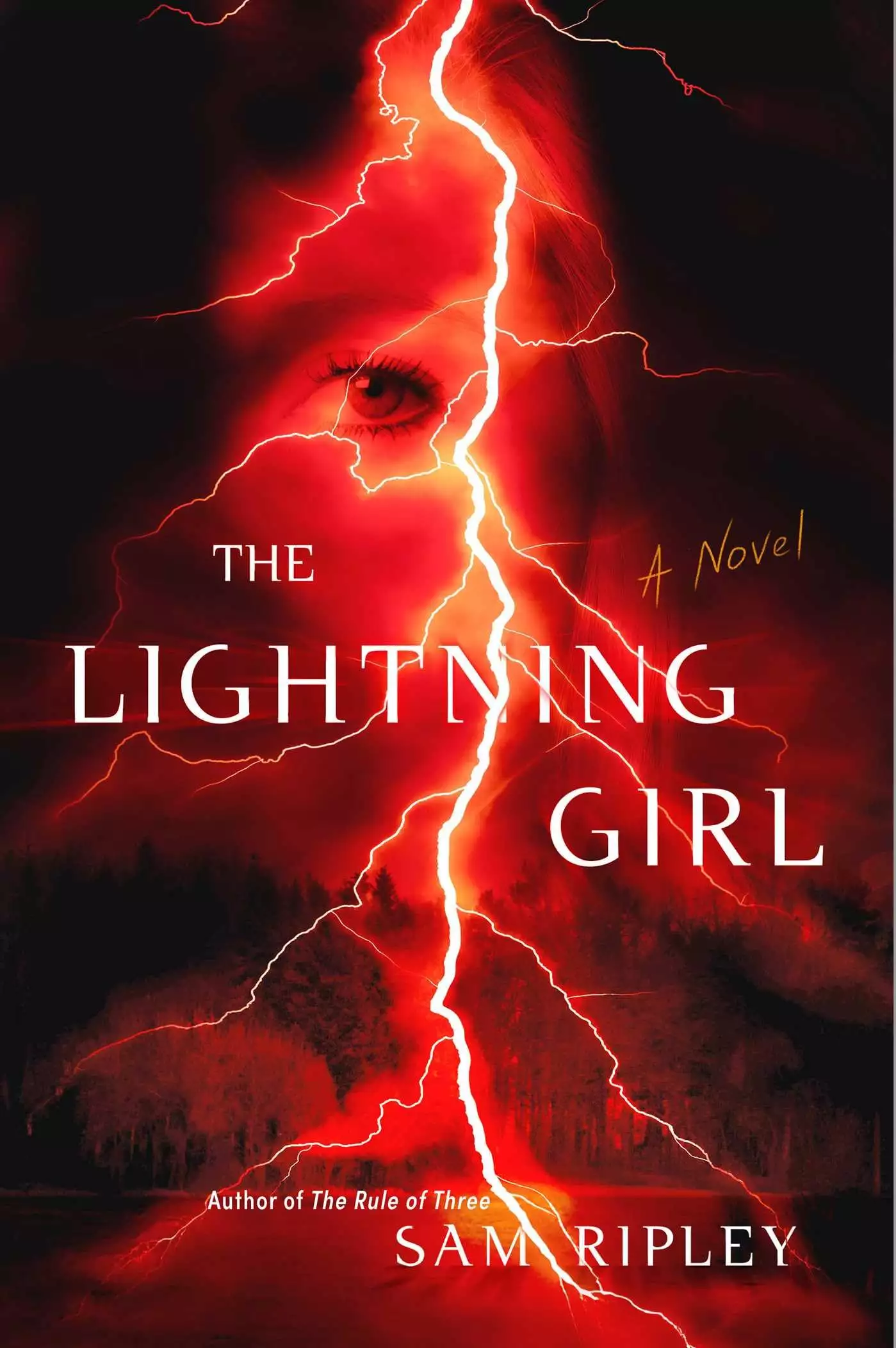
A woman searches for answers about a decades-old missing persons case in this chilling suspense thriller that is perfect for fans of Jennifer McMahon and Ruth Ware.
Thirty years ago, Sarah’s best friend Genevieve survived being struck by lightning. Already a self-proclaimed witch, she said the lightning gave her powers. A teenager’s sense of exaggeration, Sarah thought at the time. Now, returning to her coastal home town after decades away, she thinks about her friend more and more, especially the last night she was seen alive. Genevieve lived through the lightning strike but met her end when one night she slipped and fell off a cliff into an unforgiving sea. Or did she? After a terrifying vision of her dead best friend, Sarah feels Genevieve is reaching out to her for help and starts to question the narrative of events she has believed for so many years. Searching both her memory of that night on the cliff and uncovering new information that suggests Genevieve may have survived the fall, Sarah becomes determined to uncover the truth about what took place three decades ago. Because if her best friend didn’t die that night after all, what did happen to her?
Release date:
December 31, 2045
Publisher:
Atria/Emily Bestler Books
Print pages:
368
* BingeBooks earns revenue from qualifying purchases as an Amazon Associate as well as from other retail partners.
Chapter 1 CHAPTER 1 THE COTTAGE IS thin and old at the side of the lane. It looks like half a house, I think now, somehow smaller and feebler than the home in which I grew up. A swath of golden light paints one side of the cottage in the bright glow of the low sun, leaving the opposite side dark in purple shadows.
“Was it always this remote?”
My heart hammers.
Finches sing in the hedgerows, and high above, a crow caws as if in mockery of the noise of other birds below. No, I think. The crow isn’t mocking the finches; it is telling them to shut up. A grumpy old crow, then, and I find myself hoping the finches would sing louder. Put him in his place, I will them.
My pulse is still pounding as I remain utterly focused on this little moment of avian confrontation.
“What did you say, dear?” I manage.
“This isn’t just remote,” he continues to my surprise. “This is the end of the earth. I don’t remember it being like this.”
I turn to see Herry taking his time exiting the car. In part because he has to unfold his awkward teenage limbs out through a passenger door far too small for his lofty frame and in part because he’s expressing his displeasure with this whole adventure.
Upright, he turns on the spot to take in the environs. He gazes out across the adjacent fields to where more fields lie. Where there isn’t flowing rapeseed, there are cows. Trees in the distance.
I give him a huge hug, burying my face against his chest for as long as he can stand it.
“You used to like it here.”
“Before I knew better, maybe.”
“Think of it like inspiration,” I say, dabbing my eyes as I try to keep my voice upbeat and positive to counteract his surly adolescent tone.
“Inspiration for what?”
It’s a good question. “For you, for creativity. A whole summer away from home. That’s where you’ll find your muse, not in the ordinary, in the extraordinary.”
“Fields are extraordinary now?”
“Life,” I say, my tone refusing to accept defeat, “is about new experiences. That’s what you can write about.”
“A car crash is a new experience,” he tells me. “If we have one on the way home, I’ll write about that.”
So much cynicism in one so young.
“Can you just pretend?” I beg. “Just pretend you’re okay with this so we can get it done and return to normalcy?”
A limp teenage shrug. “It won’t be convincing, so why bother?”
I tell him, “When you were small, you’d light up like a Christmas tree when I made popcorn on the stove. You used to get so much joy out of such little things.”
“Corn is the least nutritious grain available,” he says, eyes still pointing anywhere except at his mother. “It’s basically poison.”
“Mummy, Mummy,” I say in a loud, childlike voice, “Mama, Mama.”
This sudden outburst finally drags his gaze back from the endless fields.
“That’s what you would say,” I explain, “when the kernels began to pop. You were so excited and wanted to make sure I didn’t miss a single one pop.”
His face is as blank as a robot’s, but somehow less human because I still remember how happy and expressive he was when he was younger.
“Your dad had to lift you on his shoulders so you could see them in the pan.”
“Sounds dangerous,” he says. “I could have had hot oil splash me in the eye.”
“I always kept the lid on.”
“Then how did I see them when they popped?”
He’s trying to catch me out in a lie like he’s a wily participant trying their damnedest to ruin a magician’s trick. Only this is no trick.
“It was glass,” I tell him, feeling smugger than I would like to feel, and yet this is still a victory.
“How convenient.”
He makes it sound like I’m making up details to strengthen an untruth, and against such adolescent mistrustfulness, there can be no winning.
“I give up,” I say. “But just know you’ll come back to me one day, and you’ll blush and feel embarrassed when I tell you about these kinds of conversations.”
His robot’s face finally becomes human once more, but only so it can look at me with an expression that says keep dreaming.
I try not to take such moments personally because I was probably the same with my own mother. In fact, I know I was the same. Not that I really remember such surliness, because when we’re pumped full of equal parts hormones and self-loathing, we think we’re the normal ones and everyone around us is weird. It’s a cycle that repeats with each new generation, yet somehow, every parent forgets they were precisely the same.
He’ll come back to me, I know.
I mean, I told him he would, and I told myself that because the truth is that by the time I was ready to come back to my own mother, it was far, far too late.
My face betrays my feelings and my sadness because I see in his eyes that he sees them too.
For the briefest, most beautiful moment, it seems he will ask me if I’m okay or say something sweet and comforting, but he looks past me to the cottage and trudges toward it.
“Let’s get this over with,” he grunts.
At least he doesn’t roll his eyes, I suppose. All his derision is communicated in words, so for that, at least, I should feel grateful. He doesn’t shout. He doesn’t swear. And I know—I mean, I hope—that deep down, he doesn’t hate me. If anything, I’m a nuisance. Someone who feeds him, clothes him, is always there for him, and in doing so, is a constant inconvenience to his quality of life.
I can handle being an inconvenience. I don’t mind being a nuisance.
I just want whatever feeling he is capable of, even if the way he feels toward me is little more than sneering ridicule, because that means he still cares, that the sweet little boy I raised is not wholly gone. That lovely little boy is merely hibernating, and a pimple-faced grizzly has awoken in his place… but one day, winter will be over, and the grizzly will pass by. Even as I think about it, I realize that all mothers must create such delusions to endure the agony of an empty nest.
No one tells us that the hurt begins long before the nest is empty.
We step inside my childhood home, and nothing will ever be the same again.
We hope you are enjoying the book so far. To continue reading...

 Please log in to recommend or discuss...
