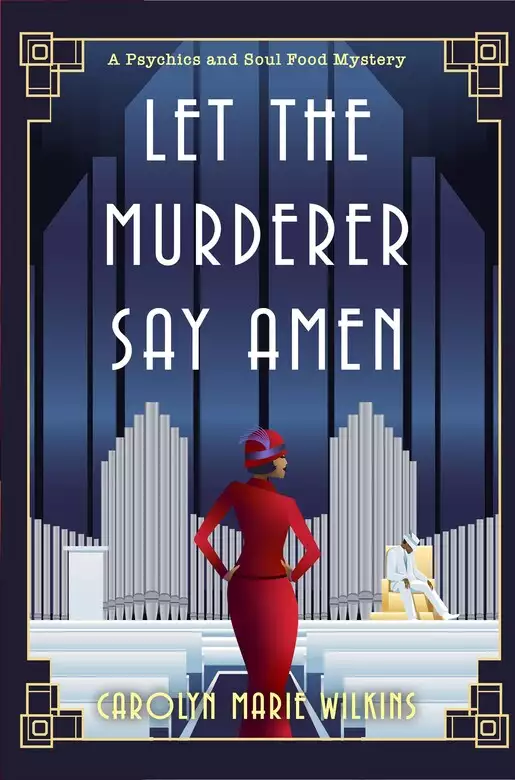
As prosperity and great cultural changes sweep across 1920s America during the Jazz Age, Nola Ann Jackson learns more about developing her natural psychic talents from her aunt—talents that prove crucial when she investigates murder in her Black community.
The people of Agate, Illinois, have welcomed Bishop Pius Amun Ra with open arms, flocking to become congregants of his Temple of Righteous Revelation. He has won over the hearts not only of the Black churchgoers, but of the city’s white political and wealthy elite. Bishop Ra is more than a preacher of the good word, he is a faith healer, blessed with the gift on the banks of the Nile during his youth in Egypt. His worshippers believe he can cure cancer—and even raise the dead. Sequoia LaMarche was saved by Bishop Ra, and the young white woman serves his church as a singer, receiving death threats for her efforts. Despite Ra’s protection, members of the Temple’s inner circle hold Sequoia in contempt, including bodyguard Sam Constant, who publicly accuses her of stealing money from the collection plate. After the confrontation, Sequoia’s murdered body is discovered, and Sam becomes the police’s number one suspect.
Nola is a good friend of Sam’s sister, believing he’s innocent. Guided by her psychic instincts, she conducts her own investigation, uncovering secrets about the Bishop and the people closest to him, including his wife. The leaders of the Temple are not as righteous as they claim. Their altruism masks sins they prefer buried. And when another murder occurs, Nola must unveil the killer before she becomes the next victim . . .
Release date:
July 28, 2026
Publisher:
Kensington Books
Print pages:
272
* BingeBooks earns revenue from qualifying purchases as an Amazon Associate as well as from other retail partners.
Minty Layton frowned and mopped the sweat dripping from her forehead with the sleeve of her DeLuxe Catering uniform.
“It’s hotter than burnt fish grease out here, Nola,” she said. “Cover those barrels of ice with a damp cloth and pull them underneath that tree a bit farther. Don’t want them melting before the afternoon is out.”
The barrels were already as far under the tree as they could go, but I’d worked at Minty’s catering company long enough to know it would be useless to argue. Minty Layton was one of the finest cooks in downstate Illinois, colored or white. Like many great artists, she was prone to fits of temperament before important events.
“Yes, ma’am,” I said, and tugged the sweating wooden barrels an inch or two farther into the shade.
Every year on the third Saturday in June, the Negro Business Association organized a parade to celebrate our emancipation from slavery. For colored folks in Agate, Illinois, the Emancipation Day Parade was the most important event of the year. The parade for 1924 promised to be the biggest spectacle yet. There would be marching bands, colorfully decorated floats, and scores of uniformed marchers representing every Negro church and social organization in the city.
People from miles around would be thronging Agate’s colored business district to see the parade make its way down Lincoln Avenue. Since DeLuxe Catering was the only catering company in Southern Illinois owned by Negroes, the food we sold at our roadside table needed to be beyond reproach.
Though it was only ten o’clock in the morning, the day had already begun to heat up. Sweat ran down the back of my neck as I helped Minty position two long tables next to the sidewalk and cover them with a checkered oilcloth.
“Hurry up with those Dixie cups, Nola,” Minty snapped. The colors in her aura flashed red, then orange as she spoke. My psychic senses were letting me know in no uncertain terms that Minty’s anxiety level was escalating. “In this heat, folks are gonna get thirsty mighty quick,” Minty continued. “We need to be ready.”
When Minty was in this kind of mood, the best thing for me to do was to remain as calm as possible. Once we’d sold some of the fried catfish sandwiches and red velvet cupcakes we’d brought, Minty would relax, and the nervous colors flashing in her aura would settle down.
“Yes, ma’am,” I said. “I’ll get on it right away.”
I am a psychic. Although I’ve seen auras all my life, I never knew what they meant until I moved in to live with my Aunt Sarah. My aunt is a master psychic with a deep knowledge of herbs, charms, roots, and potions. She runs a thriving hoodoo conjure business out of her home, providing healing and psychic advice to colored and white folks alike. When I wasn’t working for Minty and her husband, Edward, at DeLuxe Catering, I helped my Aunt Sarah with her conjure work.
Slowly but surely, she’s teaching me how to harness my psychic abilities. I’m learning to better understand the auras I see around people and make sense of the crazy buzzing sound I hear when I get a strong intuition about something. My skills are still very much hit-or-miss, of course, but I’m improving day by day.
“We’ve got to get a move on,” Minty said, tilting her chin toward the gathering crowd of colored folks in cotton frocks and overalls positioning themselves along the sidewalk. “Bring me a tray of sandwiches from the truck. We don’t want to lose a single customer.”
I brought out the sandwiches, wrapped each one in wax paper, and arranged them in what I hoped was an attractive-looking pyramid on the table.
“Hurry, Nola,” Minty barked. “Help me with this damn display case.”
Minty and I straightened the glass-fronted display case a fraction of an inch to align it dead center on the table. When she was satisfied with its position, she slid a tray containing two dozen freshly baked red velvet cupcakes from the metal rack behind the table and lovingly arranged the cakes one by one inside the display case. In keeping with the Emancipation Day theme, each of Minty’s bright red, light-as-a-feather cupcakes was decorated with stripes of blue and white icing and topped with a miniature American flag.
Minty stepped back to survey her handiwork and permitted herself a small smile. “Not bad, if I do say so myself,” she said. “Fetch the sign from the truck, Nola. Put it in front of our table so people can see it.”
Hands on her hips, she watched closely as I taped the carefully lettered sign to the front of the table:
DELUXE CATERING COMPANY—BEST SOUL FOOD IN SOUTHERN ILLINOIS
FRIED CATFISH SANDWICHES WITH ALL THE TRIMMINGS
FRESH SQUEEZED LEMONADE AND EMANCIPATION DAY CUPCAKES
By eleven o’clock that morning, there was not a square foot of empty space along the parade route.
Cheering crowds, supervised warily by a group of uniformed policemen, lined the sidewalks on both sides of the street. Children waving miniature American flags shrieked with excitement, as the grown-ups jostled among each other to get the best view. Minty and I could not yet see the parade, but we could hear it approaching. The thump of the bass drum and the blare of a high-pitched bugle grew louder with each passing minute.
“Sounds like Hank Spivins and the Carbondale Brass Band,” I said. “I hear they’re facing stiff competition this year.”
“The Temple of Righteous Revelation has put together a crack outfit,” Minty told me. “They can play anything from light classics to ragtime.”
“Is that the new church up on Tower Street? I’ve heard their preacher can heal the sick. Some folks say he can even raise the dead.”
“He calls himself Bishop Ra,” Minty said. “Wears an Egyptian robe and drives a Cadillac limousine. Can you imagine?”
“I read about him in the Agate Daily Chronicle,” I said. “The article says he was born in Egypt.”
“Egypt, Mississippi, more likely,” Minty said, laughing. “He’s paying us top dollar to cater a dinner for his followers after the parade. While you’re serving the food, you’ll get a chance to see the bishop up close and personal. Meanwhile, go and fetch some more cupcakes from the truck. This batch here is gonna go like hotcakes.”
For the next hour, Minty and I kept busy doling out sandwiches, cupcakes, and lemonade. I’d just finished selling a large Dixie cup full of lemonade to a sweating passerby when I spotted Eleanor Constant pushing her way through the crowd thronging the sidewalk.
“I’ve been looking all over for you,” she said. “I figured you’d have a table along here somewhere.”
Eleanor was the head librarian at the Douglass Branch Colored Library. She was elegant, funny, and dressed to kill in a fashionably short blue dress and straw bonnet.
“I’ll take a pink lemonade, if you please,” she said and plopped a nickel on the table in front of me.
I slid her nickel back across the table. “Lemonade’s on the house today,” I said. “How’s things? The library keeping you busy?”
“The Negro Writers Circle has been meeting every night for the past month,” she replied. “Did you know we’re putting out a poetry magazine in July?”
I laughed. “It’s the only thing Ben talks about these days. That is, when he comes up for air long enough to talk to me at all. I haven’t seen him in days.”
Ben Langford was a brilliant writer, possibly even a genius. He was also the current man in my life. When Eleanor introduced us two years ago, I’d recently moved back to Agate from New York City after losing my husband in the war. I was new in town, desperately lonely, and eager to get on with my life. The minute we met, Ben pursued me with passionate intensity.
To say that our relationship was tempestuous would be an understatement. Ben just turned twenty one, and is nearly four years younger than me. After a brief stint at Atlanta University, he returned to Agate and took up residence in the attic of his mother’s house on Upper Fifth Street. He’s a hopeless romantic, an absent-minded dreamer with a penchant for Shakespeare. He can be maddeningly childish, forgetful, and ridiculously self-centered. On the bright side, Ben is also sweet, sincere, and sexy as hell.
Thinking about the way his hands felt against my skin made me aware of a heat that had nothing to do with the temperature.
“Tell me about you, Eleanor,” I said, hastily changing the subject. “Still dating that rascal Jim Richardson? Please tell me you’ve kicked him to the curb.”
Now it was Eleanor’s turn to blush. Jim Richardson worked as a recruiter for the Negro Voters League. He was tall, with a smooth caramel complexion and a courtly manner that drew women to him like flies to honey. Jim and I had a brief fling two years ago. A fling that ended the day I caught him in the arms of another woman. Eleanor knew all about Jim’s philandering ways, but insisted they didn’t bother her.
“Jim and I are grown-ups,” she told me. “Our relationship is not serious. Just two lonely people out for a little fun.”
I shot her a skeptical glance. “You’re happy with that?”
“Between the library, my friends, and the Negro Writers Circle, I’ve got no time for a committed relationship,” she said. “The last thing I need is a man who expects me to iron his shirts and cook his dinner. I’m happy with things the way they are, Nola. Jim has his freedom, and I have mine.”
I suspected my friend was just fooling herself, but I didn’t want to push it. It was, of course, none of my business anyway.
“I can’t wait to see the floats in this year’s parade,” I said. “Everybody is talking about the one Bishop Ra’s temple has put together.”
“That church has more people marching than any other group,” Eleanor said, “a fact that has upset some of the other churches in town.”
“The Temple of Righteous Revelation is less than two years old,” I said. “Folks around here are not crazy about new people moving in and upsetting traditions.”
“A few pastors sent a formal objection to the Parade Planning Committee,” Eleanor said. “They changed their tune when they found out R. L. Williamson was the bishop’s biggest donor.”
“The steel magnate?” I said. “Why on earth would R. L. Williamson care about the Temple of Righteous Revelation?”
“His wife contracted a rare form of cancer,” Eleanor said, leaning in close to be heard over the blaring of the Carbondale Brass Band as they marched past. “He took her to one of Bishop Ra’s healing services. She has apparently made a complete recovery.”
I whistled softly. “Sounds like some kind of fairy tale,” I said. “Almost too good to be true.”
“Definitely too good to be true,” Eleanor said sourly. “People will believe almost anything these days. R. L. Williamson was so grateful that he donated one of his properties to the temple.”
“That’s how they got their new place on Tower Street?”
“Exactly,” Eleanor said. “A rags-to-riches story if there ever was one. They’ve built a fancy new sanctuary on the ground floor, with living quarters for the bishop and his close associates on the top two floors.”
“You seem to know an awful lot about these folks,” I said. “Are you a member?”
“Of course not,” Eleanor said, laughing. “That honor belongs to my brother, Sam. He’s head of the bishop’s security detail. Can’t say I’m happy about it, but that’s the way things are.”
Eleanor and I stopped talking to watch the marching band from Agate Colored High School strut past, blaring an off-key rendition of John Philip Sousa’s “Stars and Stripes Forever.”
Next came a contingent of colored war veterans, many still in uniform and waving flags as they marched in formation. The Agate chapter of the Women’s Christian Temperance Union came next. Marching in tight rows behind two women carrying a large banner that read W.C.T.U. 1924 - GIVE PROHIBITION A CHANCE, thirty women in matching white blouses and ankle-length blue skirts smiled and waved to the crowd.
As the last of the women passed by, a flatbed truck sponsored by Mount Moriah, the largest colored Baptist church in town, rolled into view. Festively decked out in red, white, and blue bunting, the truck carried Mount Moriah’s pastor, who waved to the crowd while a small brass band in sober black suits blasted out a rousing version of “Down by the Riverside.”
When the song was over, Minty wiped her hands on her apron, pulled an empty milk crate from under the table, and sat down next to us with a satisfied smile.
“We are officially sold out of sandwiches,” she announced. “Just in time to see Bishop Ra’s people march by.” Three white horses ridden by somber men in purple and gold uniforms pranced down the street, their manes braided and their reins dripping with gold tassels. The men sat straight and proud in the saddle, the gold braid on their uniforms sparkling in the afternoon sun. Fifty female members of the group, clad in white from head to toe, marched in formation behind them.
“These ladies look like they’ve been practicing this drill for weeks,” Minty said appreciatively.
“When the bishop tells his people to jump,” Eleanor said, “the only thing they ask is ‘how high?’ Temple members are expected to give the bishop their money, their property, their love, and their time. He demands absolute loyalty from his people, and, apparently, he gets it.”
Minty cocked her head and studied Eleanor for a minute. “You don’t like these people, do you?” she said.
“No, I don’t. Unfortunately, I can’t say the same for my brother.” Eleanor’s customarily cheerful aura turned gray and heavy. “Sam is a true believer. He had a serious drinking problem when he came home from the war. He’d wake up with screaming nightmares every night. Liquor was the only thing that seemed to calm him. One night, he went to a healing service at Bishop Ra’s temple. He hasn’t touched a drop since.”
“Maybe the bishop really does have healing power,” I suggested. “It’s not impossible.”
Minty poked me in the ribs. “You should know, Nola. You’re the psychic. I’m counting on you to tell me if Bishop Ra is the real McCoy or not.”
“I’m just a beginner,” I reminded her. “Sometimes I can see things, and sometimes I can’t. If you really want to find out about Bishop Ra, you’ll have to ask my Aunt Sarah. She’s the expert.”
The last of the women from the Temple of Righteous Revelation marched past us, their white dresses shining in the noonday sun. They were followed by a marching band decked out in tall black hats and purple uniforms with the interlinked letters RR embroidered in gold across the front. To Minty’s delight, the group stopped directly in front of us and launched into a virtuoso performance of Rossini’s “William Tell Overture,” followed by a version of “The Battle Hymn of the Republic” that had the crowd singing along.
“What did I tell you?” Minty exclaimed. “Professional-caliber musicians. What a show!”
“You ain’t seen nothin’ yet,” Eleanor said drily.
An enormous purple Cadillac touring car rolled into view. Flanked on both sides by somber bodyguards in black suits, the car had its top down and was driven by an elderly Negro man in a white chauffeur’s uniform.
In the back seat of the Cadillac sat a large man of indeterminate age. He had caramel-colored skin, a high forehead, and a prominent nose. He wore a white Egyptian robe, a gold turban, a sparkling gold chain, and a ring on every finger. Next to him sat a diminutive high-yellow woman in a white turban, diamond earrings, and a white evening gown.
As the Cadillac’s pace slowed to a crawl, the couple smiled and waved to the crowd.
“See that man?” Eleanor said, pointing to a well-muscled man perched on the running board of the car. “That’s my brother. Sam—or Lieutenant Sam, as he calls himself now.”
“Handsome,” Minty said approvingly. “He married?”
“Married to his job,” Eleanor said. “We used to see each other at least once a month. Now he hardly ever visits me. Sometimes I wonder if Bishop Ra has done something to his mind.”
“He’s probably just busy,” Minty said soothingly. “I bet he stops by the minute this parade is over with.”
“Minty’s right,” I added. “Right now, Sam must have his hands full. According to the Agate Daily Chronicle, the temple’s membership has tripled since Mrs. Williamson received her healing.”
“All the more reason to worry,” Eleanor said grimly. “There’s an element in town that’s dead set against having an interracial church in Agate.”
Minty and I absorbed this news in silence. The influence of the Ku Klux Klan had weakened since the arrest and conviction of the state’s top Klansman on rape charges last spring. Agate’s Mayor, Edwin Hyland, was vigorously opposed to the group. Still, no one doubted that the Klan remained a force to be reckoned with.
“I hope there’s not going to be any trouble at the bishop’s banquet tonight,” Minty said with a frown. “Trouble is very bad for business.”
At that moment, the purple Cadillac pulled to a stop directly in front of us. As the crowd shouted with approval, Minty and I craned our necks and stood on tiptoe to get a better view.
“Blessings of healing be upon you,” Bishop Ra proclaimed and raised his arms heavenward.
Minty poked me in the ribs. “Put some hoodoo on the man so he behaves himself, Nola. We’re being paid a lot of money to cater this dinner tonight. I want everything to go off brilliantly, without a single hitch.”
The bishop, watched over carefully by Eleanor’s brother and his cadre of bodyguards, continued to offer his benediction to the crowd. “Peace,” he said in a loud, resonant voice. “Peace and blessings to you all. Peace.”
The sound of a sharp crack rent the air.
A man pointed across the street toward the Commerce Insurance Building. “Up there,” he shouted. “On the roof! There’s a gunman up there.”
Crack. Crack. Two more shots rang out.
Eleanor’s brother dove into the purple Cadillac. He pushed the bishop to the floor and covered him with his body. Horn blaring, the bishop’s car accelerated and careened down the nearest alley, sending marchers and onlookers scattering in all directions.
Musicians in purple uniforms dropped their instruments and dove headfirst into the crowd. Terror-stricken groups of onlookers ran pell-mell down Lincoln Avenue, knocking over the reviewing stand and the row of wooden sawhorses that lined the avenue. Children screamed and clutched the hand of any adult they could find to avoid being trampled underfoot in the pandemonium.
A squad of uniformed policemen pushed through the crowd and charged toward the Commerce Insurance Building with their pistols drawn.
For a split second, I stood stock-still, unable to comprehend the chaotic scene exploding all around me.
“Get down!” Eleanor shouted. She grabbed my hand and pulled me underneath the long wooden table we’d been using to display our wares.
Minty Layton, her face an odd mixture of terror and determination, ran toward the cash register.
“Never mind that now, Minty,” Eleanor shouted. “Get down!”
With a grim smile, Minty opened the cash register and stuffed a wad of bills down the front of her dress. Then, with a satisfied nod, she crawled under the table to join us.
For the next several minutes, we waited. Sirens wailed as more police arrived. No further shots were heard, and the panic-stricken screams of the parade goers gradually died away.
When it sounded as if the chaos had died down, the three of us crawled out from under the table, brushed off our dresses, and took stock of the situation. The glass display case lay in pieces on the ground. Paper plates and cups littered the sidewalk like confetti. The ice chest lay on its side, pouring a river of lemonade into the gutter.
“What a mess,” Minty said, shaking her head in disgust. “I suppose it could have been worse. The good dishes we need for tonight’s banquet are already over at the Prince Hall Masonic Temple.”
Eleanor picked up our battered DELUXE CATERING sign and placed it on the table. “I can’t imagine they’ll go ahead with the banquet now,” she said. “We don’t know if Bishop Ra is alive . . .
We hope you are enjoying the book so far. To continue reading...

 Please log in to recommend or discuss...
