
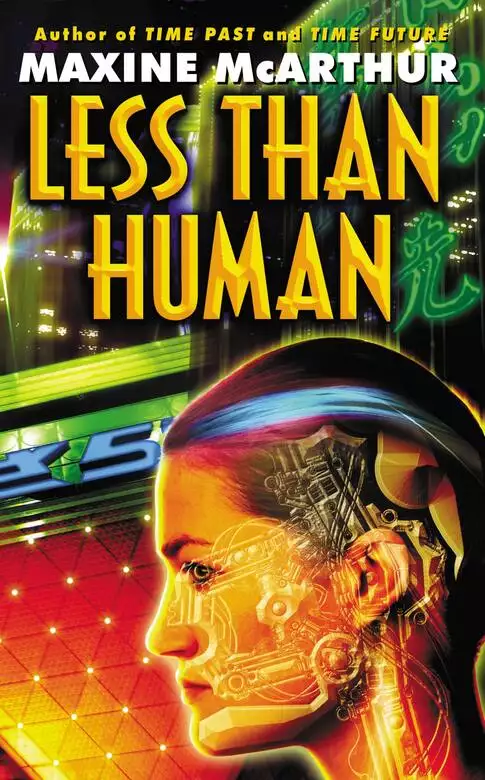
Less Than Human
- eBook
- Paperback
- Book info
- Sample
- Media
- Author updates
- Lists
Synopsis
When a factory worker is mysteriously killed by a robot, cybernetics engineer Eleanor McGuire is unwilling to call the incident "human error." In a different part of Osaka, four teenagers are electrocuted in an apparent group suicide, and Police Inspector Ishihara isn't convinced it was self-inflicted. When their investigations cross paths, the foreign scientist and the aging cop find a trail that will lead them to more murders, corporate crime, and a strange online cult led by a secretive guru who promises immortality to his followers if they help him destroy civilization. But how can McGuire and Ishihara stop this psychopath if he doesn't seem to exist?
Release date: June 27, 2009
Publisher: Grand Central Publishing
Print pages: 400
* BingeBooks earns revenue from qualifying purchases as an Amazon Associate as well as from other retail partners.
Reader buzz
 Please log in to recommend or discuss...
Author updates
Less Than Human
Maxine McArthur
the multistoried residential complexes that were transforming the cityscapes of Japan. The size and cleanness of the Betta
set it apart from the corrosion black concrete, sagging wires and ad-lib extensions of the old town. Here, it declared, is
the future.
As if the sight of the Betta were not advertisement enough, vid panels on every street corner extolled the advantages of living
there. No more tiny apartment crowded with junk, burbled the vid, as cinematographically superb shots of the Betta interior
rolled past on the screens. Get rid of all those appliances. In the Betta, the world’s first totally integrated living environment,
everything is built-in. Streamlined rooms with robotic helpers and digitally controlled shopping, cooking, and cleaning will
simplify your day. You can relax in one of the rooftop gardens or browse through the internal shopping mall if you get sick
of ordering your groceries online. Buy your piece of comfort and security now, before interest rates rise!
The late-afternoon sun beat down on four teenagers hurrying past the now-unused train station and through the deserted streets
in the old town. The teenagers were students, by the look of their bright clothes and the phone implants glinting in their
hair. They carried bulging supermarket plas-bags. They bustled past the grimy doorways, along the neat concrete paths and
landscaped gardens surrounding the Betta, and entered the main building.
They must have been residents at the Betta, because the elevator doors in the main lobby read their microchips, opened for
them immediately, and took them up to the sixth floor. They whispered as they walked down the corridors, nudging one another
uneasily past the closed doors that contained families eating meals, children doing homework, mothers scolding babies, dying
grandmothers, and who knew what else, for Betta walls were soundproof; past a couple of cleanbots, like automated vacuum cleaners
humming along the corridor walls; past the wall holos showing peaceful summer scenery, until they reached their apartment
door. They tumbled in, and the door swished shut behind them.
“I’m worried.” The shorter of the two girls lifted her plas-bag onto the kitchen bench and looked anxiously at the others.
“Niniel-sama asked me why I had to visit home today. I felt so bad lying to him.” She wore a short, sleeveless dress made
out of squares of different pink fabric. As she was round and tiny, the effect was of an animated patchwork cushion.
“He asked all of us,” said the boy with a line of nose studs and bronze circles of tattoos on his cheeks. He was all knees
and ankles, as some boys were. “That’s why this weekend was such good timing. Bon holidays give us the perfect excuse.”
“What if they find out?” the short girl persisted.
The other girl, tall and narrow-hipped, began to unpack groceries. Her green-checked trousers and white shirt were wrinkled
and stained as though she didn’t worry about appearances. “Tomoko, if you don’t want to do it, go back.” She called out to
the other boy who was in the living room. “I didn’t think we’d be able to get in here. How did you float the ID so the system
listened to us, Dai?”
“Easy,” the boy named Dai called back. “I just told Iroelsama…”
“But he’ll tell Niniel!” wailed the short girl, Tomoko.
“No, he won’t. I said I wanted to take some things I’d left at my uncle’s place, but my uncle doesn’t approve of the Children,
so I had to get in while he’s away.”
“This isn’t really your uncle’s place, is it?” said the slim girl uneasily.
“No, of course not.” Dai chuckled. He was small and sturdy, with a round face that looked too large for his body. “The owner’s
on our movie chat group, and he told us he was going away. Used his e-mail addy as an alias, would you believe? I traced him
from that.”
The boy with the tattoos raised his hand solemnly. “Hey. Before we start—no matter what happens, we keep this secret, right?”
The girls nodded, and Dai said, “Right.”
“And it’s not like we’re doing anything wrong,” added the tall girl. “We’re just practicing early so that when we get to be
novices, we’ll be really good. Right, Tsuneo?”
The boy with the tattoos nodded, although his expression was uneasy.
They ate the noodles with absentminded haste, then gathered in front of the wide computer/vid screen in the living room. The
short girl passed around blue capsules, which they all swallowed.
The gawky boy with the studs and tattoos, Tsuneo, rummaged in a stylish backpack.
“Who’s going first?” He held up two spray cans.
“Do we have to do the paint?” the tall girl complained. She tugged at the neck of her T-shirt as though it was too tight,
then reached up and pulled off her hair, tossing the wig onto the sofa with a flourish. Her head was shaved smooth, except
for a gleaming phone implant.
“I thought we agreed,” said Dai. He was squatting in front of the computer panel in the riving room wall, attaching wires
to its external ports. “To get into the spirit of the thing.”
Tomoko giggled and snatched one of the paint cans. “I’ll go first. But you have to promise to go next, Dai.”
Dai shrugged. “Whatever.”
“Are you sure it’s safe?” The slim girl watched Tomoko disappear into the bathroom.
“Lissa, it’s the stuff they use in the theater.”
Lissa pouted. “I want to have incense, too.”
“We didn’t bring any.”
“Why not?”
“Why do you always argue when you’re high?”
They grumbled at each other until Tomoko came out of the bathroom, carrying her pink dress and hiding her silver-painted body
behind a towel. Dai went next, then Tsuneo, then the tall girl Lissa. By that time they had abandoned the towels and were
all giggling at each other’s silver nakedness.
“Tomoko and I go first, like we decided.” The boy Dai, gleaming like a stocky gnome, knelt in front of the monitor and fitted
biometal attachments onto his fingertips.
“Is that what the novices use?” Wide-eyed, Lissa watched Tomoko do the same.
“They get permanent ones,” said Tsuneo.
Wires ran from the fingertip attachments to the wall computer and also to some hand computers they’d brought with them.
“Are you ready?” Tsuneo said, his hand on the start switch of one of the handcoms.
Little Tomoko coughed. “Can you turn the aircon colder, Tsuneo? I’m really hot.”
Lissa nodded. “Yeah, it’s making me breathless…” She pushed herself back on her heels, one hand to her throat.
Tsuneo clicked the air conditioner right down.
“Come on, you guys, let’s get going…” Dai clutched his chest midsentence. “What’s… wrong?”
“I haven’t started the program yet…” Tsuneo’s voice dissolved in paroxysms of coughing. He started to crawl to the kitchen
for water, but his breath ran out and he couldn’t find more. The last thing he heard was Lissa’s choking cry as she fell.
The last thing he thought was, What did we do wrong?
To: E. McGuire, Mechatronics Research, Tomita Electronics Co.
Sender: A
Subject: Re: catching up
Eleanor-san
I am glad that you found ray notes on artificial synapses interesting. I have been engaged in some private research on the
matter and believe that my “angle” is one that will provide scope for further development. I would like to discuss this personally
with you in the near future. You tell me that your current integrated systems project will be reviewed soon. Perhaps after
that? I can take leave and come to Osaka, so tell me when I should book the train.
Eleanor blanked her personal com screen with a frown. Akita’s requests for a meeting were getting hard to ignore. She hadn’t
seen him since he left the company, twelve years earlier, and that was how it should stay. He’d given her a couple of ideas
to use on her robot, but he’d always struck her as being a little too on edge, even in those days. The last thing she needed
now was to be distracted by personal relationships. Not now that she was close to results with the Sam project.
The robot Sam had four gangly metallic limbs, an almost nonexistent trunk, and an oversized, upside-down triangular head with
huge camera eyes. Multicolored wires twisted in and out of the limbs, and its battery pack gave it a hunch. But it stood by
itself and was learning to navigate. She wanted it to walk across the room and pick up a beaker from the bench. It should
recognize the bench on the far side of the lab from the perceptual map she’d helped it build over the past two years.
One foot rose slowly, moved forward, and descended again. Then that pendulum became the fixed point, and the other leg swung
forward. The robot took three more steps. It stood next to the bench.
Pick up the beaker.
She imagined the order as a liquid, flowing through the silicon synapses and pushing the robot irresistibly toward its goal.
Its eyes found the beaker on the bench top.
Pick up the beaker.
In her chair on the other side of the lab, Eleanor wiped sweaty palms on her trousers. The robot had to work out how to do
it by itself.
Its arm extended. The three-fingered hand opened, reached out.
The fingers would curl around the beaker, and data from its surface would pass through the haptic sensors, through the synapses
into the tapestry of artificial neural networks that determined reaction, all in an infinitesimal amount of real time. I feel,
therefore I am. I act, therefore I think…
The phone buzzed.
Eleanor spun her chair and glared at the source, the wall unit near the lab door. Not more interruptions…it was a holiday.
Why couldn’t they let her work?
It was Saturday of the Bon holiday week in mid-August, the slowest day of the year. Most Tomita Electronics staff were either
at home or visiting relatives in the country. But the blasted building sensors knew her employee microchip was in the lab.
Eleanor pushed her chair back, slowly, so as not to distract the robot, and tapped the RECEIVE button. The readout of the dialer’s number below the screen showed an internal line, Public Affairs.
“McGuire here.” She didn’t bother trying to sound civil.
“This is Degawa.” The screen showed a swarthy man of about thirty-five wearing, a long-sleeved white shirt in spite of the
heat. His voice sounded vaguely familiar. “Public Affairs Department,” he added unnecessarily.
She remembered Degawa. A year ago he had helped her conduct a press conference when her department failed to win a government
grant. His job was to act as a buffer between R&D departments and the rest of the world.
“We have a situation,” he said, now using formal speech. “I’ve called the division chief and the managing director, but they
won’t be able to get back to town until this evening.”
“What’s the problem?”
“There’s been a fatal accident. With one of our robots.”
Her cheeks went cold, and all she could think to say was, “Where?”
“A factory in Minato Ward. Kawanishi Metalworks. It seems advisable that you attend.” There was a sheen of sweat on Degawa’s
otherwise impassive face.
Eleanor knew how he felt. The room felt suddenly hot, despite the air-conditioning. She wiped her palms on her trousers. “But
I don’t do industrial robots now. You want Number Four Lab.”
“There’s nobody at Number Four.” Degawa’s formal verb endings had dissolved, and his voice held a hint of panic. “You worked
on this robot. Your personnel data is linked to the relevant research records.”
Degawa didn’t want responsibility for this. He expected her to waste time going out to a factory in one of the hottest parts
of the city because some idiot had ignored safety warnings … Then she felt ashamed at the thought.
“You’re the most senior staff here right now,” he said, as if that decided the matter.
There was a clunk behind her. She turned and saw the robot sweep its hand along the bench top in search of the beaker that
was rolling at its feet.
“Damn,” she said in English.
“I beg your pardon?”
“Nothing.” She’d have to take the robot back to the beginning of the sequence. “When did it happen?”
“They think it must have been early this morning,” said Degawa. “A security robot found the body on the factory floor. It
raised the alarm; the company called an ambulance and the shop manager. The manager called his superiors, and they notified
us.”
“What about the police?”
“The manager said the police response team called an engineer. The engineer said it was clearly human error, and they logged
it as an accident. There’s still one constable there until the local station clears the scene.”
Degawa sounded smugly sure of his facts. Good that the police had finished—Eleanor didn’t want detectives staring at her while
she checked the robot.
“Was the dead man …” She would have liked to use more than the bare phrase, but couldn’t remember an alternative. It wasn’t
a word one used every day. “Was he operating the machine or trying to fix it?”
“I don’t know the details. But protocol demands that we recall the robot and issue an official message of condolence.”
The first part of that job was hers, and the second Degawa’s. She hoped she could take one look at the scene and approve the
recall; otherwise, she’d be contradicting the police report, and goodness knew what kind of protocol that would offend.
Degawa’s eyes met hers briefly, then glanced politely away again. “Supervisor, I realize you are probably aware of the rules,
but you will forgive me reminding you that you should not speak to the press about this accident. The company will make a
statement tomorrow.”
Eleanor tried not to let her annoyance show. “I know the rules. How soon should I go?”
“I have just ordered a taxi for you. Please send a copy of your report to this office as well as to the director’s office.”
He inclined his head at exactly the correct angle and the screen went blank.
Eleanor sighed. Degawa was right, she’d worked on industrial robots when she first came to Osaka and joined Tomita. Worked
on them with Akita, in fact. But that was fifteen years ago. And how could there have been a fatal accident if the factory
followed safety regulations? If they hadn’t, it wasn’t her company’s problem.
She’d never seen a factory accident that wasn’t due to human error. Someone had ignored barriers and warning signs. Or a maintenance
technician tried to do too much.
She picked up the beaker and paused the robot. It didn’t seem to be processing its sensory input efficiently. They had to
do something about the reactions, and quickly. On the wall above the bench, an old-fashioned paper calendar showed a red circle
drawn around next Tuesday. Her project was due to come before a budget committee that was looking for projects to ax.
The hints she got from Akita offered some prospect of development in this area, but they didn’t have enough time to go back
and redesign sensors. It was Saturday afternoon now, which didn’t even leave enough time to polish a different sequence. They’d
have to stick with the walk-and-pick up, but maybe try something easier to grasp, like a soft toy.
She patted the robot on its unwieldy head. It was just the right height to pat, about that of a five-year-old child.
“It’s not your fault.”
As Eleanor got out of the taxi a wall of heat hit her in the face. Gasping and squinting against the late-afternoon glare,
she looked around. The taxi pulled away from a gate set in a two-meter wire fence. A metal plate set in the post beside the
gate said KAWANISHI METALWORKS INC. EST. 1954. The whole area was full of large blocks of sprawling factories, and the air smelled thick and metallic. It smoked gold as
the sun lowered.
She rarely went outside these days, and certainly not in the heat of the day. Tomita Corporation was linked by rail to the
Amagasaki Betta, where Eleanor and most of the researchers lived. Everyone used either subway or skyway connections. She hated
being driven. It made her sweat with nervousness, even if the car was in autodrive.
The taxi honked farewell at the end of the street. The driver, released by autodrive from the irksome task of actually watching
the road, had talked to her constantly, demanding the usual personal information—where she came from, why she worked in Japan,
whether she was married, how she learned Japanese, was her red hair a natural color, why was she carrying a tool kit and hard
hat … Eleanor had exhausted her store of stock answers and was reduced to brusqueness.
In a side street opposite the factory some of Osaka’s huge homeless population camped in lines of blue vineel tents. Nobody
moved near the tents, which stood in the shade of the buildings. Everything else was gray concrete, baking in the heat. Osaka
even looked gray from a distance—gray angles stretched from horizon to horizon, fading into a gray haze broken only by the
immense, squat silhouettes of Bettas.
The town always looked gray outside the Bettas. Eleanor could remember when nearly every street in Osaka was like this—dirty,
colorless, treeless. The Great Tokyo Quake of 2006 had been a terrible thing, but life for ordinary Japanese had certainly
improved afterward. Who wouldn’t prefer to live in a temperature- and humidity-controlled environment with autocleaning facilities?
Not to mention the smart appliances. Total Interactive Environment, they called the Bettas.
Eleanor wiped sweat clumsily from her upper lip with the hand that held her hard hat and wished she was home in her Betta.
She could feel her fair skin frying.
After the Quake, the government and big business had teamed up to initiate the Building for Life Plan, or “Seikai,” as it
was commonly abbreviated, for the Japanese archipelago. No more unplanned, disaster-prone development. All Japanese would
live in safe, self-contained minitowns connected to fast transport networks. Bettas, they called the huge complexes. A Betta
Life for All. Which was fine in Tokyo, which had to be rebuilt from the sewers up anyway; but in Osaka, the Seikai plans had
not progressed as far or as comprehensively. Bettas and the new train networks coexisted uneasily with remnants of the old
city.
The Kawanishi factory gate was latched, but not locked. There was an intercom unit set on one of the gateposts, but it remained
silent when she announced herself. Inside the courtyard she could see a blue-and-white police car parked against a single-story
building, and a uniformed policeman waited at the entry. He stared at her with official impassivity but his eyes registered
every detail of her face, hair, and body.
Sometimes she thought she didn’t care, but just then it fed her frustration. People never used to stare so much. Since the
U.S. closed its borders and the European Union began to regulate foreign travel, white foreigners were as rare as when she’d
first lived in Japan as a child.
Eleanor inclined her head as much as she could be bothered in the heat. “I’m from Tomita Electronics Corporation,” she said.
“The makers of the robot involved in the accident.”
The constable’s round, red face dripped sweat as he nodded. That dark blue uniform must be stifling. “They’re expecting you.”
He opened the steel door of the building.
It was even hotter inside. Lights blazed along the ceiling, and the place stank of metal. A large poster on the wall next
to the door showed a rotund blue cartoon cat brandishing a hard hat. Safety First Don’t Forget Your Helmet said the speech balloon. Eleanor settled hers onto her plait obediently.
The ovenlike air was ridiculously nostalgic. Life had seemed simpler when she worked on industrial robots. It was easier to
believe such robots made a difference to people’s lives. Eleanor had worked on an assembly line when she was a student, and,
as far as she was concerned, the robots were welcome to it.
The rows of machines were silent and still. Voices echoed at the other end of the floor. That glassed-in cubicle on the wall
at the other end of the factory would be the control room. Banks of computer monitors were visible through the glass, and
two men stood talking in front of it.
One was portly and in his midforties, polo shirt and golf slacks incongruous with his hard-hat. The other was a younger man,
midtwenties, wearing stained and crumpled overalls. They watched suspiciously as she approached.
Eleanor bowed properly and proffered a business card. “My name is McGuire, of Tomita Electronics Corporation.”
Gotoba started visibly. “Eh, you can speak Japanese.”
One of these days, Eleanor thought, I’ll scream. And nobody will understand why.
“I’m the supervisor of our robotics department in the research division. The department that developed your robot.” How useful
formality could be.
The portly man took her card and bowed grudgingly. “I’m Gotoba, floor manager here. This is Sakaki, one of our maintenance
technicians.” Gotoba inclined his head at the young man in overalls. “He knew Mito. That’s the deceased,” he added, dropping
his voice.
Eleanor bowed again. “Manager, please accept our sincerest apologies.” Not that I think we did anything wrong, she was tempted
to add. “We will, of course, remove the offending machine as soon as I have examined it for our records.”
She glanced meaningfully at the tall, angular shape of the Tomita welder on the far side of the factory floor. Orange tape
stretched around its workstation.
“You’re going to examine it?” Gotoba said. He exchanged a glance with Sakaki, who looked down.
“The machine is under extended warranty,” she said. In other words, if a design flaw caused the accident, Tomita was obliged
to fix or replace it.
“If you’ll excuse me.” Eleanor indicated her tool kit, bowed again, and walked with relief toward the robot. Behind her she
heard a flurry of whispers, then Sakaki caught up with her.
“Did you handle this robot?”
Sakaki nodded. “I’m responsible for routine maintenance.”
His tilted eyes squinted tighter, as if holding in some emotion. Maybe he’d been close to the dead man. Eleanor knew she should
make a show of being more sympathetic, but she hadn’t known the dead man, and all she really wanted to do was get the initial
examination over so she could go back and finish her own work. And, dammit, she’d forgotten to phone Masao and would have
to wait till they got outside. The phone link would never work inside, with the electronic interference from the machines
plus the shield for the factory network.
“What sort of modifications have you made?” All companies would revise any specifications that didn’t exactly meet their needs,
but few of them consulted the manufacturer. “Have you adjusted the safety sensors in any way?”
Sakaki shook his head. “We gradually widened the job parameters, but the safeties haven’t been touched.”
Eleanor ducked under the orange tape, which was merely looped over peripherals. The welder stood beside the long bench that
was its workstation, arm outstretched at the point the emergency stop function cut in, end-effector dangling forlornly. As
far as she could see from a safe distance, the force of the blow had knocked the manipulator half-off, leaving some connective
wiring exposed.
Judging from the height of the arm at its stop position, the dead man had been standing when he was hit. There were chalk
marks on the floor, just like in televid police dramas. The marks didn’t tell her much—unlike in the dramas, they didn’t form
a neat outline, just a squiggle. The white chalk had mixed with dust to become orange.
“Anyway, I don’t adjust the controller.” Sakaki stopped outside the tape. “I only do routine stuff. Check batteries and connections,
keep an eye on accuracy ratings. You know.”
There was no other sign of disturbance at the workstation. The peripherals—the positioners that fed the pieces onto the line
and held them for the robot to weld—and the pieces themselves, waited for work to resume.
“Your Japanese is really good,” he added shyly. “Better than mine.”
Eleanor gritted her teeth and smiled through them.
If nothing was wrong, why did Mito come inside the robot’s work envelope? The control panel was here on the perimeter if he
wanted to adjust anything. The teach pendant with its portable stop button was in its place. Factories like this couldn’t
afford the latest instruction software—they still relied on sims followed by teaching, like they’d done since the late nineties.
But sensor-based safety measures had progressed since then, and why didn’t they function last night? Eleanor didn’t design
robots in which you could turn every safety off. The operator was always protected.
“Were there any tools nearby when they found him?” She glanced back at Sakaki.
He met her eyes briefly then looked down. “No. But the controller was unlocked.”
So Mito intended either to pause or adjust the robot’s program. Maybe so he could move into the work envelope. It should have
stayed paused. Her robots didn’t have minds of their own.
At least, she smiled to herself, thinking of Sam back at the lab, these ones don’t.
Maybe Mito made a mistake, thought he’d disabled the robot properly, went to physically check something and got hit.
Why didn’t he have his tool kit, then?
“Was he a cautious kind of fellow?”
Sakaki was staring at the blurred chalk marks, and she had to repeat herself before he heard properly.
Sakaki paused and bit his lip. It wasn’t a fair question—for him to admit Mito was careless might be interpreted as admitting
Mito was to blame for what happened.
“He was very careful. He was a very serious fellow,” said Sakaki eventually.
Eleanor sighed and turned back to the only real witness. The robot’s controller opened easily.
“Uh-oh.” She frowned at the screen inside, where neat rows of code displayed the robot’s status. They bore out the hypothesis
that Mito had adjusted the robot’s program, as normally the screen would be set at operator interface, in ordinary Japanese.
The robot should have gone to emergency stop as soon as Mito breached the security devices. But it stood at halt. The police
would have switched off the power as soon as the body was discovered, so the robot must have gone to halt after striking Mito.
That, Eleanor told herself crossly, is impossible.
As the police and their engineer were satisfied Mito’s death was an accident, all she had to do was add her stamp to the papers,
and the whole thing would be over. The robot would be recalled and because it was an old model—nearly eight years out of date—it
would either be scrapped or resold on the secondhand market.
And she could get back to her budget committee preparations, never knowing why the robot went to halt instead of emergency
stop.
Sakaki caught her eye. “Excuse me, but I need to go and log in. I’ll be back soon.”
“You’re on duty tonight?”
He nodded. “Normally there are two of us, but everyone’s gone away for Bon.” They both averted their eyes awkwardly until
Sakaki sidled away.
She walked around the robot enclosure again, slowly, with half-closed eyes, plotting its arcs of possible movement from what
she remembered of the program. Even the most experienced technicians can make mistakes, become too familiar with their charges.
An industrial robot could be unpredictable. Signals fro
We hope you are enjoying the book so far. To continue reading...
