
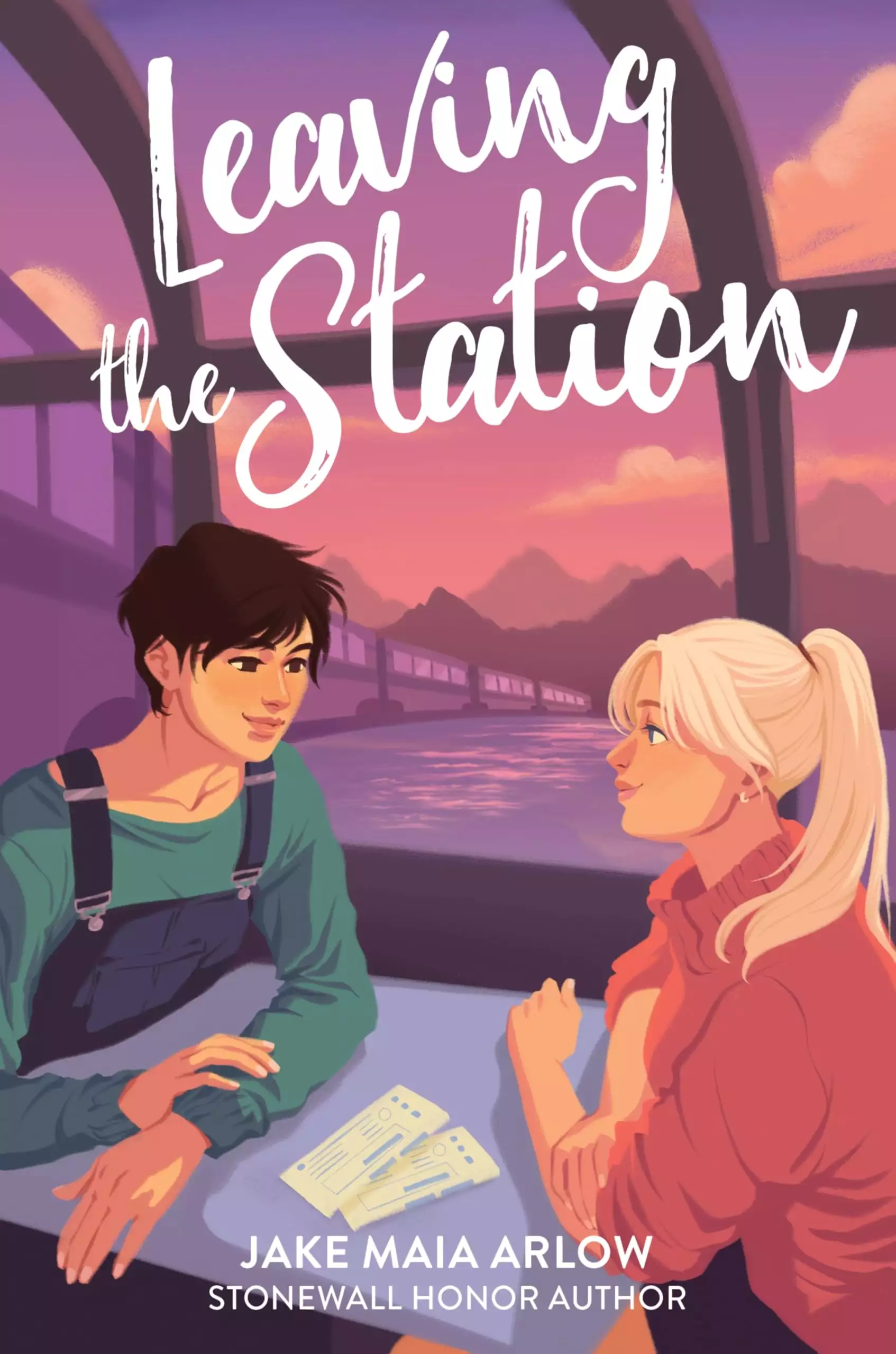
Leaving the Station
- eBook
- Audiobook
- Hardcover
- Book info
- Sample
- Media
- Author updates
- Lists
Synopsis
Nina LaCour meets Alyson Derrick in this cross-country journey of identity, love, and friendships as Zoe tries to figure out her life, one train stop at a time.
Zoe's life has gone off the rails.
When she left Seattle to go to college in New York, she was determined to start fresh, to figure out what being a lesbian meant to her, to experiment with clothes and presentation away from home for the first time.
Instead, she lost touch with her freshman orientation friend group, skipped classes, and failed completely at being the studious premed student her parents wanted her to be.
But the biggest derailment of all? Her newly minted ex-boyfriend—and the fact that she had a boyfriend to begin with. When she met Alden, he made her feel wanted, he made her feel free. He made her feel . . . like she could be like him, which was exciting and confusing all at once.
So, Zoe decides a second fresh start is in order: She's going to take a cross-country train from New York to Seattle for fall break. There, no one will know who she is, and she can outrun her mistakes.
Or so she thinks until she meets Oakley, who's the opposite of Zoe in so many ways: effortlessly cool and hot, smart, self-assured. But as Zoe and Oakley make their way across the country, Zoe realizes that Oakley's life has also gone off the rails—and that they might just be able to help each other along before that train finally leaves the station.
Release date: August 19, 2025
Publisher: Storytide
Print pages: 304
* BingeBooks earns revenue from qualifying purchases as an Amazon Associate as well as from other retail partners.
Reader buzz
 Please log in to recommend or discuss...
Author updates
Leaving the Station
Jake Maia Arlow
Monday, 6:45 a.m., Just outside Manhattan, New York
“You’re going all the way?”
“Excuse me?” I ask the man seated across the aisle from me.
He’s burly, with leathery white skin and sport sunglasses resting on the back of his head like some kind of off-brand Guy Fieri.
“To Seattle?” He leans over and points to the ticket on my phone. I pull it away. “You’re going all the way out there?”
“Oh. Yeah.”
“Ah, a long-hauler.” He grins at this, and it’s a grotesque thing that makes him look less like Guy and more like Pennywise. “I’m getting off at Chicago.”
I laugh, but it comes out forced, the way it always does when an adult man is talking to me and I don’t want him to be. I turn and heave my suitcase onto the rack above my seat, hoping this will put an end to the conversation.
“What do you have in there, bricks?” he asks, not getting the message.
“Textbooks,” I mutter.
“Same difference.”
I rummage through my bag for the book I bought at the Hudson News in Penn Station. The cover is a sepia-toned image of a woman facing backward as she runs through the war-torn streets of 1940s Berlin.
I don’t plan on reading it, but having a book in hand on the train is mysterious movie-extra behavior, and that’s the energy I’m trying to bring to this cross-country journey.
I’m happy to fade into the background, to not be perceived except vaguely in people’s peripheral vision, filling out the scene.
I hold up the book and wave. “See you around.”
“You sure will.”
On that ominous note, I sling my backpack over my shoulder and head to the front of the car, pushing the button that opens the air-lock door to the next one with a satisfying whoosh. There are more rows of coach seats with people milling about in the aisles, preparing for a long day on the train.
They whip out playing cards, chess sets, coloring books, crossword puzzles—idle things to occupy their hands. Some people are on their phones, but most aren’t. Maybe it’s because train travel feels so fancy, so Victorian. No one would bat an eye at a woman in a petticoat.
It’s the Monday before Thanksgiving, so the train’s completely full, but there isn’t the frantic atmosphere of an airport during the holidays. The people on the train aren’t trying to get anywhere quickly—they’re just trying to get there.
“Excuse me,” I say brusquely to a woman who’s blocking my path forward, only to see that she’s carrying a baby so small that it must’ve been born on the train.
She gives me a dirty look but lets me pass, and I whisper, “Sorry,” no less than ten times.
“Gooood morning. This is your conductor speaking,” a voice booms from the loudspeaker. “We are at capacity. If there’s no one sitting next to you now, there will be in a stop or two. Your backpack doesn’t need its own seat. I repeat, your backpack doesn’t need—”
The loudspeaker crackles, and there’s a moment of dead air before a second voice comes on, cheerier than the last.
on down anytime, my lovely train people. We’ve got coffee, candy, wine, beer, and so much more. Next stop, snacks!”
The loudspeaker cuts out again and the first voice comes back on. “No, actually, the next stop is Croton-Harmon.”
The conductor reminds us again that riders will be boarding the train at each stop. After a minute of this, his voice fades into the background and everyone resumes what they were doing: puzzles, sleeping, breastfeeding, etc.
The sun hadn’t risen when we left Penn Station, and it’s only now cresting the horizon. It’s going to be another hazy late-fall morning, cloudy and gray.
I rarely saw this time of day at school. When I did, it was during the first few weeks of the semester, when I could bring myself to care about assignments enough to try to finish them at the last minute.
Being awake at this time on the train is different. Before boarding, I was so anxious that my whole body was shaking—which isn’t unusual, though this specific instance may have been caused by chugging a giant train-station iced coffee on an empty stomach—but now that we’re on the move, I feel lighter.
Because I made it out.
College hasn’t exactly been “great.” I would struggle to characterize it as “fine.” “Steaming pile of dog shit” is about right, though not entirely accurate, seeing as dog shit can be cleaned up.
No one on the train knows about my first months of college, though. They don’t know what I’ve done.
On the train, I’m not Zoe Tauber, fuckup to end all fuckups.
I’m just a passing nuisance who bumps into infants and makes unpleasant conversation with strangers.
I’m free.
Day Two of College
“Oh my god, he’s even creepier in person.”
“I thought we didn’t have a mascot.”
“His face makes me want to puke.”
Everyone clapped half-heartedly as our school’s mascot appeared out of nowhere. He was an ungodly, bearlike creature who looked more like taxidermy that had escaped a natural history museum than a proper mascot.
He stumbled onstage and raised his hands like he was ready to party; no one else was.
I turned to the three people next to me, who I’d been seated with by virtue of our alphabetical adjacency.
“What happened to the costume? I remember the bear from the brochure being . . . cuter. At the very least his eyes were pointing in the same direction.”
They all stared at me, and I was worried I’d said the wrong thing until they started laughing.
“You’re so right,” the person farthest from me said as they extended a hand. “I’m Rex, they/them, undeclared but thinking of majoring in Feminist, Gender, and Sexuality Studies or French.”
I held my hand out and we shook, which would’ve felt overly formal if Rex wasn’t wearing a blazer.
The three of them arrived at this event together, laughing and moving with ease as if they’d known each other all their lives. Maybe the hours it had taken me to work up the courage to leave my dorm and come down to today’s orientation activities were crucial friendship-making time that I would never get back.
Next to Rex was Autumn (“she/they, Architecture”), and Shelly (“he/him, Fiber Science”).
When it was my turn, I didn’t know what to say. They all seemed so sure of themselves, and I was not. Nearly all the introductions I’d made since arriving the day before had involved pronouns and majors, and I didn’t feel confident in my choice of either.
“Zoe,” I told them finally while the haggard bear did a poorly choreographed dance to “Low” by Flo Rida. “She/her. Biology.”
The previous day, when my dad had left me on my own in my freshly unpacked dorm, I’d felt almost too free.
We’d just left a premed reception, where he was on his worst behavior.
“You should talk to the professors,” he’d told me through a mouthful of sharp cheddar. “The other kids will mingle among themselves, and then you’ll have a leg up when it comes time for med school recs.”
My parents had always had high expectations for me, and those expectations increased tenfold when college was involved.
It wasn’t that I didn’t want to be premed or go to med school or be a doctor. I wanted those things desperately. Or maybe, more accurately, I wanted to want them.
My brain naturally worked in the way someone’s needed to in order to be good at science. I didn’t have to try all that hard, and for that, I was rewarded with constant positive external validation: high test scores, Science Olympiad trophies, acceptances into my choices of premed programs.
But from the second I’d set foot on Cornell’s campus, the forward momentum that had propelled me from competition to competition, test to test, application to application, had vanished.
I’d been planning my grand entrance into college life for a while. The academics didn’t matter, but the aesthetics did. Leaving for Cornell meant I’d get a chance to present more masc, to figure out what being a lesbian meant to me, when it had previously been put on the back burner.
I was across the country from home; there was anonymity here. But I couldn’t bring myself to do it. I was wearing a dress that day—a cute one and a go-to of mine in high school. It didn’t even feel wrong; it was stretchy and comfortable, perfectly molded to my body.
So maybe it was fate that I was seated next to these three queer people and not some random premeds with something to prove. It was the universe telling me that I could do what I wanted to do, wear what I wanted to wear. That the plans I had weren’t for nothing.
When the mascot finished dancing and the dean finished speaking, everyone funneled out into the lobby for “light refreshments.”
“Wanna go to a diner instead?” Rex asked. “I have a car.”
I nodded a bit too aggressively.
The four of us piled into Rex’s ancient Toyota Corolla and drove across town to a run-down Greek diner. We took videos of each other trying to fit as many fries as possible in our mouths. Autumn won with thirty and insisted she could’ve kept going if we hadn’t made her laugh.
I was amazed and proud of myself for how quickly I had found a group of friends. I imagined a future with them in it: living together post-college, going to each other’s weddings in ten years.
I may have been a tad overeager.
Monday, 7:15 a.m., Approaching Croton-Harmon, NY
Most people have settled into the ride by now. This leg of the journey runs along the Hudson, whose waters are dully reflecting the cloudy sky. I grab a seat in a booth in the nearly empty café car and turn to face the river, open my book to a random page where the main character is fighting her primal lust for a soldier, and promptly ignore it.
It’s the first calm moment I’ve had since I bought my ticket. Other than walking (which I considered), the train is the slowest way to get back to the West Coast for Thanksgiving break. That’s why I chose it.
I’ll go all the way across this terrible country, from sea to shining sea, by rail. I could’ve left from the Syracuse stop, which is much closer to Ithaca, but I figured if I was going to be on the train for days anyway, I might as well be completist about it, so I took the bus down from Cornell in the middle of the night.
The longest train ride I’ve been on before was from Seattle to Portland, which is just over three hours. All I knew about this route when I booked the ticket was that I couldn’t be in Ithaca for one second longer, but I also didn’t want to be in Seattle right away. I needed a liminal space to think through the life choices
that brought me here.
Now I’ve bought myself four days of time, which isn’t much, but it’s enough to try to figure out what I’m going to do once I get home.
The journey will be so slow that I’ll barely make it home for Thanksgiving dinner, which is great because then I won’t need to fight with my parents about how it’s a holiday celebrating genocide or how I’ll never live up to their expectations and we can all avoid each other until we descend to the kitchen for cold, greasy leftovers on Friday morning.
Not only that, but the Amtrak website warned that, for the most part, there’s very little cell service.
That was what really sealed the deal.
I stare out the window again. That’s all there is to do, all that’s expected of me.
It’s almost pleasant, until my phone lights up on my lap.
I swipe the notification away before I can read who it’s from, then turn my phone off for good measure. I don’t want to know what anyone is trying to say to me.
What I want is to be an entirely different person, one who made at least one correct choice at some point in the past. But even on the train, I’m still myself. I’m the one person I can never escape.
A small child scoots into the booth across from me. I wave and smile. She stares.
She’s long and gangly, though I can tell she’s younger than she looks. When I was a little kid people thought I was years older than I was because of my height. It’s her face that gives it away, the same way mine did. She has round cheeks that aren’t stretched out like the rest of her.
She’s silent for a long time, staring. It’s unnerving.
Finally, she speaks: “Did you know that former President Richard M. Nixon created Amtrak?”
Monday, 7:30 a.m., Still near Croton-Harmon, NY, Just a Bit Closer than Before
“What?” I ask the long child.
“You know, Richard Nixon?”
I hold up two peace signs and lower my eyebrows, reluctantly remembering the US history class where I learned about him. “This guy?”
“Um, maybe?” she says. “Like, the old president who sucked or whatever.” She rolls her eyes and I try not to laugh as she continues. “So, he signed this law, and then the government got to own the railways.”
“How old are you?”
She crosses her arms. “Why do people always ask me that?”
“Would it help if I told you how old I am?”
She nods.
“I’m eighteen.”
“I’m nine,” she says.
“That’s half my age.”
“Duh.”
“I’m Zoe,” I tell her.
“That’s a good name,” she says approvingly. “I’m Aya.”
“It’s nice to meet you, Aya,” I say. “That’s a good name too.”
“Thanks, it’s Japanese,” she tells me. “That’s where my great-grandparents are from. Did you know that Japan was the first country to have rail lines that were made just for high-speed travel?”
“I didn’t.”
“It’s true! The first-ever bullet train was the Tōkaidō Shinkansen. But ‘bullet train’ isn’t its official name; it’s just what they call them in English. The old slow trains from before the Shinkansen that went from Tokyo to Osaka took six hours and forty minutes. But guess how long the Shinkansen took?”
I know from previous experience speaking to children that I should highball the number. I don’t want to upset this child who has deemed me worthy of her train facts.
“Five hours?” I guess.
“Four!” she says, her face lighting up.
“That’s so cool.”
She goes on to tell me about how, in 1997, the Shinkansen was only delayed on average eighteen seconds from schedule, when a tall woman walks into the café car with a worried look on her face. The look eases slightly when she spots Aya.
“There you are,” she says, smoothing Aya’s hair, which is shaped into a classic childhood bowl cut. “What did I say about wandering off?”
“To not do it,” Aya mumbles.
“Or at least tell me where you’re going.” She glances at me, and her eyes are bloodshot. “Sorry about her.”
“No no, not at all.” Aya has been the first person on this train that I’ve actually liked talking to, and I tell her as much.
Her mom leads her in the opposite direction then, toward the sleeper car, and as the door slides open, Aya turns around and waves to me. I wave back.
Clearly, I’m not the only one trying to avoid my parents.
I ease back into my seat and let my eyes unfocus. In this first hour of the trip, I’ve had more conversations with strangers than I’ve had
since the first week of college. But maybe this is what’s meant to happen on a long train ride. We’re going to be sharing this small space for at least a few hours, possibly days. We need to build some train solidarity.
And I don’t mind the conversations like I usually would, because the people I’ve been speaking to don’t know anything about who I am off the train. To them, I’m a way to pass the time. They’re not my college friends, who I’ve done a fabulous job of disappointing.
And they’re certainly not my parents, who’ve pushed me my whole life to be the person they want me to be.
It was a constant, from when they had me quit dance in third grade to “focus on my studies,” all the way up to the day my dad dropped me off at college.
I did everything right, from kindergarten to senior year, but recently something broke inside me. All I can do is stare at my phone and play Tetris. I don’t know what happened, but being alive feels a thousand times harder than it did last year.
I went to college to be a doctor, and now, less than four months later, I have no idea who I am or what I’m going to be.
But my parents are contributing what they can to my college fund so that I can be Dr. Tauber.
They should use that money to buy a condo in Florida or whatever it is old Jews with disappointing children do.
Day Four of College
It was the third time in as many years that I had been forced to learn about the electron transport chain.
I had a hard time figuring out why I needed to know this. I didn’t think that doctors gave this much thought to basic biological processes. It couldn’t have been relevant to them as they were saving lives or shaving bunions or what have you. Electrons moved, our cells made energy, and none of it mattered.
Once I came to the realization that nothing we were learning in Intro Bio would be of any use to me in the future, I stopped paying attention.
It was the second day of class.
professor’s every word. Instead of listening to the lecture, I studied her leg. When she was anxious, it bounced faster. When she was focused it was slower. Sometimes, it barely bounced at all.
I recorded my observations in the margins of my notebook. I figured I was doing science, and that had to count for something. I didn’t have a control group or consistency or government funding, but neither did Darwin.
Or maybe he did. I didn’t know.
When the professor dismissed us, I shoved my pen into my backpack and ran out of the classroom. I was going to meet Rex and Autumn and Shelly at Jansen’s Dining for dinner.
I felt decently good about my chance of having real friends. We even had a group chat, called “Tees Have More Fun,” since all of our last names began with T.
Rex: freaking out . . .
they’ve got tomato bisque here
Autumn: sending out a news alert rn
Shelly: more like a bisque alert
I smiled down at my phone as I ran out of the classroom.
Zoe: be there in a sec !!!!
Due to an unfortunate asbestos-related incident, my biology lecture was temporarily being held in the student union, nicknamed “the Straight,” (after a dead investment banker, not a sexual orientation, which thankfully I googled before asking anyone) so in order to get outside I had to walk through crowds of people ordering large quantities of coffee or handing out flyers for hyper-specific clubs. ...
We hope you are enjoying the book so far. To continue reading...
