For readers of Ismat Chughtai, Banu Mushtaq and Saadat Hasan Manto.
A tooth powder seller's muse. A moustache-wielding matriarch. A beautician who keeps close company with rats.
The women in this unconventional collection of short stories break out of their societal bonds, challenge norms and write their own fates.
First published in Urdu in 2021 to critical acclaim, Kallo opens readers to a new world. Men, though instrumental, are incidental; piety and grime jostle for space; queerness of all kinds is welcome; and women's passions, desires and fears are at the forefront.
This sharp takedown of the hypocrisies of society, particularly the man-made divisions of national borders, religion, caste and class, is a masterclass in irreverent satire - great if you love a bite in your humour - with female protagonists you can't help but root for.
A landmark work of feminist and queer Urdu literature now available in English for the first time.
'Dazzling, delicate and richly imagined stories.'- ANEES SALIM, winner of the Sahitya Akademi Award, 2018
'A lucid and deeply sensitive translation.'-Rana Safvi, historian and author
'In story after story in this collection, Sameena moves forward - proudly, unapologetically, fearlessly - holding aloft the banner unfurled by Ismat.'-DR RAKHSHANDA JALIL, writer, translator and literary historian
'Taut prose... Saira Mujtaba has translated the stories with a deep cultural register.' -SHAFEY KIDWAI, winner of the Sahitya Akademi Award, 2019, and a well-known bilingual critic, author and reviewer
An essential for every feminist and queer reading list - and for anyone who loves sharp, fearless literary fiction.
Release date:
July 16, 2026
Publisher:
Hachette India
Print pages:
248
* BingeBooks earns revenue from qualifying purchases as an Amazon Associate as well as from other retail partners.
‘Dazzling, delicate and richly imagined stories that usher you into the unseen world of women and touch all the strings in your heart. Sameena’s prose is powerful, magical and gorgeous. And Saira’s translation makes sure nothing is lost in the book’s journey from Urdu to English.’
– Anees Salim
Winner of the Sahitya Akademi Award, 2018
‘Sameena Nazir gives a new meaning to feminine écriture – in her hands, women’s writing is not merely a label or a genre; it is a lancet that can penetrate a festering wound, a gentle light that probes the dips and hollows of a woman’s mind and body, and a clarity that has no room for coy modesty. The title story “Kallo” picks up where “Lihaaf” left us but this time without the ambiguity of an open ending. In story after story in this collection, Sameena moves forward – proudly, unapologetically, fearlessly – holding aloft the banner unfurled by Ismat in the male-dominated arena of Urdu writing nearly a century ago.’
– Dr Rakhshanda Jalil
Writer, translator and literary historian
‘Sameena Nazir writes fearlessly from the margins, giving voice to women who desire, grieve, defy and refuse to disappear. Her Urdu fiction explores queerness, sensuality, longing and loss with rare honesty and emotional intensity.
Saira Mujtaba’s translation of Nazir’s short stories, Kallo and Other Stories, preserves the intimacy, urgency and raw power of her voice, bringing these works to English readers beyond the Urdu-speaking world. These important stories refuse to look away from lives too often pushed aside by society and literature alike. A lucid and deeply sensitive translation.’
– Rana Safvi
Historian, translator and author of In Search of the Divine: Living Histories of Sufism in India
‘In fiction, the female body is often depicted through the lens of women protagonists as a site of promiscuity, trauma, persecution, shame, abuse and trafficking. The ordeal hardly stamps out the vibrancy of the interior dignity and aspirations that make a woman an intriguing and complex figure who refuses to be wrapped in a formulaic phrase. This is what the tantalizing, occasionally titillating female characters of Sameena Nazir articulate. The first English collection of her stories, Kallo, revolves around female characters considered morally loose. Still, their portrayal deserves more than criminalization, stigmatization, and stolid stillness. Sameena Nazir, a playwright, theatre and film actor, fashions a gripping, multisensory depiction of Kallo, Miss Razia, Bi Amma, and Baji, whose ostensible presence produces a sense of invisibility and, for the author, serves as a trenchant commentary on hypocrisy and social abandonment. Sameena’s taut prose, revealing the incredible lives of ordinary women rooted, stands unmatched in the contemporary Urdu literary landscape. Saira Mujtaba has translated the stories with a deep cultural register, making them impeccably accessible to the Anglophone world while preserving their cultural nuances.’
– Shafey Kidwai
Winner of the Sahitya Akademi Award, 2019, and a well-known bilingual critic, author and reviewer
TRANSLATOR’S NOTE
I owe some of the most important and eventful moments of my life to serendipity. In 2019, I went to Kathmandu, Nepal, as a Salzburg fellow and met some amazing people doing very important work in their fields to make the voices of sexual minorities heard. This was a cause I felt strongly about, having seen two tragic deaths in my own close family – my uncle Mohammad Aslam and aunt Roohi – result from society’s punishment of their sexual identities. It was there in Nepal that I met Fatima Bhaiji, a young editor from Karachi who is a potent voice of the LGBTQI+ community. Fatima Bhaiji told me about Sameena Nazir and introduced me to her wonderful work.
Before taking up the pen, Sameena had been an actor, director, and an aficionado of the stage and screen. Perhaps this is the reason that as a writer, her stories are very cinematic. They appealed, thus, not only to my literary tastes because of her writing prowess, but also to my love for cinema, a love that preceded my interest in translation, and dated to my days as a student of filmmaking at Jamia Millia Islamia.
Sameena’s stories not only exude literary brilliance but speak of characters who are very much a part of society, and yet have hidden a part of their identities because of social stigma. Urdu literature has very few stories featuring characters with non-normative sexualities. We all know, of course, of Ismat Aapa’s ‘Lihaaf’ and my amma Begum Masroor Jahan’s ‘Kunji’, which is about a male bisexual dancer. But other than these, there is a conspicuous absence of such characters in Urdu literature, and a whole collection of stories by one author is unheard of.
Yet there were Sameena’s stories and characters, each one of them a voice waiting to be heard, to be understood and not judged, and to be accepted in their entirety.
And, thus, I embarked on this journey of translation. I faced many challenges and dilemmas on the way. Many words – ‘fateha’, ‘maayun’, ‘sadqa’ – just didn’t have an English equivalent, and I was caught between keeping them in italics and explaining them in the footnotes or explaining them in the text of the story itself. I finally settled on keeping them as they were, no italics and no meanings, to keep their essence alive, trusting the reader would follow along in context.
Many things are lost in translation, as they say, but at the risk of sounding hackneyed, I must say that a lot is gained in translation as well. I must confess that I felt so emotionally connected to the characters in Sameena’s stories that I carried them along in my being for the whole time I was working on the book.
My uncle wrote in his last note:
This is not a suicide. I had a right to live. But I was forced to die. My blood is… [at the hands of a] system of double standards and hypocrisy, confused moral values and obsessive prejudices, righteousness and retribution. It is a system where any difference is treated as subversion; any variation as a threat; any true happiness as a transgression. In this blinkered society which lives by its petty hypocrisy, truth is strictly no-no. The status quo has to be maintained at all costs and at any price. All dissenters and deviations from the norm will be eliminated; subtly, relentlessly, mercilessly.
With this personal history of the wounds society can inflict on sexual minorities, I would find myself wanting to step into the world of ‘Mee Raqsam’ and stop Saleem and Saif from taking the extreme step, or just go and give a comforting hug to Mushtari Bano and Kallo, to say that I was not judging their love. I guess some of you might think that’s being very sentimental, but that’s how I am in real life. I try to connect to a person’s soul and not merely intellectually when I strike up a conversation. Images and shadows are but a reflection of the physical self; the soul is captured through something inexplicable. Similarly, I wanted each character’s soul to be felt the same way in English as I felt it in Urdu, even though the translation was not a mirror image of the original. This deep personal connection gave me a sense of ownership even as a translator. I believe that without this sense of ownership and attachment, one cannot do justice to the characters and their stories. A translator must be emotionally attached to every word they translate.
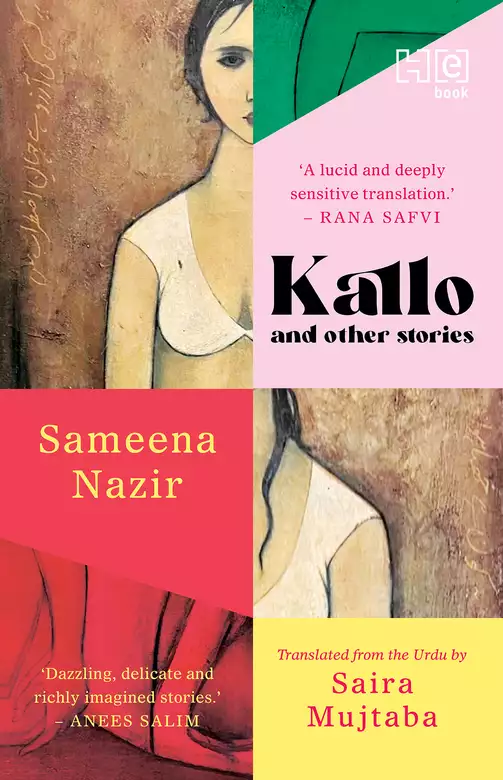
With this emotional attachment, the book’s cover was something I held very dear. Serendipity again came as my guardian angel. The initial designs were all digital art but I’ve always been more biased towards paintings. At the risk of sounding archaic in today’s age of AI, I still believe that each brush stroke from an artist holds an intimacy that digital illustrations lack. It was around this time that Yuman Hussain, whom I fondly call Yuman Aapa, shared some paintings in our common WhatsApp group, and I was completely smitten by one of a lady staring into nothingness. The painting was the work of her father, Dr Anis Farooqi, the former director of the National Gallery of Modern Art and an artist of great merit. The woman in the painting immediately reminded me of the many characters in this collection. An Urdu couplet ran on either side:
Ye kiski aarzu hai jahan-e-izterab mein
Ye kaun hai chhupa hua. . .
(Who is it that my heart yearns for in this restless world?
Who is hidden. . .)
The second half of the sher wasn’t legible, but what I could make out instantly brought out a sense of longing that is common to all the characters in this collection. Kallo longs for a home and some stability; Mushtari Bano longs for love, as do Saleem and Saif; Ms Razia longs for a successful career; and Bi Amma longs for a homeland.
So here’s presenting a set of very interesting and touching stories. If you’ve ever had a love and longing that could never be yours completely, they will be sure to leave a mark.
KALLO
The day Kallo the whore was driven out of her neighbourhood for sleeping with her uncle, Mushtari Bano had coincidentally decided to consume kerosene and kill herself after her hakim husband’s betrayal.
Poor Mushtari Bano, a devout woman who was regular with her prayers and fasts and who would keep a watch on Kallo from a distance, couldn’t even in her wildest dreams imagine that the urchin would hit her nerve one day!
I first spotted Kallo at the tooth powder seller’s tamasha. Every Friday evening, a bulky man would appear with a drummer and sell assorted tooth powders. Both young and old would throng his cart.
‘Wood, coal… if you want some relief, you have to chew on my powder,’ he would announce, and his praise would make the best of qadirs and naat-khwan pale in comparison. The vendor was more melodious and mellifluous than all of them, and Kallo was his model. With her dark, pockmarked face, her unabashed eyes, her straw-like hair, her long jumper soiled in grime and dust, her cracked heels and crooked, long and dirty nails, Kallo was a masterpiece of filth in flesh and blood. But she had a set of pearl-white teeth, and the vendor would open Kallo’s mouth over and over to convince his customers that she exclusively used his special tooth powder. However, I knew that Kallo had barely brushed her teeth in weeks.
Anyway, the vendor was only interested in selling his powder. After the crowd dispersed, the vendor would hand Kallo a fistful of chana and a few coins as remuneration. This work was certainly more honourable than the other menial jobs that she did in the neighbourhood. For example, Rashida Bhabhi would shout, ‘O Kallo! The little one has pooped! Go and wash him, will you? The poor kid is smeared in poop in the toilet, and you are just watching him? Don’t you have any shame? And yes, a heap of his clothes has also piled up. Wash them as well.’
Kallo would attend to the job without uttering a word of complaint. Rashida Bhabhi would leave two thick rotis and some mint chutney in the basket, and this would be her meal for the day.
Scrubbing Sughra’s grandmother’s back; picking lice from Sughra’s and her sister’s heads; bringing coal from the community store; bending under the weight of the coal; grinding the wheat; cleaning up the locked storerooms; feeding the oxen; grazing the goats, etc. – Kallo did all such menial jobs. In return, all she got was a meal or two and some old clothes.
After finishing up all these chores, she would return to her uncle’s house with an aching back and bone-splitting pain, where she would be the target of her aunt’s insults and uncle’s punches. They would yell at her for loitering around all day like a stray bitch and not lending a hand at home.
Home. For Kallo, home was just a red house surrounded by lush trees that was sketched on paper. Her aunt’s daughter, Zahra, would often draw such a sketch and later fill it with colours. The sky in her drawings was always a happy blue, strewn with violet clouds. Kallo would gaze at the picture with eyes full of desire. To her, a home was something found only on a calendar, for what she called ‘home’ was just a rusted tin shed with a plastered floor, on which she spread her dirty sack to sleep, and at times, play hide-and-seek with the stars that peeped through the innumerable holes in the roof.
This tin shed was the only shelter for a shivering Kallo in the winter, a drenched Kallo in the rains and a perspiring Kallo in the summer.
It was a blazing summer when we had the niyaz for Khwaja Baba. Some pulao-zarda was left over after distributing the portions in the neighbourhood. By the next day, the garlic in the pulao had begun to give off a foul stench. Suspecting the pulao had turned bad, Miyan Saab got up without eating while the kids unwillingly ate roti with milk, making faces.
I thought of Kallo at once and sent my oldest daughter to get her. She came by, scratching her head, picking on her teeth. She devoured the rancid pulao as if she had been hungry for ages. She didn’t even leave a grain of rice. In fact, she sucked on each and every bone. I’ll be rewarded for this! I thought when I saw a contented Kallo burping after her sumptuous meal. The pulao would otherwise have been dumped in the garbage, a meal for cats and dogs. It would have been such a big sin to waste all that food!
After finishing the meal, Kallo washed a pile of utensils. She unblocked the drain that had been clogged for months. Despite her ugliness, I felt a sudden rush of affection for her. At once, I fished out my older one’s old satin suit that had come off at the seams and gave it to her.
She made a partition with a bedsheet near the drain and took a bath. After all, she had got a new pair of clothes!
After offering my asr prayers, when I recited the salaam, I chanced upon her black, soot-like body. La hawl wila quwat! I thought. She had the face of a devil but the body of an angel! Just like a cot, her body was sturdy and strong, like a life-size statue of an African woman. She poured water on her head from a jug. Her two dark crescents grew rounder and tenser. The grime from her head washed away, becoming one with the soot of her body. Her curly locks danced like snakes on her voluptuous hips. I felt a bit jealous. My husband had been practising restraint for a while. And after bearing five children, I couldn’t maintain my curves. My muscles had grown loose like an old gunny sack that was only fit to mop the floor after years of being used.
I took back the satin suit from her. It needed a bit of a repair, that’s it. It could easily be mended at home. Inflation was high, and war was lingering upon us. It was no joke to buy new clothes.
Kallo didn’t mind at all. She wiped her body dry with the bedsheet, put on her soiled garments and skipped away.
It had been ten years since Hakim Shatari and Mushtari Bano’s nikah. He had brought the fragile nineteen-year-old home with a lot of fanfare. The wedding was marked by a great show of firecrackers, and innumerable coins were showered on the newly-weds. The wedding’s splendour was discussed for many days.
Hakim Shatari was in his forties at that time.
He didn’t look more than thirty as he would savour dry fruit halwa made from goat’s milk every day. Many questioned why he married so late. My husband had once obliquely hinted that Hakim Shatari was interested in young men. It was only after earning his mother’s scorn and his father’s mortification that he married the docile Mushtari Bano.
Mushtari was the eighth child of twelve brothers and sisters. She silently nodded in acquiescence to Hakim’s proposal and followed him quietly like a tethered cow. That first year, Hakim played with Mushtari as a young kid plays with his toys, clinging to her body like a pyjama string. He would dote on her all the time, serving her walnut halwa one moment and meetha paan the other, taking her out to see all the local fairs. In fact, Mushtari Bano had also gone to the cinema with him, as big a taboo for Muslim wives then as eating pork. Tauba! Tauba!
But when two years passed by on the swing of marriage without any news of a bun in Mushtari Bai’s oven, her in-laws began to raise their brows.
The extended family members started doubting Hakim Shatari’s manhood. He didn’t think twice before marrying another woman from his village. Mushtari Bano was stunned! She hurriedly packed her bags and headed to her parents’ h. . .
We hope you are enjoying the book so far. To continue reading...

 Please log in to recommend or discuss...
