
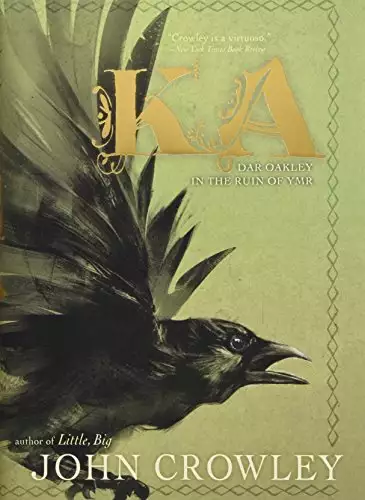
Ka
- eBook
- Paperback
- Audiobook
- Hardcover
- Book info
- Sample
- Media
- Author updates
- Lists
Synopsis
From award-winning author John Crowley comes an exquisite fantasy novel about a man who tells the story of a crow named Dar Oakley and his impossible lives and deaths in the land of Ka.
A Crow alone is no Crow.
Dar Oakley—the first Crow in all of history with a name of his own—was born two thousand years ago. When a man learns his language, Dar finally gets the chance to tell his story. He begins his tale as a young man, and how he went down to the human underworld and got hold of the immortality meant for humans, long before Julius Caesar came into the Celtic lands; how he sailed West to America with the Irish monks searching for the Paradise of the Saints; and how he continuously went down into the land of the dead and returned. Through his adventures in Ka, the realm of Crows, and around the world, he found secrets that could change the humans' entire way of life—and now may be the time to finally reveal them.
Release date: October 24, 2017
Publisher: Gallery / Saga Press
Print pages: 464
* BingeBooks earns revenue from qualifying purchases as an Amazon Associate as well as from other retail partners.
Reader buzz
 Please log in to recommend or discuss...
Author updates
Ka
John Crowley
CHAPTER ONE
Before the mountain at the world’s end was built on the river plain, before the high city there grew up, before most of the Ravens went away into the forests of the deep North, before the People’s long rage to kill Crows, before Dar Oakley’s sea-journey to the West, before the Most Precious Thing was found and lost again, before the ways were opened to the lands of the dead, before there were names in Ka, before Ymr came to be and therefore before Ka knew itself, Dar Oakley first knew People.
Dar Oakley didn’t have that name then, or any name. It would be eons before Crows had each a name, as they do now; then, no, they had no need of them, they called those around them Father, Brother, Older Sister, Other Older Sister; those they didn’t know as relations, or forgot in what degree, were spoken of as Those Ones, or Others, or All of Them There, and so on. And since they had little to say about other Crows or very much need to talk about them when not in their presence, this was enough.
But without names it’s impossible to remember stories, and hard to tell them. So Dar Oakley will begin as Dar Oakley in this one.
There weren’t many Crows then. Or rather there were very many, all around the world; but not many in any one place. Where Dar Oakley had been hatched and fledged, except in the winter roosts that drew Crows from far away, there were not more Crows than any one of them could know by sight and voice. If it were to happen that an unknown Crow came trespassing among them, he or she would be seen off, or at least kept at bay a long time; many seasons could pass during which a strange pair would remain strangers, and even when they were accepted, no one would forget they weren’t really Us.
Dar Oakley’s parents were two such. Where they came from, where their birth flock had its demesne, why they left and came here, Dar Oakley never knew: for as soon as they could, they forgot it themselves, each wanting only to belong here, one of these Crows; eventually they would be as disparaging about newcomers as the rest. Even so, from their birth Dar Oakley’s older brothers and sisters were looked on with suspicion, everyone sure they could still detect something different, something not-Us, about them: and one by one they left the flock, to seek out brothers and sisters who had left before them, or to be strangers elsewhere, no one knew where—or indeed if there was a Where or a There to go to.
So these Crows weren’t just like the Crows in the fields and woods beyond my house.
But that demesne between the wide, shallow river and the forest was a fine one for a flock such as that one was then. Most years the river flooded its plain in the spring, which kept the tall growth and the young trees down. There were mussels and fish in the river—when the Salmon ran, a family of Bears would fish there, and their leavings were rich—and there were grubs and Voles and quick red Newts and a thousand other things in the earth. Crows ventured across the river and up over the foothills of the stony and densely forested mountain, but never very far; nor did they often go far into the woods that began where Hemlocks grew at the river-meadow’s edge, though they claimed them as theirs to an indeterminate distance. The woodlands provided them with the cadavers of small animals, with snails and slugs and the eggs and nestlings of other birds when such could be got, and big dead things they could pick over with the Ravens when the Wolves were done with them. There was enough for all, but not much more. Winters were hard, and they ranged farther then for food, even over the heath to the big lake that lay darkwise from their demesne; but the rest of the year they stayed close to the places they were born and claimed as theirs. Far beyond where they went were other Crows, Crows they had no dealings with, and who themselves rarely left their own demesnes.
That was how it had been forever, a past too long and featureless to be remembered, and rarely spoken of. When they talked, these Crows mostly talked about the weather.
And then the People came.
A long while after that, for all the wealth they’d get as a result, for all that they flourished and multiplied as never before, old Crows of that flock would sometimes say, I wish they’d never come over the mountain, or crossed the river; I wish they’d never come at all.
They could say such things because by then Crows had learned the trick of thinking that the world could be different from the way it is, and therefore to wish it was.
Dar Oakley invented that. So he would say.

Dar Oakley’s family freehold was far off from the others, one that had been claimed by the parents in the early years when they were outsiders. It wasn’t rich. It fed his mother and his father, his mother’s Servitor (a melancholy male who had loved her since he was a fledgling), and himself and two sisters. They were the nestlings of that spring who had survived infancy, their coats still not the lustrous black of grown-ups, all three of them still needing to be watched, though they didn’t think so themselves. And a young vagrant such as Dar Oakley’s parents had once been, who kept warily apart and had yet to communicate much with the rest but who was tolerated, perhaps for long-ago’s sake. In autumn Dar Oakley reached the age to be a watcher—not all by himself, his task was only whatever word was given him by his mother or father or the Servitor perched in a high spot. Through the day they all moved over their reach of ground, walking its well-known hillocks and streams, looking for anything interesting and possibly edible. At each move they posted a watch, a couple or three of them who listened for calls from distant families and watched the sky and the trees and the ground for Hawks, or Foxes, or other intruders. Only after the call-and-response was done—All right? All right here, as I see—would they descend to eat.
Dar Oakley liked to take a wind-shaken perch absurdly high in the tallest tree around, where he could see threats come from miles off, if there had been any threat, which there had never been in his short life; the common threats to cry out about—a Weasel, a Fox, a Hawk—were close at hand. Often enough he wasn’t really watching, only looking; sometimes he’d forget to eat at his turn, gazing over the far reaches beyond the flock’s habitations, wondering what that was that he could see but not quite resolve. How far that way could a Crow go?
He had a talent for getting lost on sleepy afternoons when the others lay listless in the autumn sun or nodded in the Hemlocks: gone by the time his mother called for him, too far to hear her. Much as he loved his family and still followed his mother and father as he had in the spring, he never minded finding himself alone. He liked thinking, when he was far away, that he was overseeing or standing in places no Crow of his flock had ever gone to.
Never lost, though, really: not when that dot of certainty like a compass needle behind his bill, between his eyes—all Crows have it—could always point him north, “billwise” they say, and thus also daywise, east, and darkwise, west. (Crows—at least nowadays—have oddly no word for south. Perhaps that sense in their heads means both south and north at once. I’ve never determined.)
“You’d probably not believe me,” Dar Oakley said one day to the Vagrant, “if I told you how far from here I’ve been.”
The Vagrant, poking in the mud of a pond’s edge for larvae or Frogs’ eggs or whatever else might turn up, said nothing in response.
“I’ve been where there are no Crows at all,” Dar Oakley said. “None anywhere but me.”
“No such place,” the Vagrant averred.
“Oh no?” said Dar Oakley. “Go as far as I have.”
The Vagrant stopped his hunting. “Listen, fledgling,” he said, in a low but not soft voice. “Long ago I left the places where I grew up. I was run out. Never mind why. Always between then and now I’ve been on the wing.”
Dar Oakley had stopped eating too. This was more than the Vagrant had said in all the days he’d been nearby the family. “On the wing,” he said again, as though he resented it. “And nowhere there’s no Crows.” He poked at what might be the remains of a small Frog, dead in a drying puddle. “Might have liked it better if there was such a place. But no. Nowhere. I’ve been driven off by Crows from here to sunrise. ‘No Crows,’ oh sure.” He shook his head, either in disbelief or to shake a nasty taste from his mouth, and took off for a farther spot.
“I say it’s so,” Dar Oakley called after him, chagrined.
He flew. Daywise the lifting lands could be seen glowing through the thin poles of the dead bog-wood, and the bare moorlands where the hunting was poor. He went to the crown of a tree he liked, a spreading Oak close to the forest’s edge. If ever he were to find a mate and engender young, he thought a crotch of this tree would be the place to build, though he knew the choice would be hers, not his.
If ever.
From a swaying limb, Dar Oakley’s wide, sharp sight gave him a big angle of the far lands to study. A mile off (though Crows didn’t then count in miles or in any unit of distance) he could see Rabbits in the clover, and farther, a cloud of Rooks rising and settling. Farther off than that, the sparkle of the lake, which he knew about, between the folded wings of the hills. Clouds farthest of all.
He would like to have gone where the Vagrant had, if the Vagrant told the truth. He was sure he’d have enjoyed it more, wouldn’t have been so dour and silent afterward. He’d have won over the Crows he came upon, telling stories of the places he’d been and they had not. He wouldn’t have been run off as the Vagrant had, and when he chose to leave, they’d have taught him which direction to go, to places far from any Crows and full of other things instead.
One eye just then saw, down near the foot of his Oak, a small movement in the fallen leaves and husks of old acorns. He knew what it was, or anyway what sort of thing it was likely to be. He fell as soundlessly as he could to the spot, and stabbed at it even before he alighted. The Vole that had stirred the leaves made a mad dash, but Dar Oakley’s foot was on it and his bill struck it hard. Thoughtfully he took it apart and ate what could be eaten.
In doing all that he forgot what he had been thinking about, but when the Vole was in his crop, the thought bloomed in sudden force in his breast. Far. He looked around himself. He could hear from several directions his family and other Crows calling, saying the things they always said, locating one another. What would they think or do when he didn’t answer?
His heart rose. He bent his legs deeply and lifted his wings high, and as he leapt up with his tensed legs he beat down with his wings—the leap upward that had taken so long to learn when he was just out of the nest, that he did now a hundred times a day, but this time remembering those first attempts even as he did it with a new purpose; and when the leap-and-wing-beat had got him off the ground, he scrabbled upward as though climbing the air with his feet, and beat again and then again, and he was aloft—and before he’d stopped marveling at the thought of how impossible this had once seemed, how easy now, he was far away and going farther.
All day he flew. Now and then he’d settle and walk awhile, eye out for food, feeling a little exposed with no one on a branch above him to call Danger, but for the same reason exalted, a kind of creeping laughter in his throat. Then he’d be off again. He reached the great lake, which he had never seen; he could have gone by stages around its margins, but on an impulse he crossed it, its wrinkled surface under him for a long way, almost too much for him. Partway across he rested at a small island amid a clump of water-loving trees and found slugs to eat. Then he went on. On the far side he had reached a distance from home that it would be impossible to retrace before dark.
And then there he was. He was sure of it. He took a perch in a low tree of a kind he felt he had never seen before, and listened. He could hear the day: the few songbirds not napping, a Thrush, a Lark. Hush of wind; an Elk’s bellow far off in the gloomy forest. Nothing more, and none of his kind to see or hear. He called, not loudly at first, just Where are you? No answer came. A little louder. Still no answer, not the faintest echo of his call.
Too far for Crows. His brain felt hot, and his eye-haws winked.
Just to be sure, though, he flung his body sunward again. Too far wasn’t quite far enough. He went up higher than necessary on warm currents rising from the sun-heated earth. He wondered if it was possible to make day last longer by flying straight toward the sun, and somehow getting under its descending. He was so lost in imagining this, and in the feel of his strained muscles and the emptiness in his gut, that when his billwise eye caught the beings on the earth below, the sight startled him into a sudden roll.
He’d wanted new lands and other things to see. And now look at this. He righted himself and banked that way. There were four: one big and slim-legged like a Deer or an Elk but not either of those, and one shaped like a Wolf—Dar Oakley had not often seen Wolves, but often enough to know this wasn’t one. Those two were four-footed. But the other two stood upright like Bears when they reach for berries on high branches, or threaten. Mostly hairless, though, pale flesh showing, as though skinned. Their necks and forearms were laced around with something that caught the late light and shone like ice or mica. The four walked all together, friends, in a way that Dar Oakley had never seen four such different beings do. In their long, slim forearms the two-legged ones held sticks as long as themselves, resting on their shoulders—for what? Dar Oakley stalled in the air above them, trying to see every detail of them—were those skins flapping around their middles? What were the thick paws of their feet? Then as he circled he saw one of them raise the stick from his shoulder and lift it skyward, toward where Dar Oakley was, and then the other pointed more darkwise with his.
Dar Oakley banked away, alarm breaking on him. Up darkwise and black against the low sun was a Falcon; he knew its shape instantly, as though it matched a shadow in his brain. Making toward him, sharp wings slashing air.
He was in the open, too far to make the nearest trees, though impelled that way irresistibly anyway. The Falcon was gaining on him and climbing at the same time. There was only one way to evade her, and it rarely succeeded: you had to let her fall from her height upon you, she readying herself to strike you with that huge foot, and somehow cause her to miss. Then she would fall below you and have to climb back above you to strike again. It’s the way a Falcon strikes: descend at an awful speed onto you, crack your head with a downward blow of a clenched foot, and then grapple you as you fall killed or stupefied to earth. She’d rarely do it otherwise. Hawks are powerful and ferocious, but not inventive. They don’t have to be. It’s their prey that needs to think.
Dar Oakley made for the impossible trees, feeling that shadow over him, unable to turn and look up lest he lose speed. He knew by the sudden silence of the falcon’s threshing wings that she was descending, like—Crows had no word for it then, like an arrow, a shot. Somehow sensing the last possible moment for it, he somersaulted, reversing his course. The Falcon fell past him with a talon-punch, so close to him he could see her yellow eye and open bill, feel the wind from her wings. He rolled over and began to climb.
The reason the trick doesn’t work is that the Falcon gains altitude faster than a Crow can. Dar Oakley tried to wing upward and at the same time angle toward the trees. As he aimed that way, he saw—he’d never forget—the two stick-wielding beings, still lifting their sticks upward.
When the Falcon was high enough, the trees were almost close enough, as though reaching out to gather him in. And it could have gone either way, but as the Falcon dropped again Dar crashed into the trees, losing feathers, nearly breaking his neck as efficiently as the Falcon could have done it. He was safe. Unlike an Owl, she wouldn’t pursue him into the dense foliage; she’d quit and hunt elsewhere. Dar Oakley, panting open-billed, eye-haws overdrawn, heart thudding as though to exit his breast, hugged a Hemlock branch and made himself small.
She might wait, though, might hang a long while making lovely patterns against the sky. Their awful patience. Dar Oakley crept deeper into the thicket, feeling a cry extracted from his throat, the cry of any Crow for help: Come, come, trouble, trouble, not far but near, the worst there is. Knowing he had put himself beyond help.
Yes: the Falcon now sat perched on a bare branch, out beyond the thicket where he cried aloud. As he looked she dropped heavily, dodged at the Hemlocks where Dar Oakley hid, her strong wings beating at the branches to scare him out. He wanted to flee, to be in air, utterly foolish as he knew that to be. He kept crying out, now as softly as a flightless nestling on the ground, just enough to keep his head and his heart in his voice and so do nothing, not move a feather. Her eyes looking in at him, large and pale as noon sun, with a black ball in the center—no, surely she couldn’t see him.
After a while she went away, but how far? Dar Oakley stopped crying. The sun had almost set now, and he was alone in a place he’d never been. He hadn’t ever spent a night beyond calling distance of his family. Good night, Mother. Good night, Father. Good night, Others.
What if the wood he’d plunged into held an Owl?
Soft hush passing by him in the deepening darkness, just night wind, maybe, surely.
He slept, waking in the night over and over, to listen, stare into the dark branches. Beings moved around him, up the nearby trunks and down on the forest floor, scratching and rustling—the usual ones, likely, and no threat to him, but still. Dawn came, taking forever, the red glow daywise worse than the darkness. With the sun, Dar Oakley remembered the strange beings he had seen—he had forgotten all about them in the flight for his life and the night.
He unfolded a little in his thicket. Sore. That Falcon couldn’t be near, now; except in the spring, when everyone was up at first light to feed their young, Falcons were late hunters. Mist lay over the ground he could see, dispersing. He left the branch he had clung to and got going, hopping from foothold to foothold in the thicket (how had he ever got in here so deep?) until he could make open air and fly.
The strange beings were all gone, four-legs and two-legs. But there, on the dry knoll where they had stood, the sticks they carried were thrust into the ground, pointing upward. Something thin and feathery hung from each, and stirred in the mist. The sticks that they had lifted toward him, and toward the Falcon.
He skimmed the place, but was somehow unwilling to settle and study it. He banked darkwise, his wings recovering their strength; wanting to be far from here and near Crows again.
Dar Oakley couldn’t know then, nor did he know it for long afterward: the two People who had come here with a Horse and a Dog, who had watched a Crow battle a Falcon and escape, had seen a sign. He wouldn’t have known what a sign was, and sometimes even now thinks perhaps he doesn’t understand, truly. But he and his troubles had been a sign for them. The sign had told them, In this place, between the mountain and the lake, you will escape the enemies who drove you from your home places; here you can build again, raise young, bury your dead. They had left their spears there struck in the earth to mark the sign they had had, so they could return.
Dar Oakley turned for home. He thought he had come far, but returning now, it seemed not that far at all. Before the sun had reached the height of the sky he heard, from somewhere in the bogs and meadows that he flew toward, the call of a Crow.
No one believed his tales of the ones he had seen, of course, because he had (his father said) told too many such stories since he’d learned to talk, and too few of them had turned out to be quite as he’d told them. Dar Oakley didn’t want to go back to the place, though he told himself that soon he would; now and then in the dark of night he would feel that Falcon whip past him and the terror of that foot, and wake with a cry. One day when the Vagrant and the Servitor were teasing him about the story, he challenged them loudly to go with him, if they dared, and see the place, and the beings if they were there; and with much laughing and pretend fear and mock displays of courage, they went with Dar Oakley to the place, complaining about the distance and the toil, resting at the same lake island where Dar Oakley had rested. The way there was drawn in his brain.
There were the two sticks thrust in the ground.
“See? You see?”
But since that was all, and no beings approached, the other two were happy to carry the story back, making great fun about the wonderful and never-before-seen pair of sticks, and on and on till Dar Oakley wished he’d never convinced them to go there. He didn’t go again, and hoped that (true as he knew his story to be) everyone would soon forget about it and stop shouting, “Sticks!” whenever they saw him.
The weather was growing colder. Families began to leave their freeholds in the evenings and retire to the communal roost that was forming for the winter. As food grew scarcer it wouldn’t be possible for a single family to hold off the many others in search of provender wherever it could be found, and the family’s land would anyway cease to produce enough for all the members. So they joined the majority, and went wherever they went, and came back at night with everyone.
It was a good time in the year, though, at least until winter grew deep. The roosting-place changed from time to time, but for some years it had been a wooded island far down where the river widened, thick with Poplars and several kinds of Fir, and some tall giants too, Oak and Ash. Crows in ever-greater numbers came in as the sun set and the clouds colored, yakking away as they winged down the river, or out of the daywise-dark sky, out of the vanishing sun or from the mountains. There was even a crowd of Rooks who joined them nightly at the frontiers of the roost, chattering together and all at once about their affairs, impossible to understand even if anyone had cared to try.
This was the first roost Dar Oakley had known, and his heart rose and he gave voice as Crows strange to him, young females, too, came to be beside him or below him or above him on the incoming evening flight, so many. His mother and father were somewhere in the throng, and brothers and sisters of Dar Oakley’s from earlier years and far freeholds. They had their own company, enough of them vagrants or newcomers to make their own family seem like old permanents, and he wouldn’t see much of them through the winter; his father would spend evenings with Crows of his status, his mother with hers, see you in the spring.
What a roar they made, settling in those branches, calling to friends and foes, shouting out their opinions to one and all, moving from branch to branch and saying, You! Oh, you! There you are, here I am! and a hundred other meaningless but not useless remarks—older and bigger Crows, louder and better-friended ones, made their way by such greetings into the middle of the crowd, where in the freezing nights they’d be warmed by the mass of Crow bodies around them, while younger and smaller ones went to the outside. Toughen them up, their elders thought, keep with their friends. The young ones hopped from branch to branch, getting as far in as they dared, males around females, females beckoning males—young Crows who wanted mates in the spring had better look now. Hello there, hello! Better to be high up than down low, if you could find a place: those down low were often shat upon by those above, awaking in the morning to find white streaks on their black coats, lots of laughs for others.
It had grown nearly dark on a certain evening, with a big moon rising, and the Biggers were calling, Settle down now, settle down, when a thrashing or commotion began in the woods on the far bank of the river, a noise that for a moment stilled the Crows who heard it. Something large was coming through the underwood over there, and something else coming after in pursuit. The Crows started up yelling at whatever it might be—always best to cry out on any predator, though you might benefit later from its leavings—but what was it? Too early in the dark of the year for Wolves . . .
A Deer, a small female, burst out into the moon’s light, taking staggering leaps toward the river. After her came—were they Wolves? No, not Wolves, like Wolves but not, and making sounds that Wolves would never make hunting. And after them came two others, taking long steps, upright on two legs.
“It’s them!” Dar Oakley cried, and cried again over the noise in the trees.
“Them? Them?”
Dar Oakley could see, as the Deer plunged into the river, that fixed in her flank was a stick, one of the kind that the two-legs had carried—that’s what they were for. The Wolf-like ones leapt in after her, trying to bite and swim at once; she could hardly hold her head above the water. The Crows were shouting alarms or encouragement or just marveling. Dar Oakley leapt from branch to branch, crying, “Them! Them!” as the youths around him nearly lost their perches laughing.
The two-legs were at the water now too, wading in like Bears up to their waists before striking out with their forearms. The Deer reached the island and the shadows and it was hard to see, the Crows pressing in and shoving for vantage. She’d never have found the strength to mount the rocky bank if it wasn’t for the animals harrying her from behind—it was impossible to tell how many of them there were as they flopped and skidded over the rocks and the mossy logs. But the Deer was failing, her legs were buckling, they were leaping for her throat. The two-legs then made the island and came up the bank, and that was too much for the Crows—many of them rose up and into the treetops to get as far as possible from this thing happening, as they would have for anything they couldn’t account for, and who could account for these hunters?
The two-legs reached the tangle of animals, and with harsh cries they pulled the snarling ones from the now placid and surrendered Deer. Then the larger of the two-legs straddled her body, took her neck in his two pale hands, and ripped it open. Blood spurted richly, black in the moonlight.
No, it was not with his hands he had done it but with another sort of thing he had somehow all along been carrying, but it was only Dar Oakley who understood that; the others were baffled by the impossible behavior in the dark and the struggle.
They rested, briefly, their Servitors (as it was clear the four-legs were) stirring around them but not daring more. Then together the two of them lifted the Deer, flung her on her side, and with the tool (now it was clear to all it was a thing they wielded, it caught a flash of moonlight), they tore it open down its breast to its vent. It took only a moment. The Deer’s guts slid glistening out, and other parts; with the tool one hunter took the liver just as though he had reached in and tugged it out. They pushed away the rest, like Wolves showing little interest in it, and the four-legs fought over what was good in it.
Above in the trees the news went from bird to bird: the two-legs were dragging the emptied Deer, her head knocking the rocks, into the river. Swimming strongly each with one arm, beari
We hope you are enjoying the book so far. To continue reading...
