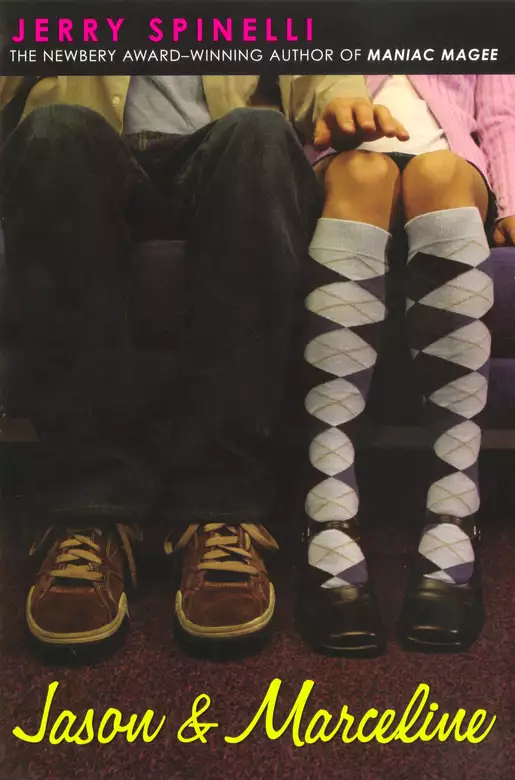
Jason and Marceline have been friends since the end of seventh grade. Now in ninth grade, Jason's starting to think that they could be more than friends, and Marceline's starting to think so, too. But does the beginning of romance mean the end of their friendship?
Release date:
January 1, 1986
Publisher:
Little, Brown Books for Young Readers
Print pages:
224
* BingeBooks earns revenue from qualifying purchases as an Amazon Associate as well as from other retail partners.
As the bus went roaring past, three middle fingers popped up in front of three faces grinning out of the back window.
“See?” I said.
“See what?” said Marceline.
“They’re laughing at us.”
“Not to mention giving us the finger.”
“That’s right. Great way to start off ninth grade. Laughed at and fingered in the first five minutes.”
She pulled out her sunglasses, shook open the arms. “You could be on that bus. Laughing at me.” She slid the shades on.
“No,” I said, “I wouldn’t. And you know why?” She stared straight ahead. “You wanna know why?” Her head swiveled slow and looked down on me—down more than usual, because the sidewalk sloped toward the street, and she was on the high side. The shades owled at me. She didn’t speak. “Because,” I said, “it wouldn’t bother you.”
Her head swiveled away. “Should it?”
“Yeah, it should, yeah. When people laugh at you, it’s supposed to bother you. If I was on that bus, I’d laugh at me too. Who walks to school when they live far enough away to take the bus? It’s crazy. I deserve to be laughed at, and it bothers me, yeah. I’m not the one that’s unusual. You are.”
“Guess I’m just a freak of nature.”
Another bus went by. More laughing faces. I wished she would take the shades off.
“Marceline—” I held my arm out, stopping her—“tell the truth. If a whole busload of kids came along, and the bus stopped, right here—right here—and everybody on the bus—everybody—crowded at the windows and started laughing their asses off and pointing and all—at you—you mean to tell me that wouldn’t bother you?”
She pushed my arm out of the way with her trombone case and moved on. I took this chance to slip around to the high side of her; now my eyes were almost even with hers. I nudged her. “Huh? Tell me it wouldn’t.”
She sighed. “Jason, why do you keep trying to make me into something I’m not? So Richie Bell will approve of me?”
“Stop changing the subject.”
“That is the subject. You trying to change me. You wish I were shorter. You wish I didn’t play the trombone. You wish I wouldn’t wear sunglasses, especially on the way to school. You wish I would ride the bus. If I have so many faults, what are you doing here with me?”
Good question. Since the end of the summer before eighth grade—thirteen months ago—Marceline McAllister and I have been… I don’t know… something. I mean, we’re more than just friends. I think. I’m sure. On my side, anyway. Like, we talk a lot and ride bikes and do stuff together. She was inside my house (once). I was inside hers (about ten times, mostly in the kitchen; that’s where we play Scrabble). I hold doors open for her sometimes—just because I feel like it—and sometimes she holds doors open for me. No Christmas presents. But birthday cards. We never kissed. Yet. But I like her better than the two girls I have kissed. So what do you call us? What are we?
“You’re crazy,” I told her. “I never said anything about sunglasses.”
She just smirked, the way she does to let me know she knows I’m lying. She’s better than my mother at reading my mind.
“Why don’t you give me some credit,” I said. “I am here.”
“You wish you weren’t.”
“That’s a lie. How can you say I don’t like being with you?”
“You’d rather be alone with me. It makes you nervous to know other people are watching. You’re terrified I might do something to embarrass you.”
I laughed. “Terrified?”
Then: radio music, horn blaring, shouting.
“Yo, Herkimer!”
“Hey, Herk the Jerk!”
Tires squealing, crunching the curb. It was Vesto and his car. Vesto turned sixteen over the summer—by far the oldest kid at Avon Oaks J.H.S., maybe at any junior high. His car was a big old Buick, with one door all putty and Rust-Oleum, no hubcaps, and the trunk tied shut with a rope. It was beautiful. And jammed with guys—bodies coming out the tailpipe.
A door twanged open. Little Looie Lopezia fell out, like something from an overstuffed locker. He picked himself up and tunneled his way back in. Among the legs and arms and earphones, Richie’s face came into view, practically upside down. “C’mon, Herk. Jump in.”
Marceline was half a block up the street and moving.
“Nah, ts’okay, no room.”
“Yeah there is—look—” Bodies shifting. Grunts. Curses. Squawks. “There—c’mon.”
If any space was there, I sure couldn’t see it. “Forget it, man. What do I look like, a maggot?”
“Hell with ’im,” came Vesto’s voice. The car shot off, leaving me with a faceful of gas and howls.
Marceline was now not only up the street, she was on the other side. Just as I caught up with her, she recrossed.
“Hey,” I called over, “waddaya doing?”
“Freeing you.”
“From what?”
“Me.”
I stepped down from the curb. She wheeled. “Don’t you dare!”
I froze. “Huh?”
“Stay there.”
I kind of laughed, stepped back onto the curb. I looked around. I prayed no bus would come along. “What’re you talking about?”
She didn’t answer. She went on walking.
“Marceline, I’m supposed to be walking you to school.”
“I’m not a dog. You don’t walk me anywhere.”
“With you. I’m supposed to be walking with you.”
“You are.”
This was insane. Wacko. I had to get back over to her, had to—
She wheeled again: “No!”
I backed up onto the curb. Was this happening? Was I dreaming? Was I really walking a girl to school on opposite sides of the street?
Suddenly she yelped. “I’ve got it!” She put her trombone case down, opened it, took out the trombone parts, jammed them together, and started to toot. After a few notes she called: “Jason, remember how this goes, so I can write it down when we get to school.” Then she went on tooting. Right there. Shades and all. On the sidewalk. The morning sun flashing on the slide.
I knew exactly what she was doing. Marceline had been writing a song. “Trombone Troubadour.” All summer long she was stuck on the refrain, couldn’t get it right.
She stopped and called: “No, that’s no good. Forget that. Don’t remember it. Now wait—” She tried some new toots. “There—that’s better. Start remembering—” she lifted the horn to her lips, took a deep breath—“now!”
A bus went by. For three or four seconds you couldn’t hear the trombone because of all the hooting and howling. The bus driver even gave a toot on his horn.
She stopped (“No—that’s wrong too. Forget it.”) and started (“Okay, try this. Start remembering—now!”) again.
“That’s it!” I yelled. “We’re through! Finished! You don’t really wanna do all that crazy stuff! You’re just daring people to laugh at you! You’re a sadomasochist! You lie awake at night thinking up ways to make me look like an idiot! If you think I’m remembering those notes for you—or even listening to that slop—you’re crazy!”
She pushed the mouthpiece away and just stared at me. Then I felt something against the back of my legs, and another horn, like a trombone from hell, blasted my heart right out of my chest and sent it end-over-end like a fifty-yard field goal. I turned around. Vesto’s car was behind me—right behind me—on the sidewalk, the bumper touching the back of my jeans.
Door twang. “This time,” Richie grinned, “y’either come with us or you’re grass.”
I got in. I would have even without the threat. The guys cheered. Richie kept pounding me on the back. We jolted back down to street level, Vesto gunned the engine, and the tires peeled a long, high note—the only note I was going to remember.
So I rode to school in style. Naturally, we got mobbed when we pulled up. Vesto could have run for king. He must have driven ten different groups around the block. People were lining up at the curb like it was the loopy roller coaster at Hershey Park.
The bell rang. Everybody groaned and herded inside.
When I reached the second-floor landing, a bunch of kids were at the window, laughing and pointing.
“What’s she doing?”
“What a weirdo.”
“She’s even weirder than last year.”
“Marceline McBeanpole.”
From my place halfway up the last flight of steps, I looked over their heads and saw her across the street: the only one outside, trombone case on the sidewalk, still trying to get it right. A girl’s voice sneered, “It’s just for attention, the stuff she does. She thinks she’s impressing the teachers.”
No, I thought, that’s not true. She’s not trying to impress anybody. This is just the way she is, that’s all. She’s just being herself, I thought. But I didn’t say anything.
I crept up the stairs. I hoped nobody would notice me. Too late—
“Yo, Herkimer! Lookit your lover girl out there!”
I bopped to the top and through the door, pretending not to hear.
The hallway was all bodies. Moving. Surging. Mooing. I brushed against them, bumped off them, slid through them. Voices called my name, first-day voices I hadn’t eard since June. I kept moving. The deeper I plunged into the herd, the lonesomer I felt.
A tap on my shoulder.
“Excuse me.”
I turned. It was a little kid. Looking up at me. Seventh-grader.
“I think I’m lost. Can you tell me where Homeroom One-Seventeen is?”
I just eyeballed him for a minute. He was the most ridiculous thing I had ever seen. He was wearing inch-thick glasses, his hair was sticking out in ninety different directions, and one of the points of his shirt collar was aiming practically straight up in the air. Then I saw the belt. It was made of hundreds—maybe thousands—of tiny beads. Red, white, and green beads. The green beads made up the shapes of reindeer, antlers and all. The red beads were the reindeer’s noses. A whole herd of Rudolphs.
Second bell rang.
“Downstairs,” I said, and took off down the nearest steps. I could hear the runt clomping after me. The kids on the first floor had almost all drained into their rooms. I tore up the hall, almost bowling over a homeroom teacher. I prayed I wasn’t too late. I slammed through the end doors, down the steps, slammed the heavy main door open…
There she was, coming up the walk, kind of bouncy, trombone case swinging. And a proud little grin on her face that said, I finally got it.
I held the door open for her. She might have glanced at me, but I couldn’t be sure because of the shades. She kept grinning, holding her head high, the way she does, and as she passed by me I hoped—I knew—we weren’t finished after all.
The main thing, the first couple days of school, is checkin’. Like, “Hey man, check that out.” And, “Hey man, check that out!”
It’s a checkin’-out orgy. Most of the people you haven’t seen all summer, and every one of them—even the nerdiest nerd—is fascinating the first time around. Most of them have changed at least a little bit. Some haven’t changed at all, like they spent the summer sitting in homeroom. And then, sometimes, there’s somebody who changed so much you’ll never recognize her till somebody tells you who she is.
Girls wouldn’t understand this, but boys are born with a kind of measuring device, located somewhere behind the eyes, I guess. It kicks in around ninth grade. It’s kind of like an artillery range-finder. Whenever a girl comes toward you, it zeroes in instantly on the gazoobies and practically gives you a hard-copy printout on things like size, shape, floppability. But mostly size.
It’s incredible, the accuracy. If a girl’s balloons gain a millimeter overnight, your range-finder will pick it up. Let a whole summer go by, your fuses start blowing. Everywhere you look—where there was nothing in June, now there’s something, and where there was something, now there’s more.
So. First morning. Richie and I are heading down the hall, when my range-finder picks up something. Still four or five classrooms away, bobbing into view for just an instant at a time, then disappearing into the crowd. But one thing I know already: we’re talking size, we’re talking great white sharks.
Richie nudges me. He’s tracking them too.
Then they come into full view. Under a pink shirt. Bouncy. Very.
A rattling kind of croak comes up from Richie’s throat, and he nudges me so hard I fly against some lockers and drop my books. By the time I get everything back together, she’s past.
Our eyes speak to each other: “Who was that?”
We search our range-finder memory banks. We come up empty.
“Maybe she’s new,” I say.
“A transfer,” Richie says.
“Maybe from a Catholic school.”
“Or France.”
We spotted her twice again that day. Still no ID.
“Know what?” said Rich.
“What?”
“Maybe she’s not a transfer. Maybe she’s just one of them quiet people. It’s a big school, y’know.”
“Rich,” I said, “stop and think. You saw ’em. I saw ’em. Our own two eyes. That girl would have to have classes in the mop closet for us never to notice her before.”
He couldn’t argue with that. A minute later I figured I had the answer. “Maybe it’s the clothes. Maybe she always wore loose-fitting clothes before. Baggy, y’know?”
Richie sneered. “I don’t care if she was wearing a tablecloth. Them things send out shock waves when they move.”
He was right. The range-finder is like an infrared camera—it can detect through camouflage and stuff. If there’s a boob anywhere in a room, the range-finder will lock in on it within five seconds. If the Russians ever sent a lady spy over here disguised as a man, she’d never get past the first ninth-grade guy.
It was still a mystery when we met at The Stairwell next day. The Stairwell is an ancient tradition at Avon Oaks J.H. If you’re a guy and you’re in the ninth grade, it’s the place to be in the morning between first and second bells (unless there’s a fight to watch). It didn’t take long to find out that other guys were wondering about the mystery girl too.
One of them was Vesto. Except he wasn’t wondering, he was flat-out saying: “I don’t care who it is, I’m getting me a handfulla them babies.”
We called Dugan in on the case. That meant getting him to hooky from Holy Ghost, the Catholic high school, which starts at ninth grade. We told him we needed him to see if she was a Catholic-school transfer, and we promised him that even if she wasn’t, the hooky would be worth it just to get a gawk at her.
When Dugan showed up that morning, he had his usual tie on, the one he’d been wearing since seventh grade. It used to be red; now it’s black. We told him to take it off, it could get him caught, but he wouldn’t. Walking down the hallway, we kept Dugan between us. We nudged him as soon as we spotted her, then we all kept quiet till she passed.
We turned to Dugan. He looked glassy-eyed, almost faint.
“Well?” I said. “Is she a transfer?”
“I don’t think so.”
“Well, what?”
He stopped, turned, looked after her as the mob swallowed her up. “Over at Holy Ghost they say they’re bigger over here. I thought those were just rumors.”
“That’s funny,” I said. “We heard they were bigger over there.”
Dugan spent the rest of the day at A.O., mostly cruising the hallways. He also went to lunch, two study halls, and a Health class.
After Dugan’s fizzle, we figured maybe we were letting our emotions get in the way. What we needed was a cool, calm, scientific opinion. Calvin’s. Calvin is going to be a doctor, and if there’s one thing he knows, it’s the human body.
When we told him about the problem, he just folded his arms and smirked. You could almost see the white coat slip over him. “You don’t know who it is, is that right?”
“That’s right,” I said.
“Okay—I’m going to ask you a question. One question.”
“Shoot.”
“Did you look at her face?”
I looked at Rich. “Huh?”
“Her face. Face.”
“Yeah, we looked,” said Rich.
“How long?”
“Enough to see we don’t know her.”
Calvin just stared at us for a minute, grinning. Then he said, “Lead on.”
Well, ol’ Doc Calvin stayed cool, but he couldn’t come up with a name. All he could say was, “Something’s wrong here.”
Then there was a voice behind us: “Jewel Fiorito.”
We all stood there with our mouths open as Marceline went strolling by. “It’s Jewel Fiorito,” she sniffed, and turned into her next class.
It was Jewel Fiorito.
At first we didn’t believe it. But then we checked out her face real good, and behind the new glasses and new hairdo and new makeup, we started to see traces of the old Jewel.
Others were seeing it too. Next morning at The Stairwell, that’s all you heard: “It’s Jewel Fiorito!… It’s Jewel Fiorito!”
Calvin didn’t believe it.
“Nobody changes that much,” he said.
“Calvin,” I said, “a whole summer. A lot can happen.”
“Two-and-a-half months. Seventy-five days. They’d have to grow about a quarter of an inch a day.”
“So?” I said. “Don’t girls develop faster?”
“That’s not development, that’s explosion. She’s. . .
We hope you are enjoying the book so far. To continue reading...

 Please log in to recommend or discuss...
