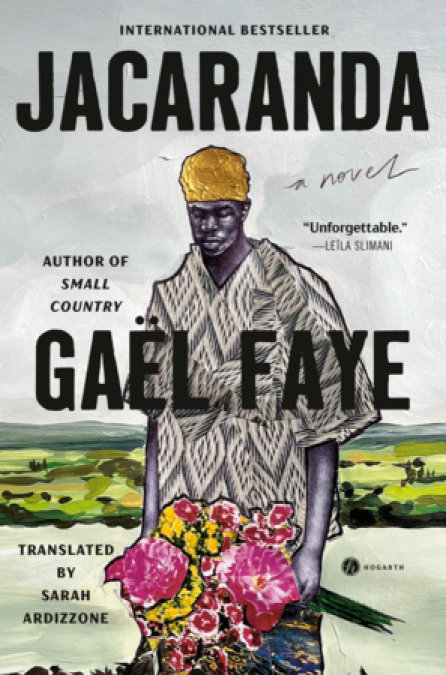
A young man journeys from Paris to Rwanda to discover the truth about his family’s past in this bestselling, prize-winning novel from internationally renowned Rwandan-French novelist and hip-hop artist Gaël Faye.
“There is magic in Gaël Faye’s writing . . . This book is unforgettable.” —Leïla Slimani, internationally bestselling author of The Perfect Nanny
“Gaël Faye’s talent is breathtaking.” —Imbolo Mbue, author of Behold the Dreamers
Milan—the twelve-year-old son of a French father and a Rwandan mother—blames flunking his exams on the emotional toll of the genocide in his mother’s homeland. In truth, his mother never talks about Rwanda; the violence is an abstraction that only reaches their French suburb through television broadcasts. That is, until Milan meets Claude, a small boy with a bandaged head whom Milan’s mother introduces as a cousin who has come to France seeking medical treatment. Milan embraces him as the brother he’s always wanted—until, one day, Claude is sent back to Rwanda without warning, leaving him heartbroken and confused.
Four years later, the boys reunite as teenagers when Milan visits Rwanda for the first time with his mother in the wake of her divorce and discovers a more fractured and vibrant community than he could have imagined. But the trip raises more questions for him than it answers—about family, the war, and its aftershocks. Over the course of many years, Milan will return to Rwanda again and again, compelled to unearth the secrets that have taken root in the shadows of long silences, confront the past, and imagine a new future.
Partly inspired by acclaimed author Gaël Faye’s own relationship with Rwanda and its history, Jacaranda is a rich and deeply felt portrait of a man seeking to understand his family and his nation as it heals from the unthinkable.
Release date:
August 25, 2026
Publisher:
Hogarth
Print pages:
272
* BingeBooks earns revenue from qualifying purchases as an Amazon Associate as well as from other retail partners.
The war! I have no idea why I said “the war,” when Sophie, our class representative, asked about my disastrous end-of-term results. She was preparing my defense for the meeting where the teachers would decide if I had to repeat the school year. “The war?” she pressed me. “Yes, the war.” I was hardly going to fess up to doing jack-shit, to being a wasteman who spent his time daydreaming and listening to rock. I needed a convincing explanation, one that couldn’t be checked out but would win Sophie’s sympathy. I could have volunteered a life-threatening disease, like cancer or heart failure, but that would’ve meant providing medical proof; or I could have told her that my parents had recently separated, except this was the case for half the students in our school and it didn’t stop them from making the grade. So, without thinking, I said it was because of the war in my mother’s country. I couldn’t believe I’d just lied like that! But the more I reflected on it, the more I reckoned my story sounded plausible. On the news, they’d been covering the conflict for weeks, broadcasting devastating images that lingered long in the mind. Yes, it involved distant events in an unknown country, but by then everybody had a rough idea what it was all about. I played my A-game and made the whole thing up: war atrocities, my mother’s grief, my father’s nightmares, how hard it was to concentrate and carry on with my studies. I knew my lie was working because Sophie listened with tears in her eyes. During the meeting with the teachers, she made my case powerfully, repeating my arguments with such emotion that the teachers, visibly taken aback, elected to press pause before determining my fate.
It hadn’t occurred to me that the school would summon my parents. I was caught in my own trap. In the principal’s office, sitting between my father and my mother, eyes down as my form tutor read out Sophie’s arguments, I stared at my foot, which was jiggling like crazy under the table. When we emerged from the meeting, and while we were still on school premises, my father gave me a roasting in front of a group of smirking students. But it was my mother’s silence that proved harder to deal with. Her customary silence. She stared at me for some interminable seconds, her gaze so scorn-filled it made me want to disappear forever. She didn’t speak to me for several days afterward. My school report arrived the following week. In the comments box, the principal had written a caustic: “When lies rise to the surface, trust ebbs away.” I was going to have to repeat my first year of secondary school. No surprises there.
That spring, Rwanda had invited itself into our lives for the first time. My mother had never spoken about it. For her, life began in 1973, when she arrived in France. She never mentioned her family, never talked about her childhood, possessed no photos from her youth there. When I was little, I must have asked her where her country was, and where her parents—my grandparents, who I didn’t know—lived. I don’t recall her answers. My mother’s past was a closed door. She didn’t listen to Rwandan music, didn’t cook any dishes from back home and never sang me lullabies in her mother tongue. There wasn’t a single foreign object in our house, and no Rwandan friends ever paid us a visit. In my mind, we were just an ordinary French family. Of course, my mother couldn’t hide the color of her skin, and so probing questions, offhand remarks and loaded insinuations regularly sent her back to the distant country she neither referenced nor defended. But she didn’t react, brushing them off as trivial. I don’t remember once hearing her complain or call out any sort of racism. What surprised people most was that she spoke French without any hint of an accent. They couldn’t get over it, congratulating her when they learned she hadn’t been born in France. Occasionally, she muddled masculine and feminine, or, when she was tired, she pronounced her l’s as r’s, but these were her only mistakes. My father claimed their difference in skin tone was never an issue for him. “Love has no color,” he often repeated. He said it proudly, maintaining he didn’t see my mother’s color. And, given she was altogether silent about her origins, I almost forgot she was born and grew up under different skies. So, when I caught her speaking Kinyarwanda on the phone, it stopped me in my tracks to hear her fluency in this unfamiliar language. I never found out who she was talking to. She remained evasive when I asked her about it, mentioning “old acquaintances” and her “distant family in Brussels.” These phone calls were my opportunity to spy on her. Her mannerisms, the way she modulated her voice, her body language, even her hand gestures, they all turned her into somebody else, imbuing her with a mysterious aura which I found deeply unsettling. To watch her in this new incarnation provoked a fleeting but unpleasant sensation in me: that of not knowing the first thing about the person I had lived with all my life. I had the terrible feeling I was a stranger to this woman. My own mother.
Rwanda came into my life via television, which we watched religiously during our evening meal. The first time the presenter talked about it, I turned instinctively to my mother, excited, elated almost, that her birth country should have made it onto the news. But she didn’t react, lost as she was in the pictures on the screen. Noticing my feverishness, my father threw me an awkward look in an attempt to discourage me. When the program ended, I waited for my mother’s reaction, which never came. The same scene played out every evening. For months, a magma of images depicting death, violence and exodus flowed onto our plates. Before the report, the presenter was careful to advise us that viewers might find some of the content distressing. We sat there in silence, staring at the screen, our forks in the air, frozen like statues before this spectacle of faraway barbarity. Then the presenter returned to our screen to introduce another news item. There would be an awkward silence before the normal routine resumed: my father pouring himself a glass of wine, my mother sprinkling pepper energetically onto her potato purée, me struggling to cut up my steak and erase the scenes of horror which had just crashed into my world. In our household, we swallowed distressing content in mouthfuls of silence. And I ended up with a terrible stomachache.
I can picture myself now, balled up on my bed for hours, sweaty forehead, forearms pressed against painful guts, hoping for the burning sensation to subside; I can picture myself in my bedroom, the afternoon drawing to a close as I stare at the passing shadow on one wall, a shadow that grows, flickers, shape-shifts and vanishes to the rhythm of the sinking sun and the impending darkness; I can picture all the hours I lay there, somehow understanding the need to be patient, that I didn’t yet know what life intended for me, that the flip side of not knowing is waiting: a long, cool, determined wait.
We hope you are enjoying the book so far. To continue reading...

 Please log in to recommend or discuss...
