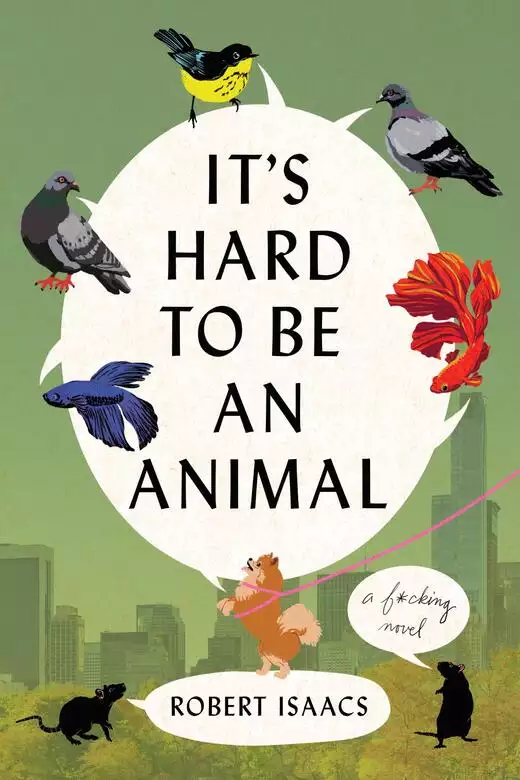
For readers of Shark Heart and Hollow Kingdom, a funny, magical, and tender debut novel following a lonely, conflict-averse man whose sudden ability to understand animals sends him on a wild romp around NYC, and ultimately helps him discover his own voice.
Strolling through Central Park on a blind date with the hilarious, irrepressible Molly Bent, Henry Parsons feels hopeful for the first time in years. He’s even daring to wonder if he and Molly might have a future together... when a migratory warbler, the sweetest of little birds, tells him to f*** off.
A gentle soul, troubled enough by the unkindness of fellow humans, Henry tries to brush the moment aside as a hallucination. But soon he’s hearing voices everywhere: dogs mocking their owners, sparrows fat-shaming each other, police horses profiling attendees at a street fair — even a pontificating, misogynistic snake. The man who never speaks up for himself is now besieged by animals who do.
When (inevitably) he overhears three rats discussing a corpse in the New York subway, he lets it slip to Molly. She’s keen to investigate, and Henry’s desperate for a second date, so he follows her nervously into an abandoned tunnel under the West Fourth Street Station. There, sure enough, they find a body... and the murderers find them.
Cue the most terrifying week of this cautious man’s life. Inspiration and courage arrive, unexpectedly, from a pair of feuding betta fish and the neighbor’s yapping Pomeranian — whose wisdom will transform both Henry and Molly forever.
Release date:
May 19, 2026
Publisher:
Grand Central Publishing
Print pages:
272
* BingeBooks earns revenue from qualifying purchases as an Amazon Associate as well as from other retail partners.
Café tables crowded the narrow sidewalk, so close to the curb that Henry felt the wind of passing trucks. He took the side facing oncoming traffic and waited for Molly to sit. Within the hour, a migrating songbird weighing less than an ounce would upend his life… but that agent of destiny was still nine miles north, winging over a lumber yard in Yonkers, so the date began normally enough.
“About coffee,” he ventured, fingering the napkin. “When I was growing up, all the adults drank it and none of us kids understood why. I still don’t. Does any hot beverage count, for a coffee date?”
“I think we can define the term broadly.” Molly tipped her chair sideways to let a busboy with an armful of plates slide through, and held up a cautionary finger. “Coffee will not be required, as long as you have a tantalizing, mysterious past involving unspecified heroism. Or a hot air balloon! Do you have a hot air balloon?”
“I do not,” he confessed. “It’s the parking. You move to Manhattan, you give up your dirigible.” She laughed and his heart spun around.
When the waiter arrived, Molly beat him to the punch. “I will have a latte, please, and one biscotto. Is that the singular? And Henry here wants Darjeeling tea, but bring us a cup of black coffee too, on the side.” Before Henry could object, she waved him off. “Let’s see! Maybe today’s the day you get your Grownup Card.”
The waiter nodded, perhaps grateful for a customer who didn’t waffle, and retreated.
In short order they dispensed with jobs, apartments, upbringing, hobbies, and the mayoral race that neither was paying attention to yet. Henry tried to remind himself that no relationships, and only one second date, had ever ensued from his co-worker Jackie’s relentless matchmaking. Still, here was Molly twenty minutes later, leaning across the table and using his coffee—or what was left after two brave sips—to finger-paint on the paper placemat. She seemed in no rush. Henry admired her sepia-toned hippo and sketched a dive-bombing kingfisher with one tine of his fork. The couple at the next table applauded both efforts.
“The Rambles?” he suggested a few minutes later, as they walked east toward Central Park. In the angled September sunlight, even the trash cans along West 104th Street looked jaunty.
“The Rambles are way down thataway.” Molly flung a hand off to the right. “Where’s your geography? Anyway, they’re always mobbed. I like the Ravine.”
Henry hadn’t heard of the Ravine and admitted it.
“Oh man! It’s the wild bit. Like, big trees. Honestly, it’s impossible to believe you’re still in Manhattan. We have to go. And we can play my game.”
The rules of Molly’s game, clarified as they crossed the avenue and entered the park, were straightforward: Player A strolls along with their eyes shut while Player B shadows them silently, offering the bare minimum of guidance to keep the walker on the path. As a joke, Henry immediately set off at a brisk tempo, midtown commuter speed—but apparently this was a standard variation, as it provoked no response. So he kept marching blindly up the hill: five, six, seven strides, and a few more. Still nothing from his guide.
Is she matching me step for step, he wondered, or trailing behind? Surely she wouldn’t let me crash into a tree. He almost lost confidence and faltered… then steeled himself: this is a test. Pass the damn test.
“A bit left,” she murmured, very close to his ear. He was startled but pivoted accordingly. The air felt different here in the park, with traffic noise fading behind them and leaves rustling above. Henry sensed it on his face, clean and aromatic, as he plowed forward like a ship pushing through water.
“Sharp right.” Her voice was now ahead of him. He wheeled rightward and she yelped. “Left! I mean left!”
His eyes popped open and his hands rose to fend off the linden branch eleven inches from his nose. Molly was laughing even before his fingers touched the bark, and she trotted back.
“I’m so sorry! Honestly, Henry, that was a genuine brain fart. Oh man, you’ll never play my games again!”
He laughed too, still coming down from the liberating thrill of the brief, blinkered walk. “I’m good!” The hand on his shoulder was a natural enough gesture to accompany her apology, but he tingled nonetheless.
“You do not lie, that’s a cool game. Exciting at the end too.”
She beamed. “Right?”
They stood on a macadam path dappled with fallen leaves and autumn sunlight. Massive tree trunks surrounded them, grander than the thin-limbed shade trees that lined the streets of the city proper. The competition for space and light was palpable—it felt like a proper forest, as if he’d hiked thirty miles north while his eyes were closed, rather than a hundred feet. And they had it all to themselves. Is this really me, he thought? Cautious, deferential Henry, standing here in the woods with this lovely, funny, irrepressible woman? The loneliness of the past three years seemed distant, like the faint twinge of an old injury.
“My turn. Revenge would be too predictable, so you can’t run me into a tree.”
She set off at a good clip and he trotted to catch up. The scrape of his soles on the ground felt intrusive, so he lightened his step and tried to move silently, positioning himself six feet ahead on the opposite side of the path. With Molly’s eyes shut, he could study her face directly—no need to blush and drop his gaze, no snatching of quick glimpses. She had balanced, proportional features, with vibrant skin and light brown hair swept behind her ears. “Pretty” was too ordinary a word, or insufficient at least: it was a uniquely open, honest face, whose unguardedness would stand out in any city. He tried to remember if her eyes were blue or brown. Then he registered, belatedly, why the question remained unanswered: she was sauntering along with such confidence, he’d forgotten the game.
“Slight right!” he blurted as her left foot landed halfway off the paved path. She grinned, thumbed her nose at him, and adjusted course. But her eyes never opened.
At the fork he hung back, by courteous habit, before realizing the decision was up to him. He glanced rightward: a shadier route, with a tempting curve. “Sixty degrees right.”
She paused, hauled an imaginary ship’s wheel around, and set off at approximately the right angle. Leaves crunched underfoot. “The path less taken,” she noted.
Twigs swayed down and briefly ruffled Henry’s sandy hair; the breeze, unexpected here in the woods, felt soothing. A flash of yellow caught his eye. He scanned and saw nothing, then spotted it again: a small bird, perched delicately on a branch about four feet above the ground and eyeing them watchfully. The top of the bird’s head was gray, but its neck and body glowed brilliantly yellow. Jet-black stripes trailed across its chest like an elegant cravat that had come undone.
“Stop a moment,” he said quietly. Molly paused a few feet away, freezing her arms in mid-swing. “Forward very softly, just two steps or so.” She smiled and followed suit. “Turn to your left, twenty degrees. Open your eyes.”
She did and her mouth dropped open in silent delight. They both held very still while the bird examined them. It was only six or seven feet away, balanced on the bobbing needles of a cedar.
“That color!” Molly whispered.
Henry nodded. “Look at the black stripe across the eyes. Like the masked villain in a superhero movie.”
“A tiny villain,” she agreed. “But good-looking.”
“Magnolia Warbler, I think.” He was confident in the identification, but didn’t want to sound like a show-off.
Molly, however, was charmed. “Oh, I knew you’d be the type who knows!” Henry ducked his head, embarrassed. “Are they native here?”
“They migrate. This one’s probably heading to Cuba, or even Guatemala. Could have started up in Maine.”
“Damn,” Molly said, impressed. “That is a long flight for little wings.”
The warbler hopped lightly to a lower branch and considered them with alert black eyes. Then it tipped its head back, fluffed the feathers around its neck, and snapped, “Fuck off!”
Henry jumped.
“I mean it.” The warbler’s voice was small but clear. “Fuck. Off. This here’s my turf today.”
Henry looked to his right, then left, whipping his head around so fast a muscle twanged in his neck. Where could the sound be coming from? It was a timbre he’d never heard before, liquid vowels with tiny, clicky consonants dropped in. Like whistled speech.
“Oh my gosh,” Molly cooed. “The song! It’s perfect.”
“Fuck the fuck off! Fuck off-off-off!” insisted the warbler.
“Can you tell if that’s a courtship song, or territorial, or something?”
Henry looked at her, startled. Did she not hear the cursing? But she was entranced by the bird. The warbler swore, “Jesus Christ!” Molly lifted her head and shut her eyes to listen, with a smile.
“Pure beauty, either way,” she decided. “I had a white noise machine when I first moved here—you know, to help you sleep—which was all birdsong. But it’s not the same.”
Henry refocused on the warbler, who stared him down malevolently. Behind the bird, bare tree trunks stretched into the distance. There was no one in sight. And nobody behind them, when he checked. Here in the woods it was just him, Molly, and this foul-mouthed Magnolia Warbler.
“Dude,” complained the warbler. “Are you deaf? Back, the Fuck, Off!”
Henry shut his eyes. I’m going crazy, he thought. I’m hallucinating. What kind of tea was that?
The warbler offered a final, dismissive “Asshole!” before darting up into the tree and out of sight.
“Magnolia Warbler,” Molly recited, practicing. “Magnolia Warbler. Safe flight, little dude! Saludos a Cuba!” She tucked an arm affectionately through Henry’s elbow and steered them both back down the path. “Now my day is complete,” she said happily.
Henry walked, stunned. What the hell just happened? He needed to sit down, catch his breath, joggle his brain back and forth to rerun the memory. But he couldn’t, because Molly was immediately onto the next game.
“Stand still,” she instructed. Then she began walking in circles around him, patting his head and saying, “Duck, duck, duck, duck, duck…”
She paused in front. “Most people think this isn’t a two-person game. But why not?” He tried to smile.
“Goose!” she chortled, and dodged behind him. Instinctively he thrust a hand out and caught her trailing wrist.
“Ah, ya got me,” she said, gracefully capitulating. “Your turn.”
Pause. “Did…” he began, then trailed off.
“Duck,” she reminded him. She planted her feet and gazed forward along the path, waiting expectantly.
Henry did the only thing he could: “Duck, duck, duck…”
At least this gave him a moment to collect his thoughts. Clearly—obviously—he didn’t just hear a Magnolia Warbler swear at them. He couldn’t have. Molly hadn’t noticed anything, after all. He needed to shake the delusion off for now, put it on the shelf for later pondering.
But the inexplicable moment put a clunk in his rhythm as they wound their way along the stream, past the Huddlestone Arch with its massive boulders, and around the Great Hill. At one point, midway through the tale of his first and worst job interview, he realized there was no punchline. Or at least none that would amuse anyone outside the field of informatics. He stuttered, tried to recover, and then aborted.
“You know, I’ve just remembered that this”—unable to find the right word, he gesticulated with annoyance at his own mouth—“is a lame story. I wish I could give you those two minutes back.”
Molly patted him on the shoulder. “Henry, my friend, we all have our lame stories. The ones we launch into before remembering they have no point.” She tapped on her scalp with stiff fingers, curled like a pianist. “In my brain, they get misfiled in ‘Anecdotes, Guaranteed to Amuse, Trot Out for Any Occasion’—I’m always finding shaggy dogs up there but never manage to refile them properly.”
Henry smiled gratefully. “It’s like the front of the story is so appealing, you forget to check out the back side.”
“There are people like that too,” she mused.
They were approaching the edge of the park now. On the other side of the low stone wall an M10 bus was pulling away from the curb, ignoring the older Asian-American woman who bustled toward it with a laundry cart of groceries, shouting, “Hold up, hold up!” Two food carts were stationed just north of the bus stop, one serving halal food and the other pretzels. Pedestrians streamed in both directions, flowing around each other without breaking stride or making eye contact.
“Well,” said Molly brightly, “this is me!” She gave him a peck on the cheek before he quite realized the date was ending. “This was fun, Henry! You are a sweet guy, just like Jackie said.”
He scrambled for words, but what came out was: “You too!”
“Excellent! We are two sweet guys!” Molly celebrated. Henry winced and was about to try again, but she said, “Oh, here we go,” and stepped into a taxi that had just disgorged its previous passengers.
She leaned out the open door. “Are you heading downtown?”
For a moment, he was tempted to lie, and hop into the cab to savor a few more minutes in her ebullient company. He could always catch the subway back north. But the clamor of street noise, all the busy, impatient energy of the populace that now engulfed them, somehow compressed his spirit back into its usual, careful, passive mode. His heart shouted, “Just jump in!” but what he said aloud was, “I’m uptown,” cocking his head regretfully to the right.
“Uptown Boy,” Molly sang, and her fingers fluttered a wave as the taxi pulled away.
He gazed after the retreating cab for a moment, as the glow faded and the usual self-protective pessimism settled back around his shoulders, insulating him. This was great, he thought, but dude: she’s out of your league. Don’t delude yourself. Don’t taint the memory by hoping for more.
As he turned to walk north, a pigeon swooped over his head, perilously close, and with a start he remembered the warbler. Already, unconsciously, he’d convinced himself it hadn’t happened. Some explanation would eventually present itself—hallucinations are real, after all. Then, bemused at his own mental phrasing, he amended: hallucinations are a real phenomenon, which some people experience. A topic to bring up with Murray, his therapist, with whom he rarely had interesting symptoms to share.
Do any warblers learn words, like budgies or parrots? Could it have been an escaped pet?
It didn’t happen, he told his brain sternly. Leave it alone. Leave it for Murray. He banked left and trotted down the stairs into the subway at 110th Street.
As always, the last few steps toward Henry’s building brought a sense of relief. The modest third-floor walk-up he shared with his housemate, Yaryk, was the only place he felt truly at ease. He liked sitting on his own frayed, moss-green couch, in the company of familiar books and plates and towels; they gave him a sense of belonging. Life anywhere else in the city required breathing borrowed air, occupying temporary space, infringing on someone’s territory. Yaryk, who’d arrived from Belarus with only a suitcase, waxed enthusiastic about every new lamp, bookcase, or kitchen implement Henry introduced, so he could furnish the apartment according to his own taste. Yaryk’s away ’til Tuesday, he reminded himself: gotta feed the fish.
He passed through the dimly lit lobby and took the stairs two at a time, feeling youthful. The warmth of the date was coming back—little snatches of conversation, funny moments he could rerun and chuckle at again. And Molly’s spur-of-every-moment joy, her cockeyed, sideways amusement at… well, everything. Her playfulness had released him in a way he hadn’t felt for ages.
As he unlocked and pushed through the apartment door, he heard a voice from the living room, faintly accented. Was Yaryk home early, the trip canceled?
“May jackals pick over the putrid scraps of flesh on your scattered bones!” the voice intoned, with somber gravity. “May all future generations lament your foul deeds, curse your inheritance, and eradicate your memory.”
“Yaryk?” Henry called.
Another voice replied, cold and judgmental. “Your words are but dust, pulled apart and scattered by the meanest of breezes. Fair nature itself abhors you, a miscegenation, a blot upon evolution.”
Henry locked the door behind him and furrowed his brow. Had Yaryk brought a friend home? Or left the radio on? He turned the corner into the living room while the first voice was sneering, “Pah! From some fetid crevice you arose, and will ignominiously return… yet find even there no welcome.”
There was nobody in the room. His morning tea mug sat, forgotten, on the coffee table, next to the pile of New Yorker magazines he never kept pace with. The radio was off. The window was shut. He scanned around, but nothing was out of place: mismatched bookcases, venetian blinds, woven chenille sofa, faded sky-blue papasan chair, two framed prints, a rustic mirror made from a reclaimed window frame, tan-on-white swirly carpet. No voices—in fact, hardly any noise at all; this was the selling point of the apartment, which faced an inner courtyard rather than the street. He stood in the center of the room and slowly rotated, yet all looked normal.
A small, hard kernel of worry made itself known in his chest. That’s twice in one day, he thought. More hallucinations. Am I safe? Who do you call when this happens?
He sat on the edge of the couch, back straight, listening intently. Nothing to hear. Nobody in the apartment, no other source of sound… which meant, again, he must have imagined it. And he was hungry.
Stick to routine, he thought uneasily. Sometimes, symptoms present and fade away with no cause ever identified. Report the aberrations to Murray tomorrow, but keep your body healthy in the meantime. Which means dinner.
He stood and headed toward the kitchen, then paused to scold himself aloud: “Henry, you forget your manners! First feed those who can’t feed themselves.”
Yaryk’s pair of betta fish, one resplendent blue and the other a fiery orange, waited in two separate half-globes mounted diagonally on the wall about eighteen inches apart. They couldn’t be housed in the same tank, Yaryk had explained, as they were aggressive. Otherwise, they were very low-maintenance pets: sprinkle a few flakes of food every day, trade in fresh water once a week, that was all.
Henry had felt uneasy when they arrived—it seemed unkind to confine any living thing in such a small space—but Yaryk assured him the pet store clerk gave a full briefing and recommended this setup. And it was diverting, even meditative, to watch the fish as they explored their humble domains. They were like pure color brought to life, oversized fins and spectacular fantails rippling like the drapes and folds of an elegant evening gown.
He dropped a pinch of food in the upper tank for the blue fish, whom his roommate had named Lazavik after a whip-wielding figure from Belarusian folklore. Lazavik darted to the surface, gulped a flake, peered down at his neighbor Dzedka (another folk name), and proclaimed in a prim, tenory voice: “These blessings fall upon me to confirm the rightness of my path; your bowl is as dry and empty as your heart.”
Henry froze.
Dzedka looked up and retorted, “The nutritious grain which passes through you becomes a foul dropping, bespoiling your tank; so it is with all things unlucky enough to touch your accursed flesh.” His tiny lips moved almost imperceptibly, yet the enunciation was edged and precise.
Henry felt light-headed, and sat on the floor before he could faint.
The fish were silent. Dzedka swam gently to and fro; Lazavik nibbled another flake.
Henry covered his face, pressing fingertips tightly into his forehead, and issued a muffled “Jesus.” He sat that way for a full minute, breathing unsteadily and trying to think, but his mind remained blank—as if he’d sent back a query, a memory call, and the internal librarian returned with empty hands and a shrug. He dropped his arms and hugged himself.
This is mental illness, he thought. Vaguely he remembered that schizophrenia could manifest late, even in your twenties. Yet wouldn’t there be warning signs, clues in advance? Although he’d been a sensitive child with easily bruised feelings, and had grown into a reflective, shy adult, he’d never had cause to fear for his fundamental sanity. Nor had his therapist ever intimated such a concern.
He peeked between his fingers at Dzedka, the orange fish, hanging motionless in the water just below Henry’s eye level. “You’re a fish,” Henry told him accusingly, but felt foolish as soon as the words came out. Now he was remonstrating with marine life: surely another troubling sign.
If Dzedka heard Henry’s complaint, he didn’t respond. He twisted halfway toward the window, then rippled and abruptly pointed up toward Lazavik. “May boils scar you,” he called across to the other tank, “and pestilence trouble your eyes, and thorns prick your feet at every turn.”
He doesn’t even have feet, Henry thought. Neither do you. And jeez, why do they hate each other so much? Then he grimaced and shook his head as if trying to dislodge a fly: this is a delusion, it’s not real. He slapped his cheeks a few times and stood up. He dropped four flakes of betta mix into Dzedka’s tank. They floated on the surface, then disappeared one by one as the orange fish darted upward in repeated lunges. Lazavik, his meal already finished, was gazing in the other direction, fins and tail only occasionally flickering.
Henry returned the betta food packet to the shelf, backed away slowly, and went into the kitchen to feed himself.
Henry didn’t fall asleep easily. His mind caromed between unsettling lines of thought. There was the worrisome possibility of insanity, but he was also distressed by… well, how angry they all were! That Magnolia Warbler, whose glowing plumage darted joy into the heart of every birder who spotted him—such a gorgeous bird, spluttering with foul-mouthed fury? And Lazavik and Dzedka: trapped in an eternal duel like two characters in a Beckett play, unable to attack or retreat, channeling their hatred into baroque oaths which they flung like spears back and forth… how could these beautiful life-forms harbor such bitterness and loathing?
But wait. Now he was embracing the figments as real—surely an escalation of delusion. It’s one thing to hear voices in your head, but quite another to conclude your fish are actually trading smackdowns. Jesus Christ.
Then a. . .
We hope you are enjoying the book so far. To continue reading...

 Please log in to recommend or discuss...
