
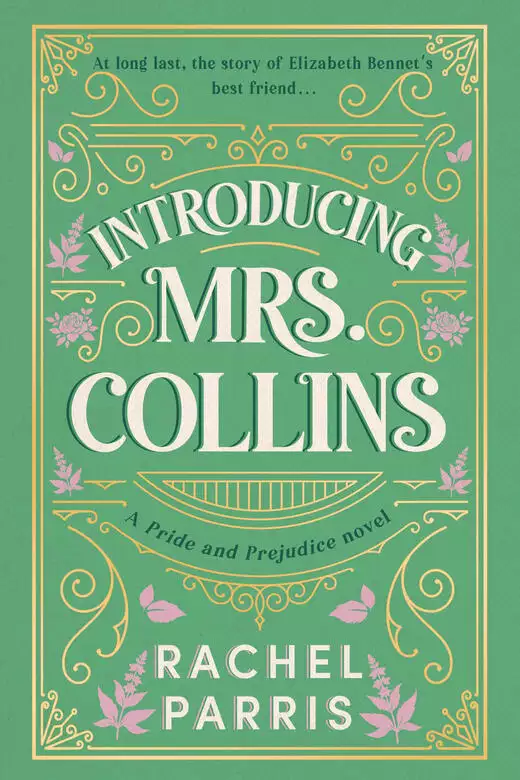
Introducing Mrs. Collins
- eBook
- Paperback
- Audiobook
- Book info
- Sample
- Media
- Author updates
- Lists
Synopsis
It is a truth universally acknowledged that a woman deserves to be the heroine of her own story.
Charlotte Lucas has never been a romantic. Practical to a fault, she accepted Mr. Collins's proposal with clear eyes and a steady heart, trading passion for security. Life at Hunsford Parsonage may be quiet and predictable, but it is hers to manage—and she's determined to make the best of it, whatever her friend Elizabeth Bennet may think.
That is, until an unexpected guest at nearby Rosings Park turns Charlotte's careful world on its head. He sees her, challenges her, and a spark is lit.
Torn between what she must do and what she truly desires, Charlotte finds herself at the center of a story she never expected to be hers. A tale of love, loss, and second chances, Introducing Mrs. Collins is for anyone who wondered if there was more to the sensible character we met in Pride and Prejudice. It is the story of a woman who had written herself out of her own life and is only now daring to want more.
Release date: November 4, 2025
Publisher: Little, Brown and Company
Print pages: 384
* BingeBooks earns revenue from qualifying purchases as an Amazon Associate as well as from other retail partners.
Reader buzz
 Please log in to recommend or discuss...
Author updates
Introducing Mrs. Collins
Rachel Parris
Am I doing the right thing? she wondered briefly.
But Charlotte had lived for twenty-seven years doing the right thing. She had been, at varying times, dutiful, obedient, prudent and polite – at least in public. Whether or not this was the right thing was yet to be determined, but it was her choice, and hers alone, and that in itself gave it merit.
‘Yes,’ she answered. ‘I accept.’
She and Mr Collins stood in the lane, soggy leaves and wet gravel beneath their feet. She shivered; she had not had time to find a shawl. Mere minutes earlier, she had seen him approaching her house, walking with some purpose and, keen for a private moment without her family listening, she had run outside into the cold to greet him.
In truth, she had guessed in the last few days that the prospect of his asking her was a possibility, and she had prepared herself for it. Knowing that today was his last day in the neighbourhood, she had stayed near a window, ready, waiting, thinking about her answer, wearing a pretty but modest dress. No shawl though; it really was just the cold that she hadn’t planned for.
Now, Mr Collins was approaching her too quickly, closing the few feet of space between them, gravel crunching underfoot with a wide smile on his face. ‘Miss Lucas, your answer delights me more than you can know!’
He reached out to grab her hands, and she instinctively withdrew them, then realised her mistake and offered them out for him to hold. His clammy fingers found hers, and she trained her eyes on his face.
His face. A placid smile was fixed on her own but, as she studied his, she thought what an odd face it was: not ugly, but somehow almost without feature. If she were asked to describe him to a stranger, she would not know what to say. For some reason, she was briefly fixated on this obstacle.
His eyes are blue, she could safely observe, but beyond that she would be at a loss. He has cheeks and a mouth she might continue. Neither sharp not rounded, neither merry nor serious. His nose was a nose such as a man might feasibly have; his eyebrows were where they should be, more or less. She thought she might be having a turn.
Tall, she thought. He’s tall; that much I can be sure of. She was relieved.
He was still holding her hands and seemed quite content. She had never looked another human in the face for this long before. It was almost meditative. And he has dark hair! There! thought Charlotte. Not featureless after all – he is tall, dark and… pious.
He was still holding her hands, and she believed even he didn’t know what to do with them. His grip was gentle. She would try to put that down as a positive.
After an awkward two minutes of clasping, he placed one of her hands on the other and patted the top one before finally releasing her. ‘I should not keep you out in this weather, Miss Lucas. I shall talk with your excellent parents, and then I shall take my leave. We shall start making arrangements immediately, I think?’
‘Yes,’ said Charlotte, rather dazed, and then, rallying herself, ‘Yes, we should indeed!’
And with such assurances, Mr Collins walked towards the house and found the front door opened for him before he could knock. So much for privacy, thought Charlotte; someone had certainly been watching. He looked round at her and waved continually as he took small backward steps into the house, as if Charlotte were the Prince Regent.
Once he seemed safely inside, presumably in the library with her father, Charlotte crept into the house through a side door, found her way to the parlour and leant against a wall.
At that moment Charlotte found herself alone, with leisure to really consider the step she had just taken. She looked about the room; it had a cold light in the mornings, being north-facing, and the effect was enhanced by its pale-blue walls. And yet it felt warm, inviting, because it was filled with items she knew so well: the mahogany cabinet bursting with books; the old, worn globe that sat in the corner, moved there because it had kept getting scorched by the fire; the figurines on the mantelpiece, always treated with such care by her mother; the portrait of her grandparents, gold-framed, above the fireplace. She looked closely at that picture. Even in a formal stance, her grandparents succeeded in looking happy with one another.
Charlotte pondered whether she would find such happiness in years to come, for she did not feel it yet. She had not expected to feel a rush of love or a giddy excitement following her engagement – and she didn’t, so her expectations were met. Good. Such feelings were reserved for younger or more romantic people – people like her sister Maria or her friend Elizabeth. She also did not expect to feel those things because this was, after all, Mr Collins, not a commanding naval captain or a rakish duke, nor even a particularly burly farmer. This was a financially stable clergyman with a large vocabulary, an even temper and the prospect of a generous inheritance.
She sat down. She drank the remains of her tea, which had long gone cold. She could tolerate cold tea. She could tolerate a great deal. Mr Collins had taken six full minutes to propose, during which time he had not required any response from her. He had listed every reason he had for marriage and for marrying her. If there were one word to describe the proposal, it was thorough. But in fact, this had given her ample time to compose herself, and once he had finished, she was able to greet him with a firm answer. His style of proposal suited her rather well.
And now, having given him the answer, she half-wondered whether she might panic; she put down the cup just in case. This had been, after all, quite a morning. Her life would now change completely; she would marry, move away, leave her friends and family. She had just attached herself, forever, to someone she did not know and who, judging from this short acquaintance, seemed to have half her intellect and a great many opinions about chimneys. She had reason to panic. But such a response would have been a first for her – and it did not come.
Her mother entered the room, shutting the door behind her, and looked at her daughter quizzically.
‘I said yes,’ said Charlotte, as if in answer.
‘I know, darling. Your father has given his permission.’ Lady Lucas searched Charlotte’s eyes and did not see what she had hoped to. She wanted nothing more than to see Charlotte settled, but she was also a sensible woman and knew the compromise this was for her clever, cherished daughter. Charlotte’s acceptance had surprised her greatly. ‘Charlotte, are you absolutely sure?’
Charlotte was irritated by this. She knew she would likely have to endure disapprobation from other quarters, but she resented having to defend her decision to her own mother, who, of all people, should understand her circumstances. ‘I am not given to rashness, Mother, as you know. Yes, I am sure. In truth, as soon as he arrived in the neighbourhood, I saw what a strong prospect Mr Collins was for marriage.’
‘Materially.’
‘Not just materially,’ snapped Charlotte. ‘He seems calm, well-educated, and with good connections.’
‘He proposed to Elizabeth only days ago! You must understand my misgivings?’
‘I do not relish that history either, Mother!’ replied Charlotte hotly. ‘I’m not delighted that he was interested in my friend before he noticed me; I do realise it is not the romantic ideal. Nobody will be writing about this union in novels or committing it to poetry. I shall not recount these details to my grandchildren as a touching story. But I will not allow my pride at being second choice to stop me from taking up what I believe to be a good opportunity.’
Her mother nodded rather sadly.
This irritated Charlotte more. ‘Mother – I am engaged! This is happy news.’ Charlotte didn’t look happy; she looked livid. ‘I do not wish to console you on my choice of husband. You should be congratulating me. It is a good offer—’ Charlotte started to say, then added more bitterly, ‘It is an offer.’
Her mother did not answer immediately. She occasionally regretted the extent to which her daughter had inherited her practicality. She sometimes wished she had raised Charlotte to have more whimsy, more naivety. Lady Lucas herself had married for love and, while not regretting it, had known enough financial constraint to want security for her daughter. But she also wanted love for her. And she knew this was not it – she didn’t even need to ask.
Charlotte now had tears in her eyes and a reddened cheek. Mothers can have this effect on daughters, at any age and in any situation. No matter the fierce and independent women they grow into, daughters still long for their mother’s approval, and Charlotte was still waiting for hers, frustrated and a little hurt.
Lady Lucas looked closely at her eldest daughter, her first-born – her favourite, in truth. She moved closer to her, holding out her hands, and Charlotte instinctively reached out and took them. They stood together, eye to eye, as her mother tenderly moved a stray hair off her face.
Lady Lucas sighed. ‘You deserve the world, Charlotte. But we do not always get what we deserve. Our task in this life to is to find happiness in what we are afforded and to improve what we find.’
Charlotte’s mother had a great many idioms and proverbs at hand for every occasion, many of which she had rendered in embroidery and hung over the mantelpiece. They were mostly lessons in stoicism and had certainly had an impact on Charlotte’s outlook, even if they made for rather drab decoration.
Charlotte nodded. ‘I know. That is why I—’
‘I know, I know. It is a good offer,’ said Lady Lucas more encouragingly. ‘I understand. You will have your own household, your own society and, God willing, children. The gift of children is worth putting up with a great deal. I will only ask you once more, and then will never repeat it, I promise: are you sure?’
Charlotte’s eyes were dry now, and her heart had calmed. She came back to herself, rather harder and more resolved. ‘It is a good match. I knew my mind when I accepted, and I shall remain firm on it. I shall have a home of my own. I shall start a life of my own. I have made my choice.’
Charlotte Lucas had not been offered many choices in her life. As the eldest of seven siblings, living still in her parent’s busy home – which had more good standing than it did income – she had been shaped into a woman who was above all rational. And like many rational women, she was somewhat undervalued.
Her family’s circumstances appeared rather elevated, but while her father was now a knight, his background had been in trade. He had risen first to mayor, from the influence accorded to him through his success in business, and from there, he had managed to propel himself to his current status. He was very gracious in his new position, displaying the confidence and merriness that had helped get him there, and even his appearance suited it: red-faced, rotund and tall, he was the picture of a beneficent gentleman. But once knighted, he had found a disgust for the business that made his fortune, and he had turned his back on it altogether, thinking those days behind him and beneath him. This had not been a wise or timely decision, as his wife had warned him, but his optimism trumped her caution, and Lady Lucas had not felt secure in their fortune since that time. If her husband could be elevated, he could as easily fall again, and she had readied herself and her children for such an event.
Charlotte had been raised in this careful, watchful spirit. She was diligent in her studies, not just to give off the air of being accomplished but because her future might yet require the ability to teach. She was helpful in the kitchen, not only to have a well-rounded knowledge of food and flavours, but because extra help was necessary. She was patient, not only with her siblings and with her friends but with her own prospects.
Love suffereth long…
Not only was this another of her mother’s embroidered moral decorations, but it was a phrase Charlotte had heard in church on countless occasions.
Love suffereth long and is kind. Love vaunteth not itself, is not puffed up. The passage from Corinthians made its way into almost every marriage service.
‘The bride looks like she suffereth long and is a little puffed up,’ Charlotte had once whispered to Elizabeth at a friend’s wedding. Elizabeth had snorted, attracting disapproving looks across the pews. Charlotte had kept a straight face – always the good girl to all appearances.
So, Charlotte knew that she, too, must suffer long. Over many years, she had watched friends and cousins find their partner and marry and move away from her and make a life of their own. Sometimes, they stayed within the neighbourhood; sometimes, they moved to another part of the country entirely or, in one case, to Woking, which was worse. She had found herself looking upon these partnerships and departures with a detached air, enough that she had almost made a study of it: the art of securing a proposal. She enjoyed espousing her theories of courtship to friends, in part to mask the fact that she’d had no experience of it herself. She had many views on romantic love and yet had never felt it. She was, in truth, sceptical that it existed, which made it much easier for her to be logical about it.
Charlotte had never been courted. She had read about love in literature (and even, occasionally, in the scandal sheets) and had wondered when it would come for her, but it never did. Neither from her nor towards her. And so, she had decided she was an unromantic person, a woman for whom love held no interest.
But she was interested in marriage. Marriage had the potential to offer her more freedoms and more security – an attractive combination – and it was one of the few choices afforded to a young woman of her standing. But Charlotte, at twenty-seven, having been out for ten years, had begun to realise that she was unlikely to receive even that choice. No option had ever been presented to her.
Until today.
The next morning, Charlotte set off for Longbourn, wrapped up warm, steeling herself for the winter winds and for Elizabeth’s reaction, uncertain which would be colder.
She had been determined that the news of her engagement would not reach Elizabeth’s ears unless it was from herself. The greatest threat to this was Mr Collins himself; he had been residing at Longbourn, Elizabeth’s family home, for the past fortnight, but Charlotte had entreated him to keep their engagement quiet until his departure, and he had set off this very morning.
Charlotte Lucas and Elizabeth Bennet had first met five years earlier and in spite of the seven years that separated them in age, had taken a liking to one another almost instantaneously. While Jane, the eldest Bennet sister, was the more natural companion for Charlotte; closer to her in age, and in temperament, it was Elizabeth who proved to be the right match. While it was obvious to all of Meryton society that the pair shared a sense of humour, their friendship had deeper roots. In Charlotte, Elizabeth found a patience and steadiness that was a welcome contrast to the Bennet home, a house held hostage by the chaos and caprice of Elizabeth’s mother and her younger sisters. As for Charlotte, she found in Elizabeth a boldness and spontaneity she often felt she herself lacked.
That said, she knew her friend well enough to know she was a romantic and somewhat judgemental. Of course she was: being judgemental together was one of their favourite pastimes. How unhappy a circumstance to now be the subject of that censure, when ordinarily they would share in it.
As Charlotte was a just a few steps from the doors of Longbourn, Elizabeth herself opened them and welcomed her with a wide smile. ‘Oh, Charlotte! Come in! Oh, I feel like I could sing!’
‘Please don’t!’ Charlotte replied teasingly, pleased to find her friend in high spirits. ‘What has brought on such drastic behaviour?’
‘Why, you will join us in it when you hear – we may all breathe a little easier. He has gone! At last! Farewell Mr Collins!’ cried Elizabeth.
Two of the other Bennet sisters stood behind Elizabeth in the hall: Jane, the eldest, and Lydia, the youngest. There was a giddy relief among them all – even Jane, who was usually tolerant to a fault.
Charlotte smiled awkwardly.
‘Although,’ continued Elizabeth, ‘he threatens us with another visit, so while he is gone for now, we must be ever ready for his unfortunate return.’
‘Like ringworm,’ added Lydia gleefully, earning a look of disgust from Jane and a chuckle from Elizabeth.
Charlotte spoke before more was said that pained her. ‘I have news, Eliza. Could we speak alone?’
Elizabeth’s face fell serious. She showed her friend into the parlour and ushered out yet another sister.
Charlotte sat and looked her friend in the eye.
Like a cold bath, it was better to just get into it directly without delay; Charlotte knew trepidation would only make things worse. ‘Mr Collins called on me yesterday, and he asked me to marry him.’
Elizabeth gasped, and her hands covered her mouth. She, again almost laughing, uttered, ‘Oh! Charlotte! I am shocked… so soon after he asked… but anyway, I am sorry for you! Was it very awkward? Did he take—’
‘And I accepted him. We are engaged.’
Elizabeth let out the remaining half-laugh she had been holding in. But seeing the seriousness on Charlotte’s face, she stopped. ‘Engaged to Mr Collins! My dear Charlotte, impossible!’
Charlotte had expected this indignation and kept her reserve. She cooly defended her position, and Elizabeth, with some effort, held back her natural incredulity long enough to offer mealy-mouthed congratulations. Both unable to speak further, they joined the Bennets in the next room, relieved for a while by alternative company.
But as Charlotte was preparing to take her leave, Elizabeth drew her back into the parlour.
Evidently her feelings had been bubbling away, and she now allowed them to burst forth, saying vehemently, ‘Why? Why did you say yes Charlotte? He is dreadful.’
‘He is not to your taste.’
‘He is not to your taste, Charlotte. We have laughed at him together. How can you make this decision? It makes no sense!’
‘It makes perfect sense, Eliza. I am unmarried and older than you, and unlike you, I am not inundated with interest from all quarters.’ Charlotte’s patience was now wearing thin.
‘Better to be alone than tied to a man like that.’
‘Is it? Are you so sure? What experience have you of being alone? And living on what? You would have me be a spinster into my dotage, while you are married with children and a home of you own, and I, a lonely friend you have to visit occasionally. Is that what you would wish?’
‘What is this fantasy you’ve concocted? Charlotte, I do not know from where these thoughts have come—’
‘I have thought about this for years, Eliza! Do you not imagine that every season, each as fruitless as the last, I have wondered what my future will look like, wondered how I will secure my happiness, a home, a family. Have you, as my dearest friend, never considered that question for me? Or have you thought only about your own prospects, which are so much happier? Did you not think, in turning down such a man as Mr Collins so easily, what a lucky position you were in – to feel so certain of what you have to offer, of your looks and your advantages, that you need not even consider it? What a luxury that is, to be so sure. I do not have that luxury.’
Elizabeth was quiet but not calm, and she could not look her friend in the eye. After a minute, she said, ‘I hear what you are telling me, and I do understand your fears… but I cannot believe you will find solace for them in that man.’
‘I had hoped for support from you…’ Charlotte’s voice was low and warning now.
Elizabeth crossed towards the fire and began furiously poking it.
Charlotte continued, ‘I knew you would not have done the same thing, but I am trying to do the right thing for myself—’
‘You are not doing the right thing!’ cried Elizabeth, rounding on her.
There had never before been a scene like this between them. For a moment, they each raged silently. Elizabeth was more openly agitated, whereas Charlotte, cursing the tears in her eyes, slowed her breath and found her stillness, which was a power of hers.
‘You have made your feelings clear. Perhaps I will see you before I leave. Good day.’
Her cool grey eyes could have chipped ice into Elizabeth’s, as she rose and exited the room.
Charlotte walked quickly out of the house, avoiding any other Bennet, and made her way towards home.
Once out of sight, she bent in two, stumbling and sobbing. She thought the sorrow would overwhelm her. She felt more let down by Elizabeth than her heart could endure; she felt tangible sharp pains in her chest. She had never been subjected to such an outpouring of disdain. And from the person she esteemed most in the world! She had read pity and disgust on her friend’s face and had been made to feel foolish and small. Of the faults she knew others levelled at her, foolish had never been one. Plain, certainly, a little stiff, but not foolish. Foolish like Mr Collins… And now, she had to start a new life with him, without a friend.
All morning, she had stood firm, but now she felt the ground go from beneath her. She stumbled home unsteadily and ran upstairs. She pulled her shoes off and threw them in the corner, tore off her jacket, loosened her stays and got into bed. So much had changed in so short a time.
‘Was that you, Charlotte?’ she heard her mother call from downstairs. ‘Is all well?’
‘Yes, Mother,’ she called back in a reassuring tone, while pulling the covers up to her chin. ‘All is well.’
2nd December 1811
My dearest and most precious lady, the keeper of my heart, Charlotte,
The very name now makes my heart sing – I know not what hymn, my dearest, perhaps even a Wesleyan anthem, but certainly a song of praise and of thanks, and one approved by God and by your father. I knew in my heart (though not immediately in my head) as soon as I met you that you must be intended for the place in which you have found yourself – by my side. I believe it is not only God’s intention for us to wed but also mine.
Your first thoughts upon reading this must surely be to wonder how the news of our forthcoming nuptials has landed upon the auspicious ears of my esteemed patron Lady Catherine de Bourgh. Allow me to put you out of suspense, my dearest one, without even a momentary hesitation – without even the suggestion of delay.
Before I impart her reaction, let me tell you that she was eager to know my choice and indeed asked about the subject even before I had raised it myself; such is her generosity of spirit. When I first described you, the conversation went thusly:
‘Who is her father?’ was her first excellent question, to which I replied simply, ‘Sir William Lucas of Lucas Lodge, my lady.’
‘Ah. Very well then,’ she replied.
Such vivacity of response is a great honour to you, my dear Charlotte, and when she heard that we were to marry forthwith, returning to Hunsford immediately, her delight was hard to surpass: ‘You may both visit me within the month of your return’ – an utterance that brings me only slightly less joy than your acceptance to be mine. Lady Catherine has such flair when it comes to her calendar.
To think of you at the altar before long is beyond delightful, but I am perhaps even more enthused to imagine that which must come next. I refer not to the necessary act that must take place within a marriage, which I should not draw your attention to so soon, but which I have now already put to ink upon the page, so I shall let it be. But I should be at pains to mention that the prospect of that act brings me no fear or foreboding. I am happy, and indeed willing, to fulfil the role bestowed upon me as your husband. However, the future thoughts I referred to above are not of that act, which I now regret the repeated mention of – but in fact, they are of you in my home – our home – settled and happy.
To think of you at Hunsford Parsonage brings me great joy. I have wanted little in life but the peace and security of a life of duty, a pleasant enough position in society, friendship enough to be visited from time to time, and most importantly perhaps, the love of a wife and a family. (The patronage of Lady Catherine is an addition to my joy I never even knew to wish for.) You are the key to my happiness, Charlotte; I hope I can be the key to yours. I shall endeavour to be – until death parts us.
I do so wish us joy, Charlotte. I feel sure we must deserve it – two fine, goodly, modest people, embarking on a life in Christ, and in Kent.
Your humble servant,
William Collins
3rd December 1811
Dear Mr Bennet,
I could not settle until writing to thank you most humbly for your hospitality in these past weeks. So much has happened in a very short time that I would think it had been a year! (Had I not the dates written down in front of me, which I have.) In fact, as I left, I overheard your youngest daughter remarking that it felt like a year since I had arrived! That shows how in accord I have been with your family.
Your kindness in permitting me to stay and in allowing me to partake in a variety of social occasions with you and your daughters shows a great generosity of spirit. While I admit that there were advantages for you in having a man of my position join you in such company, I assure you that it was I who felt fortunate, even more than you may have.
As for myself, I am delighted to tell you that I have recently found the very greatest felicity – and only a mile from your own door! I am engaged to Miss Lucas of Lucas Lodge. She has made me the happiest of men, and I hope that she will name the day as soon as possible. We shall be married from Meryton, and it is my wish, as well as hers, that you and your family might attend.
I must touch briefly on the subject of the entail. I will not be ponderous. There is no reason for me to be explicit about something that is already well known – that being the fact that, upon your death, I shall inherit the estate of Longbourn in its entirety, and your wife and daughters will be left with nothing, perhaps destitute. I have no wish to speak of it. And yet I must, only to explain that my sole purpose in proposing marriage to one of your daughters was in kindness and selfless Christian charity – an attempt to rescue them from the future that was before them. I now believe that Elizabeth did me a great service by refusing me. She saw very well that I was making too large a sacrifice in asking for her hand. I hope that, in the future, she may receive a proposal from a more willing gentleman – as distant a hope as that may seem to you and certainly does to me.
However, I hope that your wife and your daughters will feel compensated for their future loss in the knowledge that their home will now fall to such a dear family friend as Miss Lucas. It must give your wife great comfort to know that such an intimate acquaintance, who has known the house so well for many years – and is, after all, local – will have the honour of being its mistress. That thought – of your comfort – guided me in my choice of wife, and be assured I mentioned it in my proposal to her.
I need not tell you, sir, how happy my current circumstance makes me. You married for love, one presumes, and so you must know how much joy springs forth from such a union. You have only known Miss Lucas as a life-long friend of your daughter, whereas I, in a week, have the measure of her completely. She is the perfect match for me: her temperament is calm, her voice is melodic, and her words are easy to understand. I have found myself a diamond in the rough of Hertfordshire.
I am grateful indeed to you for the invitation of a further visit, and I will gladly oblige. I will return in a fortnight to stay at Longbourn. I will spend the chief of my days at Lucas Lodge, becoming better acquainted with my excellent new relations, but I will happily honour the Bennet family with my company in the early mornings.
Until then, I wish you and your family every happiness that can justly be afforded to them.
Your humble servant,
William Collins
‘The arrangement of the dinner service shows a fine taste, Lady Lucas, and may I admire your tablecloth? Is it cotton?’
Lady Lucas looked at her future son-in-law and fixed a smile on her face. ‘It is linen, sir. But I thank you for your attentions. It is a fine design.’
‘Fine indeed. I have always thought that simple floral patterns suit a house best, unless it is a very large, grand house, which may support a more complex aesthetic. . .
We hope you are enjoying the book so far. To continue reading...
