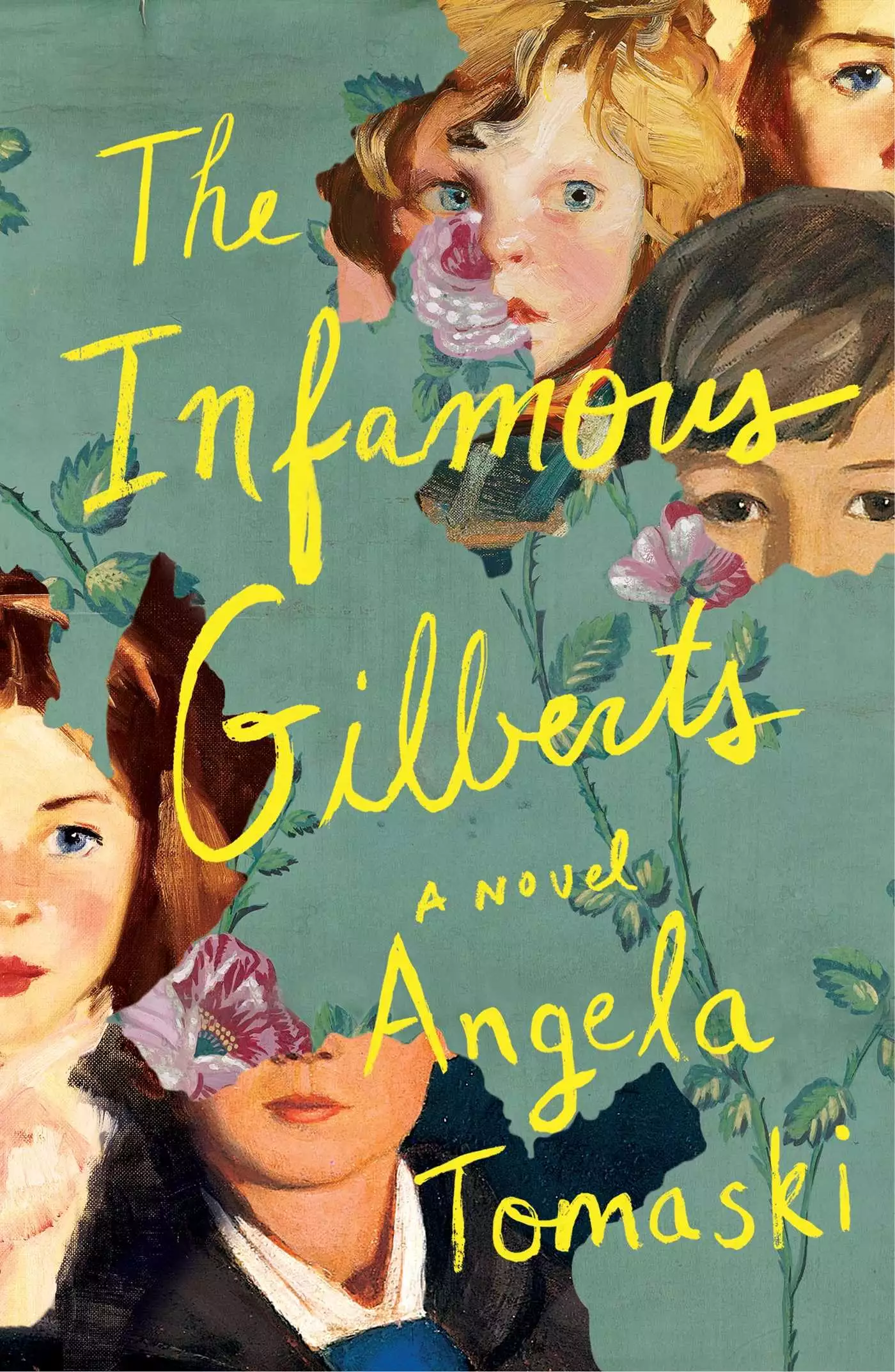
The Remains of the Day meets The Royal Tenenbaums in this darkly funny debut novel about a wealthy, eccentric family in decline and the secrets held within the walls of their crumbling country manor.
Thornwalk, a once-stately English manor, is on the brink of transformation. Its keys are being handed over to a luxury hotelier who will undertake a complete renovation—but in doing so, what will they erase? Through the keen eyes of an enigmatic neighbor, the reader is taken on a guided tour into rooms filled with secrets and memories, each revealing the story of the five Gilbert siblings.
Spanning the eve of World War II to the early 2000s, this contemporary gothic novel weaves a rich tapestry of English country life. As the story unfolds, the reader is drawn into a world where the echoes of an Edwardian idyll clash with the harsh realities of war, neglect, and changing times. The Gilberts’ tale is one of great loves, lofty ambitions, and profound loss, and Angela Tomaski’s mordantly witty yet loving account is an immersive experience. Reminiscent of the haunting atmospheres in Daphne du Maurier’s Rebecca and Shirley Jackson’s We Have Always Lived in the Castle, The Infamous Gilberts offers a fresh take on a classic genre, capturing the essence of a troubled but fascinating family.
Release date:
January 20, 2026
Publisher:
Scribner
Print pages:
224
* BingeBooks earns revenue from qualifying purchases as an Amazon Associate as well as from other retail partners.
WELCOME TO THORNWALK, home of the last of the Wynford Gilberts—Lydia, Hugo, Annabel, Jeremy, and Rosalind. The downfall of this great family was once the subject of much tawdry gossip and many a sensational headline, and perhaps you hold in your heart some remnant, some echo, of this. If so, I ask you to let it go, and here, with me, meet them all anew.
You are entering through the servants’ hall, as you see. The keys to the rest of the house have already been surrendered to the hotel people, but this one was given to me by Miss Annabel Gilbert herself, and it shall not be relinquished to anyone but her. Since she is dead, that is unlikely to happen.
Come through, come through, but do not touch the door handles. The family’s fingerprints are still upon them, and I have sworn that they shall remain.
“Max,” Hugo said to me, near the end, “what will become of them all, after I am gone? What will happen to Annabel’s dried conkers and the cracked Crown Derby shepherdess that Rosalind hid under the morning-room dresser? I worry, because they’re not the sort of thing people like these days.”
It broke my heart.
You find yourself now in the main hall. Pause for a moment, if you will. Breathe gently. A sensitive person will always breathe gently in a place like this, knowing the air to be a rare perfume.
But enough of that. Who knows when the philistines will arrive with their clipboards and their skips and their bottles of bleach? Until then, let us explore.
We shall start with Lydia, the eldest of the five.
Climb the staircase to the corner of the gallery. You will find a white door with a large crack in the centre panel, badly repaired with brown packing tape and paint. The crack was made by the swinging of an axe, but I shall tell you that story later.
For now, look up. Someone has fixed a heavy metal bolt to the top-left-hand corner of the doorframe. How ugly it is, you think, how incongruous—not an antique fitting, not in keeping with this glorious house—but no one asks why it is there. It is their fundamental flaw. Curiosity may have killed the cat, but it is the making of a man.
Now, open the door and go inside. There is a certain fragrance in the air. I wonder if you recognize it? Yes, it was lily of the valley she wore.
There is another scent, of course—oh, many—but do not despair. It is possible to untangle the threads. Take your time. There it is… a musty tang, like stewed nails. It is blood, very old blood, rubbed deep into the fibres of the sea-blue rug at your feet. It was cleaned badly, even then, but that story too comes later.
There is a dressing table against the right-hand-side wall. Pretty, isn’t it? White lacquered wood, perhaps late nineteenth century. Not valuable, certainly, but quaint. Surely it can stay.
Sit down on the stool and look into the glass. Can you see a face? A shadow of a girl with long red-gold hair? Layer after layer it pressed there, this face, year after year, dark eyes boring into dark eyes, despairing at the passing days. She is beautiful, yes, but what will come of it? She has a banker’s mind and expects a return on her assets. It is Lydia Gilbert, at the peak of her only mountain.
Open the drawer. Ah ha! A little bottle rattles towards you, a glass bottle with a daffodil-yellow smear at the bottom. Pull out the stopper and take a sniff. Yes, there it is. Lily of the valley. Almost seventy years ago she left, and you are the first person to touch this bottle, except me. Her fingers were the last upon it (before yours and mine). They hovered over it a moment before she closed the drawer. Mr. Coldwell would buy her perfume, Lydia was thinking. Much better perfume. French scent. Buckets and buckets. But not yet. Go back to before I mentioned Mr. Coldwell, before there was any hope of such a person, to the desperate face at the glass. It is this girl we are concerned with now.
Consider the five of them in the library below. No, wait, consider the four. Let us say that at this particular moment Hugo, the elder son, is away at school. There is not enough money to send the rest of them, or for a proper governess, and they are currently unchaperoned. The housekeeper has taken it upon herself to teach them to read, but that is the extent of her energies. She has gone back to her laundry.
Consider the mother, Margaret Gilbert, small and tired-looking. Something in the past has badly squashed her and you can still see it in her eyes. She stands in the doorway for a moment and watches them. Perhaps they need a little more direction, she thinks. Not much learning is taking place between the sprawling board games and dolls’ houses. She wrings her hands and turns away.
There is an aunt who, now and then, sends someone to help, but they do not stay long. They get a rough reception, perhaps, from this little group. Rosalind, the youngest, cares nothing at all for books, only cartoon magazines full of pony stories and fairy stories. Jeremy, the second youngest, won’t be told what to do, not by these sorts of people. Lydia is too old, really. And the middle child, Annabel… poor little Annabel… well, the aunt has told them not to bother with her.
No, they do not stay long, these companions and tutors. They feel a definite uneasiness here. They do not want to be absorbed into this very special little vacuum. So they drift in and drag themselves out, leaving behind a favourite book or poem. Until Higgins.
Get up from the dressing table and turn to the bed. You may need to switch on the light. Lift up the blue-flowered flounce at the mattress’s edge and slip your hand beneath. Halfway down, a foot deep, you will find a little wooden box. Control the fluttering of your heart! There is nothing of value inside—not the kind of value people look for now—only a string of amber beads, a pin with a tiny synthetic-pearl tip, and a tarnished silver cross. But of what value to the dark-eyed girl? Let us see what price she has paid for them.
In 1928, when Lydia was fifteen, a man called Mr. Higgins was employed as their tutor. He stayed longer than most and was slightly harder to get rid of.
I shall not go into details. You can imagine them all for yourself—the nature rambles in remote corners of the garden, the deep, low conversations over books of dubious educational but rousingly emotional worth. He refers to her as a young lady… Yes, you can guess the rest.
Rosalind discovers them one afternoon in the old Chaplain’s Cottage—sharp-eyed, birdlike, suspicious little Rosalind—and Mr. Higgins is thrown from the house.
“I love him, Mother,” Lydia declares, over and over, with tears in her eyes. “I love him, I love him, I love him.”
Mrs. Gilbert can think of nothing to say. She has been caught off guard by this sudden leap from the precipice of childhood. She does not recognize this wild-eyed, frantic creature, and marvels at the complete loss of her own power. She feels baggy, like a popped balloon.
She does the only things she might be expected to do. She has a bolt fixed to the outside of Lydia’s door and calls Aunt Beatrice.
The next day, this formidable woman arrives. Pause for a moment to observe her. Large, satin-covered, creaking slightly, wearing one of those elaborate steel-grey bun wigs. There is a sly-looking brown dachshund under her arm, a hint of mothballs around her handbag, and a tiny sugar crystal clinging to a corner of her lower lip from a biscuit hastily devoured in the back of the car. There, I think that will do.
“She says her heart is broken,” says Mrs. Gilbert to her sister-in-law. “She says she is dying.”
“She is not dying,” says Aunt Beatrice.
Mrs. Gilbert marvels. How can Aunt Beatrice be so sure? How can anyone be so sure of anything?
“I love him,” declares Lydia as Aunt Beatrice enters the bedroom.
“You do not love him,” says Aunt Beatrice, “because the man is an idiot. How embarrassing, Lydia. Really.”
Lydia hesitates.
“I knew we ought to do better,” continues Aunt Beatrice, lowering herself onto the edge of the bed with a sigh, “and said so to your mother, but she thought he might be adequate while Jeremy and Rosalind were still quite young. He was so much cheaper than the others.”
Lydia’s face is suddenly very red.
“I have nothing against near-blindness,” continues the aunt, as the sugar crystal drops from her lip into the rug at her feet, “nor facial features that remind one of a mole—though a compassionate woman might think twice before inflicting such things upon her offspring—but I draw the line at rancid breath. Breath of this sort is genetic, Lydia. It is endemic in the lower orders. I shall not go so far as to say it is characteristic of the class, but it has not been bred out of them so painstakingly. For obvious reasons, we do not often talk of it—it is a shame to have to do so now—but when one speaks of programmes of breeding, Lydia, it is partially the eradication of bad breath that is at stake. Thankfully, you have not gone so far as to allow him to touch you in any way…”
It is admitted that there has been a kiss. Perhaps more than one. That is how Lydia has earned her little box of treasures.
“Well,” says Aunt Beatrice, examining the hoard, “this is not without promise.” The objects themselves are worthless, naturally, but the reasoning is sound. The Gilberts are merchants after all, great captains of enterprise and exchange. In the absence of the children’s father, her poor unfortunate brother, she sees it is up to her to harness such Gilbert-like proclivities and steer the family ship.
And so Lydia is taken to London, to Aunt Beatrice’s own physician, where her mouth is examined, and swabs taken and cultured. She is directed in the use of an unpleasant-tasting medicine and various caustic soaps, and the lesson is learnt.
Higgins doesn’t know this yet.
Cross the room to the window and look down into the darkness. I can almost see Higgins there now, a little round face, white in the light of the window below, blinking behind his spectacles, getting ready with his bits of Shakespeare.
But Lydia does not come to the window. She sits stiffly on the edge of the bed, her lips pursed, thinking of the indignity of the swabs, the smell of the caustic soap, and her aunt’s terrible words about breath… No, this last is so terrible that her thoughts cannot go anywhere near it. But the swabs and the soap are enough.
The peppering of the glass with clods of mud goes on. At last, Lydia lifts the sash.
“Go away,” she calls down.
“Lydia, my love,” Higgins cries. “What is the matter?”
“Nothing is the matter,” says Lydia.
“Who has put you up to this?” says Higgins.
“No one. I just don’t like you anymore.”
“You don’t love me anymore?”
“No, of course not.”
Oh, the heartlessness of the girl! A woman scorned is nothing compared to a girl whose lover suddenly has a reputation for bad breath.
There are no more visits, no more letters. Higgins is gone.
Poor Mrs. Gilbert weeps upon her bed as Aunt Beatrice, cold, looks on.
“So innocent she was,” sobs Mrs. Gilbert.
“The innocence of children is very short-lived,” says Aunt Beatrice, “if it exists at all.”
“She was so beautiful.”
“Beauty is as beauty does,” says the aunt.
“Really?”
“No. Thankfully, it is much less than that,” says Aunt Beatrice. “Though, generally speaking, it is probably safer for beautiful people to do as little as possible. Just in case.”
THERE, THAT IS THE STORY of “The Bolt on the Blue-room Door.” In fact, it is only half the story, less than half, depending on how you measure these things. The rest is connected to the crack in the door and the bloodstains on the floor, but all that will have to wait.
We hope you are enjoying the book so far. To continue reading...

 Please log in to recommend or discuss...
 The Bolt on the Blue-room Door