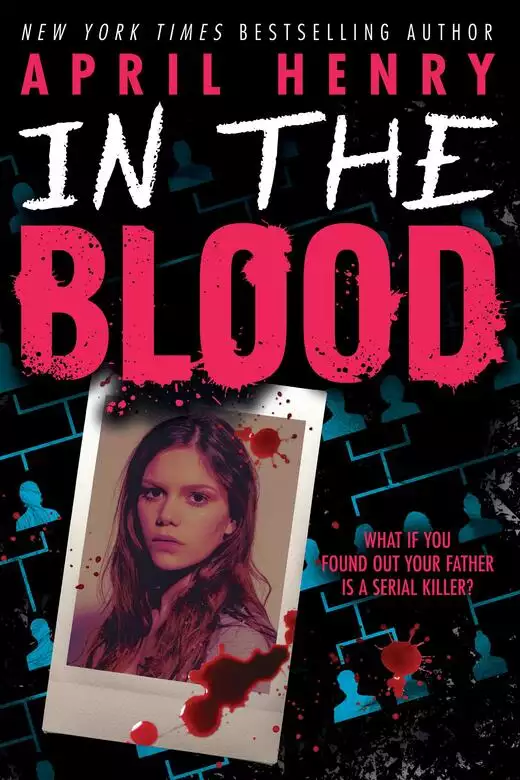
When an adopted teen takes a DNA test to find her biological parents, she unknowingly puts herself in the crosshairs of a serial killer.
Adopted as a newborn, Tessa has always wondered who her biological parents are. After turning eighteen, she takes a DNA test in hopes of finding the answers. With best friend El and lab partner Victor, Tessa uses the results to start building her family tree. But they find more dead ends than answers. Her biological mother, who was raised in a religious cult, has cut all ties with her controlling family. And her biological father remains a complete mystery, at least until the police show up. For fifteen years, they’ve been trying to identify a serial killer known as the Portland Phantom. Tessa may be the link they’ve been waiting for.
April Henry delivers a twisty thriller about the families who choose us—and the ones we’re born into. Biology does not have to dictate one’s destiny.
And don’t miss these other chilling thrillers from April Henry including When We Go Missing, Stay Dead, Girl Forgotten, and Two Truths and a Lie.
Release date:
May 12, 2026
Publisher:
Little, Brown Books for Young Readers
Print pages:
272
* BingeBooks earns revenue from qualifying purchases as an Amazon Associate as well as from other retail partners.
“HAPPY BIRTHDAY!” EL SANG OUT, BOUNDING INTO TESSA’S room.
Tessa felt a fizz of excitement as El handed her a book-size package wrapped in floral paper. Tessa wasn’t much of a floral person, but she was definitely a present person.
“My birthday’s not until next week.” As was the start of their senior year. Tessa was always the first in her grade to turn a year older. Despite her words, she was already sliding her finger under the tape.
“I wanted to give it to you in private.”
Tessa was sitting on the edge of her bed, and now El flopped down into the bright orange chair. The fabric contrasted with her hair, currently bright blue.
El always gave the best gifts. Was it a bold necklace, a hand-bound journal, a concert ticket? Maybe it really was a book, a new release by one of Tessa’s favorite authors.
But she couldn’t think of anything El would wait to give her in private.
The wrapping paper finally yielded its secret. A white box printed with an abstract design of leaves. “What’s this?” Tessa looked at El. But she already knew.
“It’s an Ancestry DNA test.” El took a deep breath. “Once you’re eighteen, you can finally find out who your real family is.”
So that’s why El had waited until they were alone. Their friendship had started in third grade, just before Thanksgiving, when their substitute teacher told them their homework would be to create a family tree. The photocopied chart she handed out started with a blank line labeled Me and then branched back into lines for Mother and Father. Past them were lines for four grandparents and then eight great-grandparents. Thanksgiving, she explained, would be the perfect time to find out more about their family history.
But the only line Tessa could fill out was the first one, for her own name. Tessa Lundgren. The name she’d been given when she was adopted.
The rest of Tessa’s family, with their blond hair, blue eyes, and skin that tanned golden brown in the summer, definitely looked like Lundgrens. But Tessa? Her dark hair and eyes and milk-pale skin did not look one bit Scandinavian.
Back then, El hadn’t known why Tessa had started to cry, just that she had. El slipped out of her chair and wrapped one arm around Tessa. As El informed the teacher the assignment was “stupid,” Tessa balled up the paper and threw it onto the floor.
They both got sent to the principal.
Later, Tessa’s normally cheerful mom explained to the substitute how insensitive the assignment was to kids who were adopted, in foster care, or otherwise being raised by people who weren’t their biological parents. Afterward, she reiterated to Tessa, “You’re special because you were chosen by us. It doesn’t matter whether you’re biologically ours. You’re still our daughter.”
At recess the next morning, Tessa told El the truths she normally hid. No one knew who her parents were. As a newborn, she had been left at a fire station without even a note.
But El didn’t see it as Tessa being unwanted or discarded. To El, Tessa’s past was a mystery with an answer that was probably way cooler than El’s regular, boring family.
After that, they spent hours speculating about who Tessa’s “real” parents were. As little kids, they were certain her parents were royalty, or at least fabulously wealthy. As they got older, their fantasies expanded. Her parents might be artists, painting masterpieces and living in a cabin in the wilderness. Or elite executives flying on private jets from one high-stakes negotiation to the next. Maybe they were world-renowned scientists making groundbreaking discoveries. In each story, her parents had given her up only because they were too young, too important, or some combination of both.
Now, Tessa stared unseeing at the white box, her mind racing with a thousand doubts and fears. Did she really want to know who her biological family was? Would they even want to know her? Would learning about them change how she felt about herself? Would it change how the only parents she’d ever known saw her?
El’s voice pulled Tessa out of her spiral. “You don’t have to do it if you don’t want to. But think about it. If you don’t, you’ll never know.”
Tessa nodded, but she was remembering the story of Pandora.
When Pandora opened that forbidden box, she unleashed illness and death into the world.
Once Tessa took the test, she couldn’t undo it.
MOST TEACHERS TOOK IT EASY THE FIRST DAY OF SCHOOL. Not Mr. Prenty, a tall, thin man who reminded Tessa of a long-legged bird. As soon as the bell rang, he clapped his hands.
“Welcome to Bio Two.”
Tessa smothered a yawn. It was after lunch, and the room was hot and stuffy.
Two girls in the back row were whispering. Mr. Prenty fell silent, face impassive, until they stopped.
“We have a lot to do this afternoon. Today we’ll be partnering up, watching a safety video, and performing a short experiment.”
Partnering? Tessa scanned the room for a familiar face.
Mr. Prenty had other plans. “I’ll be assigning partners based on last names. And before anyone asks—no, you cannot change partners. In real life, you’re going to have to get along with coworkers you have nothing in common with. And in this class, as in life, your success depends on teamwork.” He picked up a printout. “Abbott and Andrews. Bancroft and Cooper. Corning and…”
Lundgren was pretty close to the M’s. Maybe Tessa would get Bree Madigan? Like her, Bree spent a lot of time in the library.
“Lopez and Lundgren.”
So much for getting someone she knew. Tessa couldn’t even remember Lopez’s first name. Vincent? Victor? She studied his profile out of the corner of her eye. His dark wavy bangs were on the long side, but the rest of his hair was short enough to reveal the curve of one sideburn and a silver hoop earring. He wore a short-sleeved plaid shirt and jeans. As if sensing her gaze, he turned. His dark eyes met hers, his face impassive.
Tessa looked away. Her cheeks felt hot. With her paper-white skin, it was too much to hope the flush didn’t show.
“In this class, we’ll be working with chemicals, some of which are hazardous,” Mr. Prenty said. “This video will address safety issues.”
He dimmed the lights. In the video, actors portraying high school students while appearing to be in their mid-thirties demonstrated how to use exhaust hoods, fire extinguishers, and emergency eyewash stations.
Maybe this class wasn’t going to be as boring as Tessa had thought.
Mr. Prenty flipped the lights back on. “We’ll be spending the rest of class extracting DNA from strawberries.”
DNA. Tessa pictured the Ancestry DNA kit, now hidden in the back of her sweater drawer. She straightened up.
“DNA is an instruction manual for making a living organism. It basically tells it how to develop and function. We’ll be using household chemicals to extract DNA from strawberries. A single strand of DNA is too tiny to see with the naked eye. But strawberries have a lot of DNA, and we’re going to clump it together so it’s visible. Most species have two copies of the genome, one from each parent. But the strawberry actually has eight, contributed by eight parental species.”
“It’s like a ménage à trois, only it’s a ménage à huit!” Trey Cooper joked. He was always joking, but at least this was a smart joke.
Mr. Prenty acted as if he hadn’t heard. “You and your partner should pick a lab table and then one person will get supplies. Together, you’ll need four strawberries, two plastic cups, a coffee filter, a plastic spoon, a coffee stirrer, and a resealable plastic bag.” As he spoke, he wrote each item on the board. “Let’s get started.”
Tessa and her new lab partner looked at each other across the room. He pointed to an empty black lab table in the middle and she met him there.
“I’m Tessa.”
“Victor.” He gave her a half smile. The side of his throat was marked with a small black mole, right above two silver chains. Tessa had the irrational urge to put her fingertip on it.
Instead, she said, “I’ll get the supplies.”
As she did, Mr. Prenty said, “One partner will remove the stems and then put the strawberries inside the plastic bag, seal it, and gently smash them. This lets the solution reach more area.”
A few seconds later, Trey pounded his big fist onto the side of his open bag. Strawberry bits splattered halfway across the room. His partner squealed.
Mr. Prenty frowned. “Mr. Cooper, another such incident and you will be out of this class. Do you understand me?”
Looking chastened, Trey nodded.
“The cells are like water balloons. We’ll use detergent to make them pop open, or lyse, releasing the DNA. The other partner should measure two teaspoons of salt and one of detergent into a cup. Then add a half cup of water.”
Tessa waited her turn for one of the half dozen measuring cups while Victor lightly thumped his fist on the strawberry bits.
“Swirl the salt and detergent water gently.” Mr. Prenty emphasized the last word. “That’s our extraction liquid. Then have your partner open the plastic bag and pour it in.”
Worried about spilling, Tessa rested her fingers on Victor’s hand as she tipped the water into the bag. She was hyperconscious of his cool skin.
“Seal it up and work it gently, like you’re making a smoothie by hand. The detergent will break open the strawberry cells. The DNA is now collecting in the liquid, but so is a lot of other stuff. Scientifically, it’s known as cellular debris, but it’s just strawberry schmutz.”
Following Mr. Prenty’s instructions, Tessa set the white flat-bottomed coffee filter on top of the other cup. She held the edges as Victor poured in the red mushy liquid.
“After most of the liquid has filtered through,” Mr. Prenty said, “toss the filter into the food-recycling bin. What’s left has the insides of the strawberry cells, including the DNA. To isolate it, we need to change the molecules from a liquid state to a solid one. We’ll use rubbing alcohol that’s been in the freezer.” He held up a couple of white plastic bottles.
When it was their turn, Tessa poured from the ice-cold bottle. The liquid immediately started to separate.
“You can see it’s making layers, with the rubbing alcohol on top and the extraction liquid on the bottom. Now gently swirl it.” When Victor did, something that looked like cotton fibers started to clump. Mr. Prenty said, “Those white bits are the strawberry DNA. You can fish it out with the coffee stirrer.”
As they did, Bree said, “It looks like snot.”
Mr. Prenty didn’t seem offended. “To our eyes, it does look like snot. But if we could look at it at a molecular level, we would see that classical double helix.” With a practiced hand, he drew two linked strands winding around each other like a twisted ladder. “DNA is like a recipe that tells cells how to build an organism. Each of these rungs is like a written step in the recipe.”
Tessa regarded the whitish, viscous clump of DNA. She didn’t know whether to be impressed or grossed out.
Maybe a bit of both.
A WELFARE CHECK ON A TWENTY-TWO-YEAR-OLD WAS SOMEthing only an overly anxious mother would demand, Keisha Washington thought as she parked her police cruiser at the curb of the tiny blue house just before noon. The house was rented by Alida Cleary, recent college grad. A ten-year-old maroon Subaru Outback was parked in the driveway.
In Keisha’s experience, welfare checks were usually for some old person who would turn out to have died in their sleep, or maybe just fallen and been unable to get up. Not a girl who had probably partied too hard or simply forgotten to charge her cell phone.
Keisha ran the Subaru’s plate. Registered to Alida.
Back in California, Alida’s mother was frantic about her daughter. Hence this welfare check. Alida supposedly always called home every Sunday at 6 PM but hadn’t four days ago. She wasn’t answering her phone, and when her mother checked with her employer, they said they had last seen her the previous Friday. Calls to her phone had initially gone to voicemail, which was now full.
Just because her car was here didn’t mean Alida was. She could be with a friend or even out for a run. As she got out of her patrol car, Keisha scanned the house. While it needed a coat of paint, there was no gaping door or broken window. She climbed the chipped redbrick stairs.
Her mother had said Alida didn’t have a boyfriend. When she had checked with Alida’s friends, they hadn’t seen or heard from her since Saturday morning.
But in Keisha’s mind, everything had asterisks after it. No boyfriend—that her mother knew about. And the friends her mother knew to call were probably not Alida’s only friends. Keisha was only three years older than Alida, and Keisha had secrets her parents were never, ever going to find out. So maybe there was a new man—or woman. Or a party had gone on a little too long. Maybe Alida had simply gotten tired of “always.”
Keisha pressed the doorbell but heard no corresponding buzz or chime inside. She switched to a sharp knock, loud enough to reach every corner of the house.
Still no footsteps or answering voice. Keisha stood on tiptoe to peep through the row of small glass squares set into the door. A living room with a blue couch, a TV, a brown recliner. No signs of a struggle.
She gave the knob a quick twist. Locked.
Next Keisha circled the house, looking through windows. Living room from a different angle. Tiny dining room. Small, square kitchen with white cabinets and a worn white linoleum floor.
About to move on, Keisha spotted something. The back of her neck prickled. Was that a foot in the kitchen doorway? Or just a random shoe at an odd angle? She pressed her cheek against the glass.
It was definitely a foot, but she couldn’t see more. She knocked on the window, but the foot didn’t move.
Was Alida experiencing some type of medical emergency? An overdose?
Keisha keyed her mic and gave her call sign. “Someone’s inside on the floor, but they’re not moving.”
“Ten-four. Be advised, all free units are responding to a twelve-seventy-three on West Burnside.”
Keisha swore to herself. If the armed robbery call was legit, she was unlikely to receive backup anytime soon.
Wait! Had the foot just twitched? Keisha knocked on the window again. “Alida? Alida?”
The foot stayed where it was.
Damn it. Keisha remembered the catch in Mrs. Cleary’s voice. What if the time it took for backup to arrive was the only time this girl had?
Experimentally, Keisha pushed the sash. It slid up. She keyed her mic again. “Be advised, I’m making entry.” Taking a deep breath, she grabbed the frame and scrabbled up and through.
She landed on the balls of her feet, hand on the butt of her service weapon in case things weren’t as quiet as they seemed.
But the only sound was her own breathing. She moved toward the body, which had its back against some cupboards.
Because it was a body. She knew it in her gut.
Keisha squatted. Her fingertips pushed past the girl’s long dark hair to her throat, already knowing she wouldn’t feel a pulse. The girl’s skin was cold and firm. Alida was long pa. . .
We hope you are enjoying the book so far. To continue reading...

 Please log in to recommend or discuss...
