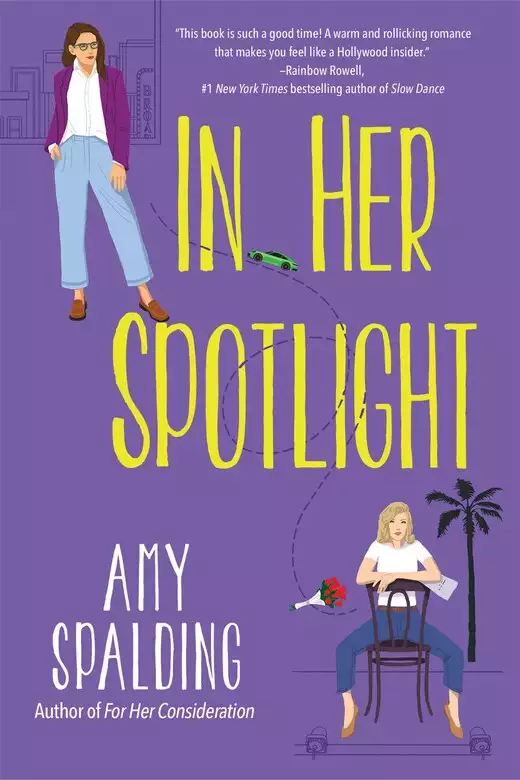
For fans of Casey McQuiston, Alexis Hall, and Meryl Wilsner, an actually hilarious, sweetly sexy, gloriously relatable, second chance, sapphic rom-com from the acclaimed author of For Her Consideration, starring a franchise Hollywood actress aims to prove her chops in a theatrical production directed by her ex whose heart she broke a decade earlier.
Hollywood actor Tess Gardner is not the kind of famous she set out to be. She's ready to show she’s more than Princess Platinum of the Vindicators series, a pretty face with CGI superpowers that literally sparkle. Tess wants to prove herself as an actor and that means theatre—the true calling of her thespian heart. But just when Tess lands a part working with an acclaimed stage director, a brewing scandal forces him out. His replacement? None other than hip, buzzy director Rebecca Frisch. The same Rebecca Frisch whose heart a firmly closeted Tess broke over a decade ago during summer stock . . .
As Tess wrestles with her lingering guilt and attraction to Rebecca, she also finds herself struggling to rein in her superstar status backstage. When things unexpectedly reignite with Rebecca, Tess bristles even more against the walls of her A-list life. Since the industry’s made it clear that girl-next-door superheroes can’t also be gay, coming out isn’t realistic for Tess. And ultimately, Rebecca will head back to New York and likely seek out a less complicated relationship anyway.
Will the curtain close on her chance for happiness or will Tess finally take a leading role in her own life?
Release date:
February 24, 2026
Publisher:
Kensington Books
Print pages:
336
* BingeBooks earns revenue from qualifying purchases as an Amazon Associate as well as from other retail partners.
There was no getting around it. I wasn’t the kind of famous I’d set out to be.
Obviously I didn’t want to feel this way. I practiced gratefulness every morning, post-yoga, for god’s sake! When you thanked the universe for the breath you drew, the stars over your head, the good fortune that had found you, it didn’t seem appropriate for a small voice in the back of your head to whisper that it didn’t matter how much money you made, how many projects you booked, how many action figures had been crafted in your image—no one respected you as an actor.
But that was changing today. Or, more accurately, in five weeks, when Hometown preview performances began.
It really had to, because otherwise I was out of ideas.
My phone rang as I zipped down the 110 Freeway toward my destiny, as much as anyone zipped down the 110 at nine thirty in the morning. I glanced at the dash display, where my agent’s name popped up over the GPS, and decided to hit accept.
“Hi, Joyce,” I said, slipping into the next lane to speed past a sluggish SUV. “I assume that thirty minutes before my first rehearsal is finally too late for you to suggest again that I drop out to do some car chase movie, so what’s up?”
My agent burst into her trademark spiky no-bullshit laugh. “You know me too well, Tess. And it turns out that thirty minutes out may not be too late after all.”
I checked my side mirror before merging to make my way around a slow line of cars. Traffic in Los Angeles was as bad as everyone said, but I prided myself on getting around it as much as possible.
“There’s going to be a piece in The New York Times later this week about Geoffrey Gordan,” Joyce continued. “Given its … revelations, he’s stepped down from directing this production of Hometown. Supposedly. I believe Downtown Theatre Association asked for his resignation. Nonetheless, he’s out.”
“Wait,” I said, Joyce’s words coming faster than I could process them. “Geoffrey Gordan has revelations? Like … MeToo revelations?”
“Yes,” Joyce said, with a sigh. “No specifics yet, but that appears to be the situation.”
My breath was tight in my chest, and my skin pulsed hot like I’d been stung. Last year on a round of publicity in New York, I’d used my only night off to see the Geoffrey Gordan–directed revival of Our Town, a production that swelled with the play’s big ideas on mortality and community. Later, from my hotel room, still a bit weepy, I’d emailed my team with a message to be forwarded to the director. In it I asked if there was any chance I could read for his next show. I missed the stage, missed that relationship with the audience, missed how I felt standing backstage when places had been called and all the possibility in the world swirled around us.
In the light of the next morning I’d been embarrassed about my display of emotion to an email’s worth of industry executives, and I’d been sure their promises to make contact with Geoffrey Gordan had been emptier than my tear ducts during the curtain call of Our Town. A few months ago, though, the offer arrived: the lead in the world premiere of a new play, to be developed in LA, directed by Geoffrey Gordan.
I’d never said yes to anything so quickly in my life.
“I understand that Gordan’s involvement was the key draw for you,” Joyce said. “Your theatrical agent and I chatted, and this should allow you to back out.”
“Is the play canceled?” I asked.
“It isn’t, no,” Joyce said. “It sounds like there was too much money to be lost otherwise, so they’re bringing in some apparent wunderkind from New York to shore up the potential losses.”
I frowned. “Do you know who?”
“Despite that the team must have had these changes in the works for at least a few days, no. It would be perfectly acceptable if you—”
I merged again to leave everyone slower far behind me. “I’m not sure it sends a good message for me to leave after a sexual harasser steps down.”
“Hmmm,” Joyce said in lieu of agreeing with me.
“Joyce, I know you want me in that car-chase project with whatever Chris they’re hiring,” I said, “but I’m doing this for me. And then you can talk to me about at least one bad but expensive gig after the show closes, OK?”
“I never said bad,” Joyce said. “Only expensive.”
“Get me a movie where I get to drive the car,” I said, “instead of screaming from the passenger seat. I’ll be so much more amenable.”
Joyce chuckled. “Before I let you go, Erica wanted me to remind you about the LA Times photoshoot this morning, which is still happening—the theatre seems eager to put a happy spin on this mess. Your talking points should be in your inbox, and Erica will be on-site.”
“Sure, and, yes, the team was at my house this morning.” Hair, makeup, styling, all to guarantee I looked like Professional Actress Tess Gardner, whose shoulder-length blonde-ish waves were always tamed into evenness, whose small frame would look only more delicate in the cheerful pastels and neutrals to signify she was a regular girl in her late-early-thirties who might muscle up and fight bad guys on the big screen but was sweet and demure everywhere else, whose green eyes shimmered like she had a secret but certainly not one that would undo her entire life.
“But, again, if any part of you feels that—”
“I’m almost there,” I said. “Can I let you go?”
“Of course. But feel free to make the choices you need to make. If the new director isn’t up to your standards, there’s nothing wrong with reevaluating this opportunity.”
I said goodbye to Joyce and pressed the volume button on the steering wheel enough times that the car vibrated with the Taylor Swift track, leaving as little room as possible for my own thoughts.
The theatre complex wasn’t far off the freeway, but at twenty ’til ten, LA was still awash in rush-hour traffic. I prized myself on how well I could weave in and out of it, consistently shaving minutes off Waze’s ETA, but there was no escaping it altogether. When I filmed locally, even though the locations were far-flung—as far as Los Angeles geography was concerned, Playa Vista and Santa Clarita and Pomona—call times were usually so early that traffic wasn’t a concern. Days were so long that the worst of it was over by the time I was back on the road and on my way home.
Theatre, though, had me right in the thick of it, the kind of “normal” schedule I couldn’t remember working. Joyce and my theatrical agent had, of course, negotiated for everything they could get me, including car service, but I’d turned it down. Often the only stretches of time when I still felt like myself were the ones spent behind the wheel.
Now, even, with the Geoffrey Gordan news rattling through me, I still knew what I was capable of. There was no reason to abandon ship! If the theatre had brought in this supposed wunderkind, who was I to worry? Putting on a show was at its heart about doing a big impossible make-believe thing together.
I flashed my parking pass at the attendant as I pulled off of Grand Avenue into the Downtown Theatre Association’s parking garage and lifted my foot from the brake—only to slam it down again when the gate didn’t lift.
“I have to scan it,” the attendant said in a tone drenched with exhaustion.
“Sorry,” I said, handing it over and beaming at him. “It’s been so long since I’ve worked in the theatre. On sets they usually—”
“I apologize,” he said quickly, a look of recognition washing over his face. “Have a good morning, Ms. Gardner.”
BEEP. The gate lifted and the attendant averted his gaze as he handed my pass back to me.
“Thank you so much,” I said. “And have a great day!”
The truth was that I was actually a very friendly person. When you grew up an extrovert in the middle of nowhere, you learned to capitalize on encounters—any encounters—with other people. As a kid I chatted with the mailman, the cashiers at the gas station-slash-convenience store down the hill from our property, the distant neighbors whenever we crossed paths. Now, though, it wasn’t only about feeding my soul with tiny connections as often as I could. One cranky word to a drive-thru barista or limo driver or parking attendant, and that might be it. Just that fast, Tess Gardner was hardly America’s Girl Next Door, Tess Gardner was an ungrateful spoiled bitch.
I waved and pulled through to find the company parking section. Rehearsal was still over fifteen minutes away, and given LA’s propensity for lateness, I assumed I’d be the first one to arrive. But I slid in between a sensible Honda Accord and a sensible Subaru Crosstrek, both of which looked even more sensible once my bright green 911 Carrera was between them. I’d had a vague understanding of what a Porsche looked like to me before I owned one. Too showy? Almost obnoxious? But it had been fleeting. It was my dream car. It handled curves effortlessly, the engine ran as smooth as a cat’s purr, and the road thrummed underneath like the Porsche and I were one. I was not here to be Just A Regular Girl anyway. I was amongst my people—theatre people. It wasn’t time to tone down or be less myself. Today was about coming home.
DTA’s complex was home to three theatres: the Goodwin, an ornate opera house; the Rydell, a small and intimate stage that frequently developed new work; and the Jaffe, a theatre large enough for Broadway tours and productions of big, new shows. My time on the stage had been far removed from a world like this, and despite my current career I could hardly believe I’d be performing at a two-thousand-person-capacity theatre, eight shows a week, for six weeks.
I found my way into the Jaffe Theatre and smiled my way past security and into the lobby. A theatre employee glanced up from her station and smiled, and I beamed exactly like Professional Actress Tess Gardner would.
“Do you need any help finding the rehearsal space, Ms. Gardner?” she asked.
I smiled and shook my head. “My team sent directions, but thank you.”
“I’m sorry—I shouldn’t, but …?” She held up her phone, and I nodded and waited for her to join me and snap several selfies of the two of us. By the time she stepped away, thanking me, the seal was broken. More employees—including security—trickled over, and I took photo after photo, smiling as if I wasn’t thinking about the time I was expected to be at my first rehearsal.
Finally, the crowd ebbed, and I headed to the elevator that would take me up to the rehearsal space. The buzz of conversation was loud as I arrived, and I walked calmly toward it even though I was desperate to see if the new director had arrived and if it would be someone with anything close to Geoffrey Gordan’s résumé and if anyone had noticed I was two minutes late.
The rehearsal space was already set up for the table read, though no one was sitting. Small groups of people clustered throughout the room. Even though I couldn’t make out what anyone was saying, there was a sharpened urgency to the din of voices. Was everyone as shocked as I was about the allegations, or was it an open secret in this world? Was everyone wondering who’d replace him, or was I the last to know?
It had been nearly a decade and a half ago, the summer after college, the last time I’d been in a space like this—though to call the rehearsal room at Applewoods Summer Theatre a space like this was being incredibly generous. It was basically a modified cabin; the lighting was dim, and the air smelled consistently like cold cuts even though the mess hall was at the other end of the property. The air in the Jaffe’s rehearsal room was fresh in the way well-ventilated offices were. The chairs all matched one another, and the lighting—while fluorescent and not particularly flattering—had no resemblance to a haunted house. My film career had gently ascended, from the role in the sleeper hit comedy that I’d booked a month after moving to Los Angeles to the supporting role in the drama with more money behind it. By the time the audition for Princess Platinum arrived, it was easy to see that my path had led me exactly there. My theatrical path, though, Applewoods to the Jaffe without a stop in between? It boggled my mind.
I noticed Michael Madden, triple Tony Award winner, standing in a small circle of people, and I made a beeline. He’d already been cast in a leading role—as my character’s father—when I’d received the offer, and I couldn’t believe I’d be sharing the stage with theatre royalty.
I’d all but joined the circle, but no one had noticed, so I hovered just outside of the radius, waiting.
“It’s like the first day of school,” actor Henry Bowman said, as the others chuckled and agreed. Every movement from every person pulled straight from the stage, playing to the back row, broadcasting that the theatre was deep inside of them, while I stood and took up a very small amount of space.
“Oh,” Michael said, glancing at me. A few feet away from me, he was as commanding as he was onstage. His brown hair was flecked with silver in the way that society said worked for men, and his denim-button-down-with-jeans look crafted an air of Americana thespian, the nicer if less-authentic version of how my brothers back home dressed all the time. “Princess Platinum’s here.”
The others turned to look at me, and I smiled as if Michael Madden’s tone had been pleasant and as if he’d referred to me by name.
“Hi, good morning,” I said. “It’s so good to be here. I’m Tess. Michael, I’m such a huge fan, and I’m so excited—”
I cut myself off when I realized he was speaking softly to Henry, who laughed and avoided meeting my eyes, and that the circle hadn’t widened and I was still a point near but not on the radius, like some baffling geometry problem I couldn’t have solved back in high school and definitely not now.
“What have you heard about Gordan’s replacement?” asked a woman with short, no-nonsense, light brown hair I recognized as Kathleen Addams, who was playing my father’s new wife. I’d seen her a couple years ago in a new play at Manhattan Theatre Club that I’d liked, not loved, but her performance had riveted me. Riveted me and, of course, filled me with an intensive pulse of jealousy for the work I wished I’d been doing instead of more press for the streaming release of the second Vindicators movie. I could tell from her vowel sounds, flatter than the average person’s, that she was probably from somewhere smack-dab in the middle of the country like I was, and I was drawn to her the way I’d wanted my teachers to not only give me A-pluses but also to like me, to think I was a good person, even if I wasn’t.
I opened my mouth to say I’d only heard it was some wunderkind, but realized quickly enough not to embarrass myself that no one was talking to me and no one wanted my input. Plus, in any business, information was power, and at this very moment it felt like maybe that was all I had.
“If you ask me,” said Michael, though no one had, “the whole thing seems like a lot of bullshit.”
The thing about Hollywood was that things had gotten a little better, a few people had taken a few steps back, but many things hadn’t changed at all. Most of the men who’d taken steps back had simply stepped forward again. Theatre, though, I’d assumed, would be different. More civilized.
“Who do you think this so-called wunderkind is?” asked Henry, who was playing my brother. He was over a decade older than me, but read younger onstage and onscreen. His hair was a little darker than mine, but there was something about his build and his posture that was familiar; us as onstage siblings made sense.
The remaining member of the cast, Ashlee Romero, shrugged lightly, the kind of small movement you could later claim hadn’t been intentional. She was the youngest member of the cast, playing my character’s brother’s vaguely inappropriately younger girlfriend, blonde and pretty but, unlike me, had a packed résumé of stage experience.
“Who said anything about a wunderkind?” asked Kathleen.
“That’s the rumor,” I added, potentially unhelpfully. I was good as an observer, saying enough to blend in and to indicate I knew my role in any given scenario. I was great at being the center of attention, firing off publicity-approved anecdotes and making everyone feel entertained. Cast aside to the margins of a conversation, however, was not the role I knew how to play.
“Fantastic.” Kathleen said it like a curse word, and I bit the inside of my cheek to show restraint. “I love it when young men with little life experience get incredible opportunities.”
“Someone young,” Michael mused. “Maybe Ken Argyle. Everyone loved his Doll’s House last season.”
Kathleen all but snorted. I tried to get myself more in her sightline without moving, without signaling to anyone else that I was doing it. I wanted to shoot back a gesture, a can you believe the way they still let men tell stories about women like we should be grateful? But Kathleen didn’t look my way; my gesture didn’t stand a chance.
“What about you?” Michael asked, and once he was looking directly at me, everyone else was too.
“All I heard was the wunderkind thing too,” I said, casually, even though nothing felt comfortable about the sudden shift in everyone’s focus, four sets of experienced stage eyes on me.
“No,” Michael said, a mocking blur at the edge of the word. “Have you ever done theatre before?”
“Oh, yeah, of course,” I said. “I’m actually trained for the stage. Juilliard. And—I know it’s barely professional, but Applewoods—the summer stock theatre in Ohio—was my first paid acting gig.”
“I did Applewoods too,” Kathleen said, smiling at me. “That’s where I met my ex-husband, actually. Hard not to fall in love with your Romeo.”
“I would have loved seeing you as Juliet,” I said, though I wondered if I was too effusive. Too effusive was the most honest part of my brand, though!
“Oh, no, I was the Nurse,” Kathleen said with a cackle. “You know there’s always one girl they give all the old person roles to.”
I did know, though it hadn’t been me.
“Professional theatre,” Michael said.
“It was all very professional,” Kathleen said, “if you know what I mean.”
I did know what she meant, even if I’d devoted a lot of energy to forgetting about the fact that I’d once fallen in love at Applewoods, too.
Michael crossed his arms over his chest, a move so we’d know he’d given up but not due to defeat. His focus shifted, and the rest of us turned like a Greek chorus, as a group passed through the doorway.
It was no entitled man. A shimmer of glossy dark hair and a flash off a pair of glasses caught light between two people—DTA’s artistic director, Neil Bryant, and Hometown’s playwright, Stephanie Hoff—as a Tony-nominated and Obie-winning director whose Arcadia revival had garnered a slew of critical raves and whose wardrobe had merited two separate pieces on The Cut strode in.
Though the most significant thing to me about Rebecca Frisch was that about a dozen years ago we’d fallen in love, and then I’d wholly broken her heart.
Every person in the room crowded into a loose semicircle around Neil, Stephanie, and Rebecca while I stayed where I was. A vague whisper reached my ears: Can a woman even be a wunderkind? I gauged the least conspicuous spot in the crowd and wondered if one could make it through an entire rehearsal process without ever interacting with the director. Seemed unlikely.
A hand lightly touched my arm, and even though Rebecca was still several feet away shaking hands and introducing herself, I jumped as if it was her hand on me.
“Jesus, Tess,” hissed my publicist, Erica, dressed in her usual black dress and four-inch heels, ninja-like if ninjas had strawberry-blonde ponytails, appearing seemingly out of nowhere. “Everything good here?”
“Of course,” I said quickly, politely, in-no-way-was-my-ex-girlfriend-standing-a-few-feet-from-me-ly. Erica was right to wonder, though; I was used to being guided gently via light touches to my elbow. Publicists were like well-dressed herding dogs. Herding dogs who bit, though.
“The social media team and the LA Times need a few group photos,” Erica said, leading me away from the gathering cluster of people into the hallway.
A photographer stood, camera-ready, next to a very young person with aqua hair who was wielding two iPhones.
“Hi, Tess,” the person said. “I’m Verne, they/them pronouns, director of social media for DTA.”
Erica stepped in front of me as if to protect me from a bullet, and not just a Gen Z individual addressing me directly instead of looking only to her.
I leaned around Erica and held up my hand in a wave that I hoped looked casual and friendly and not as if my publicist was literally trying to block access to me. Erica wished she was Tree Paine but I was the wrong kind of famous (i.e., quite but still not anywhere enough) for that kind of control. “It’s nice to meet you, Verne.”
They nodded and glanced back down at one of their phones. “I’m going to record a lot of content today to release throughout the rehearsal period and into the run. We encourage you to share with your followers across platforms. Box office and donations really benefit from cast participation.”
“We can discuss Tess’s social media presence,” Erica said, but I waved her off and stepped around her.
“Sure, just let me know what you need, though keep Erica looped in on everything so she can keep my social team updated, too.”
Erica sighed audibly as she guided me into place for the LA Times photos.
“I thought you said it was a group shot,” I whispered, as I saw the rest of the group assembling farther down the hallway. Did that include Rebecca? Was it better or worse if it did? Could I look neutral near Rebecca? Was it possible to blow up a career’s worth of hiding who I was in one press photoshoot?
“Eventually,” Erica said. “Solo shots of you first. You’re the only one anyone cares about. Look theatrical! I’m kidding. Who the hell cares.”
My team had made no secret of their thoughts about me taking this job. Six weeks for rehearsal and previews, six weeks of performances, nearly three months in which I wasn’t shooting something that would make us all a lot of money. Why do theatre for practically free when I could be screaming from the back seat of a car driven by one of the Chrises in front of a green screen? Why play a role that figuratively no one would see when I could be stepping into my platinum bodysuit and speaking up as one of the voices pressuring Pantheon Studios into expanding Vindicators from a trilogy to a quadrilogy?
After I posed for a few minutes’ worth of photos, Verne led over members of the creative team for the next shots. I shifted with the arrivals, even as Erica commanded with a look to stay right in the center. Right in the center? Where Rebecca would see me and potentially be unknowingly-cruelly forced to throw her arm around my shoulders in a show of theatrical camaraderie? No thank you, Erica!
I was certain I’d sense Rebecca’s presence, so it was with more than a mild jolt to realize she had already lined up, a few people down the line from me. It had gone unnoticed because she didn’t move the same way, didn’t pass through life the way she had a dozen-ish years ago. Despite the attention I’d paid to the brief New York Times Magazine profile, sartorial features on The Cut, her face onscreen split-seconds before she lost last season’s Tony, the occasional light stalking of her Instagram grid, I hadn’t been prepared for that.
The photographer and Verne snapped a few minutes’ worth of shots. I prided myself on being good at the entirety of my job. Sure, there was acting, which I knew I excelled at. But there was also this, giving face in a fluorescent-lit hallway at 10:00 a.m. on a Monday morning. Playing nice with social media teams. Smiling like the girl who was best friends with everyone while standing next to men who were figuratively Michael Madden, and who were literally Michael Madden.
Throw Rebecca Frisch into the mix, though, and those skills felt tenuous at best. Every subtle shift of my body for the camera gave a flash of Rebecca in my peripheral vision, every flash felt like the world had been blotted out except for her, every moment pulsed with the danger of a truth revealing itself.
“OK, everyone,” Rebecca said, as the camera’s clicks slowed. Even though she’d used the word everyone it felt like she was speaking directly to me. “Let’s get to work.”
The hallway full of people burst into enthusiastic applause, and I joined in while deciding whether or not to attempt eye contact. When had I ever felt like this? I’d never set out to be someone who could easily command any room, but I’d discovered early on that I could. Yet here I was, about twenty-seven minutes into my time at the Downtown Theatre Association, and I’d never felt so inept in my life.
Rebecca, though, glanced my way as she walked by. As my heartbeat shook throughout me while I tried to figure out what to do, she held up her hand in a casual wave. “Hey.”
It didn’t matter that I hadn’t figured out what to do, because Rebecca kept walking purposefully as if my response didn’t matter. As if I didn’t matter.
The entire group filed into the rehearsal room, and I reminded myself that it was fine that Rebecca Frisch thought nothing of me. I didn’t deserve more than nothing! And we were getting to work, the very work I was here for. Despite that Geoffrey Gordan wasn’t here and my ex-girlfriend was, the rush I’d felt when I was young washed over me as I sat down at the table with my script. This room full of people was about to make something that had never existed before and that would disappear into the ether when it was over. That was nothing short of magical.
Also, luckily, Rebecca was a few seats to my right, and it would have been nearly impossible to make accidental eye contact with her. For the moment, I was safe again.
Neil Bryant, front and center by the cluster of chairs facing our table, stayed standing as the rest of the room took their seats. For years, DTA had been run by a series of middle-aged white man after middle-aged white man, and I’d been ecstatic to read the press announcement a couple of years ago that the organization had selected a Black man who wasn’t much older than I was for the role. I wanted to prove something to him, that I could be part of the new era he was ushering in and not just a name to boost ticket sales.
“It probably goes without saying that this is a different speech than I’d planned to give . . .
We hope you are enjoying the book so far. To continue reading...

 Please log in to recommend or discuss...
