
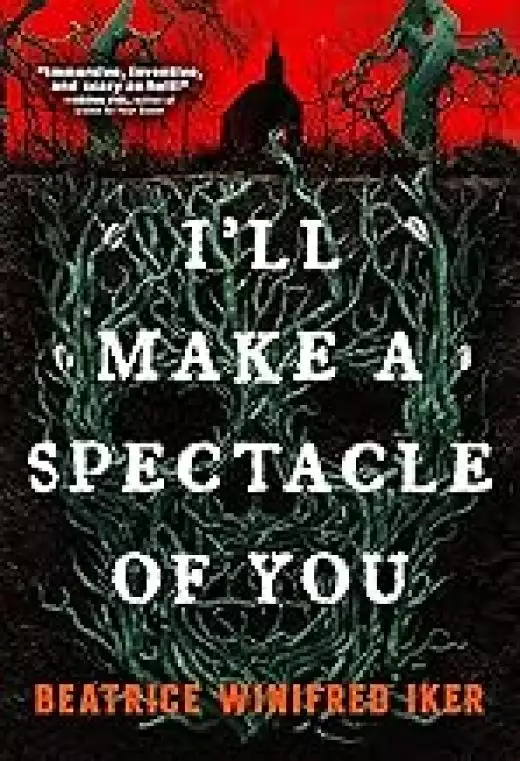
I'll Make A Spectacle of You
- eBook
- Paperback
- Audiobook
- Book info
- Sample
- Media
- Author updates
- Lists
Synopsis
This heart-pounding Southern gothic horror debut from Beatrice Winifred Iker, takes readers to Bricksbury University, the oldest and most storied HBCUs in the nation. But as one student is about to find out, a long history comes with a legacy of secrets.
Zora Robinson is an ambitious grad student at her dream program, the Appalachian Studies at Bricksbury university. When her thesis advisor suggests she research the local folklore about a beast roaming the woods surrounding campus, Zora finds a community uneager to talk to an outsider.
As she delves into the history of the beast, she uncovers a rumored secret society called the Keepers that has tenuous ties to the beast…and Bricksbury itself. Zora soon finds herself plagued by visions of the past, and her grip on reality starts to slip as she struggles to uncover what is real and what is folklore. But when a student goes missing, Zora starts to wonder if the Keepers ever really disbanded.
There’s something in the woods and it has its eyes on Zora.
Release date: November 18, 2025
Publisher: Orbit
Print pages: 416
* BingeBooks earns revenue from qualifying purchases as an Amazon Associate as well as from other retail partners.
Reader buzz
 Please log in to recommend or discuss...
Author updates
I'll Make A Spectacle of You
Beatrice Winifred Iker
The sun hummed above Zora that lurid June afternoon. It was so bright that she shielded her ten-year-old eyes beneath emerald branches crisscrossing overhead. She sprinted along the golden-lit trail, her beaded braids clacking behind her in air so muggy it had to be gulped. Pine stuck to Zora’s pursed lips and then on her tongue when she couldn’t lick it away. On an ordinary day, she wouldn’t’ve noticed it. It would be a minor nuisance. But that day, the sweet-laced woodsy sap was an invasion curling down her throat. Her mouth softened, sinking into a frown.
Her older sister, Jasmine, led the way deep into their grandparents’ forested Knoxville property like she always had. And as they ran, Zora focused on the textured underside of Jasmine’s tennis shoes like she always had. But today, something was different.
“Jazz! Hold up!”
Jasmine’s stride was unbroken. Her usual gentle smile absent, replaced by scrunched eyebrows folding into a look of stubborn determination. Zora’s mouth watered as she passed her favorite honeysuckle bush, where they each plucked blossoms for the sweet nectar hidden within. Jasmine’s pace made it impossible for Zora to stop or do anything other than try not to keel over at the burning in her chest. Zora leaned over as she ran and her lungs heaved painfully. She should have been sweltering, but the beads of sweat rolling down her backbone were cold.
Sunrays strained through Zora’s hands as she shielded her eyes from the glare. She feared the glow would trick her into taking a wrong turn or tripping over gnarled kudzu vines. Wasn’t that what kudzu did? Confused you? Grandpa called it “curly devil” and said it was a powerful addition to any magic. But that power, he warned, ain’t always right. Zora was still thinking on that.
The possibility of getting lost and the bright sun notwithstanding, Zora usually loved running. Specifically, she loved running with Jasmine. But her sister had just turned thirteen and had started to love running with Zora less and less. Zora saw it. The way Jasmine had looked down when their grandmother suggested they play outside proved it. Something had changed between them.
The woods around the house were normally a playground. The acres of untouched Tennessee forest hidden on the outskirts of town were the ideal location for exchanging secrets and practicing the basics of conjure. They passed the bright red signs warning intruders they were about to trespass on private property. Zora blinked at the metal triple-stapled by Grandpa two summers before. Then they passed the leather bags of protection amulets, and Zora knew they’d gone too far. These were county woods.
“Please stop, Jazz!”
“Ugh! Fine.”
Jasmine’s words were incredulous, but she was huffing just as much as Zora. Her narrow shoulders shook as a coughing fit momentarily racked her body. Zora hoped Jasmine would fall over and dirty the sporty dress she wore. Jasmine didn’t even wear dresses until a few months ago, and certainly not to play in the woods.
They were silent until Zora could breathe well enough to be angry. “You know we’re too far out! Grandma and Grandpa said—”
“Yeah, well, they ain’t here,” Jasmine huffed again.
Zora glared at how her sister’s throat worked to breathe and how her long legs struggled to remain upright. Jasmine adjusted and then readjusted the orange dress that reminded Zora of shiny traffic cones. Jasmine had exhausted herself, and for what? The bubble of suspicion that had been building in Zora’s chest since they’d set out from the house burst. Niceties didn’t exist in the woods. They never had. That had been one of its beauties—something they’d loved together.
Zora stared Jasmine down. “What did I do to make you hate me?”
Spat words lay between them like a furious diary entry spoken aloud. But to Zora, they were more than that. However painful, this moment would forever be etched in her memory, a reminder of the undeniable truth it held.
“Huh?” she asked when Jasmine shrugged away her question. The words swelled, pulsing in Zora’s chest before she blurted them out. “Go ’head. What is it? You afraid I’m gonna steal that lil dress? Best believe I wouldn’t. It’s ugly as sin.”
“No, what’s ugly is me seein’ you in your room kissin’ the American Girl dolls.”
Zora stood stunned as Jasmine’s words slapped her across the face. Was it ugly to kiss dolls? Or was it ugly because Zora was kissing them? Heat warmed Zora’s cheeks as an emotion thundered through her. She couldn’t name it then but knew now it was shame.
“I didn’t…” Whispered words drifted off as she registered the smug look in Jasmine’s eyes and how her hands sat firmly on her teenage hips, drawing Zora’s attention to the subtle but noticeable changes. Jasmine was different. Her once-slender figure had taken on a new, more shapely form. Was this the reason for the burning ache in Zora’s chest?
Jasmine had violated Zora’s privacy and then used the information she discovered to wound her. She was becoming a new version of herself, someone Zora couldn’t understand. A stranger.
It was clearly time to return to their grandparents, but just when Zora lifted her foot to sprint back to their house, she heard it. Voices, deep in the woods, staggered on top of each other. They spoke in a tight cadence. In Zora’s childhood mind, her first thought was that they were a singing group, maybe a band or choir. But as their voices grew closer, she heard an anger that surpassed the tones of sister combat. She didn’t have a word for it. The closest she could come was rage. Wrath. Some other sin she’d learned in Bible study and verse-to-spell memorization.
“Zora.”
Jasmine grabbed Zora’s shoulders so tight that Zora yelped in surprise.
“Run, Zora.” She’d been out of breath moments before but now inhaled sharply as she glanced over her glaring orange shoulder.
“What? What about y—”
The voices were closer now. So close that Zora could make out a few words.
“Goddess” and “balefire” and “sacrifice.”
Zora’s body grew tense. Her legs trembled.
“Z—run!”
And Zora did. A mile away, she heard Jasmine’s screech, but she kept running back to their grandparents’ house and never returned to their woods again.
Jonesborough was heavy. All who entered felt it.
The oldest town in Tennessee had eighteenth-century dust coating the streets. Leaves withered early, desperate to escape life among the whispering sycamores. The wind never blew like it oughta—instead, it lurched around the citizens’ spines like lightning cracked across the holler, goading them to lose their way and their wits.
Still, people smiled at you so long as you looked familiar. And kept smiling so long as you smiled back.
The tiny mountain town was a clot of Appalachia’s best and worst attributes. Home to Andrew Jackson’s restless ghost and the country’s first HBCU, Bricksbury Mountain College, Jonesborough both shocked visitors and lulled residents with its willful inability to self-actualize.
To Zora Robinson, though, the place wasn’t cobblestone streets where Civil War enthusiasts came to argue whether the Union-leaning folk in the area made any difference just up the road in the Battle of Blountville. Nor was it the town where her sister, Jasmine, was finishing her doctorate in biblical studies. No, to Zora, Jonesborough was boundless possibilities. It was a repository of local and global knowledge. It was a pin in the map of her life that would mark the moment everything finally made sense. One day, she’d look back on this place and be grateful for the lessons learned and achievements earned. During lectures and appearances, she’d say, “This was my genesis. Bricksbury Mountain College was to me what Eatonville was to my namesake, Zora Neale Hurston.” Or something to that effect.
Bricksbury thought nothing of the Ivies. What were they to the institution with a 99.7 percent graduation rate? What were they to the safest campus, with the fewest employed security officers and lowest instances of crime?
Bricksbury was a feat. A towering display of composed intellect swirled with just enough backwoods charm to piss off the uppity city folk. More Black physicists, CEOs, and federal judges graduated from Bricksbury than any other college in the country.
But because Bricksbury thought nothing of the Ivies, Zora’s degree in African and African American studies from Dartmouth didn’t get her a place there. Nor did her sister—estranged, for all intents, and vocal about not wanting Zora to attend the same school—send any letters of recommendation. Made no pleas to the dean of admissions. Not even an email. Zora got into Bricksbury on her own—primarily through her documented research assistance over the last few years. The highly connected professor she assisted taught her the importance of not only what you know but also who you know. Dr. Maurice Grant was a formal older man who reminded Zora of her late grandfather—and was the entire reason she was at Bricksbury.
Around ten years old, Zora developed a fascination with the past. She spent years poring over journals, letters, and anything else her grandpa saved from his years as a history teacher. When their parents dropped Zora and her sister off at their grandparents’ house on long summer days, Jasmine gardened and gossiped with their grandmother. Zora, three years younger, stayed out of the Knoxville heat and devoured the past with Grandpa. He was delighted to share his passion for local history with Zora, even taking her on “field trips” to places he’d always wanted to take his students, if he could ever have talked the district into funding.
Grandpa gave her more than an understanding of the Clinton 12; he took her to Clinton High School itself. The twenty-minute drive forever altered Zora’s life. History was different when you could see where one hundred sticks of dynamite had leveled the school building. Walk the streets the students had—the Klan had—the media had. It was a roller coaster of emotions from sorrow to rage, and finally, hope—something segregationists never extinguished in the community.
Grandpa took her to the Baptist church that often housed those who fled the burning crosses placed on their lawns by white pastors and their congregants. Zora learned about the people who protected them, including conjurers, whom the church quietly summoned.
Conjurers primarily lived out in the county, as did most of Zora’s family before moving to Knoxville. The Robinsons were powerful, backwoods folk, Grandpa had told her, and Clinton was where her family’s history intersected with the region’s, right at the spot where prayer and magic were woven into Black America.
Zora spent the drive back to her grandparents’ house resolved to protect the untold stories—all of them, in full. It was the first time she’d researched what it meant to be a “historian.” It was her beginning.
At the same time Zora developed her adolescent interest in history, Jasmine dove pride-first into religion—specifically, their African Methodist Episcopal Zion denomination. However, she’d branched out to biblical studies for her bachelor’s, master’s, and doctorate. Zora supposed she couldn’t really be angry with Jasmine. Well, she could. And was. But she shouldn’t. She shouldn’t blame her sister. They’d both needed something, anything, to cling to that wasn’t each other, and that preferably didn’t remind them of each other. Zora found purpose and peace in conjure and history books. But Jasmine needed something else to balm her memories of what happened in their grandparents’ woods.
Zora’s history ambitions led her to Dartmouth, where she braved four New England winters. Afterward, right out of school, she’d spent a few years working tirelessly as an archives technician in her native Knoxville. It was a dream position. The Beck Cultural Exchange Center, headed by Dr. Grant, taught her more of the practical elements of being an archivist, and during those long hours cleaning, repairing, and preserving records in the stacks, she had time to think. Despite her parents’ and sister’s insistence that a graduate degree in Appalachian studies was a waste of her time, Zora paid them no mind. She was used to being the disappointing younger child.
Zora supposed she should be thankful she didn’t grow up indulged due to her spot in the birth order. Jasmine didn’t give her a chance. When Zora leaned into Black and Appalachian historical accounts, Jasmine leaned into the Bible. By the time she turned sixteen, Jasmine had ascended to the top of the children’s Sunday school leadership board at their home church. Their parents beamed with pride, while Zora grew up invisibly beside them in the pews. Nothing she did—not even awkwardly coming out or failing to hide a pre-prom pre-roll—adequately turned their attention from Jasmine for that long.
When Jasmine left to devote herself to biblical studies at Bricksbury, she was proficient in Biblical Greek and Hebrew and fluent in Latin. Zora’s 3.98 GPA and “secular” interests could never compare; she had the pleasure of disappointing their parents both academically and religiously, which she decided was just as impressive as it was depressive.
So, Zora was unfazed by their lackluster opinion of her lifelong dedication to folklore. She’d heard it all, as had her therapists, and Zora looked at her acceptance to Bricksbury as two-pronged: proof this was her destined path and an invitation to tell her family to eat shit.
When Zora arrived at Bricksbury, she was determined not to allow her family to take her joy from her anymore. They wouldn’t. They won’t, Zora repeated in her mind. This was the program of her dreams. They wouldn’t. They won’t. Jasmine wouldn’t. Jasmine won’t.
Zora repeated the words and kept her eyes on the pebbled path, away from the flaring morning sun. The humidity was enough to distract her from family drama for now. She treaded on stone pavers long cracked and unnaturally angled. The blanched grass creeping through the fractures was scraggly and lifeless. Zora didn’t want to look at it, but the sun’s brightness glinted painfully every time she looked up. Her eyes already ached. She cleared her throat and slumped her shoulders forward so no one would notice she was holding a leash. Henry Louis, her Rottweiler, strolled beside her. His dark fur was shiny from his welcome-to-your-new-home bath the night before.
The cramped dorm studio would be their place for the next two years, and since dogs were strictly prohibited on campus, Zora had to be clever. Henry Louis’s collar sat comfortably around his broad neck as he strolled, the see me not mojo bag Zora clasped to it held firmly in place. She snuck a peek every few minutes to ensure it was still there. It wasn’t precisely an invisibility spell—she did consider it before ultimately deciding that making Henry Louis invisible to herself wasn’t ideal—but it rendered the dog less interesting than his surroundings. People would just… look past him. So far, so good.
Zora would get used to walking naturally with the leash, but this first walk had begun with full sun, and she’d been hoping for a rainy, overcast day. If students were busy with umbrellas and avoiding getting their hair wet, they’d be less likely to notice Henry Louis. Instead, Zora marched through the stifling Fisherman Quad, where pollen swarms caused a sneezing fit. When she was done, Henry Louis looked up at her expectantly. His morning walks were his favorite time, and he wouldn’t be swayed by anything, least of all the heat. Zora resisted the urge to pet him affectionately behind his ears. Later.
There wasn’t a breeze in the heavy September air clinging to her skin. A layer of dampness turned her men’s collared shirt into an inescapable swathe. She felt better but more vulnerable as she peeled the linen fabric off. The fresh air offered no reprieve. At least I look good. She’d cornrowed her hair that morning and grinned as she felt the ends swish at the dampness on the small of her back. Luckily, she always planned for an outfit change or three. Zora’s gray knitted tank was neither too casual nor too formal.
Crimson brick buildings sprouted in imposing clusters around the quad. The massive Gothic-revival edifices looked less like campus buildings and more like mountain mansions. The founders had wanted the school to be a home for the students, many of whom would graduate and then stay on campus to teach and live the rest of their lives.
Zora found a comfortable stride as she passed a group of theater majors doing an impromptu show on the lawn. Henry Louis was too interested in their claps and stomps, so they kept moving lest his jangling collar draw too much attention. The lawn’s morning bustle gave Zora the ideal background for agonizing about her thesis proposal, a required part of Bricksbury’s application. She’d spent exhaustive hours researching, analyzing, and writing the twenty-page document, and now she awaited her advisor’s official verdict. She should be grateful for the calm before drafting, but Zora couldn’t relax. The doubts only grew harsher as days passed. Her brain recalled additional sources she could have incorporated and objectives that could have been—should have been—better articulated. An inescapable sense of unease enveloped her as her thoughts churned in a murky, unhelpful loop.
Zora knew she needed to get out of her head, though she felt she was not entirely to blame. Her rigorous undergrad program and years spent researching the past taught Zora to look at her work critically and with frequent retroactivity. In theory, the further away you got from your work, the clearer it became. But while true, the maxim impacted her mental health both in and out of college. She hoped to find a better balance at Bricksbury, though she was gravely aware this dream was far-fetched.
Bricksbury was an academic refuge for overachievers and the victory obsessed. With an acceptance rate of less than 4 percent, you had to be consumed with success just to get through the doors. And with her groundbreaking primary-sourced thesis, Zora was gonna fuck success into the next lifetime. She just needed to balance it with regular walks with Henry Louis, meditation, and hopefully, some actual fucking.
Despite her retrospective concerns, Zora stood by her proposal, “The Spiritual History of Affrilachia.” It was well researched, with plenty of primary sources she’d unearthed herself. Those were her truest points of pride—the relationships in Knox County she’d cultivated and maintained.
Her thesis was strong. There was no need to worry. Besides, this was supposed to be a simple, exploratory walk to ensure Henry Louis’s mojo bag worked. And it seemed a success since, despite his undeniable appeal, no one had even glanced his way.
Zora focused on the raucous first-day sounds coming from the windows in the building she passed. They were sharply arched with bright stained glass placed in custom stainless-steel tracks that swung outward—modern fire codes softening into the old world. The building was three stories high, and every window was open, letting the humid air inside. Zora let the morning sunshine and laughter from the open arches wash over her. The air hung motionless, but for a moment, it was too pleasant to complain.
Belatedly, Zora realized her cheeks ached from smiling. She glanced inside a window at random. Her smile sagged, then faded away.
Jasmine.
Zora hadn’t spoken to her in three years.
And now here she was. Right in front of her.
Bricksbury Mountain College was born of righteous sacrifice. God demanded it, and Amias delivered, palms bloody and pride dampened. Amias supposed he could’ve refused God’s offer of holy protection. He’d seen fools do more with less. But this was no ambush; Amias had begged for His bargain. He and his sister, Hosanna, had searched frantically for divine protection over their fledgling school. And His word was a lamp unto Amias’s feet and a light unto his path.1 There was nothing for it but to obey Him.
When Amias and Hosanna first thought of Bricksbury Mountain College, they’d meant to nurture curiosity and preserve knowledge.2 They’d long wanted a haven for Negroes to learn without the fear of racial violence that terrorized the outside world. It was meant to be safe. They’d meant to do many philanthropic things, but they’d never stopped to consider whether they should be doing them. They just did. Amias, especially, did far too much. He bloodied his hands far too many times. And he didn’t know it until everyone he’d ever known had died. He had meant well, though.
Hosanna and Amias came from a family of proud Revolutionary soldiers and nurses. Before that, they’d bought their freedom and farmed their acreage within a day’s journey to Boston. They were quiet, strong people whose faith in God never wavered but who all wished for idle time to learn. Knowledge was a secret bridge often used to isolate, as they knew well.
Early on, Amias and Hosanna’s mother told harrowing nursing stories from the war. They’d given the nurses, especially the Black ones, minimal education, but even that was more than she’d ever gotten at home. Their father and grandfather, newly manumitted, had fought for American independence. Then the heroes returned to seaside Massachusetts with their freed papers clutched to their chests—aware slave catchers rarely caught the person they sought, but they always brought someone back.
It was a heavy thing to realize the war had offered a complicated, frail freedom they’d never have again. And that returning home meant returning to a racial terror that was not frail at all. Even on their successful farm, where the family always had enough to eat, and their mother sent them to school for many years, Amias grew up with taunting from the white children in neighboring towns. “We’ll call a catcher on you / Fiddle dee doooo,” they’d sing in adolescent soprano. Demons in starched cotton. And not the last demon Amias would see.
Amias and Hosanna battled with the intersection of education, class, and race while watching their elders and the neighboring children. They’d been taught to seek His service, and so spent weeks praying, asking where they would be of best use until He answered. They had meant to honor their parents by ensuring more Negroes could receive education. Though daunting, the siblings migrated from seaside Massachusetts, heading due south, letting God guide them to where they’d be needed most.
But they knew they’d need His protection when they arrived in Jonesboro, long before a Bricksbury brick was laid. Already, there were white abolitionists making homes and noise in the area. The lone Negro church, Jonesboro African Baptist Church, was growing wary of the attention the abolitionists were bringing to them, using the church and their congregants as “examples” of good, God-fearing Negroes. These were similar types of demons to the ones from his childhood in Massachusetts. But instead of using Amias’s fear of slave catchers, they somehow hid their white guilt behind additional racism and unearned pride. If not for the damage it caused, he might have been impressed by the extensive emotional loopholes they squeezed themselves in and out of.
Both Bricksbury and Jonesboro needed protection. Amias and Hosanna knew it, but they didn’t know how they’d do it without a well-funded army. It was Amias’s idea to ask God, if not for an army, then to make him powerful enough to fight one. But God told them to be patient.
They settled in the area. Amias learned the people’s needs and used his farming and craftsman skills. His first building was a schoolhouse. It was for all the children and was full on most days the teachers, including Hosanna, could teach. Amias built a few homes, then worked for the church briefly, where he met Elmira. They married less than a year later, and Amias asked God not to give them children on their wedding night. He knew, even then, that marrying Elmira was a social need. People had started asking questions and cocking their heads when he said he was waiting for God to tell him what to do, even though it was the truth. That was when Amias learned to lie well—it was all in the eyes, he learned, after dozens of hours staring at himself in the mirror. His eyes needed to be stiller. Indeed, if he held himself still enough, people stopped asking questions altogether.
When their cousin sent word that the flu had taken both their parents, Amias could wait no longer. Hosanna was wary. “God knows best,” she’d said. And she’d probably been right. However, Amias wasn’t in the mood for anything contrary to his mission. He wanted Bricksbury. He’d wanted his parents to see the start of it, and now he’d waited too long. God had waited too long.
On a late summer’s night, Amias and Hosanna went into the woods behind Jonesboro African Baptist Church. The bubbling creek was peaceful and perfect for grounding themselves in God’s light. Together, they asked Him for protection for Bricksbury. God was quiet for some time. They sat with interlocked hands, listening and tuning out the creek beside them and the creatures scattered among the trees. Hours later, God answered. Their sacrifice would need to be great, and it would need to be a life. He would only save a life in the place of another. Nothing is given freely, He explained.
Amias and Hosanna looked at each other with wild eyes. Would a bird suffice? A squirrel? They set out with two flintlocks, a musket, and a sharpened hunting knife for backup, eager to only do this once. They still needed to go deeper into the woods before dawn. No one else could know the crimes they were about to commit.
The birds did not suffice; neither did three squirrels and a hare. It wasn’t until Amias killed an unsuspecting fox with amber-gold eyes that something took hold of his lungs, squeezing the breath out of him. He fell to the forest floor, grabbing his chest, faintly hearing Hosanna scream in the background. The soil beneath his palms shifted for a moment, swishing back and forth under him. Then it stopped. His heart calmed. His lungs rose and fell like they should. But when he looked past his sister, who’d been cradling his face, worried he’d asked God for too much and was being punished, he saw more amber gold. More foxes, more sacrifices, that God demanded. A life for a life, God whispered to Amias, who pointed at the foxes with his bloodied knife and said to Hosanna, “A life for a life.”
By morning, they’d killed several more foxes. Amias was having difficulty carrying their corpses. Finally, the soil shifted beneath him once more. Both his and Hosanna’s breaths hitched as they felt Him. Tired limbs and sweaty clothes be damned, He was there, giving them the weapon they’d requested. The one they’d killed for. This weapon would protect Jonesboro and Bricksbury from those who would want to harm them. And that was the third time Amias saw a demon.
1 Psalm 119:105–106—Thy word is a lamp unto my feet, and a light unto my path. I have sworn, and I will perform it, that I will keep thy righteous judgments.
2 Malachi 2:7—For the priest’s lips should keep knowledge, and they should seek the law at his mouth: for he is the messenger of the Lord of hosts.
Campus noise softened into the background as Zora gaped, numb, in the burning sun while her sister gesticulated at the front of the classroom. Nothing was more important than witnessing this. Practiced hands drifted in time with Jasmine’s voice, punctuating and underlining her thoughts. Since her first time teaching a Sunday school class, Jasmine had always been a natural at captivating an audience. Zora remembered asking if she was nervous the Saturday evening before in their shared bedroom, warm comforter up to her chin. Jasmine frowned at Zora as if she’d been asked to question her purpose. Now her—according to the blackboard—Introduction to the Old Testament students/admirers leaned forward in their seats as Zora’s sister explained some ancient point or other. They were, as biblical studies students, ironically, enraptured.
Jasmine looked around the room, meeting her students’ eyes with a gentle, berry-lipstick smile. A familiar knot swelled in Zora’s throat as she held her breath; she, too, was compelled to watch. The shame of their grandparents’ woods claimed her lungs. It was a heavy shame. Not the kind that’s sweet-talked into submission with comfort food and vision boards. This shame had tainted Zora. It was the weight of knowing she’d abandoned her family.
Knowing she was ten years old at the time and couldn’t be held responsible didn’t stop Zora from blaming herself. That Jasmine had, in fact, screamed for Zora to leave didn’t matter. She couldn’t logic her way out of self-blame. At ten, she’d heard voices in their grandparents’ woods and knew danger had met them. She knew it. So, why did she run away? Why didn’t she stay and help Jasmine or convince Jasmine to leave with her? Questions she and her therapist wished she would stop asking herself.
Fifteen years later, Zora didn’t know her sister. Their relationship died in those woods. She stared at the students fawning over Jasmine, spines straight and eyes sparkling. Had her sister ever given Zora as much attention as she was giving them?
Jasmine—Mrs. Robinson—mass. . .
We hope you are enjoying the book so far. To continue reading...
