
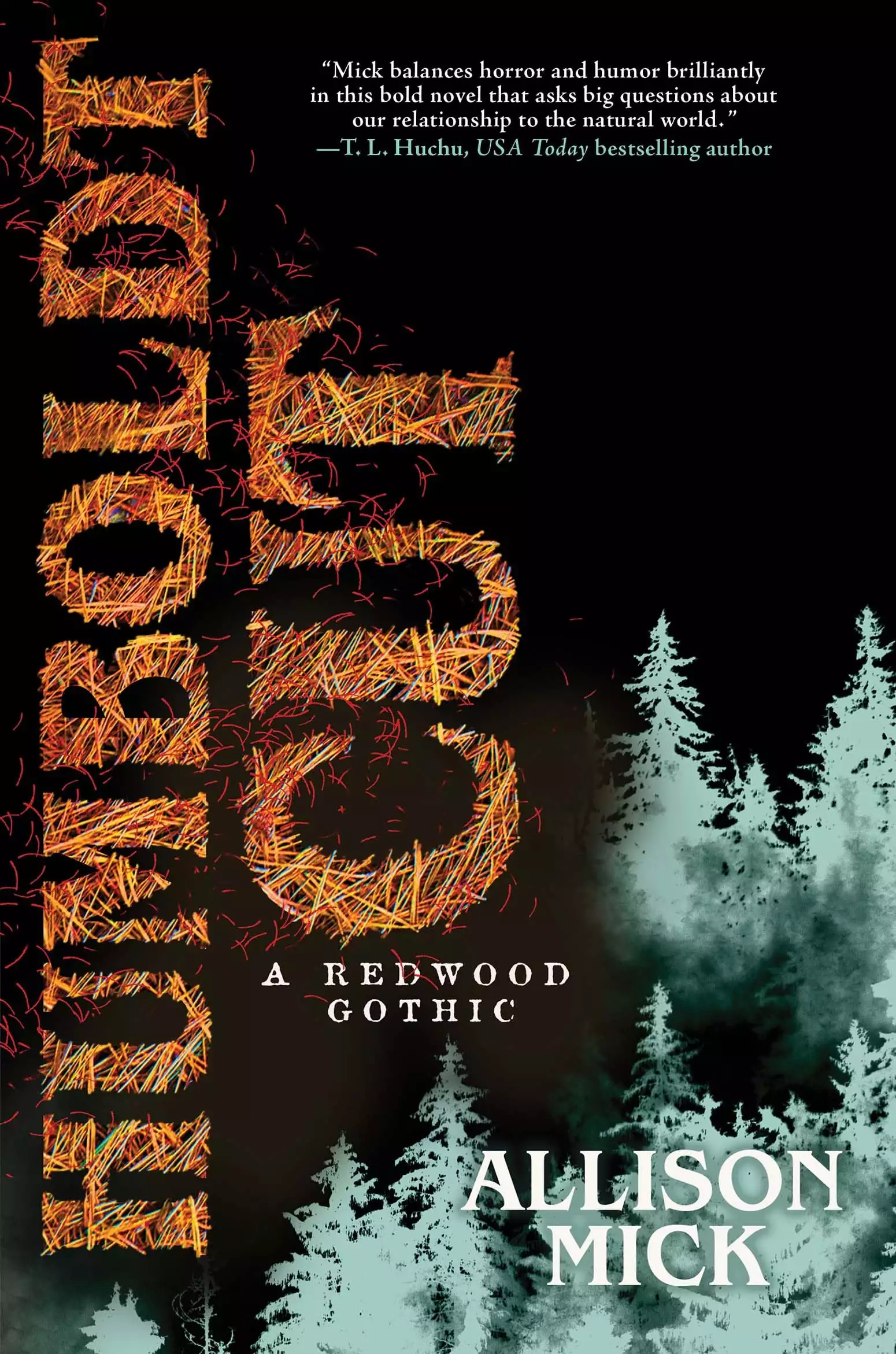
Humboldt Cut
- eBook
- Audiobook
- Hardcover
- Book info
- Sample
- Media
- Author updates
- Lists
Synopsis
Jordan Peele and Jeff Vandermeer meet The Overstory in comedy writer Allison Mick's darkly humorous debut eco-horror novel, as a Black woman returns home to the redwood forests of northern California, only to unearth the monsters that lurk among the trees...
Jasmine Bay is a nurse for an Oakland mental health facility, battling her own demons, caught in a spiral of suicidal despair. Estranged from her brother James and his wife Tilly, who was once her best friend, Jas has chosen self-isolation to protect herself—even if it means denying herself a hopeful future with co-worker and potential love interest Henry Lewis.
When her godmother dies, Jas returns to Redceder for the funeral, a logging town where her grandfather William Whipple made a living deforesting the countryside, ripping and raping apart nature's very foundations for corporate profits. As trees fell to axes and chainsaws, so did dozens of lumberjacks, falling prey to the dangers of their job—and to the ecoterrorism of Jas's grandfather who was lynched for his crimes.
And buried in the haunted woods are even more dark secrets perpetrated by Jas's family. Unnatural acts giving birth to entities made of human flesh and petrified bark, seeking to avenge the devastation that ravaged their land. It is an inheritance that threatens to consume the remnants of Jas's family, and her very sanity. . .
Celebrated comedy writer Allison Mick's Humboldt Cut exposes the traumatic costs of environmental destruction in an energetic, darkly humorous horror adventure that combines the botanical terrors of VanderMeer's Annihilation and the psychological horror of The Only Good Indians by Stephen Graham Jones with a dash of Jordan Peele.
Release date: January 27, 2026
Publisher: Erewhon Books
Print pages: 357
* BingeBooks earns revenue from qualifying purchases as an Amazon Associate as well as from other retail partners.
Reader buzz
 Please log in to recommend or discuss...
Author updates
Humboldt Cut
Allison Mick
Prologue: These Woods
1951
A million-million imperceivable eyes barely registered the goldenshine pollen dancing through the forest air. It sparked into blazing comets passing through a column of sunlight. Some things were too important to watch too closely—everything cast off will return to the forest if someone doesn’t steal it first. These woods operated on a timeline too vast to acknowledge urgency; when death feeds life feeds death in concentric rings across millennia, there’s no real difference between the two, between anything. Only increasing complexity toward what happened before creates the potential for the present.
The woods here were Potential embodied at its purest: quick-growing Picea sitchensis, fire-resistant Sequoia sempervirens, lightweight Thuja plicata. All beautiful, useful, and profitable in their own ways.
The Fallers
The blue truck slowed to a stop along a steep gully, kicking up nutrient-poor dirt and sawdust. An unsmiling old man stepped out, staring across at the dense mural of variegated green. Impassive, the forest returned his gaze. He opened the passenger door and carefully lifted a small Kodak Vigilant from the passenger seat. Adjusting the lens, he looped the strap around his neck. Snapped a picture of the expanse. He loved the woods with his whole heart.
He looked down the incline where the dozen or so men on his crew littered the grove. The foreman’s stomach dropped a little when he thought about the responsibility he had over them. The most dangerous job in America. For good reason. Especially in these woods.
There’s a small glade, long and narrow like the inside of a church. The canopy’s branches reach across to shield this place from the sun; it forms a wooden cathedral of gray and green shadows.
Above him, cables thwanged arrhythmically. He squinted up at the high rigger. All these young men, so drunk on their own vigor they don’t even realize they’re spitting in death’s face. If the high rigger has got time for acrobatics, he’ll have finished putting up the cables needed to drag this mother down to the yard once she’s been cut down.
In no time, the old man was at the trunk. Thirty feet across, the titan towered over him. A living thing so alien and yet more of this world than him, his truck, this road, and anything he considered part of his world. So old it predated the arrival of Europeans on this continent. An entity so large as to be rendered faceless, stripped of individuality, becoming one of those things that are so big we have no choice but to call them “places,” a forest rather than a tree. It made him feel like one of his daughter’s baby chicks, who were so small that they barely registered the human legs around them as more than pillars that occasionally showered them with grain. This pillar’s grain was a thick, pale yellow pollen that had already started caking on the spittle in his beard. Released to ride the fog to open spaces and seed a new generation of giants. Not for much longer.
The man rounded the tree to face the nave of this forest chapel. Above his head, on either side of the redwood, stood a young faller. Two boys, both named Tom, with thick arms and strong backs, were going for the Humboldt cut: a wedge cut into the trunk at an angle that suggested a slack mouth. The strong boys bounced as they swung their axes while balancing on flimsy springboards. The springboards were jammed into the tree ten feet off the ground. The cut doesn’t work on a human scale, so these boys stood on lumber, bobbing up and down to hack into the neck of a thousand-year-old giant.
“Boss.” The leftmost of the Toms tipped his cap to the old man, his sleeve lifting enough to show a peek of what the foreman felt was an idiotic line tattoo of an axe head. Not even a Humboldt axe at that. If you’re going to get inked up like a syphilitic sailor, at least get more than a little hatchet head that won’t even fell a Wisconsin pine. The little punk’s only worked timber for two seasons. Ridiculous.
A nod and a grunt served as enough of a greeting to the fallers. The boss had a greenhorn today. A gangly fifteen-year-old skulked up to him from the other side of the S. sempervirens.
And the boy was green. Wide eyes. Soft hands. The boy’s obsequious slouching made the old man want to smack him on the mouth. He’ll probably die in these woods, he thought. Or turn into an old man like me. Or worse. The forest takes all kinds, especially those that mean to harvest her parts to build a more efficient means to kill the rest of her.
The skyline cable thwanging above them percussed to the logging crew’s symphony of shouting, grunting, sawing, and a couple expensive gas-powered chainsaws. Noise upon noise.
The old man started his spiel about how this whole thing’s about to go. More noise for the noise.
“Sir?” The boy even yelled like a servant. Where the fuck do they find these guys?
The man gestured for the boy to follow him. Handing the kid an axe, he demonstrated how to chop down the smaller trees colonnading the glade. The two worked side by side, chiseling wedges into the spruces and pines. They worked together to push the trunks over, hefting them down the center of the chapel with dozens of others to fill the nave with pews.
From the high-up cables, a harness-less young man in his early twenties tightrope-walked quickly down a line. He barked down: “Oy!”
Half of the men stopped chopping. Gas chainsaws powered down, sputtering to silence. The greenhorn could barely see the high rigger against the blackened canopy.
“We’re good! That’s enough!” The man scampered across the line and hopped off onto the bough of the nearest tree.
The old man was annoyed. Dirty sweat and pine needles lodged in the furrows that radiated outward from his nose and petered out around his ears. “Ach, Whipple,” he grunted.
“He’s the skyliner, right?” asked the boy. Still dumb enough to be impressed. By Whipple, of all people.
“Yeah. We say high rigger. He don’t need to be up there, but he never comes down less’n it’s to eat. He’s a wee shart fuck who don’t want anyone to see how small he is down on the ground. He ain’t died yet so I don’t give a shit if he sleeps up there.”
Whooping, bellowing, the Toms hoisted their axes in triumph.
Another man yelled, “Picture!”
The half of the men who didn’t stop working at Whipple’s signal stopped at this. All the men looked to the foreman. The old man nodded. Most dropped their axes as they swarmed the giant tree, now sporting a slack-jawed grimace across the width of its trunk. The boy hung back, keeping slightly behind the old man.
cloud of dirt, dust, pollen, and sawdust.
The man in charge picked up his camera from the stump where he had stashed it. The boy leaned in to admire it.
“That an Ensign?”
“Kodak.”
“I had a similar one in San Francisco. Sold it to get up here.”
The old man nodded. He knew all about sacrificing what you love to bet on your future. Everyone here had a similar story. Jettisoning whole lives to come to the middle of nowhere to do the most dangerous job in America. No one joins a logging crew if they already have the life they want.
“If you want, I can take the photo. So you can be in the picture too,” the boy offered.
“No, s’all right. You get in the pitcher.”
“It wouldn’t be right, sir. I’ve only been here a few hours. This is your all’s tree. I can be in the next one.”
His smile was so earnest and optimistic that again the old man had to stifle the urge to hit him. Instead, he responded using the road much less taken: He smiled back. Eyes only.
The crew clambered up the springboards into the gaping mouth of the death-row redwood. The dozen and a half men stood in the mouth, as big as any whale’s, as alive as any whale’s. They smiled big whale smiles. The old man leaned against the tree below them, squinting even in the low light, which the boy accounted for as he adjusted the lens.
Even with this huge wedge removed, the tree breathed; nutrients, water, messages of warning rising and falling in its organs. Trees hundreds of miles away knew her to be screaming while a handful of organisms one half-millionth their weight stood smiling in her wound. With just a scant touch more gravity, she could crush them in that mouth. She could bite down on those industrious men who would kill and sell her body. They shuffled around in it. Pushing each other. Arguing about who gets to hold which axe. Should anyone be holding axes? Can the chainsaw be in the picture? But she was unable to bite down. They were good at their job, killing her. The only thing left to do is fall. And even that’s not her choice. They knew exactly how to cut so she would fall down exactly where they wanted her to. They’d set down a bed of smaller trees to cushion her landing. So she’ll fall. When they’re ready for her. After the picture.
The Buckers
The boy snapped the photo, and the men climbed down to get ready.
When the boy handed him back his camera, the old man snatched it, fearful for his treasure. He wrapped his buffalo plaid jacket around it and returned it to his vault stump. More metallic thwanging rang out from the cables above him. He didn’t even look up, but in his spiteful ignoring of the gymnast, he noticed Whipple still climbing up a nearby hemlock. Taking his sweet time too. Must be wind in the cables. A bad omen. We’ll have more’n a few logs falling off the haulback lines today if that keeps up. As it is, a tree takes an hour to reach the lumberyard, bouncing down the mountain like a shit ski lift.
The bed was set. The cut was done. The men took up ropes and chains hooked into the giant sempervirens. A hundred years ago, these same men’s great-grandfathers would have sailed from New Bedford, Nantucket, and Providence. They had used the same motions to cull the Atlantic’s humpback whales. The tree groaned its own cetacean song. The men grunted in reply; heave, ho.
They pulled over and over, feeling more give each time. The old man heard that up in British Columbia, they were using tractors to do this work now. Wouldn’t need all these men in that case. Pity. Every time man builds an industry, another industry comes in to take man out of the equation. Or the industry reaps until there’s nothing left. He’d never seen a humpback, even back in New England.
The telltale CRACK. The men released their chains and took cover behind trees, bushes, each other.
One would think a tree falling in the woods would start to feel anticlimactic after a while. Despite ten years at this job, the old man’s spine still tingled watching a hundred tons of thousand-year-old wood as it sailed noiselessly through the pollen-dense air.
He didn’t even hear the Toms yell, “TIMBER!”
The felled redwood smashed to the ground, turning the bed of thick logs into matchsticks. Splinters the size of drumsticks rode a cloud of sawdust
outward.
The impact was tectonic. His wife and daughter said they never heard or felt the trees falling. He wondered how. How can something so colossal just not even register only ten miles away? He wondered if one day he might fell the wrong tree and crack the Earth in half.
There were only a couple injuries from the fall. All minor. Men who weren’t good at shielding themselves always caught a little shrapnel. It was what he deserved for being too old for the war; one way or another, he was going to have to watch young men get hurt and die. He’d only lost one kid this season, though, hence the gawking greenie next to him.
“I knew it was a big tree but . . . wow,” the kid rightly stammered.
The old man inspected the log. No breakage along the whole two hundred feet. Good. He never got sick of this. He imagined himself a modern-day David gloating over the hulking corpse of Goliath.
“Grab your saws!” he called.
Jonesy used an axe and white paint to mark the tree into forty-foot lengths. The buckers carefully produced two-man saws fresh from the filing shop.
The old man clapped the boy on the shoulder and warned, “B’careful with these. Too long a look at the saw teeth can draw blood. And keep your wits about you. Fallin’ this tree probably loosened some of the other branches above us. Falling branches killed more’n tree trunks ever did.”
The old man pointed above them, to the trees he deemed caution-worthy, and the boy was nearly blinded by the newly created hole of sky in the canopy. Its nakedness struck him as obscene. The boy quickly abandoned the thought for the spectacle in front of him. Regarding the bed of shattered logs, he found it funny that the things he previously thought of as “logs” didn’t even survive what he now knew as logging. It’s all so much bigger.
He and the old man began their sawing. From what his roommate told him, they’d be at this for hours.
The Choker Setters
Three hours later, the foreman showed the boy how to set the medieval-looking spiked choker around the now-manageably sized tree trunk. The boy’s hand fit in one of the smaller furrows in the furry red bark. They hammered in the spikes with the
side of an axe. The tree would fall, many times, on her way down the mountain. But the choker, its spikes, and its torso-length chain links would make it easier to pick her up again.
They strung her up, pulling her down the haulback lines that Whipple saw to. The cables led down the mountain. The trees were half dragged, half hoisted, bobbing along like clumsy ghosts, floating in ugly parabolas before touching down on the ground, scraping at the soil before bouncing back up again.
Before setting to work on the next section, the crew crowded around a tin water tank with an open top, letting water spill down their faces until their beards and mustaches dripped with wet sawdust.
The boy took off his gloves to pour water on his hands. The skin was mangled and bloody.
The men on the logging crew smirked at each other, knowing from experience that pouring water on a first morning’s blisters would only make the afternoon’s more hellish. They all went through it so there was no reason to warn the skinny kid with the big eyes and wispy mustache. There’ll be a new greenie soon enough and then he’ll be one of them. Probably even before he’d broken in his spiked boots.
No time for that now. “Get your gloves back on. We got a long day.” The old man strode back toward the log.
“We’ve already had a long day,” the kid jibed.
Since the kid couldn’t see his face, the old man smiled.
The boy at least had enough sense to wipe his hands on the inside of his shirt until they were completely dry before putting his gloves back on, flustered, stumbling after the foreman. Still getting used to boots with inch-long spikes on the bottom.
Nearly back at the log, the old man softened a bit and decided to throw the kid a bone. “It gets harder, you know.”
“What’s that, sir?”
Christ, this fuckin’ kid. I said what I said. No, he’s just a stupid kid. He don’t know nothin’. “The skin. On your hands. It gets harder and don’t bleed as much. Over time.”
The boy smiled. “Oh. Thanks. I never—”
The boy disappeared.
the scene before him.
The boy’s body lay crushed by a branch the size of a couch.
His blood had splashed onto the beard and clothes of the foreman, who just stood there. Shell-shocked.
All around him, more gunshots cracking. More branches plummeted from the trees. The old man looked around for cover, trying to find somewhere safe. Another man—one of the younger buckers—pushed him to the ground and immediately got impaled through his back. The bucker fell to the ground, slightly elevated by the leg-sized branch in his chest. More men fell around them.
The old man stayed on the ground and thought about his daughter and her chicks. The tears streaming down her face after he accidentally crushed one with his caulk boot. I’m sorry, Alice.
Sounds came from above him. A hoarse barking like the coughing yelp of a deer. He lifted his head to locate the sound and saw another branch falling at him. He scuttled across the ground toward his vault stump, kicking up pine needles. In his periphery, a figure descended a trunk, but when he looked to follow the movement, there was nothing. Just a redwood.
It was at the stump that the old man realized everyone else was dead.
The branches kept falling like gunfire, then suddenly stopped.
The old man’s ringing ears drowned out the eerie silence of the redwood forest until more sounds emerged.
From the quiet came another deer-cough. Answered by another, deeper bark near another tree. Jesus Christ. From behind the stump, the man could barely make out a figure moving through the trees. Then another. Their skin was hairless, moist, and covered in rusty leopard spots that camouflaged them perfectly in the tree trunks. Their bodies were too alien to be human. Eyes too black, arms too big, legs bending at the wrong angles. Monsters. They climbed the trees even more gracefully than Whipple.
Paralyzed by fear, the old man ducked back behind the stump until the cough-barks faded into the distance. He closed his eyes so tightly his head hurt, and he felt he might go blind. But blindness was better than seeing those hairless, coughing things again.
Behind him, a twig snapped. They were back. Instead of adrenaline, the man’s veins flooded with the absolute certainty that he would die in the forest on this day. I’m sorry, Alice. I’m sorry, God. In his final moments, he realized his daughter would be the one to tell the future generations what he was like. He hoped she would be kind. That she knew how much he loved her and wanted her to have a good life.
Another snapped twig. Closer this time. Maybe six feet away. The old man, resolute in his fate, didn’t even bother to turn around.
“Boss.”
“Whipple? What the fuck?”
Whipple warily approached the old man, who hugged his legs, happy to see him for the first time ever.
“We gotta get you out of here,” Whipple whispered to the foreman, pulling him up.
Huddled together, Whipple and the old man stepped gently through the gully toward the road where the foreman’s truck was hopefully uncrushed and serviceable. They passed monstrous burled stumps whose woody protrusions reminded the old man of the cancer that had killed his father, warping his skull until he couldn’t breathe. The burls’ brown marbling reminded him of those . . . creatures. The barkers.
“What were those things?” the foreman asked, whining more than he cared to but too terrorized to care.
The look Whipple gave him said it was more whining than Whipple cared for too. They let the forest sounds fill the awkwardness as they shuffled through more leaves than the old man had ever noticed were in these woods.
At an escarpment overgrown with tree roots, the younger man roughly pushed the elder through the roots into a makeshift cave. The old man tried to escape the root cave, hoping his truck was nearby, but Whipple grabbed him when a scream echoed off the stone walls of the gully.
“Stay in here,” Whipple warned gravely. “Do not leave.”
“Where are you going?”
“For whoever that was.” Whipple flashed an apologetic smile before darting back into the trees, immediately disappearing into the heavy brush.
Beneath the roots, the old man started to wilt. Wooziness overcame him as all the strength he had left oozed from his body like maple sap from a still. He leaned against the cave’s back wall, cushioned by the soft soil, finally able to rest. The
boy, the Toms, Jonesy . . . Every man he had talked to today was now dead. While cradling his head, he noticed that his hands had taken on a pale, mottled look in the cave light. What is happening out there? he wondered. He strained to listen. To pick up a noise—any noise—in the silence.
He didn’t know if he heard or imagined the hacking deer-cough from off in the woods, jarring, like a kick to the face. Either way, he was terrified. He pressed harder against the back wall, praying he could stay hidden by the roots.
Ninety-nine years ago, a tree fell in the woods. As its wood decayed, successive waves of moss, mycelium, and other plants grew on it. Its roots grew for a few decades longer, reaching across the forest floor and falling over a small escarpment, forming a cave. More plants grew on the nurse log, thriving from the dead tree’s nutrients: a line of Douglas fir saplings, twenty kinds of mycorrhizae, and by 1951, magenta tree mallows were in bloom.
The mallow didn’t belong here, of course. But in 1931, this particular plant’s great-grandparent rode up from San Luis Obispo, pinned to a hat. The car took one of the looping turns of the Redwood Highway too quickly. The hat flew off and fell down a gully onto this very nurse log. The weather had only gotten better in the past twenty years, becoming more like Southern California every day. That pretty flower’s descendants lived and died on the nurse log, and now they fed Vanessa annabella, the West Coast painted lady, a butterfly with nothing but beautiful names. After eating its fill of tree mallow leaves, a V. annabella caterpillar—at this point not a lady but still painted with white and ochre impasto speckles—went on a walk.
While the trees slaughtered the loggers, the caterpillar sauntered down the tree mallow’s vines toward the roots, each section of its spined body tensing and releasing. Unhurried, its forked hairs swayed to and fro. It was on these roots when Whipple thrust his supervisor into the cave and knocked the caterpillar to the ground.
On the ground, the fuzzy gray protagonist had nowhere to go but up. The nearest and most graspable surface in the cave was the old man’s denim cuff. Luckily, the caterpillar evaded the steel spikes lining the bottom of the foreman’s caulk boots.
winds than this and had hung onto smaller targets than this. She inched up, spines tingling as she perceived the change in altitude. Higher. Higher. She reached something like the tattered bark fibers of her home sempervirens. The man’s beard. Using every foot, she climbed from hair strand to strand over chunks of dirt, sawdust, pollen, blood. Suddenly, there was an opening.
When the caterpillar crawled into his ear, the old man jumped so high he banged his head. He could feel and hear the caterpillar’s rough body entering his own. He shrieked and scrabbled, falling to the ground as he batted fruitlessly at his ear. Blind and afraid in the cave’s darkness, he kicked against the ground until he was out in the open, bawling and pawing at his head.
The caterpillar, shaken free by the man’s hysterics, landed hard on a pine twig. Unbothered, she continued her climb upward. She’d been through worse than this in her short life.
When the old man stopped shaking, his body was tense all over. Of everything that’d happened that morning, this was the thing that made him cry. This made him lose his calm so completely that he jumped out in the open where smooth-skinned freaks of nature would surely hear him and kill him. This. He wasn’t even surprised when he heard the crunch of leaves behind him. He’d done this to himself, worrying more about a caterpillar in his beard than his own life, ’pparently. Such stupidity deserved death. He hoped it’d be fast.
“I told you to stay in the cave.” Whipple again.
Laughing, the old man flopped onto his back. Always looking up at the high rigger. May as well let him feel like a big man now, standing over a silly old man crying over bugs. The men always talked poorly about Whipple—the almost-midget with the Negro wife hidden away somewhere. But from down here, the man may as well be king of the forest.
The king looked displeased. “Now you’ve done it.”
“Done what, Whipple?” The old man was still giggling incredulously as he lumbered up to his feet and shook out his adrenaline-soaked limbs. Saved twice in a day by fuckin’ Whipple who—now that we’re both standing—isn’t that short. Shorter’n average for sure, but a far shot from the little men of the Wizard of Oz.
Whipple’s eyes widened as he looked up at the old man. No, past him.
Above them, that metallic cable noise sounded again.
Whipple grimaced.
The old man turned to follow the skyliner’s gaze and barely saw more than teeth as one of the hairless creatures with the speckled amber skin crushed his skull with a wet crunch.
The Skyliner
Whipple uncovered his eyes. Next to him on the ground lay the old man’s corpse. Strips of skin and beard were all that was left of his head. He should’ve stayed in the cave. Might’ve been better. Whipple fished the man’s keys from his pocket, then scooped handfuls of leaves and dirt and pine needles over the man’s body. The mound squirmed with bugs, already there to feast.
“Mmmm!”
Whipple heard the whimper not too far from the foreman’s final resting place. He stood to locate the sound. It sounded close, but sounds and distances could distort in these woods; it could be coming from anywhere within three hundred yards.
A flash of a white hand in his periphery alerted Whipple to this new man’s location at the lip of the gully. The skyliner hopped up toward him, deerlike, until he stood over one of the hotshot fallers. Tom, maybe?
“Whuhh,” Tom croaked. His legs were crushed. His face was swollen. His lower lip was missing. His strong arms were streaked with blood, forming a forked river around his hatchet tattoo.
Whipple nodded down to him, and Tom exhaled blood bubbles of relief. Whipple grabbed the man’s arms and yanked. The big man yelped like a hurt game animal as his arms nearly dislocated from his shoulder sockets.
Tears streamed down his face. He babbled, pleading incoherently with Whipple, who continued to drag him down the gully to the root cave.
Denuded of other men, the forest was dead silent but for Whipple’s grunting and Tom’s moans. Whipple pulled Tom past the old man’s burial mound,
which had become barely a heap. Its height was half what it was before, the human body quickly reduced to rich, black loam. The speed with which it happened would be unnatural outside of these woods.
At the cave, Whipple pulled the faller between the roots. He pushed the man up against the soil wall and left him there.
Whipple was already a few hundred yards away, picking up the old man’s camera, when the screaming started. In no time, Whipple was in the old man’s truck, throwing the shattered Kodak into the passenger seat.
Tom’s life leached out until his skin took on the same reddish mottle of the other forest wraiths. The faint blue outline of his tattoo remained on a thickening forearm that quickly lost its other human qualities.
Whipple drove his dead boss’s truck down the logging road. Through the window, he heard Tom’s screaming go hoarse as his life drained, his yells rasping into a hard coughing bark.
At the end of the logging road, the skyliner didn’t turn toward town. He went farther into the forest, heading home to his wife. He loved her and these woods with his whole heart. ...
We hope you are enjoying the book so far. To continue reading...
