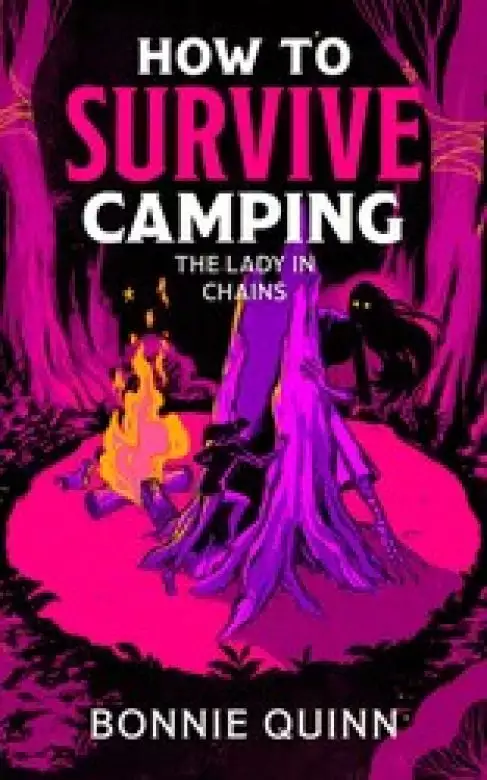
Campground manager Kate returns in this supernatural, campy, and cozy horror tale filled with thrilling adventures, mysterious monsters, and spine-chilling encounters, perfect for fans of Welcome to Night Vale and Chuck Tingle.
Every year, campground manager Kate sends out a pamphlet titled “How to Survive Your Camping Experience.” It includes a list of rules to help campers have an enjoyable experience and hopefully survive any encounters with the campgrounds other…inhabitants.
With the campground in the throes of a bad year, it will take more than a list of rules to keep everyone safe. Monsters that were previously lying dormant are starting to stir and they’re waking up hungry. Among them is the Lady in Chains, a creature feared by both human and inhuman things alike.
Her reappearance creates an upheaval in the balance of power in the campground by renewing an old grudge with the harvesters, who are willing to sacrifice anyone they get their hands on in order to gain an advantage. On top of all this, the Man with the Skull Cup has started taking an unusual interest in Kate. But with the harvesters on the prowl, the Lady in Chains hunting her down, and a sinister spider infestation, Kate is going to need all the allies she can get, even if those allies aren’t actually…human.
Release date:
April 28, 2026
Publisher:
S&S/Saga Press
Print pages:
288
* BingeBooks earns revenue from qualifying purchases as an Amazon Associate as well as from other retail partners.
Structural Incentives and Antisocial Behavior This year’s camping season at Goat Valley opened at the beginning of March, when the hoarfrost had finally melted and new shoots had started pushing through the earth. The days were getting longer and the winter chill had left. My staff were cheerful. It felt like a time for new beginnings.
But then came the omens.
It started when I was told that a farmer in the area had a dog whose litter of puppies were all stillborn, save for the one that had two heads. A few days later, I found the front gate covered in spiderwebs. Then that same night there was a heavy storm. Hardly unusual for March, but the timing was deeply suspicious.
The thunder woke me an hour before dawn, so after the rain stopped and the sun peeked over the horizon, I opened the garage and drove out on my four-wheeler. We only had a handful of campers present, but I had to make sure that they were okay. It wouldn’t do to start the camping season with a death on the campground.
I’m sure readers of this guidebook are wondering how we stay open when we seem to have campers getting killed in horrible ways left and right. Our numbers aren’t usually that bad. My stories make it seem like I run Camp Sudden Demise, located in the scenic town of Murdersville, but in reality, our death and injury count is only slightly inflated from the surrounding areas. It’s a violent world out there. Even then, most of the campground’s injuries are caused by alcohol and poor decisions on the part of my campers.
Except during bad years.
During bad years, our numbers can double or even triple. And I had my reasons to believe this might be one of them.
The theory of a “bad year” has been in my family for generations. We know it’s happening by intuition, a sense that the land is uneasy and that the inhabitants are restless. I was the first in my family to solidify the theory with data, and sure enough, among the early warning signs was a marked increase in deaths, disappearances, and injuries. Not just unnatural ones, either. Lots more broken legs or people with heatstroke in bad years too. It’s a bad time for everyone.
I do have some help, though. My best asset is the Old Sheriff. He helped my parents and now he helps me. He intended to retire and was training up the New Sheriff as a replacement, but that didn’t quite go as planned. So the Old Sheriff is still my liaison with the town, even if he’d much rather be retired. He knows the deal with Goat Valley. We’re partners. The police and the campground have an arrangement, let’s just say.
Then there is Bryan, my most reliable employee. Bryan isn’t just a good worker—he also has dogs. Very special ones. And wherever Bryan goes, the gigantic black hounds go with him. I find them incredibly useful to have around, as most inhuman creatures would rather flee than deal with them. The people around town probably think them a nuisance, but no one was about to argue with the guy that has a fiercely protective pack of dogs that have somehow lived almost three times longer than any dog had a right to.
But in the morning, it was just me patrolling the campground. The storm had shaken things up a bit, and it didn’t take long to find trouble. A camper was standing in the middle of the road, clutching something to her chest, facing one of our… permanent campground residents. He wore a black hoodie with the hood drawn over his bald head. His face and ears were covered with a multitude of piercings, and plain metal bands were on his fingers, made of a metal that didn’t shine as brightly in the sunlight as it should. In his hands was cradled a cup made out of a human skull. I drove closer, reminding myself that it could always be worse.
The Man with the Skull Cup was quite survivable, so long as the intended victim agreed to take a drink.
I stopped the four-wheeler a polite distance away and waited as he raised his cup to her lips. He was speaking to her, too softly for me to make out the words, his lip piercings faintly catching the scant sunlight making it through the overcast sky. Then, balancing the cup in one hand, he pulled the parcel out of her hands and away from her chest. My heart sank.
It was a book. A guidebook, to be specific, with an alarming number of bookmarks sticking out of its pages. He considered them for a moment, removed one without bothering to look at the pages it marked, and silently handed the book back to her. He walked off, nodding to me as he passed by the four-wheeler.
“Hello, Kate,” he said, a trace of smugness in his voice.
I didn’t reply. We had a bit if history he and I, but I didn’t care to interact with him more than I absolutely had to. I watched him go for a moment, wondering what that was all about, before turning to the camper.
She was almost vibrating with excitement.
“The Man with the Skull Cup!” she exclaimed. “Except… I didn’t see them as a man. Is that normal?”
“It is,” I sighed. “Everyone sees him as someone different. Okay, now that you’ve drunk from the cup—”
“I know. Don’t eat or drink anything for twenty-four hours.”
For a moment I was pleased that the guidebook was working. People were paying attention! They knew what to do when confronted with the inhuman!
“Though I was wondering if you’ve seen the Dancers,” she continued. “I’d like to meet them next.”
And like that, my happiness evaporated.
She was a thrill-seeker. I’m familiar with that subset of my campground visitors. I describe it as antisocial behavior—breaking the rules simply because they don’t like that the rules exist. We have people that return despite having had an encounter with one of my other residents, hoping to see these creatures again. When I was a kid, I once laughed about them and called them crazy. I was parroting something I’d heard my classmates say. My father took me aside and explained that it only seemed crazy because I’d grown up with these things. For everyone else… it was like finding out dinosaurs were still alive. How would I feel if I found a campsite where dinosaurs still roamed? Wouldn’t I want to go there, no matter how dangerous it was?
I think this might have been before I watched Jurassic Park.
“So the bookmarks are…?” I asked.
“All the creatures I want to meet,” she said. “And I just crossed one off the list. Did you see him take the bookmark with him? That was so cool!”
“Yeah,” I replied through clenched teeth. “Why don’t you take a moment to find the bookmark for ‘Kate,’ because you can cross that one off your list while I make a phone call?”
“Oh but I don’t have a bookmark for the camp manager…”
I was already getting off my four-wheeler and walking away. I opened a channel on the radio.
“Bryan, please tell me you’re on the campground,” I said.
“I’m here. Where do you need me?”
“Do you think you could keep someone distracted with the dogs for a few hours while I make sure the rest of the campground is safe? This camper is using the guidebook as a checklist to find creatures. The exact opposite of its intent.”
“Sounds like someone that’d try to pet some bison,” he sighed, sounding resigned. “I’ll be right there.”
I gave him our location and then plastered my best customer service smile across my face as I walked back to the camper to tell her that she’d be able to meet Bryan’s dogs soon, so long as she stayed put. Then I got back on my four-wheeler to complete my patrol of the campground.
“Bryan,” I said over the radio as soon as I was out of earshot. “Try to get her to eat or drink something for me, will you?”
It was amazing what people will forget when they are distracted. It would only take being handed a water bottle at the right moment to slip up and break the rules of the Man with the Skull Cup. No food or water could be ingested for twenty-four hours after drinking, or the victim would be violently ill as a result.
Consequences can also be effective at changing someone’s behavior.
I needed to finish my rounds. The forest was strangely quiet as I drove through it, dodging fallen branches and debris from the storm. The air was still, though, the only sound the hum of the four-wheeler’s engine and a handful of distant birds. The conversation with the camper reminded me uncomfortably of my experience with Perchta, a Germanic goddess-turned-saint, who once threatened to disembowel me if I didn’t try harder to keep people alive. I didn’t want to give her a reason to follow through on this, but some campers made it hard.
I hadn’t seen anything else out of the ordinary by the time I descended into the deep woods. It was unlikely that the campers on-site would go down into the forest, as the rain had left massive puddles across the dirt road and brought back the bite of late winter. The deep woods are the most dangerous part of the campground. They are the furthest removed from civilization, and the dark, remote parts of the forest are where monsters live. Even I wanted to avoid the deep woods right now.
I did one last patrol of the campground to see if anything was active. The Dancers’ favorite clearing was empty. There was nothing inhuman on the road. And while the forest was still quiet and cold, perhaps it was just a normal weather pattern, and the omen reported by the Old Sheriff was nothing.
The day passed by peacefully. Still, as dusk approached, I made up a giant carafe of coffee and resolved to spend the night with my radio close at hand and the four-wheeler ready to go. Normally I wouldn’t have bothered, as my campers are all adults and can make their own bad choices, but I really was trying to be more proactive at keeping people alive, even if that was mostly about stopping Perchta from taking my insides and draping them through the forest like Christmas lights to celebrate her favorite season.
Shortly before midnight, the emergency phone rang. I was dozing lightly on the sofa and the ringtone at max volume instantly woke me. I snatched it off the table, the bright red case making it instantly recognizable even in the darkness, and hurriedly answered it. I was utterly unsurprised to hear my new least favorite camper’s voice on the other end.
“There’s, uh, frost inside the tent,” she said.
“I’ll be there shortly,” I said, starting the engine of the four-wheeler. “Just stay put.”
The frost was one of our less deadly phenomena. It was slow moving, and so long as we got to its victim quickly, we had plenty of time to relocate them to one of the small houses scattered around the property.
In fact, my aunt Aleda had a guest room for this specific purpose.
I drove to the campsite and stopped the four-wheeler a few yards away from the camper’s tent. The frost was spreading before my eyes. It crawled along the ground like a drop of ink in water, a glittering veil that sparkled when I shone my flashlight on it. Anxiously, I jumped off and ran over to the tent, feeling the grass shatter beneath my feet. The tent was covered in a layer of ice. Its zipper was frozen over. My camper was trapped inside.
“Get away from the sides,” I said through the thin fabric. “I’m going to cut you out.”
I pulled out my pocketknife and jammed it through the ice. It cracked and a chunk of it fell, landing against my leg. I could feel it burning through my jeans and I hastily kicked it aside. Then I sawed through the fabric, cutting a long slit from the top to the bottom. The camper pushed herself through, wrapped in both a jacket and a blanket, shaking so violently that her teeth chattered. There was frost in her hair and her lips were pale.
“Is this… normal?” she asked.
“Nope,” I replied tersely. “It shouldn’t be moving this fast. Let’s get out of here.”
I was almost at the four-wheeler when I realized I had heard only one set of footsteps cracking the frozen grass.
“What happens if you don’t leave?” she asked from behind me.
I turned. She was still standing by the tent, staring in wonderment at the ice slowly thickening around her.
“You freeze solid,” I replied. “Now let’s go.”
“And what about that?”
She pointed at something just around the corner of her tent. I hesitated, unsure if I could bully her into leaving with just words or if I’d need to walk back over there and physically drag her away. I realized then that her clothing was shining faintly in the moonlight from the frost that was encroaching onto her body, but she wasn’t moving, wasn’t walking in my direction. Just… staring at the ground.
I swore, grabbed my shotgun from the four-wheeler, and stalked back over.
On the other side of the tent was a bulge in the earth. A mound, pushing upward, cracking the frozen soil as it moved. I stared at it for a few heartbeats.
“What is it?” she asked.
“I… have no idea.”
It cracked. Like an egg.
Dark soil poured out, bubbling out of the wounds like boiling water. The ice was quick to cover it, but the earth did not stop moving—it took shape—consolidating into packed clumps of encrusted soil, the ends splitting and arranging themselves into thin columns, stretching toward the sky. Like branches, I thought. Like branches coming out of the ground, formed of dirt, veined with white lines of frost, coated with icy glass skin. A multitude of them, like a field of fresh-sprouted wheat.
They thickened. Branched. The earth cracked and churned furiously, and finally, the camper turned and ran, knowing that something was coming up out of the ground and she didn’t want to still be there when it emerged. I fired one shot at the ground, not knowing what else to do, and then I turned and ran as well.
We didn’t make it very far. The ground crumbled beneath us and the frost wrapped around it as it disintegrated, encasing the soil, and I felt ice clutch at my ankles. I threw myself forward, digging my elbows into soil that wasn’t frozen yet, and I hauled myself up and away from the crumbling earth, pulling myself onto solid ground. Then I rolled and turned to see if the camper had made it.
She had not.
She was on her chest and stomach, clawing at the soil in front of her, trying to find purchase, but she wasn’t strong enough and the earth was frozen hard as stone. The grass snapped as she raked at it, the slivers of ice biting into her fingers like needles. Her blood flowed sluggishly from the wounds and even its warmth could not melt the ice around her.
And her legs… they were entrapped in pale frozen tendrils that had emerged from the forest floor. The strands thickened, cutting through the fabric of her jeans even as it froze solid. They were dragging her backward, toward the sinkhole that had swallowed her tent whole.
“H-help!” she gasped, too frightened or too chilled to properly scream.
I grabbed hold of her wrists, dug my heels in, and began to pull. But even as strong as I am, it wasn’t enough, and I felt my feet slipping beneath me. A few moments more and I’d lose my purchase entirely and be pulled forward, into the ring of ice and within range of those grasping tendrils.
I thought about letting go. For a moment, I thought about it.
Then I felt a presence at my back, and an arm reached around me. I saw only a few details, pale skin, tinted blue and covered in lacy frost. I smelled the sharp scent of an evergreen tree.
It grabbed her by her hair. And then it pulled her straight up, and her body simply slid out of the grasp of the icy tendrils, which went lax as if in defeat. I let go too, startled, and stumbled sideways. The entity held her aloft, and I saw in his other hand, he loosely held a branch of a tree.
He threw her aside. It almost felt contemptuous. She didn’t move when she hit the ground, and I cast one last frantic glance at the stranger, just long enough to ascertain he wasn’t going to do anything more, and then I ran to her.
She was breathing. Her eyes were squeezed tight and she was crying. I pulled the hem of her jeans up, and the ice that had worked its way into the fabric cracked as I did.
Her skin was almost white, save for vivid red imprints of where the ice had grabbed hold of her.
Well, at least she didn’t seem to be dying. I turned back toward the sinkhole and the stranger and found them gone. There were no branches. No hole. No pale man covered in frost. Just a perfect ring of frozen grass, glittering like crystals in the moonlight.
“Wh-what was that?” the camper whimpered.
“I don’t know.”
“But you’re the campground manager!”
She was trying to get up. I took a short breath, tried to contain my temper, mostly failed.
“I don’t know!” I snapped. “Don’t you get it? I don’t know everything. There’s creatures on this campground I haven’t encountered yet, we get new ones that just… show up… or the ones already here change, and the only way I find out anything about them is because someone dies—someone like you!”
She was quiet a moment. Only a moment.
“Do you think we could get my tent back?” she finally asked. “My car keys and cell phone were in it.”
Maybe it was the sleep deprivation, or maybe it was the adrenaline, or maybe it was the realization that the storm was an omen and that the bad year was still happening and my campground continued to find new and horrific ways to surprise me, or maybe it was all of these, but I just screamed in frustration and walked away. I called the Old Sheriff and asked him to discretely send an ambulance and if he could come escort a camper permanently off the premises.
Private. Campground. Comes in handy sometimes.
Because while I always regretted the loss of a repeat camper’s revenue, prime camping season was about to start, and the last thing I needed was a liability like a thrill-seeker hanging around. As the frost had so dramatically proven, the bad year wasn’t over, and if I didn’t figure out how to resolve it before our big events, I was going to have a whole lot of dead campers on my hands.
We hope you are enjoying the book so far. To continue reading...

 Please log in to recommend or discuss...
