
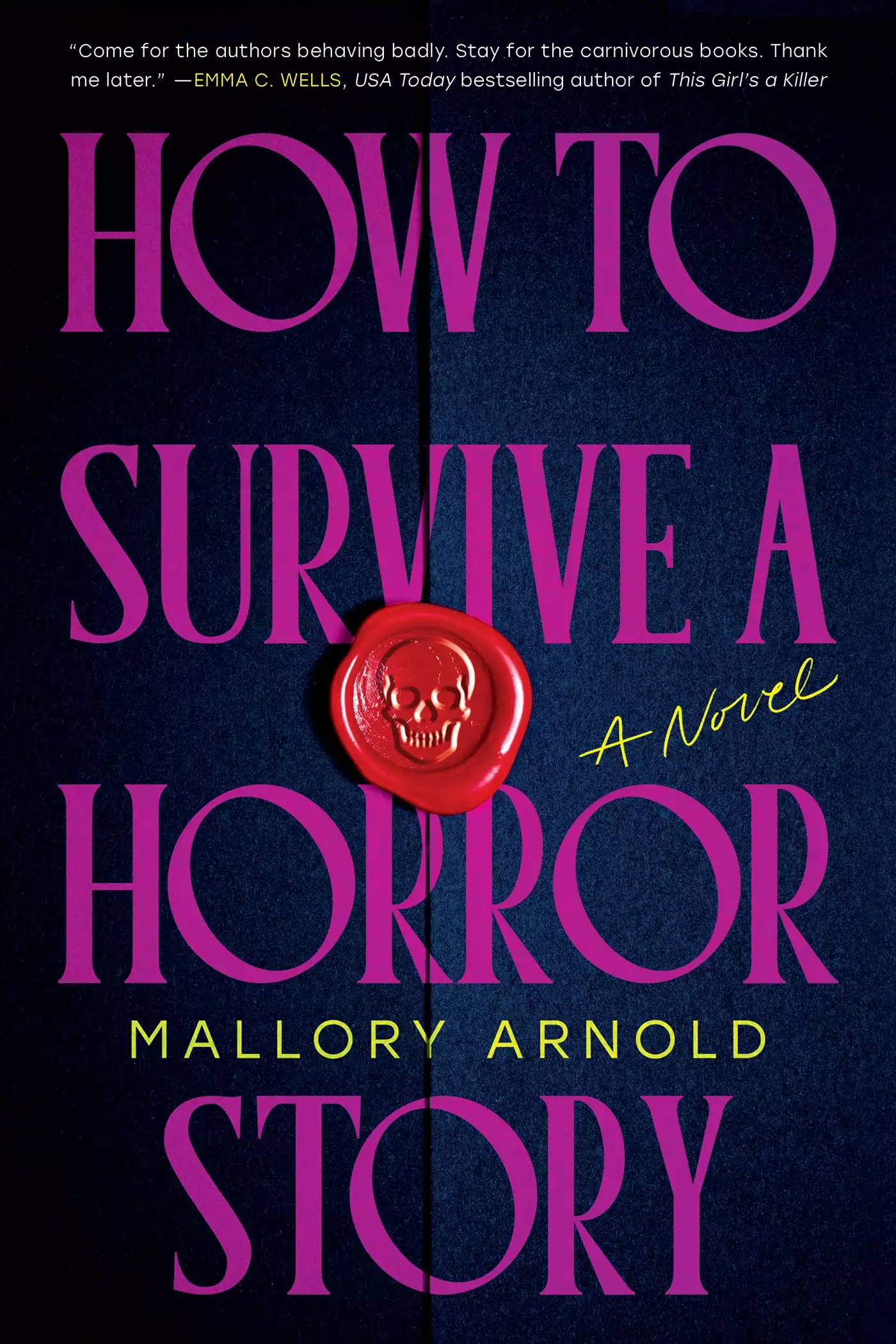
How to Survive a Horror Story: A Novel
- eBook
- Paperback
- Audiobook
- Hardcover
- Book info
- Sample
- Media
- Author updates
- Lists
Synopsis
Seven authors enter the manor
Can they survive the story within?
When legendary horror author Mortimer Queen passes, a group of writers find themselves invited to his last will and testament reading expecting a piece of his massive fortune. Each have their own unique connection to the literary icon, some known, some soon to be discovered, and they've been waiting for their chance to step into the author's shoes for some time.
Instead, they arrive at his grand manor and are invited to play a game. The rules are simple, solve the riddle and progress to the next room. If they don't, the manor will take one of them for itself.
You see, the Queen estate was built on the bones of Mortimer's family, and like any true horror story, the house is still very, very hungry.
With the clever, locked-room thrills of Everyone in My Family Has Killed Someone with the ghostly horror of The Fall of the House of Usher, How to Survive a Horror Story is a bright, biting, thrill-ride that begs us to contemplate how the best horror stories come to be.
Release date: July 8, 2025
Publisher: Poisoned Pen Press
Print pages: 363
* BingeBooks earns revenue from qualifying purchases as an Amazon Associate as well as from other retail partners.
Reader buzz
 Please log in to recommend or discuss...
Author updates
How to Survive a Horror Story: A Novel
Mallory Arnold
The gravel road leading up to Mortimer Queen Manor curves and bends like an uneven spine. Melanie Brown’s Toyota quivers about on the vertebrae as gravel spits out from underneath its tires. The road is strangled by a thick forest, with trees bearing down on it, giants bending over to inspect something squashed on their shoe.
The car radio conked out an hour ago, and no matter how hard Melanie bangs on it, the comforting mumblings of lazy-afternoon NPR won’t come back. She tugs on her uneven bangs, a product of rusty scissors and a terrible mistake made in front of her bedroom mirror last night. It had been a poor attempt to cover the fresh scar marring her forehead, which is now even more prominently framed by fraying strands of hair.
Her cell phone buzzes in the cupholder, and she answers it on the second ring. If it’s her sister, Petra, Melanie is eager to talk. If it’s her mother, making her wait for a third ring is liable to start an argument.
“Are you there yet?” someone snaps in a taut voice from the other end before she can utter a greeting.
Melanie sets the phone on the dashboard, hitting Speaker so she can use both hands to keep the car from veering off course.
“Yes, Moth—yes, Cynthia. I’m just pulling up to the address now.”
Only a few months ago, their mother decided they were old enough to refer to her by her real name. “It’s about time I got back to who I really am,” she told them. “I was your mother for so long, I feel neglected as a person.”
Neither Melanie nor Petra pointed out that, regardless of how they referred to her, she was still very much their mom. There was no undoing that.
“Hmph.” Cynthia sniffs.
Melanie waits, listening to the sharp whistling coming through her mother’s nose. “Did you need something or—”
“How long are you staying again?”
“Just the weekend.”
Another “hmph,” followed by an aggressive slurp of coffee. “You’re missing my bridge tournament.”
“I know. I’m sorry.”
“What am I going to tell my friends? That my daughter trekked across the country to sleep in a creepy old man’s house?”
Melanie grips the steering wheel tighter, her knuckles whitening. “It’s not like he’s going to be there, Mother. He’s dead.”
A crow flies dangerously low in front of the car, forcing Melanie to jerk the wheel and almost skid off the road. The phone slides off the dashboard and into her lap. She picks it up and is about to put it back when she realizes the call has dropped anyway.
She exhales a shaky breath. There’s an ache in her neck that comes only from a conversation with Cynthia. The whiplash of her message was clear through the phone: I do not approve. It’s why Melanie waited until last night, while they were out to dinner, to tell her about the letter she’d received about a week ago. Cynthia nearly choked on her charred brussels sprouts at the news that Melanie was not only named in a will but in a wealthy man’s will and would be leaving the next morning to hear what she was bequeathed. One would think a mother would be excited about this, but Cynthia preferred when her daughters were slightly down on their luck, just enough that they still needed her. Melanie loosens her grip on the wheel. Who says I’m not still down on my luck? she can’t help but think.
After ten minutes of winding along, she gets spit out into an open valley where the Mortimer Queen Manor basks under the gray October sky. That’s what it had been called in the letter—a manor. An outdated title that suggests an icky kind of wealth: a manor owner has money that is old and tinged with years of poisonous family history. At least that’s what comes to mind when she hears the word.
Melanie pulls up to tall iron gates protecting the property, and with a melodramatic groan, the doors swing open. She drives the car slowly, inching her way forward so she can stare through the windshield up at where she’ll be staying for the weekend.
“Oh…my…” she breathes, forgetting that she’s driving for a moment and allowing the car to roll along independently.
The manor is an extremely tall house, though it’s terribly skinny in width and slightly leaning like a stack of badly organized books, not at all what she pictured when she first received her letter. Did Mortimer really live here when he was alive? In this century? It looks uninhabitable, the sort of place she’d give a wide berth just in case there was an old caretaker with a shotgun perched at a window.
She pulls the car around to the side of the house, then thinks better of it and reverses for several feet so that it’s parked a safe distance away. If the foundation is as flimsy as it looks, a bad storm would blow the whole thing over, and on her nonexistent writer salary, she can’t afford for her Toyota to be crushed in toppling-manor-related incidents.
As she steps out onto the gravel and meets her destination face-to-face, Melanie can’t help but tense, her muscles bunching like rusted mattress springs under the weight of the manor’s eye. Even though the letter she received not even a week ago is clearly an invitation, nothing about this house is. If anything, it demands to be left alone, and Melanie suddenly longs to turn tail and head back down that winding road.
The exterior drips with Gothic foreboding: stone gargoyles and cherubs missing limbs, the fascia sharp, like canine teeth. Centered above the wraparound porch, there’s an abundance of windows with two large circle panes that resemble beady eyes, crowned by a widow’s peak with more cawing ravens perched atop, assessing. This house, it’s…grotesquely human, the window shutters slanting like eyelids, the porch roof curving like a smile. Everything about the place makes Melanie wary, like she’s about to step foot into an oversize Venus flytrap, the deadly plant peering down as she stands before it, feeling as small and insignificant as a bug.
She’s not sure which is making her stomach ache more: the house or the prospect of walking inside and encountering strangers she’ll have
to talk to. Either way, she feels like vomiting up the banana muffin she managed to choke down on the way here.
After reaching into her pocket, Melanie withdraws the letter. It’s sustained a series of wrinkles, creases, and a tear in the corner, but that’s only because she’s felt the need to read it a hundred times to confirm its contents.
Why me?
It’s a good idea, she decides, to have it in hand just in case someone needs proof she’s really been invited. Otherwise, who would believe her? Melanie pulls her suitcase out of the trunk. She’s just realizing she forgot to pack a toothbrush when footsteps approach from a car now parked at her rear.
“Hey there,” says a tall man as he bounds toward her, his springy, eager energy and open-mouthed smile giving off the semblance of a golden retriever. “Do you need help with that?”
Admittedly, he’s a very handsome golden retriever, with sandy-blond hair and a long camel peacoat, a thin red scarf winding through the collar. Melanie wordlessly shakes her head.
“You sure? It looks bigger than you.” The man grins, his smile devilishly crooked.
Melanie stares up at him through her bangs—for longer than is socially acceptable, she realizes, as the grin wavers and his expression turns confused, then concerned. Her hand tingles, as if Cynthia is standing there and whacking a hairbrush across her knuckles. Whack. Sit up straight! Whack. Speak louder! Whack. Enunciate!
“I’ll manage,” Melanie finally says. “Thank you.”
She flexes her fingers, reminding herself that no one will be here today to correct her social inadequacies. Not even Cynthia—former
Miss Teen Rhode Island. Melanie’s sister, Petra, would have a fit if she knew Melanie was still feeling the press of their mother’s admonishments. You’ve got to grow a backbone! Petra often tells her. Mother—or Cynthia or whatever she wants us to call her—can go stuff it for all I care.
Easy enough for Petra to say, having been born with silky chestnut hair and an intoxicating personality. It’s always the most beautiful people who go around telling everyone else that life doesn’t have to be so hard.
“I’m Scott,” the man says, extending a hand for Melanie to shake. “Scott Clay.”
She tries not to grimace as he squeezes much too enthusiastically. He then stares at her expectantly until she realizes she’s supposed to give her name in return.
Whack. Don’t be so off-putting! Whack. Introduce yourself!
“Oh!” She stumbles over her words. “Melanie Brown.”
A cold breeze flutters through Melanie’s hair, and her bangs fly up like retracting window shades.
“Whoa!” Scott frowns. “What happened?” He gestures to her forehead, where she can only assume he’s seen the scar.
“Oh.” Her face flushes, and she quickly smashes her bangs down. “Just a result of one too many drinks.”
Scott snorts. “Been there. Done that.”
Melanie hoists her oversize bag up by its handle, and she and Scott begin walking to the front of the house.
“Did you know Mortimer well?” Scott asks, gingerly brushing his yellow eyebrows so that they’re nice and neat.
Even though it’s the truth, the response feels restless on her tongue. She didn’t know him, but she did meet him. Once.
Problem is, she’s been having trouble remembering that day.
“We were colleagues. You know, because of the industry,” Scott says, seemingly disinterested in Melanie’s answer. “I was floored when I heard he died, and then floored again when I got the letter telling me I was in his will. Mortimer respected my books, I think. Never came out and said it, but the old guy was a man of few words, wasn’t he?”
Melanie doesn’t say anything, but Scott continues anyway.
“Have you heard of them? The Dark Skies series? Quite a few have hit the New York Times bestseller list…” He seemingly accepts Melanie’s silence as an answer. “No? You must not be a reader.”
“I read,” Melanie says. And write, she wants to say but doesn’t dare. What if he asks what she’s published? It would be mortifying to answer, Nothing.
“Well. Anyway, that’s what I’m thinking,” Scott says. “Maybe Mortimer was a fan, you know?”
“Maybe,” Melanie says flatly. As friendly and…bouncy as he is, Scott makes her feel uneasy. Particularly extra-peppy people are always overcompensating for something.
“I think he must’ve been,” he says, sounding resolute.
She nods in reply, only half listening. Her heartbeat thunders with every step that takes her closer to the manor. She should find solace in the fact that she’s not the only one surprised by their invitation this weekend. But to her, it raises a new shiny red flag.
Once they’re feet from the manor’s wraparound front porch, both Melanie and Scott stop. She tilts her head up, taking in the peeling paint, outdated trim, and snarls of ivy crawling up the sides. Mortimer Queen was not shy about how much wealth he accumulated over the course of his career—he actually griped on countless podcasts (Authorfiles, Armchair Expert, Read and Weep…) that he had too much money and no idea what to do with it. Melanie tries to swallow her judgmental thoughts while her eyes scale the molding porch, but it’s hard not to question if Mortimer was putting up a front this whole time. Surely someone with money would make proper repairs to their house.
Neither she nor Scott moves for a moment, and she wonders if he feels as reluctant to go in as she does.
“Well?” He takes a big breath. “Shall we?”
No, no, we shall not, she wants to say. But even though Scott is a bit bigheaded and too boisterous for Melanie’s comfort, she’s glad she has someone to enter the manor with.
She steps across the threshold into the entry hall and immediately snaps her neck back, unable to look away from the ceiling. It’s dizzyingly tall, decorated with ostentatious painted scenes—characters Melanie recognizes from Mr. Queen’s novels. There’s a half naked man dragging himself from a broken grave (The Rise of Bartholomew); two women dressed in black robes, holding melting candles, the wax dripping all over their hands (Veiled to Death); a mountain of skulls with ruddy-cheek children playing among them (Playmates of the Shadows); and more Melanie doesn’t know. All are cast in light and shadow from the sparkling chandelier dripping from the center.
That’s when she notices the ticking.
just everyday time markers. No. These are strange-looking ornate cuckoo clocks, some with swinging pendulums in glass cases and others with carved animals or faces within their bodies. In every shape and size. The worst part about them was the sound.
Tick, tock. Tick, tock. Tick, tock.
Every clock is in tandem, their hands synchronous, producing a terribly loud chorus of ticking, worsened by the grand acoustic ceilings. It sets Melanie on edge, as if there’s an immediate countdown to something terrible. She notices that the biggest clock in the room is the only one inactive. The towering dark-brown grandfather clock stands on its own; the gold pendulum in the glass case hangs limply. It must be a lot of upkeep to make sure all these timepieces stay in good condition, so it’s no wonder at least one of them is broken.
The hall is so very strange that Melanie notices the people in it last, which is incredible, considering both her rampant social anxiety and how vibrantly they are buzzing about the space. As Scott leaves her side and thrusts himself toward the five fellow guests smiling at one another and exchanging polite chatter, Melanie can’t help but think they look like chess pieces arranged against the black-and-white-tiled floor, the ticking meter timing their every move.
It’s easier for her to catalog them that way, really. Scott Clay—who is now pawing at everyone in greeting, his shoulders back, his grin wide—is clearly the king piece. Which makes the young woman to his right—somewhere around twenty-five, with milky skin and platinum hair in a tight bun at the nape of her neck—the queen. She’s wearing a tailored black pantsuit with a deep neckline showcasing her sallow sternum; her outfit could be construed as sultry but, because of how the woman’s eyes flash dangerously as she surveys the hall, seems fearless to Melanie.
A few feet away, an older woman hasn’t reached Melanie’s same conclusion, glaring disapprovingly at the girl’s bare flesh. This, Melanie decides, is the bishop, in a floor-length dress with flowy sleeves that spill over her hands, like the garb of a disapproving religious figure. Her hair is chopped at the chin and dyed an unnatural maroon red, clashing boldly against her purple eyeshadow and coral lipstick.
Then there’s the knight, a bear of a man who towers over everyone. He seems to be bursting out of his tucked-in plaid dress shirt and faded jeans. His unruly beard is amber, making him look like a Texan Santa Claus. He seems like he could weigh four times as much as the rail-thin man next to him, who is glued to his cell phone. The light from the screen reflects off his shiny face, his equally greasy hair combed back with far too much gel. Melanie assigns this man as the rook, mostly because looking at him makes her so uncomfortable, she would like to move him as many spaces away from her as possible. His facial features are too small for his face, beady like a scavenger, and his eyes keep darting restlessly around the place.
Melanie turns away from him, her nerves rising again when, yes, there he is. The pawn appears. A squat balding man with thick round glasses looks about as nervous as Melanie. He dabs at his forehead with a handkerchief, his lips moving slightly like he’s mumbling, inaudible above the clocks.
There, Melanie thinks, satisfied. Everyone’s accounted for. This eases her social anxiety a bit, and she plans on standing safely on the outskirts of the room until someone forces her to do otherwise.
This, unfortunately,
happens too soon.
The queen approaches, her tiny kitten heels clacking against the tile floor. Up close, Melanie sees that her eyes are slightly bugged and lined with charcoal, making her look like some kind of dark fairy in a fantasy book. She half expects a pair of spindly wings to unfurl from the queen’s shoulder blades.
“Should we leave our bags here?” the woman asks.
This is such an odd thing to ask that Melanie has to do a few mental backflips before responding.
“Uh, I…I’m not sure.”
“I just wondered if you all would be taking them to our rooms or if we should do that ourselves,” she continues, turning to point to a winding staircase at the far end of the room. “I don’t entirely trust myself hauling my bag upstairs wearing these shoes.”
She gestures to her heels and laughs sheepishly. “It seems inappropriate now, but I wore them because… Well, I guess I just wanted to look nice.” She swallows visibly. “For him, you know?” Her eyes suddenly look watery. “That’s silly, isn’t it? I’m sorry.”
This is a worst-case scenario for Melanie. Talking to a stranger is bad enough, but addressing their emotional turmoil while trying to relay that she’s, in fact, not the manor’s baggage girl, is painful.
The woman taps at her eyes, slightly smudging the liner. “Anyway. Bags?”
Melanie can’t tell if Scott walking up to join them is a saving grace or simply adding to the nightmare. His smile so big, there should be a long pink tongue hanging out of it as he pants excitedly. “I’m sorry to interrupt, but are you Crystal Flowers?”
Of course her name is Crystal, like her parents already knew she’d be sparkling and gorgeous when she grew up. Someone like her
couldn’t possibly be named something like Sarah or Helen or Mary.
“Yes,” Crystal replies easily, her eyes turning toward Scott. “And you are?”
If Scott had a tail, it would fall and get tucked between his legs. “I’m… Well, I’m…”
“Kidding.” Crystal smiles. But it’s a cool smile—not too big. “I know who you are, Scott Clay. Doesn’t everyone?”
This makes Scott boom with relieved laughter. “You had me going for a second,” he says. “I can’t believe you’re here.” He turns to Melanie. “Can you? I mean, of all people…Crystal Flowers.”
“Yes, well…” Crystal curls a piece of hair behind her ear, which Melanie sees is studded with diamonds. “I was good friends with Mortimer.”
“I see you’ve met Melanie,” Scott adds, nodding her way.
“Yes,” Crystal says. “I was just asking how the bags will be handled.”
Scott frowns, looking between the two of them. “She’s not… Er, Crystal, this is Melanie Brown. She was also invited to the will reading."
The clocks fill the awkward pause. Tick, tock. Tick, tock. Tick, tock.
Ugh. Melanie wishes the floor would swallow her.
“Oh my gosh!” Crystal’s hand flies to her mouth. “I’m so sorry! I had no idea… I guess I thought…you just looked like someone who… Not that you… Uh…”
“It’s nice to meet you,” Melanie says, fumbling with the words. “And don’t worry about it. If it’s any solace, I don’t know what to do with my bag either.”
Crystal laughs gratefully, and Melanie knows she’s said the right thing. “Thank you for being gracious, but I’m still embarrassed. And if you’ve seen any of my work, you know that’s a rare feeling for me.”
Scott chuckles like she’s just said a dirty joke but stops when he sees Melanie’s eyebrows furrow. “Don’t tell me you don’t know who she is?” he asks. “Now I feel much better about myself.” He addresses Crystal. “Melanie didn’t know who I was either. I was more than a little surprised, to say the least, but now I can only assume she might not be a big reader.”
“I read,” she repeats for the second time. Annoyance twinges the back of her throat.
“Maybe she’s just not a fan of our genres,” Crystal says, coming to her aid.
“Wh-what genre is that?” Melanie feels utterly incompetent.
“Horror. Well, I write erotic horror. Scott keeps it pretty PG, from what I’ve read,” Crystal says. “I’m a little…dirtier.”
Melanie’s face grows hot, and she suddenly wants to look anywhere but at Crystal.
Scott’s expression is practically giddy before he leans in and speaks quietly out of the side of his mouth. “So, Crystal, have you recognized a few of our fellow peers in the mix here today?”
She swings her head, her hair flying as if in slow motion over her shoulder. “Yes, I think everyone here is an author of some acclaim.”
“A horror author, at that. How interesting.”
At the same time, both Crystal and Scott’s eyes fall back onto Melanie with a mix of sympathy and bemusement. She’s the odd one out, it seems. In the game of chess, she’s the lone red checker that was accidentally tossed into the box.
“So, what do you do, Melanie?” Crystal asks in
a placating tone.
Melanie feels her mouth open, but nothing comes out. Thankfully, she is rescued by the harsh clanging of an iron door, abruptly bringing the conversation around the room to a halt.
At the top of the spiral staircase, a woman emerges. She is slightly gray-skinned with straight black hair, her smile unwavering as she descends the stairs. As she nears, Melanie clocks a large black mole above her lip, the image of a smashed beetle flashing unpleasantly through Melanie’s mind.
“My name is Gia Falcone, and I’m the manager of Mortimer Queen’s estate,” the woman says, spinning slowly on her heel to make eye contact with the guests. “And I’m so happy you’re all here. Please make your way into the parlor room for a short cocktail hour and introductions before dinner. You may leave your luggage here, and we’ll have the manor staff take it to your rooms.”
Gia has a sort of transatlantic accent, the kind used in old-timey black-and-white movies in the 1930s. Her dress, Melanie notes, looks equally vintage, like she’s just been plucked from another era and landed here.
“We’ll be doing introductions?” asks the bishop—the older woman with the blunt red bob. “To one another, you mean?”
Gia opens her mouth to speak.
Brring! Brring! A familiar peal sounds—the chime Instagram makes when you have a new like. A few people glance at the rook with eye rolls, and the greasy man looks up from his phone, gives a contrite smile, and shoves it in his pocket.
“Yes,” Gia says, trying to ignore the interruption. “It was very important to Mr. Queen that you all get to know one another before we begin."
pounce on all fours and wag his butt in eagerness.
Gia’s black eyes slowly fall on his. After a long beat, she finally says, “That’s correct.”
“Would you mind telling us…?” interjects the burly man, the knight, his Southern drawl prominent. “I mean, I haven’t heard or seen anything in the media and… Well, would it be rude for us to ask how Mr. Queen died?”
Melanie watches closely as Gia considers the question. She assumed Mr. Queen died of old age—he was old, wasn’t he? He certainly looked it. Her lack of certainty makes her stomach plummet, vulnerability leaving a chill up her spine. God, what is she doing here?
“Mr. Queen was ill,” Gia says sadly. “It was incredibly sad but expected. He was prepared to die.”
Melanie hears Crystal whimper. Of course she’s upset, Melanie thinks. They must’ve been close. And then there’s her, a stranger among the mourning.
A sharp creaking breaks the melancholy atmosphere, and a young South Asian man steps through the front door. He’s wearing a bright pink suit jacket with matching pants and white saddle shoes.
“Hello? Oh gosh, that was loud, wasn’t it?” he says, wincing apologetically. “I’m looking for Winnie Roach? Winnie, doll? Are you here?”
“Over here, dear!” The bishop—now dubbed Winnie—lifts her hand and flaps it.
The man hurries over before dropping a peck on her left and right cheek. Winnie’s face is flushed, from excitement or embarrassment, Melanie isn’t sure.
The man looks around, his mouth turned down. ...
We hope you are enjoying the book so far. To continue reading...
