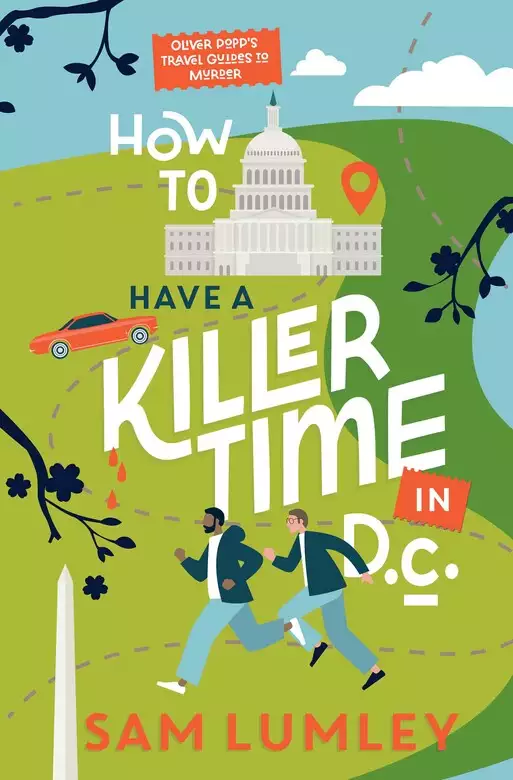
A young, gay, autistic travel writer takes a head-spinning detour when murder and romance unbalance his well-planned life and career in this fun, quirky debut mystery . . .
For twenty-four-year-old Oliver Popp, autism is just another fact of life. As long as Oliver sticks to a comfortable itinerary planned well in advance, he gets by just fine as a staff writer for Offbeat Traveler magazine. But a curveball drops into Oliver’s budding career when his first feature assignment takes him to Washington, DC, to chronicle the latest tourism trends.
His freelance project photographer is Ricky Warner, a gregarious and impulsively adorable shot of adrenaline. If the flirty gay photographer isn’t enough to unbalance shy Oliver at the get-go, there’s also an unsettling chance encounter with old acquaintance, Elise Perkins, and a congressional hearing that’s shaking up both the capitol and an entrepreneurial billionaire. The unexpected distractions soon collide—quite literally—when Elise is struck dead by a speeding car. Funny how she didn’t move and didn’t scream. She just stared it down like she knew it was coming. Forget the National Mall and Mt. Vernon Square. Oliver and Ricky are game for something much more interesting: solving a mystery and a murder.
With their focus shifted and a deadline coming, they only have a few days to solve the crime. For Oliver, it’s a weeks of firsts: first crush, first time without a schedule, first time playing amateur sleuth, and first time getting wrestled out of his comfort zone. But with a loosey-goosey new partner like Ricky, that might not be such a bad thing at all.
Release date:
April 29, 2025
Publisher:
Kensington Books
Print pages:
272
* BingeBooks earns revenue from qualifying purchases as an Amazon Associate as well as from other retail partners.
The streetcar rumbled to a stop, along with the rest of the traffic on Market Street, right before it would have smashed the hot dogs.
I was disappointed.
For the past few minutes, my managing editor, Drea, had been standing in front of the plate-glass window in the conference room, transfixed by the crumpled car below us. I had allowed myself to be distracted from the wreck by the hot dogs that had rolled neatly onto the tracks, entertaining fantasies of the meaty carnage that would happen when they met the wheels of the streetcar. Now that wouldn’t happen, and all we were left with was the much more sobering possibility of actual human injury.
“God, I hope that’s ketchup on the windshield,” Drea murmured, snapping my attention back to the car. The noise outside had diverted us from starting our meeting when the green sedan hopped the curb and plowed onto the sidewalk, colliding with the hot dog stand. Now the tip of its nose was just out of our view below, fragments of the shattered cart were strewn all over the sidewalk and street, and the vendor who had been working the steam trays was nowhere to be seen. There was a small crater of cracks in the center of the windshield, which was indeed surrounded by splatters of something shiny and red.
My stomach, which had already been a bit knotty, did a few somersaults as I considered whether it was ketchup. I wished I could have stuck with the distraction of the hot dogs. That had been helping. This was not.
“Okay, you guys, I have another meeting in fifteen, so . . . ?”
Ramona had joined us at the window at first—perhaps the first time I’d ever seen her looking at something other than her phone—but the collision hadn’t held her attention long.
With one last look down to the street, Drea and I turned and joined her at the conference table. I unscrewed the cap of my orange water bottle and took a long draw to try to compose myself, though I was fairly certain that was a lost cause by now. I usually worked from home, so a rare summons to the editorial offices in San Francisco tended to fill me with a dread of the unpredictable, especially when it was for a meeting with the big boss, the editor in chief; today had been no different, and the scene outside had further thrown me off-kilter.
Ramona tapped on her phone a few seconds longer, then dove right in. “Oliver, we’re sending you on assignment. You’re ready.”
She still kept her eyes locked firmly on the little screen in her hand as she spoke to me. I had a hard enough time reading people, but her inability to untether and fully engage with others took inscrutability to a new level.
On the upside, at least I didn’t have to worry about faking eye contact with her—a particular blessing in my still slightly unsettled state after seeing the crash. Not that she didn’t expect your full attention to be on her, regardless of her refusal to reciprocate—she had an uncanny ability to sense when your focus was anywhere but firmly on her. As long as your eyes were pointed in her direction, though, they could land on her ever-typing hands, her terrifyingly perfect, severely chic brown bob, her prodigiously pierced ears, whatever. I’d heard it rumored that her eyes were brown, but I’d never actually seen them, and I hoped I never did.
My own eyes—green, bespectacled—were blinking a bit more than usual as I processed her pronouncement, the crash now forgotten. Wait, really? A feature assignment? Already?
Drea chimed in from her spot next to me at the table. “I was telling Ramona about the conversations you and I have had about your interest in feature writing, and we agree you’ve been doing great work with your FOB pieces.” FOB meant “front of book,” the section of punchier, newsier articles, interviews, and short features that made up the first quarter or so of each month’s issue of Offbeat Traveler. “We wanted to see how you’d do with something a bit more substantial.”
I was still blinking, trying to process this turn the day had taken. In meetings like this, I was always kind of expecting the worst, but this was so far in the other direction that I wasn’t sure how to respond. Or maybe this—achieving my dream of feature writing after just under a year on the job, which frankly felt way too soon—not something as clean and simple as getting fired, was actually the worst. I had thought I wanted to do this, to be able to travel and see the world—but was I ready? How could I prepare when I hadn’t done this before? Had I gotten too ambitious and set myself up for failure? I could feel my usual level of anxiety, which I’d say generally hit somewhere around my belly button, rising fast, bubbling up around my chin, headed for my ears and nose. Save me, Drea! Save yourself, Oliver! Save me, Ramo—No, that was ridiculous. Ramona wouldn’t save me, because she’d never notice I was drowning.
What she would do was forge ahead with the conversation, blissfully unaware. “We’re getting desperate pleas from the flacks in Washington, DC, to help them do a so-called ‘reset’ on the city’s tourism. I don’t know, I guess there was some brouhaha or something before the inauguration, and the last administration made people get mad when they thought of DC and hotels in the same sentence.” One hand released the phone to wave dismissively. “They’re struggling a bit. So you get to go and put a happy face on our nation’s capital. No political stuff. Just, like, restaurants and museums and boutiques. You know, the usual deal. Drea has the details.”
With the buck passed to her number two, Ramona swiveled in her chair back toward the plate-glass window, which she still didn’t care to look out of, crossing her legs and tapping out an emphatic message on her phone that may as well have been a curt GTFO to Drea and me. We were dismissed.
“Don’t worry. I have a detailed itinerary,” Drea said, as if she had read my mind. She steered me along the outskirts of the bullpen toward her office two doors down from the conference room. “You’ll be fine. It really is just talking up a lot of local merchants, plus one or two of the less controversial museums. We have you in a new boutique hotel, which, of course, you’ll include in your piece, and everything’s really accessible by Metro—you know how they love their subway. Nothing too . . . offbeat,” she said wryly, rolling her eyes at what a misnomer our magazine’s title had become in the decades since it had been absorbed into its first media conglomerate, then passed from owner to owner.
“I also have a photographer you’ll be working with,” she continued as she settled into the chair behind her desk and I took the chair across from her. “He’s actually an old friend of mine from Howard. His name is Ricky Warner. He’s a really fun person—I think you’ll hit it off. And he’s lived in DC a long time, so he can help you find your way around. He’s willing to give you plenty of his time, so you guys should be able to work together most of the time you’re there. It’ll be really simple, and you’ll have a great time. Do you feel okay about this, Oliver?”
Talk about a loaded question. A therapist had explained to me once that some people feel anxious only at the outset of a new situation, like the first day of a new job, but once they feel comfortable in that environment, they can take any new wrinkle, like a new assignment, in stride. I had no idea what that must be like. For me, new is new—and though my job wasn’t new to me, this assignment very much was—and new is terrifying, any opportunity an opportunity for failure. But I wanted to tell Drea what she wanted to hear, and hoped that saying it would make me believe it, so I exhaled as many of my nerves as I could. “Yes, I think so. When am I leaving?”
“You leave on Tuesday of next week. I have you flying out of Oakland, into Reagan. You can get on Metro at the airport and take it more or less directly to your hotel—be sure to include that part in your story.”
She passed me a folder with a printed itinerary, a map of the Metro system with the stops and transfer stations between the airport and the hotel highlighted, a Metro timetable, lists of contacts, and clippings and press releases from the places I would be visiting. She’d share everything with me electronically, too, I knew, but she knew that I liked to have things on paper to study and that I’d want to start on the BART ride back to Oakland.
This would be okay. I was maybe not as convinced I was ready as Drea and Ramona wanted me to be, but I had said it, so I would believe it: I could do this.
“Of course you can do it, Oliver,” my mother was saying.
It was Monday evening, the hours ticking down until I headed to the airport, and I was still having second thoughts, or maybe third or fourth thoughts—it had been a mentally taxing few days—about my readiness for this next step in my nascent career. We were sitting at the table on the deck, and through the window to the kitchen, I could see Aunt Julie and her wife, Deb, washing and drying the dinner dishes. Julie and Deb lived in the downstairs flat of the old high water house that my parents had inherited from my grandparents, but they came up for dinner with my mom and me several times a week.
Spring had finally gotten to the point where the sun was still out at this hour, but it was dropping fast, and a cool breeze and a hint of marine layer were coming in off the Bay.
Breeze or no, I was starting to sweat, and my hands were clammy as I fidgeted with my napkin. “I really don’t know. It involves talking to so many people I’ve never met before.”
“You do that all the time for the things you write now. I’ve heard you do interviews over the phone. You hate the phone, and you still do great with those conversations, so what makes you think you can’t do it now?”
“When I do that, I have my questions given to me by someone else. This time I had to come up with them myself. What if they’re stupid?”
My mom looked at me, deadpan. “Oliver. You spent nearly a week, including all weekend, doing research. I’m sure the questions you came up with are much better than ‘What’s the travel toothpaste you can’t live without?’ which I know is one of those questions you’ve been told to ask before. It’s listening, that’s all. You’re a great listener. Ask your question, listen to what they say, then follow the conversation from there.”
I considered this. “Okay, what about this photographer person? I don’t know anything about him, but I’m supposed to spend practically all my time with him for four days. How am I supposed to do that?”
“You know Drea speaks highly of him, and Drea’s your friend, right? She wouldn’t put you in a situation she didn’t think you could handle, so I think it’s safe to assume he’s a nice person who you’ll get along with fine.” She gave me a funny look, waggling her eyebrows. “Maybe you’ll even . . . like . . . each other.”
I could never really tell what people thought of me, but I thought Drea liked me. I knew I liked her; she was the only person at work I’d felt comfortable telling about my autism, and since then, she’d looked out for me. If my default instinct going into new situations at work was that I was going to mess up and get fired, I could usually reassure myself that Drea would give me enough information that I wouldn’t mess up, and that even if I did, she wouldn’t fire me anyway.
As for . . . liking . . . this photographer person, this Ricky—well, that seemed like wishful thinking on my mom’s part. I wouldn’t even know where to begin with something like that. I had tried once, while I was at Cal, and it had gone nowhere; Benjamin Chao and I had circled each other for two years, constantly finding ourselves sitting next to each other in classes or in social settings but barely ever exchanging more than a sentence or two. He was cute, and we were able to establish that we were both gay and Autistic, but if we’d had more in common than that, we’d never sussed out how to find out. I figured that was about what I could expect—even if the pang I felt around my rib cage when I told myself that said I wished it were otherwise.
Julie and Deb came through the open kitchen door, Julie flicking the switch to turn on the lights strung over the deck as she stepped out. Deb waved as she headed toward the stairs down from the deck to the door to their flat below, but Julie dropped into the chair next to my mom.
They looked so alike and so different at the same time: the same small noses, the same high cheekbones, the same natural golden highlights in their hair, shot with gray on my mom and intertwining with a pink streak on Julie; but where my mom was covered against the breeze in a sensible cardigan, Julie’s tank top put her tattoos and the tangle of silver chains around her neck on display.
This was my cue to leave. Julie and my mom had “sisterly business to discuss”—code for idle girl talk—and I had a bag to finish packing.
“Hey, kiddo,” Julie said as I got up. “Have fun on your trip. I know you’ve got a lot of stuff you’re supposed to do, but if something goes wrong, don’t sweat it. It’ll give you something else to write about. Hell, maybe you should even try to get lost or something. Shake it up! Live a little! This is a big opportunity, but also a good chance to be young and dumb and have fun.”
“Thank you, Aunt Julie,” I said politely. “I’ll remember that.”
I could hear her laughing, not exactly at me, but at my love of organization and sticking to schedules, as I went inside and headed up the stairs to my room in the attic. I had to grin, too. She wasn’t wrong, but I would try my hardest not to follow her advice.
As I entered my room, I tapped the screen of my phone on my dresser and saw that I had gotten a text from an unfamiliar number. I swiped it open. It read, Hey, Oliver, this is Drea’s photographer friend, Ricky. Looking forward to working with you. I’ll meet you at the airport tomorrow, and we can get started right away. Look for this mug. Below this was a photo, a self-portrait, I supposed, but more well composed and shot than the average selfie.
I studied the photo. It was closely cropped around his face. He was smiling broadly, showing off straight white teeth and deep dimples. Thick eyebrows arched mischievously, and under them his dark eyes twinkled and crinkled at the corners as he looked at something up and to the left. His skin was a deep golden brown, and his hair was shaved nearly bald on the sides of his head, exploding into a small mop of loose dark brown curls on top.
I could feel myself getting flustered again as I pored over the photo, and I decided to blame my mom. Why did she have to put that idea into my head? Why did he have to be so . . . hot? I felt a flash of the familiar dullness in my chest, dread at the idea of another attraction I didn’t know how to act on.
I was also feeling the prick of rising sweat again as I debated whether I had to respond or not. I checked the time; it was 7:48 p.m., so it would be 10:48 p.m. on the East Coast. I decided that, even if Ricky wasn’t still up, the polite thing was to respond and figure he’d see it in the morning.
Thanks! My flight gets in at 4:56 p.m., so I’ll see you shortly after that, and we can take Metro to my hotel, I typed, wondering if I was being too formal by being so exact with the time. Certainly he wasn’t getting a selfie in return. He’d have to wait to find out what I looked like tomorrow. It was the only chance I’d ever have of having the upper hand with someone who looked like that. I clicked his picture again to enlarge it. Yep, I was definitely sweating.
A distraction was needed. Really, it was the picture that had been the distraction; I had things to get done. I threw the phone down on my bed and added a few neatly folded shirts to my half-packed duffel bag, counted pairs of socks and underwear again, decided that one extra pair of each was cutting it too close, and added a couple more. Then I caught myself. What did I think I was going to do with this guy that I would need multiple changes of socks and underwear a day?
I rolled my eyes at myself and put most of the new additions back into the drawer. I laid out the clothes I planned to wear tomorrow on top of the dresser and set my blue canvas Vans neatly on the floor below, ready for the airport security theater shuffle, and moved to the bathroom to pack my toiletry bag.
I packed everything except the items I’d need the next morning and wandered back into my room as I brushed my teeth. I glanced as casually as I could down at the phone on my bed to see if there had been another text, growing even more resentful at my mother when I saw that there wasn’t. Why had she gotten me thinking of this like some kind of setup when it was nothing more than a professional engagement to work with someone? I was sure that was all it was to this Ricky person, who probably already had lots of his own friends and a girlfriend or something.
That’s right, Oliver, I told myself. Assume he’s not even an option. It’s not like you need the headache of trying to figure out what to do in that situation again anyway. Or the heartburn.
Grabbing Drea’s folder from my desk, I plopped down on the edge of the bed and pulled out the travel itinerary I had prepared for tomorrow, even more detailed than the one she had given me. It read:
I closed my eyes and flopped backward onto the bed, trying distractedly to memorize the various colors and terminal stations for my train rides, trying not to picture Ricky’s shining eyes laughing up at me from my phone, and failing at both tasks.
Nothing like an early morning run, when you could be alone in the world for the last little while before the darkness lifted and the day began, concentrating on nothing but breathing and moving, to refocus your mind. At least, this was what I was trying to tell myself on Tuesday morning, but honestly, my breathing and moving were pretty automatic after so many years of covering the same route day after day, and my mind was free to wander.
Thankfully, my brain had moved on to a new preoccupation: the logistics of my travel that day. I had checked into my flight the previous morning, exactly twenty-four hours before departure, and gotten my seat assignment, a window seat in economy, in a mid-pack boarding group. So I’d be part of the herd shuffling onto the plane, wrestling for overhead bin space, although as a not very tall person, I had a habit of deferentially putting my duffel bag under the seat in front of me—I didn’t need the foot space as much or the hassle of reaching up to the bins. As I steered from the light puddle of one streetlight to the next on autopilot, I visualized the process: queuing up at the gate, trudging down the Jetway, finding my seat, tucking my bag at my feet, wrestling the seat belt into submission (how do they always get so tangled?), and then probably closing my eyes and praying my seatmate wouldn’t be a talker or a total armrest hog or smell too strongly of anything. This was doable. I visualized myself doing it all and making it out alive.
The person and the assignment waiting for me at the end of the flight? Best not to get ahead of myself; it was a nearly six-hour flight, after all. If I paced my visualization correctly, I wouldn’t get to that part until we were halfway to DC, and by then there would be nothing to do about it, except maybe channel my panic into the crossword puzzle in the in-flight magazine.
I had been winding through mostly residential streets in this reverie, but now I was rounding the corner onto 51st Street, which expanded to six lanes right here as Highway 24 fed onto it and it approached Telegraph Avenue, where it was lined with shopping centers and storefronts. Time to be a little more aware.
There was usually very little traffic out during my predawn runs, even at this major intersection, but I still liked to be vigilant. I didn’t run with headphones, partly for this reason, although mostly it was because, as much as I liked listening to music while doing mindless things, I wasn’t a big fan of putting things on my head or face.
On this Tuesday morning, it was even quieter than usual. There was a soft hum coming from the freeway behind me, but no cars exited onto the street. I reached the corner at Telegraph and scanned to each side; no cars were coming from either direction. An extra-short block down Telegraph to my left, Claremont Avenue angled down to terminate its descent from the Berkeley Hills. I saw no headlights coming down Claremont, either, but I noticed that it was unusually dark. A series of streetlights seemed to have gone out over there all at once, and the cloud cover blocking out the moon didn’t help.
I had the light and began to jog across Telegraph. As I stepped off the curb, I caught a flash of movement out of the corner of my eye and became aware of the slap of tires and the whoosh of air being sliced by something large, the distinctively droning near silence of an electric car approaching fast.
I jerked my head toward Claremont in time to see a sleek sedan, a Moonshot MS-100, speeding toward me, running a red light from Claremont onto Telegraph and hurtling forward. The car’s headlights were off—no wonder I hadn’t seen it coming down that darkened stretch—but through the windshield, the driver’s face was faintly illuminated by the telltale glow of a phone, his eyes cast downward, and I could see in its ambient light that he was using it with both hands.
I had a split second to react as the car careened into the lane, coming straight toward me, and a burst of adrenaline propelled me forward in a sprint long enough for me to clear the lane as the car blew through its second red light in a matter of seconds.
In a daze, I spun on my heel in the middle of the crosswalk to watch my near-death experience drive away under the streetlights of Telegraph Avenue. I wheezed out a winded “Hey!” knowing the driver wouldn’t hear it and would never know what had nearly just happened. Shaking, I turned back and finished crossing the street.
I needed to get back home. I tried to tap into the adrenaline to start running again, but I was coming down from the jolt and quickly had to slow to a haggard walk. I panted and fumed the rest of the way.
What was with all these vehicular disasters lately? What had that driver been doing? It occurred to me that the phone-addled individual behind the wheel probably hadn’t actually been doing the driving. The Moonshot, with its Silicon Valley sheen, had quickly become an “it” toy for wealthy Bay Area techno-snobs and eco-show-offs, but behind the glowing promises of fully autonomous driving pumped out by the company’s attention-hun. . .
We hope you are enjoying the book so far. To continue reading...

 Please log in to recommend or discuss...
