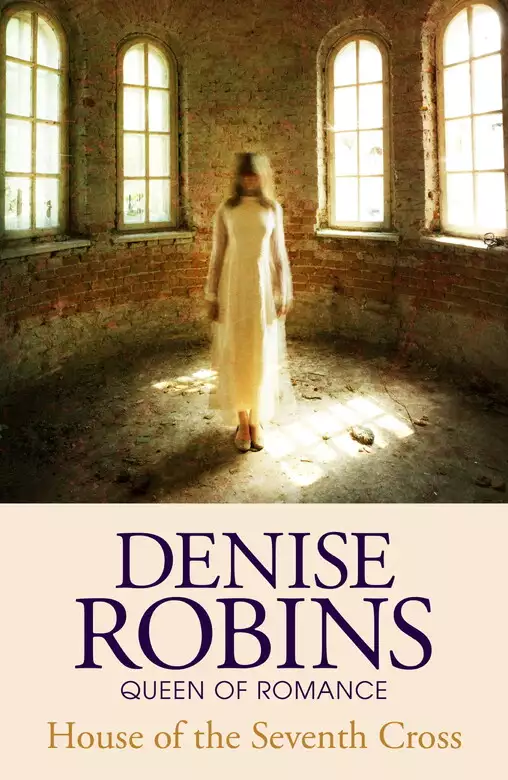
A dramatic story of love and intrigue set in the glamorous sun of Majorca.
When Rosamund Lowe recovers consciousness after a holiday car-crash, she finds herself in a strange house, and gazed upon by mysterious faces.
Kept as a virtual prisoner, and almost forced into marriage against her will, she is confused by the sinister atmosphere that prevailed. And although she meets a destitute singer for whom she conceives a violent passion, it is only when she fully recovers her memory that she is able to piece the puzzle together and find the girl she is being forced to impersonate.
Release date:
January 1, 1973
Publisher:
Beagle Books
Print pages:
176
* BingeBooks earns revenue from qualifying purchases as an Amazon Associate as well as from other retail partners.
PERHAPS it is as well that none of us can dream what lies ahead, although I often used to think when I was a teenager that I would adore to know the future, and loved having my fortune told.
On the day that I, Rose Lowe, landed by tourist flight in Palma, I certainly did not realise what Fate had in store for me.
I was on holiday. My adored mother had died some weeks ago leaving me quite alone. My father, too, was dead, and I lived and worked for a firm of lawyers in Bristol, as secretary to the junior partner. I had been working very hard and I was tired and sick of the dusty old office and endless legal documents. I needed this break, I’d saved up for it and here I was at Palma Airport.
It was new and exciting, hot and noisy. But to me quite wonderful …
I’d made up my mind to take this holiday in Majorca alone and to walk from one side of the island to the other. I left the colourful airport behind me and started out for the Puerto de Pollensa on the north side of the island. One of my friends with whom I shared a flat had a godmother there. I thought I’d start off by going to call on her.
I soon left Palma. I couldn’t bear the crowds. I had had enough of them in Bristol. I wanted the mountains. The white road ahead of me looked long and hot and dusty but all the same I immediately fell in love with Majorca. I had come in time to enjoy the glory of the beautiful almond trees—there were seven million of them on the island, so my guide book informed me.
I daresay I looked odd to the people who passed me in their cars. I was trudging along in my straight pink cotton dress, short white coat over my arm, fair straight hair which I wore rather long, falling across my cheeks, and carrying a small suit-case.
I wasn’t particularly conceited but feminine enough to be pleased when an old Spanish peasant astride a strong, sturdy donkey, called out to me:
“Buenos! Muy guapa senorita!”
I knew enough Spanish to feel flattered because he said that I was beautiful.
I stopped only to pull out a bottle of sunburn cream and cover my throat and arms with it. I was glad of my dark glasses because the glare from those hard blue skies was terrific. But I had never seen anything lovelier than the purple mountains, the little white cottages brilliant with the scarlet, shiny pimentos that the peasants hang up to dry, and the giant cacti with their spiky silver-green leaves and pinky-orange fruit hanging from them like small gay lanterns.
I walked until I was tired then sat down and leaned my aching back against an olive tree, examined my map and decided to step off the main road where there were too many cars, and take a smaller, quieter route.
That switch from the busy highway was the first move toward my ultimate destiny which till now had been hidden from me.
But when I got up to resume my walk, suddenly I heard the honk-honk of a horn, looked round and saw a long racy-looking car with a silver bonnet moving toward me. An expensive-looking foreign car. I didn’t seem to be able to escape the traffic. I stepped aside to watch it pass but the driver, a woman, hooted, waved, and pulled up beside me.
“Hey there,” she said, “do you speak English? You look English. Anyway, I can’t imagine anyone Spanish walking in this blistering heat just for the fun of it. Wouldn’t you like a ride?”
Gratefully I accepted the offer.
“Jolly nice,” I said heartily, proving my English blood beyond all doubt, so ending my vow to refuse lifts.
We laughed together.
She opened the car door for me. I climbed in beside her, only too glad to put my Airways bag and suit-case in the back, and sink on to the deep-cushioned seat beside the driver. I now had a chance of seeing my Good Samaritan at close quarters. She was younger than I had thought at first. She had been wearing black glasses and a big floppy hat which shaded her face. As she took off the hat and glasses and smiled at me pleasantly, I could see that she was about my own age. We were of a similar type; curiously so. Both very fair, blue-eyed, slimly built, and about the same height. But the stranger was not really like myself. She was expensively turned out, wearing a well-tailored yellow linen suit with a crisp white shirt. Her hair was not loose, like mine, but tied in a pony-tail, with a broad yellow ribbon. She wore three gold bracelets, and I particularly noted the brooch pinned to the lapel of her coat. It was shaped like a large flower with stamens and corolla of emeralds. Quite gorgeous, I thought. I had already noted the extravagant-looking black and white leather luggage on the back seat. Beside her, she had placed a beautiful tapestry-covered bag with huge black leather handles—Italian, I was sure. Her long oval finger nails were a much better shape than my own, I thought ruefully. Quick to note detail, I also saw that she wore a rather curious ring for a girl—a masculine onyx signet ring, on the little finger of her left hand.
Now she pulled a packet of American cigarettes from her bag, offered me one which I refused, and lit one for herself, using a small gold lighter which looked as costly as everything else. What a fascinating person, I thought. Who could she possibly be?
We began to talk.
“I feel a bit guilty,” I said. “I set myself out to walk to Puerto de Pollensa. I’ve only done about five miles, then I take a lift. Pretty weak!”
Her big blue eyes under their long thick lashes gave me a surprised look.
“I can’t think why anybody would want to walk when they can drive,” she drawled.
“I don’t possess a car and I hate buses—so I walk,” I laughed.
“I don’t think I have ever been in a bus,” she said.
“Snob,” I laughed again, wrinkling my nose at her.
I was pleased when she laughed back as I was a bit afraid I had been rather rude. “I didn’t mean that really,” I added.
“Oh, but I am a snob,” she agreed. “And a sybarite. I adore luxury and I am afraid I am spoiled, because I have always had it.”
“Lucky you!”
I could see her gaze wandering carelessly over me, possibly noting the fact that I was wearing that frightful cheap shift that didn’t fit very well; also that I had no jewellery—only the little wrist-watch on a leather strap which my mother had given me for my eighteenth birthday. She showed white even teeth in a friendly smile which encouraged me. I could feel that she wanted to be friends. I said:
“It was terribly nice of you to pull up for me.”
“Oh, I welcome your company.”
“And what a gorgeous car!” I sighed.
“It’s a Renault. The body was specially built for me in Paris. They allow Renaults on this island, which is just as well, because if you’ve got an English car you may have it impounded for months.”
“You didn’t bring it over with you?”
“No, my father’s old chauffeur brought it over to Palma a week back and left it for me in a garage. They met my plane with it today.”
We exchanged names. Hers, she told me, was Rune le Motte. An odd name, I thought.
“I have never heard of Rune before,” I said.
“I am possibly the only one in existence,” she smiled. She had a nervous habit of flicking the ash off her cigarette with the tip of her little finger. “I had a romantic-minded godfather who was a classical scholar. To him the word Rune was a mark of mysterious, magical significance. For instance, in the old days there was a Runic calendar. It evolves from the word run, meaning a whisper or a secret council from which the English word round has sprung. So, to please god-papa, I was called Rune.”
I blinked at her.
“All rather complicated but exciting. And it’s a beautiful-sounding name. It suits you.”
“Your name–Rose–suits you,” she returned graciously.
As we talked longer, I gathered that we had arrived by the same plane, though I don’t remember having seen her, but of course, she had been travelling V.I.P. and I, tourist-class.
She, too, was bound for Pollensa—but the village itself, she told me, not the Port. She had driven off the main road because she, also, liked to avoid the traffic.
As we moved along the sunlit road she began to question me about myself.
I told her a little of what must seem to her, I imagined, an unexciting life. She openly declared that she ‘wondered how I could stick all that typing all day in a lawyer’s office’. She also expressed great surprise when I said that I had reached the age of twenty but never had a really serious love affair.
There was one boy, a clerk in the office, who took me out occasionally, but I found him dull and uninspiring, and there had been a doctor I rather fell for, in the hospital where my mother had lain for months with a fractured hip. Peter was the most attractive man I had ever met up till then, with that devilish glint in the eye that can be quite fatal to a girl.
“Why didn’t you do anything about him?” Rune, my new friend, asked me.
Rather sadly I explained that Dr. Wright was already married so we decided not to see each other any more.
“Oh, well,” said Rune in her gay, easy way, “I can see you’re the romantic, idealistic type. I’m afraid I’m not. I’m always having love affairs but I don’t really mind whether they’re married or not.”
“Oh!” I exclaimed rather lamely.
She laughed and gave me a sidelong glance from her beautiful blue eyes and said:
“Shocked?”
“Not a bit,” I said indignantly.
“It doesn’t do to get too tied up with anyone in particular,” went on Rune, “although I’m bound to say I’m a bit shackled at the moment. I’ve rather left my heart behind me in Paris, still it’s very elastic. It always springs back into place.”
We laughed together. It wasn’t difficult to laugh and be friendly with Rune le Motte. I warmed toward her—especially as she seemed to show quite an interest in me. She kept saying:
“It’s quite fabulous how alike we are physically. I can’t get over it.”
“I don’t suppose we’re very alike in character,” I ventured.
“Too true, honey. I’m a hard nut and you’re a softie.”
I bit my lip, wondering if I was all that ‘soft’. My mother used to tell me that I was like my father—in his day a lawyer, and a man of strong character. I was certainly a determined person. But, somehow, this girl Rune gave me an inferiority complex.
As we drove along, I watched a couple of farm-workers in the field driving their blindfolded horses round and round a windmill.
“That’s interesting,” I said.
“What?” asked Rune.
I nodded toward the patient animals trudging their circular route.
“Isn’t that primitive! There’s a shortage of water during the summer in Majorca, you know. The farmers still have to bring the water up from the wells.”
“So you’ve read it all up before coming out here?” laughed Rune.
“Yes, I have,” I said, and coloured. Once again she made me feel inferior as though I should have been more like herself—and she was the last girl in the world to study a guide book—of that I could be certain.
“Tell me about yourself,” I said suddenly.
So she gave me a resumé of her life—that life that was so different from mine.
She was obviously the spoilt child of fortune. I was just a very ordinary girl with no money behind me and no prospects. I had in fact had to give up the one great passion of my life, which was music. Before my father died and when we were not so poor, I had actually studied the piano seriously under a Professor of Music in Bristol and adored it. It had been rather a bitter pill for me to swallow when I had had to abandon it and do a secretarial job.
However, I forgot about myself: I sat entranced, listening to Rune le Motte and the strange story she had to tell about herself.
HER father was French; her mother, American. There had been a divorce when Rune was a small child, since when the mother had died. This seemed to have affected Rune not at all. She was honest enough to describe herself as ‘a hard nut to crack’—lacking in affection, except for the fair, handsome father who had adored her. She had been born in London and brought up by an English governess. Later she went to an English finishing school. She spoke perfect French, and English without a trace of American accent. She had always lived in luxury and been thoroughly spoiled, very much my opposite, I thought. She admitted that she had no money sense and liked to spend freely.
There was only one thing she liked more than money; that was freedom. She hated any kind of discipline. Conventional ties horrified her. Laughingly she boasted that she had defied all attempts made by both governesses or school teachers to bring her to heel. So, at nineteen, she joined what was, I presumed, a sort of Left Bank beatnik crowd in Paris where she became the idol of her companions because of her beauty, her money, and her expensive car.
I asked her if she was engaged, and she took off her glasses so that for a moment I could see the derision in her cornflower-blue eyes.
“No, my pet, the shackles of matrimony are not for little Rune. I’ve got masses of boy-friends. My special one is crazy about me. His hair is too long and I’ve threatened to ditch him unless he cuts it. I’m not really a Beatnik at heart.”
“You don’t look one,” I said with genuine admiration. I found her most elegant.
“Am I boring you talking so much about myself?” she suddenly asked, “or shall I go on? Because it’s really quite a tale.”
“Go on,” I said, “please. It is like something out of a book.”
“Everything we do is, I suppose,” she said reflectively. “Some of us could be called characters out of a serious novel, couldn’t we? And some come out of light romance and others from whodunits. I’d like to be a character out of a whodunit, but I haven’t yet had the luck to meet a fascinating criminal.”
I stared at her, open-mouthed. I’d never come across such a girl. I envied her her worldly wisdom. At twenty-one she was a cynic. I was only a few months younger but felt myself to be on the mere threshold of life, still seeking for the romance at which she jeered.
She went on talking.
Six months ago, her whole life changed. Her father succumbed to an unexpected coronary thrombosis. He had actually been talking at the time of his death to a banker friend on the Bourse.
Rune genuinely mourned him at the time, she said, and I could believe it. He seemed to have been the one and only person in her life for whom she really deeply cared. Then she had been subjected to another shock. She discovered that her ‘rich’ father was on the verge of ruin, and before he could pull away from the abyss—death had pushed him over the edge. Once his estate was settled Rune found herself with nothing but the contents of their Paris apartment, some jewellery that had belonged to her mother, and a small income from her maternal grandfather in America. This in English currency amounted only to about three hundred pounds a year.
“It sounds a lot to me,” I said.
She looked at me pityingly.
“I spend more than that annually on my clothes.”
“Oh!” I said humbly.
But now Rune was explaining why she had come to Majorca.
Death struck at the le Motte family yet again. This time her father’s brother Paul, who lived in Majorca, suddenly died.
Rune had never met her Uncle Paul. She only knew that he was twenty years older than her father, and that there had been a violent quarrel between the two brothers, years before she was born, and even the war had not reunited them. She had not been very interested in this unknown uncle, so had never asked about him, although on one or two occasions her father spoke of Paul, describing him as a rather scholarly man who wrote dull books. There was also some talk about Papa having once needed money to pull off some big financial deal, and brother Paul refused it, so Papa neither wrote to him nor saw him again. He had never married. It was for his house in Pollensa that Rune was now bound.
“I’m being blackmailed,” she went on with that light rather derisive laugh of hers.
She beat a little tattoo on the wheel of the car as she drove. The shape of those hands were a little like my own, among the other similarities.
“Yes, I’m being blackmailed,” she repeated. “My uncle seems to have relented on his death-bed and left his money to me, being his one and only niece and next-of-kin. He has lived in Pollensa for the last ten years with a housekeeper and a secretary. Just before he died he was writing a history of the Balearic Islands. His secretary, who was resident, is called Mark Jervis. Papa’s solicitor in Paris was informed by Mark and Uncle Paul’s lawyer in Palma that he left quite a considerable fortune. But the silly old imbecile made me his sole beneficiary only on condition I would live in his house and look after it, plus his books and treasures and—”
“But that sounds wonderful!” I interrupted.
“Wait! The final condition is much less attractive. Uncle Paul in his final years became dependent upon Mark Jervis—he’s twenty-seven now and a bachelor. Uncle Paul appears to have been very grateful to him for all his help and devotion. Mark seems to have been everything to this old man—secretary, chauffeur, general factotum and companion. He left Mark some money, I believe. He wanted the bulk to go to his own flesh and blood, but only if I, his so-called heiress, would agree to marry this secretary fellow. If I don’t agree, I forfeit a fortune. What do you think of that?”
“Well, it really is like something out of a thriller,” I gasped. “Very dramatic.”
Rune pulled up the Renault and lit another cigarette, frowning deeply.
“Too damned dramatic for me and I’m not going to be coerced into marrying Mr. Mark Jervis or any other man, even if I lose the money. I refuse to. Wouldn’t you?”
I tried to think. Faced with such a vital problem, my brain never worked very quickly. My answer when I gave it was, I suppose, typical of my romantic attitude toward life.
“I couldn’t marry any man unless I was in love with him—and certainly never for money.”
Rune snapped down the lid of her lighter and gave a hard laugh.
“I don’t believe in love, and I’d do a lot for money, except lose my independence. I shall not marry Uncle Paul’s secretary, neither will I live in his gloomy old house on this island. It’s far too limited a life here. Not bad fun in the summer, so they tell me. You can swim and water-ski, and so on. But deadly in the winter.”
“You could always go away—” I began feebly.
“With a husband to put down his foot and tell me I couldn’t if he wanted to stay here? No, I’m not risking that or chaining myself to anyone in order to get Uncle Paul’s fortune. But I must say I wish I could get it withou. . .
We hope you are enjoying the book so far. To continue reading...

 Please log in to recommend or discuss...
