
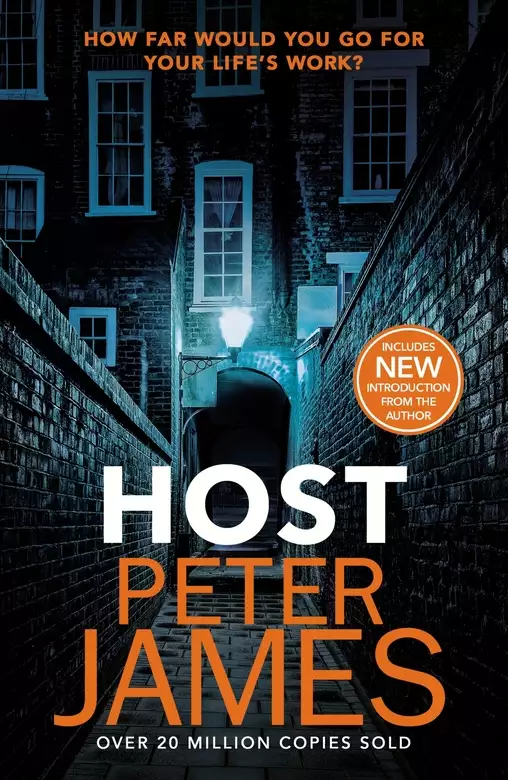
Host
- eBook
- Paperback
- Audiobook
- Hardcover
- Book info
- Sample
- Media
- Author updates
- Lists
Synopsis
How far would you go to live forever?
Brilliant scientist Joe Messenger believes that people can be made to live forever. Knowing the human body can be frozen indefinitely, Joe devises a way of downloading the human brain into a supercomputer called ARCHIVE.
But Joe's wife, Karen, is worried by his preoccupation with ARCHIVE, which seems to be developing signs of a distinct and sinister personality of its own.
Then, just as Joe is on the brink of a scientific breakthrough, a series of macabre accidents befall him and his family — and Joe finds himself facing the terrifying consequences of his own obsessions.
Release date: October 7, 2010
Publisher: Orion Publishing Group
Print pages: 644
* BingeBooks earns revenue from qualifying purchases as an Amazon Associate as well as from other retail partners.
Reader buzz
 Please log in to recommend or discuss...
Author updates
Host
Peter James
I was less happy that the Sinclair C5 electric tricycle was also on that same Observer list, but it was a salutary reminder that not all innovations succeed!
I had spent many weeks researching for this novel, back in 1991, in the Cognitive Sciences department of Sussex University, where some of the world’s key pioneering work in artificial intelligence was happening. When the book was being finalised for publication, one of the students, Andy Holyer, suggested to me, because of the theme of this book, that it might be worth experimenting by publishing it electronically as that, in his view, was going to be the future of publishing…
I phoned the very forward-thinking Marketing Director of Penguin, Andrew Welham. He asked how much it would cost, and I told him I’d been quoted £4,500 for both PC and Mac platforms. Within two hours, he phoned me back excitedly and said to go ahead!
Host came out in hardback in 1993 and in the following year was published both in paperback and in electronic form – a hard outer cover, containing two floppy discs and lots of extras. You could click on a keyword and get photographs or extra snippets of research; and the author photograph actually spoke to you – albeit rather clunkily. But the moment it was published – the then Dillons chain launched it with 12,000 copies – I was pilloried by the world press. I remember being hauled over the coals on the Radio 4 Today programme by an incredulous presenter accusing me of endangering literature; I was the front-page headline of every national paper in Italy accusing me of killing the novel. I recall meeting a novelist I much admire in the green room of Sky television, when I was promoting the electronic version, and telling him about it. He responded by staring at me sadly and sympathetically, and saying he couldn’t see anyone reading a novel in electronic form. The Times ran an amusingly sceptical piece in which the reviewer lugged his desktop computer and a generator onto the beach in a wheelbarrow, so he could read it.
And then, in the way these things happen, a couple of years on I suddenly found I had become the authority on the future of the novel! I was invited to give a major speech at the Booksellers Association Conference, and then to speak at a conference on the future of the written word at UCLA in California. To my terror, rocking up there jet-lagged from the long flight, I found I was on the podium alongside Steve Jobs, Nicholas Negroponte, one of my heroes, then head of the Media Lab at MIT, as well as the President of Time Warner. And, gulp, I was the main attraction!
I bumbled into my speech, concluding by saying I believed the electronic novel would take off when it became as nice to read as the printed page, and more convenient. At the time, I majored my focus on electronic books getting youngsters back into reading, and I was wrong on that point. The entire book world became astonished when electronic books started becoming popular with the upper age groups, because of altering the font size, ease of carrying and price.
I have to confess that not all my forays into technology are successful. Host is about a scientist who believes he could live for ever through a combination of copying the content of his brain into a computer and having his body cryogenically frozen, and builds the world’s most advanced computer to try to achieve this. When I was researching, I needed to find a really impressive computer to model the one in my novel on. And I wanted to have something that was, visually, a knockout. Unfortunately, with miniaturisation in the computer world, computers are getting smaller and less impressive-looking all the time.
I was told that there was a vast and very impressive-looking system at the Imperial Cancer Research Foundation in London, where they have a gigantic database co-ordinating all cancer research done everywhere in the world. It sounded promising and I made arrangements to go and see this beast.
I was taken down into a basement and then into a large control room with a wide glass window looking onto this huge darkened room, inside which I could see winking lights. This is it, I thought, here we go! The jackpot! The system manager then said: ‘I’m afraid if it’s drama you’re after you are going to be disappointed – we’ve recently upgraded and got rid of most of our old hardware.’ He took me into this darkened room, which was about the size of a football pitch. There was a roar of air and an impressive hissing sound. But, as I looked around, I could see acres of empty floor and disconnected wires. There was one tiny metal casing about the size of a tumble dryer. In fact, it looked remarkably like a tumble dryer. I thought for a moment it actually was a tumble dryer and maybe he’d brought me into the laundry room for a joke.
‘I’m afraid – er – that’s it,’ he said rather apologetically.
‘That?’
‘Uh-huh. Our hardware used to fill this room and another one like it. It’s all been replaced by this.’
He had one of those deadpan faces and I wondered if he was having me on. I looked around. A few packing cases, more disconnected wires. But then I saw it. My dream machine! Right down the far end, the entire width of the wall was taken up floor-to-ceiling with shiny metal casings covered in rows of winking red and green lights. It looked stupendous – Star Trek, Doctor Who and Star Wars all rolled into one!
So, I gave him one of those knowing grins – the kind that those in the know use to share a secret with each other. I pointed to it. ‘That’s brilliant,’ I said. ‘That’s perfect – that’s exactly what I need for the book. Can you talk me through it all – explain what it all does?’
He looked at me as if I were a total moron, and said: ‘That’s the air conditioning.’
My research took me both into the fast-moving worlds of computer science and into cryonics – the science of the freezing of human bodies. I met a large number of very brilliant people, some of whose ideas are both off the wall and very scary – scary because they are actually beginning to happen.
An eminent American professor of artificial intelligence I became friendly with back then told me the following, which I found pretty extraordinary: ‘Einstein said that science can tell us everything we would want to know about a cup of chicken soup except what the soup tastes like. Well, Einstein was wrong about certain aspects of quantum mechanics, and I think he’s wrong here too. Not only will machines be able to taste the soup, they’ll be able to enjoy the soup and add a pinch of salt to taste. If this seems good news for computers, remember that you’ll also be able to give them a good thrashing when they refuse to do what you tell them.’
Then he went on: ‘The first fifty years of computer science has been concerned with getting machines to think. The next will concentrate on getting them to feel. They will be capable of feeling pleasure as well as pain, capable of enjoying music, appreciating a painting, and even having a kind of disembodied orgasm. Not only will you be able to have virtual sex with the aid of your personal computer, but it will take offence if it isn’t personally included in the festivities.’
My temptation at the time was to tell him that was crazy, but I was well aware just how many of the greatest inventions were laughed at or dismissed when they first appeared, and how short-sighted some intelligent and influential people have been. For instance, in 1875 the Professor of Physics at Harvard University advised his students not to bother to major in physics any more, since every important discovery had now been made. That was one year before the invention of the motor car, and twenty years before the discovery of the X-ray! Even then, in 1899, the director of the US Patent Office recommended that the office be closed down, saying that everything that could conceivably be invented had now been invented!
In 1901, someone said: ‘Man will not fly for a thousand years.’ His name was Wilbur Wright!
I love these great empirical statements, and I have a collection called Oops – did I say that??? Here are some of my favourites:
‘Computers in the future may weigh no more than 1.5 tons’ – Popular Mechanics magazine, forecasting the relentless march of science, 1949.
‘I think there is a world market for maybe five computers’ – Thomas Watson, chairman of IBM, 1943.
‘There is no reason anyone would want a computer in their home’ – Ken Olsen, president, chairman and founder of Digital Equipment Corp., 1977.
‘Who the hell wants to hear actors talk?’ – Harry Warner, Warner Bros, 1927.
‘We don’t like their sound, and guitar music is on the way out’ – Decca Records, rejecting the Beatles, 1962.
‘So, we went to Atari and said, “Hey, we’ve got this amazing thing, even built with some of your parts, and what do you think about funding us? Or we’ll give it to you. We just want to do it. Pay our salary, we’ll come work for you.” And they said, “No.” So, then we went to Hewlett-Packard, and they said, “Hey, we don’t need you. You haven’t got through college yet”’ – Apple Computer, Inc. founder Steve Jobs on attempts to get Atari and H-P interested in his and Steve Wozniak’s personal computer.
‘Airplanes are interesting toys but of no military value’ – Marechal Ferdinand Foch, Professor of Strategy, École supérieure de guerre.
‘The abdomen, the chest, and the brain will forever be shut from the intrusion of the wise and humane surgeon’ – Sir John Eric Erichsen, British surgeon, appointed Surgeon-Extraordinary to Queen Victoria, 1873.
And, perhaps most famous of all:
‘640K ought to be enough for anybody’ – Bill Gates, 1981.
I went to Los Angeles during my research for Host, to visit the premises of the Alcor Life Extension Foundation, which is the world’s largest cryonics organisation. It was then sited in Riverdale but has since relocated to Arizona to be away from any earthquake risk. I was shown the aluminium dewars (cylinders) where their ‘patients’, as they call them, are kept in storage – as you will read in the book. At the time, people unable to afford the $120,000 to have their entire bodies frozen, could opt for the neuro-suspension alternative of having just their heads frozen, for $40,000. The preferred term at Alcor for a human being in liquid nitrogen suspension was not dead but temporarily metabolically disadvantaged.
The big argument against cryonics has always been: if you are frozen when dead, you will still be dead when thawed. But that is without reckoning on the advances of nanotechnology. Who knows what will become possible over the next 100 years or so. Perhaps, the advocates of cryonics hope, that science will enable surgeons to work on the bodies of those frozen, replace damage done by cancer, heart attacks, strokes or other diseases, rejuvenate and then reanimate them.
One particular problem for the cryonics movement is the laws of perpetuity in most countries of the world, which forbid people leaving money to themselves when they die. Both the US and UK have these laws. But, naturally, there are now some tax havens for the dead springing up in countries like Liechtenstein. There was also the start of a Deathist movement of people appalled that the dead have no legal rights! Why, they argue, should people be discriminated against just because they are dead? Particularly when they might not stay dead for ever…
I had expected the cryonics people to be a little odd at the very least and I was surprised instead to discover how bright and sanguine they were – normal people, in all walks of life and of all ages. They are united in their view that ageing is a disease like any other. They feel that modern science should eventually be capable of curing all illnesses, and a future society will benefit from prolonged youth and a much greater lifespan. They believe that if people live significantly longer, and possibly for ever, they will be forced to create a better society and to take more care of the planet. An ideological view? Maybe. But they are not without their sense of humour, also. One thing they all agree is this: cryonic suspension is the second-worst thing that can happen to us. The worst thing is to die and not be frozen!
There is no question that in many parts of the world life expectancy is steadily rising. With the growing medical technology in certain areas, such as spare part surgery, fighting certain cancers, and isolating of ageing genes, there is talk of a life expectancy of 115 to become the norm soon, and 150 within a couple of decades. I’ve heard scientists say that the first person to live to be 200 has already been born. What will our greatly increased human longevity give us? Will it make us take better care of the planet? Enable us to colonise space? Perhaps one day, as in this novel, ditch our human biological bodies altogether?
Peter James2018
This has been a monster of a book to research and yet for me it has been both terrific fun and a real voyage of discovery. I’ve met some truly great people along the way, who responded to my requests for help with a level of enthusiasm and thoroughness that has staggered me. To all of the names listed below, I owe a big debt. Thank you.
Singling out individuals is dangerous, because I do not wish to leave anyone out, but without the happy chance meetings with Blaine Price of the Human Cognition Research Laboratory of the Open University in a pub in Milton Keynes, and Michelle Cooperman of the I CRF on a platform at Victoria Station, I might still be struggling with my research right now. And I don’t know how I would have got the book written without the tireless coaching in computer science from Dr Bruce Katz of Sussex University; in chemistry from Richard Blacklock in Los Angeles; and in cryonics from the members of Alcor in both the US and the UK. And I have to single out also Matthew Elton and Andy Holyer ([email protected]) at Sussex University who never flagged or got hacked off with my endless bombardment of questions, and made enormous contributions in both time and ideas. And Sue Ansell who gave me so much help during the writing of the first draft.
A huge thank you also to the following who either in person, down a phone line or through their work, contributed in so many ways: Mr Andrews of James Parsons; Dr Fara Arshad , Leeds University; Kathryn Bailey; John Bieber; Dr Margaret Boden; Dr Herman Borden, St John’s Hospital, Santa Monica; Mr Geoffrey Briant, Senior Consultant, A & E Royal Sussex County Hospital; Andy Clarke, Sussex University; C. Scott Carrier, LA Department of Coroner; Dave Cliff, Sussex University; Andrew Clifford , Alcor UK; Phil Corsi; Professor Adam Curtis, Glasgow University; Dr Daniel Dennett; Dudley Dean; Robert Ettinger and the Cryonics Institute; Tim Evans; Dr Gregory M. Fahy; Ray Fibbit; Patricia Frie dal; Harold Holyer; Dudley and Pippa Hooley (promoted from Bovine to Aviation); The Immortalist Society; Dr Joseph Kates; Louis Kates; Mike and Veronica Keen; Dr Gerry Kelleher, Leeds University; Carole King; Dr Nigel Kirkham; Peter Lahaise; Robert Martis; Jane McNevin, A & E Royal Sussex County Hospital; Dr Ralph Merkle; Professor Hans Moravec; Professor Marvin Minsky; Mark Morris; Ian Mullen; Dr Simon Nightingale; Dr David Pegg; Nick Perkins; Margaret Potter; Mike Price, Alcor UK; Marie-Claude Pullen; Alan Sinclair, Alcor UK; Garet Smyth, Alcor UK; Dr Duncan Stewart; Lynn Squires, Imperial Cancer Research Fund; Dr Peter Ward, Leeds University; Ralph Wheelan, Alcor Life Extension Foundation; Russell Whittaker; Ian Wilson; David Wiltshire; Jennifer Zehethofer.
I am indebted also to the hard work and support of my agent Jon Thurley and his assistant, Patricia Preece, my commissioning editor Richard Evans, and editor Liza Reeves who spared a few of my little ‘darlings’. And to the saintly patience of the Gollancz team of Elizabeth Dobson and Katrina Whone. And above all to the endless support of my wife, Georgina, who must at times during her vigil of the past year have wondered if I had downloaded myself into my own computer.
May 1974. Los Angeles.
Blips of light chased each other silently across the screen on the monitor above the young woman’s bed. The peaks and troughs of their spiky green wakes were becoming less frequent by the hour. There wasn’t cause for panic, yet; but equally there was nothing to give rise to optimism.
Nurse Dunwoody paused to stare out through the sealed windows at the gauze of light that veiled night-time Los Angeles. The ghost of her own face stared back from the dark glass, surrounded by eerie, disembodied reflections of the dials and monitors of the Intensive Care ward.
Her eyes were drawn again to the bracelet on the table beside the young woman in bed number 4. Temperature: 102.5, she wrote on the woman’s hourly log. The bracelet was stainless steel, cheap-looking and tinged green by the reflected glow of the ECG monitor. There was a small red staff and entwined serpent on it, the standard MedicAlert symbol. Blood oxygen: 80 mm Hg. The level had dropped a fraction. The woman’s pulse was also down, and her blood pressure, but the rate of drop was still unchanged.
The woman was twenty-four, pretty, with long darkish hair that had become matted and greasy from perspiration; strands lay like frayed wires across the marbled skin of her forehead. She was stable but slipping steadily. The red digits on the blood-oxygen monitor that shared the shelf with the ECG had started the night at 90.
Ten days ago she had come into Casualty complaining of a vaginal irritation. Now she was close to death. Gram-negative septicaemia. Her body had turned against itself, battering her system with its own toxins. Her blood had been changed three times and she had been bombarded with drugs until her system could take no more. Dr Whitman, the head of the ICU, told the staff at yesterday morning’s briefing that the woman had a seventy per cent chance of dying.
Statistics, thought Nurse Dunwoody as she moved to her other charge, in bed number 3, a man of sixty who was only hours out of theatre after a triple coronary-artery bypass. Statistics. The mortality rate in here was twenty per cent. One in five.
She checked the man’s saline drip and his ventilator, adjusted the tape of one of the sensor pads on his bare chest, and logged his pulse, blood oxygen, blood pressure and temperature. One in five. The thought lodged in her mind like an old tune. It was a statistic that was as uncannily accurate as it was remorseless. One in every five patients would go from here to the mortuary; there was never any variation, no change in the three years she had been here. One in five would be wheeled out, taken down seven floors in the wide service lift to the small mortuary with its damp floor and its smell of disinfectant, tagged with a label attached by string to the big toe of their left foot, a yellow label only if they were going straight to an undertaker, a buff one as well if they were to have an autopsy first; then they’d be wrapped in a plastic shroud and slid into the bank of refrigerators to await collection by an undertaker’s unmarked van.
After that the final journey to the crematorium or the grave. Or – she glanced again uneasily at the metal bracelet that lay on the table beside the young woman; the reflected green light made it glow as if it had a life of its own; as if it alone were detached from the grim reality of this place. Something from another planet, another world. A symbol of immortality. It spooked Nurse Dunwoody.
Somewhere outside, the wail of a siren disturbed the predawn air, shook it the way an angry mother shakes a child, and something shook inside her, too, like a flurry of snow in a gust. Something did not feel right and she did not know what.
She would have liked to talk to the patient about that bracelet, with its universal medical symbol, to have found out more about her. But the woman had been unconscious most of the time, and when she did wake she was delirious and repeatedly mumbled a name that was incomprehensible. She had no visitors, no one had rung to ask after her, and there was little information about her background. A scar on her abdomen indicated surgery some time in the past, possibly a Caesarean section, but she had marked only a name in England as next-of-kin on her admission form, and by the word ‘Children’ had written: None.
Probably one of the thousands of hopefuls who dumped their pasts and came to Hollywood in search of fame, too many of whom ended up in this place after overdoses. Nurse Dunwoody stared back at the bracelet again. It seemed even hotter in here than usual tonight; she listened to the steady hiss from the ducts, the sharp clunk-puff . . . clunk-puff of the ventilator by the next bed. The air moved sluggishly around the ward, like the blood through her own veins. 3.30 a.m.
She glanced round wearily, watching other nurses who were filling in logs, or moving around past slumbering patients, past vacant, disoriented eyes and forests of saline drips, their bodies temporarily blotting out from her view the blips and spikes of monitors, the winking lights, the wavering dials. She found this place unnerving sometimes, late at night, like now, a strange hi-tech no-man’s-land between life and death.
At regular intervals the young houseman appeared from his office and padded around the ward, glancing routinely at the patients, their charts, their drips and monitors, his white pyjamas rustling softly, his rubber-soled shoes silent on the carpeted floor.
Nurse Dunwoody’s mind was occupied by the bracelet, and the sharp beeps failed to penetrate her thoughts for a brief moment. She saw the agitated face of the houseman as he sprinted past her, before it registered that the spikes on the electrocardiograph above the woman’s head had dropped into a single unflickering line.
‘Heart massage!’ The houseman’s face was tight with panic, like his voice. He pulled open the front of the woman’s gown, interlocked his hands and compressed her chest, paused, then pressed them down again. As he did so he looked up at the monitor as if willing it to register. He grabbed the nurse’s hands, pressed them down in place of his. ‘Don’t stop,’ he said.
The woman’s pupils were dilating even as Nurse Dun-woody took over. She pressed down, eased off, pressed down, eased off.
The houseman grabbed the bracelet and raced into the tiny office beyond the blank computer display screen. This was the reception area of the ward, now dark and silent. He snatched the phone receiver, punched 9 for an outside line, then stabbed out the number on the bracelet, and held the receiver clenched to his ear.
Come on, Jesus, come on. Answer! Answer you mother-fuckers. Come on, come on, come on! You could tell when a place was empty; the phone always had a flat, echoey kind of ring. Maybe he’d misdialled? He disconnected and tried again, fingers trembling, his breaths sharp and hard. The same ring. Then someone answered:
‘Yurr?’ The voice was drowsy, uninterested.
‘This is St John’s Hospital,’ the houseman said. ‘You have a unit on standby for a patient here.’
The voice came alive slowly. ‘Right, who’s that?’
The houseman gave the young woman’s name.
‘OK, I have it.’ There was a rustling of paper. ‘We weren’t expecting anything until tomorrow.’
‘Nor were we,’ the houseman replied, tersely. ‘How fast can you be here?’
‘Give us about half an hour to an hour.’
‘Too long.’
‘What is the current state of the patient?’
‘Cardiac arrest.’
‘Are you doing CPR? Keep the circulation going until we get there. The voice was becoming increasingly helpful. ‘Can you get some anticoagulant in – heparin?’
‘Sure.’
‘Is there someone who can do the certification of death?’
‘Me.’
‘OK, I’ll get the transport team organized. Have you called the Doctor?’
‘I’ll do that now.’ The houseman hung up, then pulled from his wallet the crumpled sheet of paper and unfolded it. The number he’d inked in months earlier lay across the creases, but the digits were still legible. He dialled and, when the old man answered, he looked around furtively, then said simply and in a lowered voice: ‘It worked too quickly.’
The young woman was lying in a shallow, open-topped container packed with ice when Nurse Dunwoody helped them wheel her into Operating Theatre 5, which they had obtained permission to use. The nurse noted the apparatus with a mixture of disbelief and amazement. She saw the heart-lung machine on its wheeled cart which a beefy man in soiled dungarees and trainers was connecting to the mains electricity supply. Two other men in casual clothing were cutting open bags of ice which they were emptying into a huge high-sided plastic box.
She watched with morbid curiosity and a growing feeling of horror as she continued to massage the dead girl’s heart, even though there was no response: the pulse was feeble, coming only from the compressions, and there was no ECG reading. Vapour rose from the top of the huge box, like a deep-freeze chest that had been opened. She shivered.
An elderly bespectacled man came in wearing blue surgical scrubs. He looked as if he’d been very handsome when younger, and he carried a strangely powerful presence with him even now. He was followed by a younger man and a woman similarly attired. Then the young houseman came in, also changed into scrubs. ‘Call me if there are any problems,’ he said to Nurse Dunwoody, releasing her from her massaging duty.
She nodded, then hesitated. Two of the other night nurses were covering for her in the ward, and she was curious to see what was going to happen next in here.
She went outside and looked through the viewing window in the door. The team worked with intense urgency. She saw the dead woman’s hospital gown being removed, and watched her being coupled to a heart-lung ‘thumper’ resuscitator; at the same time an endotracheal tube was inserted down her throat. The houseman inserted a cannula into the back of her hand and one of the assistants hung several bags of fluid on the drip stand above, whilst another adjusted the flow valves. The thumper was started and began delivering chest compressions.
The elderly man located a vein in the dead woman’s arm, and injected several boluses of drugs in rapid succession. Then another man, whom Nurse Dunwoody recognized as a heart surgeon who worked in the hospital, made an incision with a scalpel in the woman’s groin. Femoral cutdown, she guessed; they were going to cannulate the femoral artery.
Almost an hour later, being careful not to disturb the elaborate plumbing connected to the dead woman, the team raised her and laid her carefully in the ice-packed box. One of the technicians changed the electrical supply of the heart-lung machine over to its portable battery pack. The others opened several more bags of ice which they packed either side of her, then they closed the lid of the container and hurriedly, in a macabre procession, wheeled the dead woman and their apparatus towards the lift.
You poor fools Susan Dunwoody thought, deeply disturbed. You poor deluded fools.
February 1982. Toronto, Canada.
The call Joe Messenger had been dreading came at a quarter past two in the morning. His father had believed passionately that one day human death could be defeated, and perhaps because of that, and because Joe had been brought up by his father since the age of seven, his reluctance to accept that one day his father really would die had been even stronger than most children’s.
He answered the phone groggily, thinking at first it was the alarm clock, then reality hit him as he lifted the receiver to his ear and heard the polite, anxious voice of a night nurse at Toronto General Hospital. He fumbled for the bedside light, spilling a glass of water in the process.
‘Dr Messenger, your father is calling out for you. He wants to speak to you very badly.’
‘How is he?’
‘He’s very weak, I’m afraid.’ She hesitated, and he could read clearly the thinly concealed message in the words she said next: ‘I think it might be a good idea if you could come over right away.’
‘Sure, I’ll be right there.’
There was another pause, then she said: ‘There is something he wants to tell you very desperately. It seems like he wants to warn you of something.’
Joe pulled on a thick denim shirt, a rollneck pullover and corduroy trousers, splashed some water on his face and hunted frantically around his cluttered studio room for his boots. He found his socks, but couldn’t think where the hell his boots were. Didn’t matter. Shoes would be fine, any shoes, he wasn’t having to walk far. He pushed his feet into his slip-on moccasins in which he normally loafed around indoors, grabbed his quilted overjacket, a pair of woollen gloves and his car keys, and shuffled out into the corridor, treading awkwardly on the flattened backs of his shoes. One of his socks was uncomfortably balled beneath the sole of his feet.
The stale smell in the ele
We hope you are enjoying the book so far. To continue reading...
