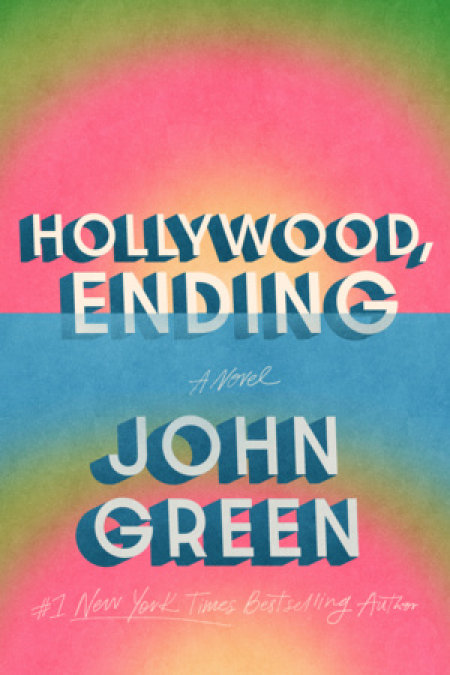
#1 bestselling author John Green makes his much-anticipated return to fiction with a behind-the-scenes Hollywood love story about finding someone to trust in an untrustworthy world.
“A spellbinding, tender, incisive, funny, and compassionate story of love and creativity.” —Booklist, starred review
“In the author’s anguished portrait of modern fame, the most challenging performance is that of an authentic self.” ―The New York Times
For rising talents Kai Laramie and Juniper Castillo, being cast in the buzzy biopic Andy Warhol Never Gets Old is the opportunity they’ve both been waiting for. They’re on the verge of breaking out, and maybe even falling in love. Soon, the movie is blowing up, and so are their lives—in exciting, but also terrifying, ways.
John Green artfully blends a behind-the-scenes Hollywood love story with an unflinching examination of the insatiable attention economy. Told through dual points of view, the novel brilliantly juxtaposes the on-screen study of Warhol’s life at the dawn of celebrity culture with the intimate struggles of two young people figuring out who they are, both together and alone.
Tender, heartbreaking, and shrewdly funny, this is a story as only Green can tell it. Hollywood, Ending is a deeply observed novel about the tension between a public and a private life, and the audacity to pursue the kind of love we all deserve.
Release date:
September 22, 2026
Publisher:
Dutton Books
Print pages:
368
* BingeBooks earns revenue from qualifying purchases as an Amazon Associate as well as from other retail partners.
When I got the news that Matthew Malone wished to make my acquaintance, I was rereading the script for Andy Warhol Never Gets Old in a bare-walled apartment the studio had rented for me. Matthew, I was told, wanted to meet in the lobby of his hotel. We’d all just moved to Pittsburgh, a city not known for its hotels, but Matthew had found the good one, of course. So I took an Uber there, pounding Altoids the whole way, thinking about what I’d say to the one and only Matthew Malone, who was playing Warhol in the movie. Matthew and I had exchanged phone calls and a couple of text messages, but my friends all wanted to know what he smelled like, how he walked, what kind of emotion his eyes held, whether or not he was a typical Pisces, and so on.
The first time we talked, a few months after my mother died, he called me and said, “I’m so excited to work with you on this,” and I said, “Me too,” and then he said, “I know you’ve been crossing through a hard time, and I’m sorry.” What a phrase. Crossing through a hard time. I was indeed crossing through a hard time.
In the first weeks after Mom died, I mostly felt relief that it was over. I felt like I was coming up for air after a long time underwater. But eventually, I learned that it was not, in fact, over. The dead are not in the past, not really, because you carry them around with you.
—
When I got to the hotel, I walked into the lobby—absurd chandelier, abstract paintings with flashes of neon. I scanned the room for Matthew, but didn’t see him. I noticed instead a beautiful boy—slight, unstyled brown hair, impish green eyes—slumped into a semicircular couch. He was writing in a Moleskine notebook. He looked—I don’t know how else to say it—like a movie star. I am attractive in a way gossip blogs sometimes call interesting or surprising. I have a slight overbite. My eyes are just a bit too far apart. I have a face built for the screen: an expressive but not particularly symmetrical one. This boy, though, in his fitted black jeans and his baby-blue button-down shirt, almost seemed to have a visible aura. Plenty of people are attractive. Precious few are genuinely magnetic. I wanted to buy stock in him immediately, even having never seen his acting. I took a few steps toward him and managed to say, “You must be Kai.”
He looked up from his notebook. He was chewing gum, and he smiled shyless and broadly as he removed AirPods from his ears. “Juniper,” he said, as if we’d known each other for years. He stood, and offered me a hand. I shook. Stronger than I expected.
Not long before, I’d gotten out of a relationship, except I hadn’t gotten out of it so much as I’d been cast out of it, like a fallen maiden cast out of the church’s good graces. On the dude’s way out, he’d told me there’s a word to describe what I felt for him—that the word isn’t love or lust but limerence, a state of involuntary obsession. I was twenty-two. He was thirty-six. He’d been the cinematographer on my last movie, which had sort of flopped, and now he was moving on to the next one.
After the movie did a paltry seven million dollars in its opening weekend, I had nothing lined up, so I enrolled in college and took a course in modernist literature and art. I kind of suspected my life as an actor could be over, but then along came Matthew Malone to save me.
We hope you are enjoying the book so far. To continue reading...

 Please log in to recommend or discuss...
