
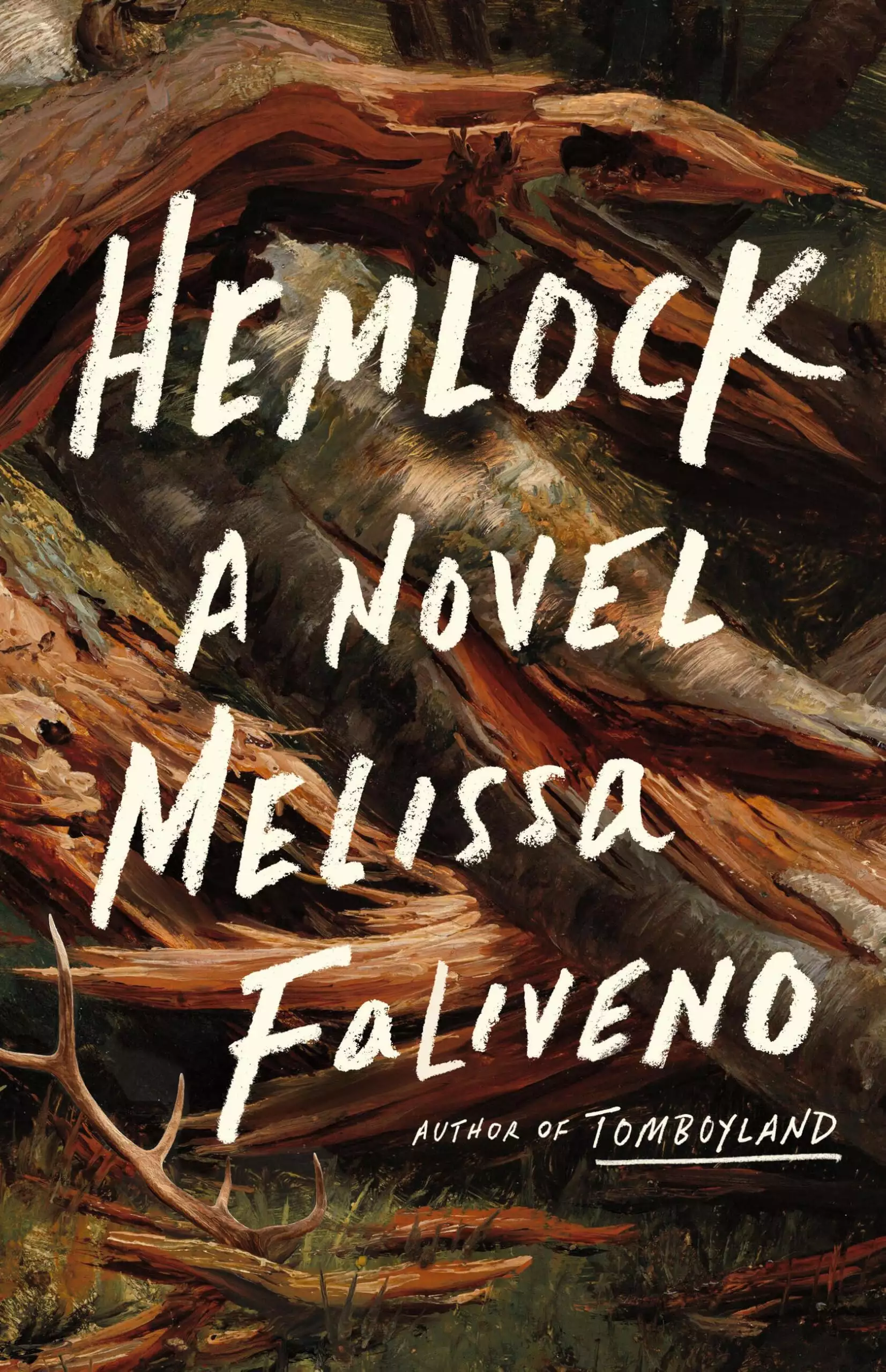
Hemlock: A Novel
- eBook
- Paperback
- Audiobook
- Hardcover
- Book info
- Sample
- Media
- Author updates
- Lists
Synopsis
A woman haunted by a dark inheritance returns to the woods where her mother vanished, in this queer Gothic novel.
Sam, finally sober and stable with a cat and a long-term boyfriend in Brooklyn, returns alone to Hemlock, her family's deteriorating cabin deep in the Wisconsin Northwoods. But a quick, practical trip takes a turn for the worse when the rot and creak of the forest starts to creep in around the edges of Sam's mind. It starts, as it always does, with a beer.
As Sam dips back into the murky waters of dependency, the inexplicable begins to arrive at her door and her body takes on a strange new shape. As the borders of reality begin to blur, she senses she is battling something sinister—whether nested in the woods or within herself.
Hemlock is a carnal coming-of-addiction, a dark sparkler about rapture, desire, transformation, and transcendence in many forms. What lives at the heart of fear—animal, monster, or man? How can we reject our own inheritance, the psychic storm that's been coming for generations, and rebuild a new home for ourselves? In the tradition of Han Kang's The Vegetarian, Hemlock is a butch Black Swan and a novel of singular style, with all the edginess of a survival story and a simmering menace that glints from the very periphery of the page.
Release date: January 20, 2026
Publisher: Little, Brown and Company
Print pages: 351
* BingeBooks earns revenue from qualifying purchases as an Amazon Associate as well as from other retail partners.
Reader buzz
 Please log in to recommend or discuss...
Author updates
Hemlock: A Novel
Melissa Faliveno
One
SHE ARRIVED AT the cabin at night. It wasn’t late, but here in the woods, in the springtime—in the far northern part of this far northern state, in this far northern country—the light left early and the dark stayed long. It was nearly pitch-black as she drove the long gravel road that cut through the trees like she was taught: slowly, her eyes scanning ditch to ditch in a figure eight for deer. She flipped on her high beams, the light cast out before her like a torch, but still had trouble seeing. She had forgotten how dark it got, this deep in the woods.
She knew she was close. She could feel it by the narrowing of the road, by the trees bending in—the bright skeletons of birch curling across the path, their bare branches reaching like arms, stark white against a black curtain of pine. The car crawled down the rutted path, too low to the ground for this kind of terrain, tires crunching over downed branches and pine cones, gravel spraying its belly like buckshot.
And then she saw it, like a beacon in the dark: the small metal sign on a low metal post, hammered long ago into the ground, a fire number blazed in white paint against red. No one in the woods had addresses or mailboxes, and there was no post office here. Mail could be sent to the grocery store in town, some fifteen miles away, where an old woman behind the counter served as de facto postmistress. But most people rarely checked, and the mail piled up, the bills turning yellow to pink, the letters from home getting more frantic and then less frequent, until the old woman behind the counter eventually threw everything away. For most people who found themselves here, and especially for those who stayed, part of the point was to disappear.
The cabin was a small place, made of hand-laid pine, that sat far back from the road in a clearing, surrounded on all sides by deep forest. She turned down the gravel drive and watched it emerge before her, materializing like a ghost from the shadows. It was smaller than she remembered. In her dreams, where it turned up often, it was huge—a hulking, looming thing with endless doors and hallways, walls that seemed to breathe; a maze of passages that changed shape and stretched on forever, into nothing. In reality, it was a normal little house, with four normal walls, a normal little porch and a chimney. It sat, unassuming, on a small slope of lawn, tucked safe inside that circle of trees. It almost looked inviting.
She parked the car but kept the engine running, the headlights casting a strange yellow glow around the house. She sat for a moment, watching it, waiting for something but not knowing what. For a figure to appear in the window, a pale hand drawing back the curtain? For the building to take a great breath, its pine-board bones expanding, filling its cavernous lungs, then sighing back into the shape of a house? Ridiculous thoughts, but there they were, unbidden in her brain. And then came another, ringing bright and clear as if someone had said it aloud: There was still time to turn back. To leave this place and never return.
She shook the thought from her head. Hopped out of the car and jogged to the shed, a large winter-faded outbuilding that served as garage, workshop, and storage unit some fifty feet from the cabin. She pulled on the heavy door, shouldering into it as it cracked up and then open.
Inside, the smell of rot. A squirrel or a mouse had probably crawled inside and died over the winter. Her stomach curled at the smell, sick and sweet. She pulled the string on a bare bulb that hung from the ceiling, but nothing happened. She squinted into the dark. At the back wall, she could make out the shape of the woodpile, a solid cord of maple and birch stacked high and neat, an axe leaning against it. The night was cold, and it would stay cold for a while, but with all this firewood she’d be set, depending on how long she stayed.
She scanned the shadows, spotted a small
fishing boat with an outboard motor, covered in a tarp. And beside it, what she’d most hoped to find: her father’s Chevy S-10, a late-’80s model, cherry red and perfect. She opened the door, found keys in the ignition, and turned. It sputtered for a second then roared to life. She smiled. At least she wouldn’t have to drive her tiny foreign car while she was here. Nothing would make her stand out more. She jogged back to the car and cut the engine, grabbed her bags and stepped out into the night.
The darkness was a solid thing, the silence loud. It rushed through her ears like wind, leaving a high-pitched ringing in its wake. She’d developed tinnitus in the city, but the constant din could usually drown it out. Here, the sound was sharp. And beneath it, from out of the silence came a symphony: crickets and peepers and tree frogs, singing into the night. She stood in the clearing, closed her eyes, and listened. She breathed deep, swallowing the cool night air. It tasted clean and sweet, like water. She opened her eyes again. A sliver of moon peeked through the trees and cast a pale light, carving a path through tall grass to the cabin. She followed it.
A fake rock on the porch housed a spare key, as it always had. She pried open the plastic by feel, fumbled to find the lock. She turned the key and pushed the door open, then stood on the threshold. A chill passed through her body. Like a goose walked over my grave, her grandmother used to say. She flipped the switch on the wall by the door, but no light came.
“Shit,” she said, aloud, to no one. She’d forgotten about the breakers. She’d have to go to the basement to turn them on, bring the cabin back to life. She hoped the pipes hadn’t frozen, as they often did when the place sat empty through winter. She’d forgotten about the problem of arriving at night, in the dark, after the place had been closed up so long. She hadn’t, it occurred to her then, thought at all about the implications of coming here like this, of being a woman alone in the woods. She hadn’t considered being afraid.
She stepped inside. The place smelled musty and strange, like it belonged to someone else. Beneath the dust and damp, that same sweet suggestion of rot. Like something had lived and died in the walls. She left the door open, let a small slant of moonlight pour in. Her eyes began adjusting to the
dark, and the place took shape before her. Not much had changed. It was a small space, a living room with a fireplace and a kitchen, a short hallway that led to two small bedrooms and a bath. And a door that led to the basement. The furniture was the same—same old couch and rocking chair, same old kitchen table. It had all been in her parents’ house once, in the town where she grew up, several hours south of here. The furniture had made its way to the cabin over the years, piece by piece, as her parents had pared down and planned, eventually, to retire here. It was a plan, like so many, that never came to pass.
She closed the door behind her. It clicked, and she was left again in darkness. She carried her bags down the hall, running her hand along the wall. She thought of the hallways in her dreams, then shook the thought away. She chose the bedroom that had once been hers, though her parents’ room was bigger. She wouldn’t be able to go in there yet, not for a while.
She dropped her bags, then walked back down the hall. She stood outside the basement door, grabbed the knob and turned. It was locked. People rarely locked their doors up here, so it was strange that this one should be—from the inside, no less, and from upstairs; as if to keep whatever was down there out. She turned the lock, her heart beating fast. She imagined an animal—a raccoon or opossum, maybe even a mother bear and her cubs—having gotten in over the winter and living down there. It happened sometimes. She imagined yellow eyes in the dark, a growl and a hiss, claws and teeth. She imagined something far worse could be waiting.
Among the things for which her home state was famous—beer, cheese, freezing games of football in the snow—was a long and storied tradition of serial killers. From those who made national news for eating their victims
or making skin suits and furniture from their flesh, who terrorized entire generations only to be memorialized decades later in some bad true-crime docuseries; to those who got far less publicity, who kidnapped women and took them to remote northern woods like these. Like one story when she was a kid, about a college girl who’d been abducted after a night out and held captive in an abandoned cabin much like this one, not far from here. By the time the girl’s body was discovered she’d been dead for weeks, and the man who killed her was never found. The story became, as such stories do, part of local lore—like Bigfoot and UFO sightings and the Paulding Light, a mysterious glowing orb that hovered above the train tracks just across the border. It became part of the mythology of the place, told around campfires in the summer. And that’s what happens when girls go out alone, they’d say, flames casting shadows across grave faces. Girls who wear short skirts and drink too much and ask for trouble. And that man—that monster—is still up here somewhere, roaming the woods and waiting. When she was a girl, she’d been fascinated by these stories, with this gruesome history of her home state. It had all seemed so far away from her then, some safe distance that could never be crossed. But now she was here, and she was alone, and it all felt much closer.
She stood at the basement door and shivered, tried to stop her stupid brain from cycling through every horror it could summon. She fished her phone out of her pocket. The battery was in the red, but she flipped on the flashlight. She took a breath and opened the door.
The stairs were steep, thin planks of pine with no risers that creaked under her feet as she stepped slowly down, the small circle of electric light illuminating each step and nothing more. She reached the cement floor and stopped, then jogged to the breaker box. She felt like a kid, running to the cellar in her grandmother’s farmhouse for a jar of pickles, heart slamming wildly in her chest. She tried to shake the fear, but it was no use. She’d watched enough horror movies to know that a woman going down to the basement by herself, in the dark, was a recipe for certain, brutal death.
She found the breaker box and opened it, then flipped the two switches marked with Scotch tape. Septic, electric, the handwriting scrawled in Sharpie. The cabin hummed to life. She flipped the light switch on the wall. Still nothing. Some bulbs would need to be changed, but she wouldn’t worry about that yet. For now, she sprinted back to the stairs and then up them, slamming the basement door behind her. She locked it, leaned against it, her pulse beating hard in her throat. She flipped a switch on the wall and the hallway flooded with light. She exhaled, realized she’d been
holding her breath. Everything was fine. She was fine. There was no one here. No monsters, no bears, no bad men lurking in the dark.
She walked around the cabin, turning on lights, opening taps, the pipes moaning and sputtering till the rust-colored well water ran clear. A thick layer of dust covered the counters. She surveyed the floors, found piles of dead flies along the baseboards. She cracked open the cabinets, their seals long stuck, found nothing inside but mouse droppings and an ancient box of tea. She plugged in the old yellow refrigerator, and it groaned on. She pulled back the curtains, and more dead flies fell from their folds. She opened the patio door and stepped out onto the porch, the light of the cabin burning behind her.
She looked up at the sky through the circle of trees, a spray of stars unlike anything she could see in the city. She listened to the crickets and peepers and frogs. Somewhere, not far away, the yip of a coyote, then a collective howl from its pack, a circle of hunters in the distance, echoing in the night. There were no monsters here—only the woods, and whatever lived within them. It was just her and the wilderness, deep and dark.
Two
IT WASN’T SO much that Sam decided to leave. It was more like the leaving had been decided for her; that some external force had compelled her to go, then carried her all those miles. She packed two bags, threw them in the back of her ’95 Mazda—her grandfather, a General Motors man who worked the line his whole life, no doubt rolling in his grave—and, not looking back as she shifted into fifth on the Brooklyn-Queens Expressway, pretty much vanished.
She left at night, the streets of New York and the tunnel and turnpike oddly empty, though it wasn’t that late. She drove west, through New Jersey and Pennsylvania, across that endless stretch of I-80, skirting Lake Erie and heading halfway through Ohio, where she pulled over at a truck stop not long before dawn and slept until the sun rose over the Sunoco sign. She pressed on through Indiana, past the thick green stink of Gary, and into Chicago, the traffic at midday not bad but not good either, then north across the state line. Through Beloit and Monroe, where her grandparents had both worked in factories, and where her mother had too; then on through Janesville, past the burnt-out husk of the GM plant, where her grandfather had assembled chassis for over forty years, before things got bad and GM went bust and everyone, including her grandfather, had lost their pensions. He died a few years later, just before he’d planned to retire, leaving her grandmother broke and alone with a new set of suitcases. They’d never been out of the state, had planned to drive across the country, maybe get on a plane for the first time, cross an ocean and see the world.
She passed the exit for her hometown as the sun began to set again, and stepped on the gas. She wasn’t ready to go back there yet, wasn’t sure if she would ever be. She skirted the capital city, its lakes and rivers shimmering in the dusk, and drove north.
Even as darkness fell, she knew the way by heart. The small handful of turns had been imprinted on her body before she ever knew the names of the roads. She knew exactly where, just north of Mosinee, the smell from the paper plant, fishy and thick, would blow in through the windows. She knew the very moment when the long stretches of farmland turned, in a blink, to pine. She knew the billboards, weathered to white, advertising divorce lawyers and Adult Megastores and the World’s Largest Cheese Emporium, reminders that abortion stops a beating heart and God is watching. She knew the crumbling bunker that had once been a military armory, a hulking cement mass now swallowed by weeds.
She stopped only so often, to stretch her legs and refill her coffee, hitting the same gas stations she knew from her youth, the same glowing signs like lighthouses in the middle of landlocked nowhere. She bought dusty bags of beef jerky and Sour Patch Kids to keep her mouth busy, wanting badly for a cigarette instead. She promised herself she wouldn’t buy a pack until Wausau, but only made it as far as Portage. She bought Newports, a brand she hated, the smell bringing back bad memories—the kind that worked its way into your clothes, into the carpet, and stayed. She’d bummed American Spirits from her friends in New York and occasionally bought a pack, though she never called herself a smoker. But Newports had been her mother’s brand, and her grandmother’s before her, and when she spotted the teal-and-white package behind the counter it had called to her. And anyway, they’d passed everything else down, so it felt right. The best way she knew to pay homage to the women who raised her.
“To the line,” she said, aloud to the night, outside a crumbling Mobil station near the prison where Jeffrey Dahmer had been locked up and then murdered. She slipped the plastic off the pack and tossed it in the bin between pumps, slid a cigarette between two fingers and raised it in silent salute. Above her, the fluorescent lights flickered and then blinked out, like the streetlights always seemed to
back in Brooklyn whenever she passed beneath them.
In the car, she smoked with the windows down, the menthol making her lips go numb. She passed the exit to Plainfield, where Ed Gein had made his famous lamps and leggings of women’s skin. She turned the radio up, the Allman Brothers singing through blown-out speakers about gypsies and freight trains and crossroads. She sang along, even as the signal faltered and fuzzed, flicking ash at the blackened highway that disappeared behind her.
She hadn’t been home in years. She wasn’t sure how long. She wasn’t even sure she could call it home anymore, or if it had ever really been. Still, driving these empty roads at night, the roads she knew so well, it was as if she’d never left. She felt a tug of something—nostalgia, probably; regret, almost certainly; longing, maybe most of all, for something she’d never really had. For the hope of what might have been, had things been different. Whatever it was, she knew one thing for sure: No matter how far she ran, this place always called her back.
She woke in the morning, sunlight slanting through the bedroom window. She was tired, and her head was cloudy. Her back and neck ached. She hadn’t slept well, despite the exhaustion of a twenty-hour drive. She rarely slept well, but it had been worse than usual. She had heard things in the night—crunches and cracks in the woods, in the walls, each new sound making her bolt upright in bed in the dark, until she’d given up and turned on the bedside lamp like she had when she was a kid, afraid of monsters and convinced the light could save her. She’d slept in brief bright fits after that, strange dreams weaving in and out of her half-conscious mind, lamplight casting shadows on the pine-log walls.
She rubbed her eyes and sat up, the bedsheets crinkling. She’d found a set in the closet the night before, still in their plastic packaging. They were white and stiff and smelled like chemicals, like they’d never been used. There was an old, patterned afghan spread across the bed, its colors bold and gaudy, that she was pretty sure one of the many great-aunts she didn’t know had made. She yawned and stretched and popped her neck, brushed a dead fly off the sheets. She grabbed her
glasses off the nightstand and put them on, noticed a spiderweb stretched behind the lamp. It was large and intricate, like it had taken a long time to make and had been there a long time too. At its center, a fly carcass entombed in webbing, and a fat black spider beside it.
She couldn’t tell what time it was. The light outside was bright, but mornings in the woods were weird like that—it could be six or nine or noon, the tall pines bending up around her, the sun already high. The light and the trees played tricks.
The bedroom window was open and the cool spring air blew in, sending the still-bare branches of maple and birch tapping against the walls. Soon those trees would be blooming, but for now, she could still feel winter. This far north, the cold held on as long as it could. She kicked off the blanket and sheets and shivered. It had been so long since she’d been in this place, in this room, where she had spent so much time as a girl, the morning sun making the honey-colored pine walls glow. She could almost smell the coffee brewing, the bacon sizzling in the cast-iron skillet. Her father had always gotten up early to make breakfast.
He had built the cabin himself. It took him years, making the long drive from their hometown on weekends, after long weeks of work, sometimes with the family in tow but more often alone. With the help of some local friends, old guys who bartered labor to get by up here, where there were very few jobs, he sawed and sanded and shellacked the pine, then laid each log by hand. He installed the windows and roof, built the porch and stained it. For a long time, there was no running water or power, but he eventually had electricity and a septic system installed. No internet, never, and barely any cell service, if you picked up a signal at all. There were some modern conveniences her father wouldn’t allow, and if they could have lived completely off the grid, they would have. Up here, miles deep into the woods, with very few people around, it was as close as you could get.
He’d named the cabin Hemlock, after one of his favorite varieties of pine that grew in this stretch of forest. People always named their cabins here, as if each place had its own personality, its own little life. He carved a sign out of a piece of driftwood, and they painted it together and mounted it above the door.
“If you make something,” he told Sam, when the work was done and the sign was hung, “if you love something, you’ve got to give it a name.”
That the tree—tall and tender and shade-giving—shared a name with a creeping plant full of deadly poison was something Sam thought of sometimes, but never said aloud. Her father liked the sound of it, and Sam did too.
She got out of bed, pulled on a sweater and long johns. She made coffee, then sat on the porch and drank it black, her hands wrapped around a mug that said I FISH THEREFORE I AM, her father’s old favorite. Steam curled up into cold spring air that sliced into her lungs. She liked the sharpness of it. Around her, the circle of trees was dense, despite the season. The forest was made mostly of conifers and evergreens—cedar and spruce and hemlock, white pine and balsam fir—and dotted among them the deciduous hardwoods, maple and birch and basswood and oak, their branches still bare. Beyond the property lines, the deep woods of state land stretched for miles, all the way to the border. It was a region known as the Northern Highlands, part of the Chequamegon-Nicolet National Forest. Also known as the boreal forest, the Taiga, or snow forest. It was a place of many names. To the locals, though, it was known only as the Northwoods.
It was quiet—nothing but birdsong and light wind in the trees. The kind of quiet that had once brought her calm. But now, after her many years in the city, having grown so accustomed to the traffic and lights and life, the quiet made her uneasy. But she was grateful for the solitude and the space, the unpolluted air. She said a little prayer of thanks. Not to God, exactly, but to a power beyond herself. It was a practice that still made her itch, but she was working on it. She listened to squirrels and chipmunks running through the leaves. She wondered what else might be out there. The thought sent a shudder down her spine. But she took another sip of coffee, shook the feeling away. ...
We hope you are enjoying the book so far. To continue reading...
