The bonds between six women undergoing IVF are tested when one announces an unexpected birth in this absorbing, candid novel about what women endure to become mothers
“Already a feminist sensation in South Korea, it’s candid, sharp and quietly devastating. And at just over 200 pages, you’ll finish it in a sitting and think about it for weeks.”—Dua Lipa’s Service95
Outside the chat, they had different jobs, personalities, financial backgrounds, but inside, they were all mothers-to-be anxiously awaiting their babies.
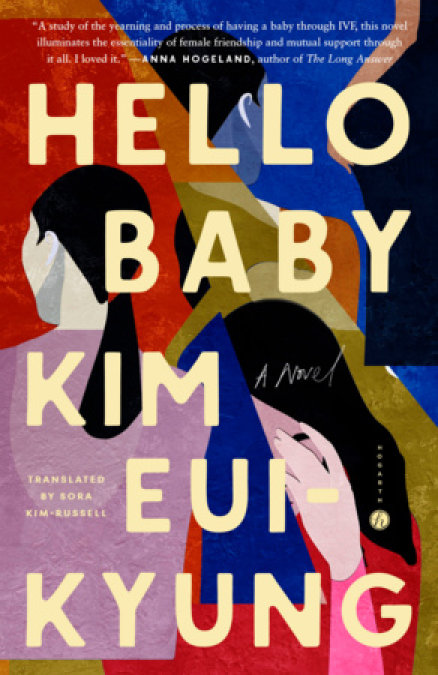
At a fertility clinic in Seoul, six women in their thirties and forties become friends. To comfort one another while undergoing IVF, they create the group chat “Hello Baby.” Over the course of two years, they share personal stories on their way to motherhood, until one, forty-six-year-old Jung-hyo, suddenly announces she has stopped treatment and disappears from the friend group. But after a year of silence, on Lunar New Year, she drops a text in the chat with the news that she recently gave birth to a baby girl. She invites the group over to celebrate her daughter’s birth. With a mix of envy and admiration, the women gather, but their doubts and suspicions threaten a friendship already stressed by uncertainty.
Switching between the six characters—a journalist, a police officer, a vet, a lawyer, and two housewives—this thought-provoking novel explores the social pressure and emotional strain on women struggling to conceive. Written with insight, humor, and great empathy, Hello Baby is a moving portrait of what it means to be a woman today and the lengths some will go to seek motherhood.
Release date:
August 18, 2026
Publisher:
Hogarth
Print pages:
176
* BingeBooks earns revenue from qualifying purchases as an Amazon Associate as well as from other retail partners.
8:30 a.m. Mun-jeong checked her temperature with the infrared forehead thermometer and rubbed sanitizer into her hands before entering the hospital. Next to the door, a receptionist answered phone calls with one hand and scanned barcodes on patients’ cell phones with the other to check them in. Across the lobby, other employees took a moment to stretch in their seats or stare at their phones before starting another day of work. A blue-uniformed nurse paused on her way to the blood collection room to take in the waiting area steadily filling with people. Mun-jeong took a deep breath, then went downstairs to the IVF clinic.
Her husband had come and gone an hour earlier, to deposit his sperm, and was already back in his writing studio. It would have been nice if he’d at least stuck around to hold her hand through the next part. Mun-jeong knew, of course, that IVF meant the baby was made outside of their bodies, but she hated feeling like they were each going through it alone. Ever since recognizing an acquaintance at the clinic, her husband had refused to accompany her there unless absolutely necessary. According to him, during their previous, failed cycle, he’d finished doing the big deed and was about to head back to the lobby when he saw a familiar-looking man sitting on a bench right outside the door to the sperm collection room. He said the man hurried to the bathroom to avoid him. The man was wearing a pandemic mask, but his eyes were clearly those of an old college friend. Mun-jeong’s husband had run away without looking back, mortified at bumping into someone he knew there, of all places.
Was low fertility really so shameful among men? Why did they have to be so caught up in their own egos when it came to the sanctity of creating life? Sure, a lot of women kept their fertility treatments a secret at work, but less out of embarrassment than fear that their plans to start a family would be held against them. Even if she managed to get pregnant, Mun-jeong intended to keep writing for the magazine right up until she went into labor. She would conduct interviews with her pregnant belly on proud display. Her current assignment, called “The Private Lives of Female Professionals,” had her featuring women who were experts in their fields and interviewing them about everything except their jobs. They talked about their hobbies, their travels, and more. With so many women deciding not to marry or have children, they had so much more to talk about than just relationships and child-rearing. A retired volleyball player she’d recently interviewed lived in a mansion with three large dogs and was an animal-rights activist who did volunteer work and donated to animal shelters. Mun-jeong relished each interview, invigorated by not having to listen to the usual banal gripes about feuding with in-laws. It left her wondering if a husband and children weren’t in fact the biggest obstacle to a woman’s success. Yet, here was that same Mun-jeong, standing now in Baby Angel Hospital, the country’s best IVF clinic and one of the top three in the world.
In vitro fertilization had gone from something you’d only expect to see in a science fiction novel to a widely used treatment for infertility. Even in the midst of the pandemic, Baby Angel Hospital was packed with people seeking to undergo IVF. Word of Korea’s success in the procedure must have spread, because there were patients flying in from abroad.
In 1978, the year Mun-jeong was born, the world’s first test-tube baby, Louise Brown, was born in the UK. Brown later married and had two sons through natural conception, but Mun-jeong, who also came into the world through natural conception, was facing IVF at the age of forty-four. When Brown was born, the Pope expressed his concerns, calling it a slap in the face of God’s providence, and the media prattled on about how it was “the greatest threat since the atomic bomb.” The reporter who came up with that particular line would never have guessed that eight million babies around the world would be born through IVF and that an IVF clinic optimized solely for the treatment of infertility would appear in South Korea. For all they knew, that reporter’s own daughter might be pursuing IVF as well right now.
Mun-jeong undressed from the waist down and pulled on a hospital gown. Outside the changing room, a nurse directed her to a bed, then took her blood pressure and outfitted her with a disposable cap and an ID bracelet printed with a QR code, her name, and that of her husband. The bracelet reminded Mun-jeong of visiting amusement parks as a child and getting those wristbands that allowed you access to all the rides. Would this wristband give her free access to a park full of frolicking children where her own future child awaited?
Mun-jeong texted her husband.
—I’m scared of going under.
—It’s not your first time.
—Yeah, and now I know how much it hurts when the anesthesia wears off. I’m scared.
Despite what she told her husband, the egg retrieval wasn’t actually as painful as she’d heard it could be. For Mun-jeong, it felt no worse than her usual period cramps. She’d been told this was because of her diminished ovarian reserve. Her body could only produce five or six eggs at most per round, and during one retrieval, the doctor had barely managed to collect three. But Mun-jeong wasn’t in the mood to be stoic about it. It wasn’t fair how heavily the burden of IVF fell on women. While they had to endure injection after injection, egg retrievals, and embryo transfers, all the men had to do was roll up to the clinic on sperm collection day and masturbate into a cup. Extracting eggs brought pain, while collecting sperm brought pleasure. Sperm collection was so much simpler. Mun-jeong’s husband didn’t seem to consider giving up after each failure, the way she did, and this aggravated her.
“Wake up, Ms. Kim. Kim Seon-yeong! Time to wake up!”
The woman in the next bed was having trouble coming around. The nurse slapped the woman’s cheek and loudly called her name. Mun-jeong had no idea who Kim Seon-yeong was, but she silently encouraged her to wake up, too.
On the way to the toilet, Mun-jeong stole a glance at the other woman. Seon-yeong was groaning quietly. Mun-jeong considered herself generally fearless, and yet she dreaded egg retrieval day. What frightened her wasn’t the pain but rather the torture of false hope. General anesthesia was no walk in the park either, of course, but failure meant having to start the long process all over again. This was her fifth retrieval. She’d undergone at least eight embryo transfers. It was hard for her to believe the lengths she had gone to. Sticking herself in the stomach with scary needles to make her eggs grow. Having those eggs extracted with an even bigger needle. Then getting the fertilized eggs reinserted back into her body. And not just once, but over and over. She’d lain awake half the night worrying about what to do if the few follicles she’d managed to grow turned out to be empty.
The nurse poked her head inside the curtain and said, “Two minutes.”
—I’m going in now.
She was hoping for an encouraging response from her husband, but her text went unread.
Mun-jeong followed the nurse to the egg collection room and took a seat on a stool outside the door. After a moment, the door opened. Inside, four nurses were hoisting a woman onto a gurney by her arms and legs in one smooth, coordinated movement. As they rolled her away, Mun-jeong stole a look at the departing woman, who was still groggy and mumbling to herself.
Mun-jeong took off her horn-rimmed glasses and handed them to the nurse along with her cell phone, then walked into the room and climbed onto the table. Dr. Ko Deok-su gazed down reassuringly at Mun-jeong with a look on his face that left her no choice but to trust him. It was a look she only ever saw on him in the procedure room. It transformed his normally brusque manner to one of paternal kindness and confidence. His face said, Trust only in me and do exactly what I say. It was like gazing up at the face of Christ, like he was going to stroke your head at any moment and tell you he understood your suffering. But even that wasn’t enough to stop her from groaning in pain when they propped her knees up and stuffed a wad of surgical gauze into her vagina. Before she could finish thinking, Couldn’t you do that after I’m asleep?! she passed out.
When she came to, she heard someone crying. It sounded like the woman in the next bed.
“It hurts, it hurts,” the woman wept.
She heard the nurse say, “I know it hurts, but you have eighteen eggs now.”
Mun-jeong’s stomach twisted with envy. With that many eggs, she would have plenty to freeze and wouldn’t have to go through another retrieval anytime soon. Now the woman was calling her husband. She argued with him over the phone, hung up, and wept even harder. Mun-jeong’s gaze fell on a piece of paper taped to the wall:
Be strong, future moms and dads.
Your baby is taking so long to reach you because their feet are oh so tiny.
We hope you are enjoying the book so far. To continue reading...

 Please log in to recommend or discuss...
