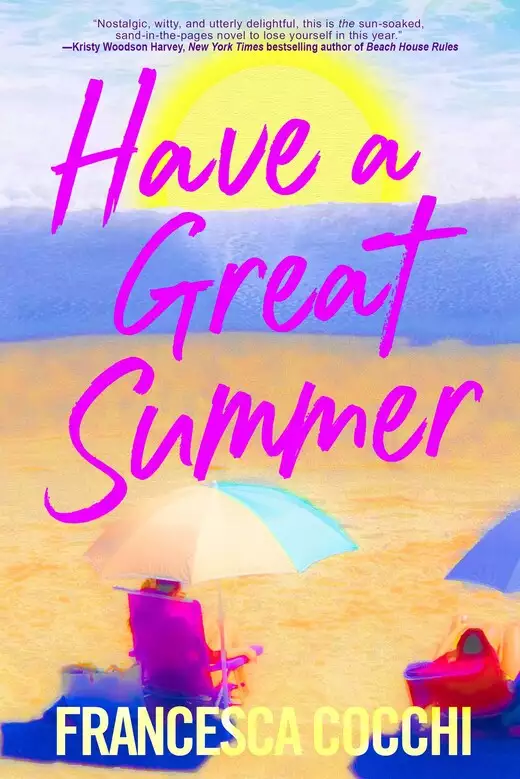
Set against a vibrant Jersey Shore backdrop and bursting with summertime romance, hometown nostalgia, smart humor, female friendship, and millennial angst, journalist Francesca Cocchi’s dual-timeline teenage-crush-to-adult-lovers debut is the perfect beach read for fans of Annabel Monaghan, Carley Fortune, and Emily Henry.
If time is supposed to heal all wounds, Lina Mariano’s broken teenage heart never quite got the message—but 15 sunny, sandy, angsty Jersey Shore summers later, she finds herself unexpectedly facing her old crush, getting a new perspective—and maybe even a hopeful glimpse of the future . . .
Lina Mariano is stuck—in her hometown, in her job, and in the past. And after six years of writing up local weddings as a columnist for a popular lifestyle website, she’s wholeheartedly sick of nuptials. Worse, the next one on her list is none other than Sebastian Nikolaou’s.
Working high school summers with sweet, handsome Sebastian at his mother’s iconic beach restaurant, teenage Lina was totally wrapped up in the way he made her feel—until the night that everything changed. Even so, she’s embarrassed to admit how often she still thinks of him, and now, comparing their present lives is wrenching. It will take a careful look at her younger self, and some wisdom from the best friend who was there for it all, to see that making her dreams come true is up to her alone—whether or not those dreams still include Sebastian . . .
Poignant, engaging, and insightful, Have a Great Summer is an ode to the confused teenager in all of us, and a reminder of the blissful, excruciating, delicious days of summers gone by.
Release date:
May 26, 2026
Publisher:
Kensington Books
Print pages:
320
* BingeBooks earns revenue from qualifying purchases as an Amazon Associate as well as from other retail partners.
Everyone assumes the worst thing about living in a beach town year round is the off-season lull. The truth? It’s those glorious summer days filled with constant reminders that other people are on vacation and you are not.
Take, for example, the fact that I—a twenty-nine-year-old woman—bike to work in the summer, not because I’m particularly nostalgic for the time when my baby blue beach cruiser was my only mode of transportation nor as part of my efforts to be environmentally conscious, but because parking is a nightmare. A year ago some benny (what Jersey Shore locals call the New Yorkers and North Jerseyans who flood our beaches every summer) discovered that no one checks the meters in my office’s employee lot and spread the word like tourist gospel.
Or take the forty-three-minute line I waited in for lunch at my favorite bagel place today, packed between a group of college girls in bikinis that looked like they had been purchased on Instagram and a sunburnt dad bartering with a four-year-old (one more hour in the ocean in exchange for three bites of lunch—fine, how about two?). I scarfed down my toasted cinnamon raisin with cream cheese in two minutes, which left me exactly zero minutes to bike back to the office.
And while you’re at it, take the Jeep I park my bike next to when I arrive at the city clerk’s office a few hours later. It’s a black Wrangler with the doors off, two sandy surfboards strapped to the roof. The kind of car that brags, I’m off the clock. Jealous?
As I lock my bike, I silently hope that the Jeep’s driver is here to pay a parking ticket.
Inside, I wave to Linda. She smiles at me from behind the counter and holds up a finger, then disappears into the rows of filing cabinets to grab the documents we spoke about on the phone.
I’m here for a story—or, at this point, I suppose it’s really just a pitch. A few weeks ago I’d heard rumblings that a buzzy Manhattan-based restaurant group was eyeing Brantley Beach for its next concept, so I’d emailed Linda, asking if she could keep an eye out for any leads. She’d called me this morning with an update: Sure enough, Diamond Group had applied for a local liquor license.
I scan the drab waiting room. There are only three other people here: Linda’s coworker and the couple she’s helping at the far end of the counter, their backs to me. The Jeep’s owners, I assume. I listen for keywords, but instead of “parking violation” I catch “marriage license application.” Figures.
I take a seat along the back wall and pull my laptop out of my bag, then balance it on my thighs so I can catch up on emails while I wait. The contents of my inbox remind me just how desperately I want the Diamond Group news to be true. If they really are opening a restaurant in town, Shore Life will want to cover it.
I’ll want to cover it.
Partly because it has the potential to be an exciting food story, with appeal beyond our usual Monmouth and Ocean counties audience. But mostly because it has nothing to do with weddings.
Because honestly? I’m starting to get sick of weddings.
My whole career up until now has revolved around them. After college, I landed a job as a severely (though predictably) underpaid editorial assistant at the biggest bridal magazine in the country, Ever After. I couldn’t afford to live in New York City (even with the three potential roommates I’d found in a Facebook group, it would have been a stretch), so I opted to move back in with my parents and commute an hour and a half each way via train from the town where I grew up, smack-dab in the middle of the New Jersey coastline.
Ever After was my dream job. It didn’t matter that the hours were long, or that my salary roughly translated to minimum wage (a hefty chunk of which went straight toward my student loans), or even that I wasn’t writing as much as I’d hoped. I’d gotten a job in “the industry”—something I’d been warned by countless professors and friends’ parents and parents’ friends would be next to impossible these days.
And yet there I was, researching floral trends for the staff writers, fetching samples for photoshoots and transcribing interviews with famous planners, designers and (my favorite) chefs. The editor in chief was brilliant, creative and devastatingly chic, but also kind and supportive—so different from the Miranda Priestly incarnate I’d conjured when I’d first accepted the role. I managed her calendar with the steadfastness of a president’s chief of staff. I wanted to be her. I fell in love with the job, the team, the city—and somewhere along the way, I fell in love with weddings, too.
Each morning I settled into my squishy plastic seat on NJ Transit, turned up my podcast and watched the shore give way to skyscrapers, content.
The problem with a dream job? Eventually, you wake up.
Two weeks after my one-year anniversary of working at Ever After, the publisher called an all-hands meeting. She announced we’d be decreasing our frequency from twelve issues a year to six, and that only half of the staff would be keeping their jobs. I wasn’t one of them.
I spent the next month refreshing job boards on LinkedIn and Ed2010 to no avail: It was 2018, and it seemed like all of the big New York City publishers (and most of the small ones) were facing a similar fate. I sent LinkedIn messages to every writer and editor and stylist and photographer I’d crossed paths with during my first year as a working adult and set up phone calls with a few. Everyone promised to keep me top of mind for any openings or freelance opportunities. But something about the way they spoke warned me not to get my hopes up. I felt my connections to that world severing as quickly as they’d formed.
I breathed a sigh of relief when an editor from a local website called Shore Life emailed me about an opening for a lifestyle reporter, based right in my hometown. The company was shifting its budget and editorial strategy toward content designed to bring in either a new audience or ad dollars. And, as it turned out, weddings attracted both. No matter that I was twenty-three and unwed myself—my experience at Ever After meant I was the perfect candidate to become Shore Life’s resident wedding expert, responsible for churning out dozens of digital stories per week: roundups of the season’s biggest trends, local vendor spotlights and a big, monthly feature on a Jersey Shore wedding that would soon become my “Real Weddings” column.
I wasn’t ready to give up on New York, but Shore Life felt like the perfect solution for the time being. I could save some money, build up my clips, then try again next year.
But instead of just one year, six passed. I’m still working at Shore Life, I’m still single—and I have major wedding fatigue. I flood my editor’s inbox with pitches for non-wedding stories, and she reluctantly approves about one a month to appease me. Which is why I really need that document Linda found to confirm my suspicions.
I glance toward the counter but she still hasn’t returned. That’s when I hear his voice.
“I’m sorry, Claire. I honestly just didn’t think of it.”
I know that voice. I haven’t heard it in thirteen years, but that hardly matters—I’d never mistake who it belongs to. I freeze, my fingers hovering an inch above the keyboard, and shift my gaze to the left as subtly as possible, toward the couple. And now that the man has turned to face the impossibly beautiful blond woman next to him I can see that he is, in fact, who I think he is.
Sebastian Nikolaou. The subject of a big, embarrassing, years-long high school crush. And—though I doubt he even realizes it—the first and only guy to truly break my heart.
His hair is a little different—still thick and dark like I remember, but cut much shorter on the sides, with what remains of his once-wild curls combed into submission. The woman next to him is pretty tall, maybe five feet nine, but still he towers over her. His already olive skin has taken on a deep tan, like it always did this time of year. He wears a white knit polo, navy blue chinos that skim his mile-long legs and buttery leather loafers, an expensive-looking watch on his wrist. It’s jarring to see him so dressed up, so adult-looking. He’s thirty-one now, I realize. Whenever a flash of him appears in my mind—something that has happened more often than I’d care to admit over the years—he’s always sixteen or seventeen and wearing either swim trunks (no shirt, no shoes) or a navy blue Bubba’s shirt, khaki shorts and white Vans—his uniform for the two high school summers we worked together at his family’s restaurant.
“Well, I really thought we’d get this done today,” the woman says, a pinched look of desperation on her pretty face. She looks effortlessly chic, wearing a chambray blouse tucked into white linen trousers, her tiny waist cinched with a leather belt, and a pair of designer sandals. “It was hard enough for me to even get this week off. I don’t think I’ll be able to get out this way again until the wedding.”
That’s when I notice a sparkling diamond on her left ring finger, and I realize that I know who this woman is, too: She’s Sebastian’s fiancée, Claire. I mean, I don’t know her know her, but I still follow Sebastian on social media, and I’m embarrassed to admit that I recognize her. He isn’t very active on any platform, but on the rare occasions he has posted over the years, I’ve certainly taken notice. A tagged Facebook album of ever-so-slightly blurry photos of him with friends at a college party his freshman year at the University of California in Santa Barbara. A sepia-filtered Instagram feed post of a new surfboard in the sand, the Pacific in the background. A “Throwback Thursday” at Bubba’s with his mom for her sixtieth birthday. And, yes, an engagement announcement, reposted to his Instagram Stories from a user named @ClaireC717.
I’d seen the photo right before bed one night this past fall, my traitorous Instagram algorithm serving it front and center the second I opened the app. It was taken on the beach, somewhere in Santa Barbara, I assumed—he’d stayed there after college, working in restaurant supply chain strategy, according to LinkedIn. I remember thinking it was a stunning photo that appeared to be taken from the vantage point of a drone. Something an influencer would post and the social lead at Shore Life or Ever After would DM for permission to share.
There was Sebastian, down on one knee, looking as devastatingly handsome as ever. His mouth slightly open as if he’d just let out a joyful laugh. His teeth a flash of bright white. The collar of his linen button-down blowing in the breeze. Claire was facing him, doubled over with her hands covering her mouth, shock playing on her blue eyes. (Does something about being proposed to render women physically incapable of resisting this pose? If I wrote for a less earnest outlet, I’d pitch an investigative report.) The caption read, EASIEST YES! I CAN’T WAIT TO BE YOUR WIFE, @SEBASTIAN_SURFS.
I’d tapped her profile, but it was private. A dead end. All I could see was a smiling profile photo of her and a bio that read UCSB CLASS OF 2016, followed by the Greek letters of a sorority.
“Shelly?” Sebastian says now, turning back to the woman behind the counter while Claire taps out a message on her phone. “What if you signed it for us—would that work?”
Shelly sighs, as if she’s about to recite something she’s told other people a thousand times. “Like it says on the site: No witness, no license. I’m already the notary.” She taps her pen against a section of the papers between them for emphasis. “Can’t do both.”
Sebastian drags a hand down his face and rubs his chin, but then he nods, accepting this. He turns back to Claire.
“Who could we call?” Claire asks, looking up from her phone.
Sebastian raps his knuckles lightly on the counter. “Not my mom. She’s closing the restaurant tonight, and she’s really short-staffed since the high school kids aren’t out of school for the summer yet.”
“What about Andre? Or Theo?”
I clock the names of Sebastian’s best friends from high school.
“Both working. And even if one of them could cut out early I doubt they’d get here by five.” I glance at the time on my laptop: 4:47. “We’ll just have to come back another time. I’ll figure it out.”
I can’t see Claire’s face very well now, but I imagine she does not look happy. She nods, quick and curt.
“Bring a friend or family member next time,” Shelly says. “Someone who really knows you—they’re attesting to your intention to get married to each other.” She hands the unfinished paperwork to Sebastian, smiling. “And unless you want to come back to see me a third time, make sure they bring ID.”
I’m head down, rummaging through my bag for a pretend object to avoid being seen by Sebastian and Claire on their way out, when Linda’s traitorous voice travels from the depths of the filing cabinets. “Ha! There you are.” She emerges, waving a manila folder in my direction. “I’m so sorry, Angelina. Our intern must have refiled it this morning by mistake. His system is all madness, no method.”
I offer Linda a tight smile and wait, like a hunted animal that knows it’s been discovered and has nowhere to run.
“Lina Mariano.” Heat burns my cheeks at the sound of my name coming out of his mouth: a fact, not a question.
I’m still sitting, frozen in place. I force myself to meet his eyes across the room. “Sebastian Nikolaou,” I manage to croak out. His name is an incantation I’ve been afraid to utter for years, worried of the dark powers it might wield. “Hi.”
He crosses the room, reaching me in a few long strides. I slide my bag and laptop onto the chair next to mine and stand, awkwardly. He’s standing right in front of me, curved slightly, like a question mark, to address our height difference (I’m only five feet tall, and the Converse I keep under my desk and changed into for the ride here aren’t helping me out). I tip my head back until I make contact with his eyes (they’ve always reminded me of green sea glass), an action that proves a lot more intimidating than it was a minute ago when he was all the way on the other side of the room.
Just as I’m wondering what will happen next, he bends down and hugs me.
I squeeze my eyes shut and hold my breath. Acts of self-preservation: My senses simply cannot take any more of him. I need to restrict access.
I pull away first and push my shoulders back, determined to look totally unfazed by this run-in. I quickly imagine what he’s seeing right now. I blew out my hair this morning, so that’s a plus, though I’m sure I could use a comb after biking here. I’m wearing a white blouse with a tie at the waist, my favorite Abercrombie jeans and the aforementioned Converse. I wish I’d taken the time to put on more makeup than tinted moisturizer and a few swipes of mascara, but overall, not bad.
“I can’t believe I ran into you,” he says, and the genuine smile that follows has my ego doing somersaults. “My mom will be so jealous when I tell her.”
Now I’m the one smiling. I’ve run into Barbara “Bubba” Nikolaou, restaurant owner and beloved Brantley Beach community member, every now and then over the years, and she’s always over the moon to see me (a mutual feeling). She still says I’m one of her favorite employees of all time. “How’s Bubba doing?”
“Good, good. She’s retiring, believe it or not. After this season.”
He’s right: I can’t believe it. “Really? Wow—I mean, good for her, though! She certainly deserves it.”
Just as I’m about to ask what will happen to the restaurant, Claire appears. Because I’m a tragic woman, I’d briefly forgotten about her.
“Lina, this is my fiancée, Claire Cunningham.”
“Nice to meet you!” she says brightly, wrapping one manicured hand around Sebastian’s bicep and extending the other to shake mine.
“Lina Mariano,” I say as we shake.
“Lina Mariano…” she repeats, with some familiarity. Her big blue eyes shift as she tries to place me—identify my significance. I indulge myself for a second: Maybe Sebastian has told her all about me when he’s feeling nostalgic.
But then she snaps her fingers. “Shore Life, right? I love your column! It’s how I found all our wedding vendors. I know nothing about New Jersey, so you really saved me.” She says “New Jersey” in that sort of mocking way people who have spent very little time in New Jersey but hate on it anyway always do.
“Don’t think it will win me a Pulitzer, but it’s fun,” I say. I can practically hear my best friend, Maren, on my shoulder: Would it kill you to cut the whole self-deprecation thing for, like, two seconds? While I’m always flattered to meet a reader in the wild, I’m also a little embarrassed. Sebastian probably had no idea that I cover the local wedding scene for a living—when I’d told him I wanted to be a writer all those years ago, this isn’t exactly what I’d had in mind. “I’m glad you found it helpful,” I add.
“You’re always so modest, Lina,” Sebastian says. “My mom told me every business up and down the Shore with a remotely wedding-related service would kill for you to feature them. And the ones you do cover can barely keep up with all the calls they get after.”
See? Give yourself more credit, says shoulder-Maren, smugly. I relax a little.
“So how do you know Seb?” Claire asks.
I internally cringe at this nickname, which I’ve never heard before. Then I look to Sebastian for help, curious how he’ll concisely sum up our relationship to one another.
Those green eyes consider me for a moment before he answers. “Lina and I worked at the restaurant together in high school. She’s one of my mom’s favorites.”
The truth, if quite an oversimplified version of it.
“That’s perfect!” Claire exclaims. When I knit my brows, confused, she adds: “You can be our witness!”
I catch the briefest flash of concern on Sebastian’s face before he nods. “Do you mind, Lina? It should only take a minute.”
I look from Sebastian to Claire and back again, wondering how I got into this situation.
Sebastian Nikolaou is getting married to someone who isn’t me. And, apparently, I’m going to help him do it.
“Of course,” I say, feeling my fragile little teenage heart break all over again. “I’d be happy to.”
I’d thought slinging hot dogs and slushies would be a pretty easy gig. Certainly better than sweating in the sun as a lifeguard or operating rickety rides at the boardwalk. But that first morning made me seriously doubt my own judgment.
It was the summer of 2009—for me, the one between eighth grade and high school—and I’d be working the snack bar window at Bubba’s, the diner-slash-seafood-grill where the boardwalk begins in Brantley Beach. My best friend, Maren Murphy, had gotten her first summer job, too, sorting vintage clothing and accessories at the hip thrift store her aunt owned. At the time we felt like we’d waited a lifetime to finally become working women. I could practically smell the perfume-scented Hollister jeans I’d buy with my first paycheck.
The first red flag I ignored? My shifts started early—and even back then, I wasn’t a morning person. Bubba’s opened at 7:00 a.m. to serve lifeguards and boardwalk joggers, which meant I’d have to arrive at 6:30 sharp to brew coffee, slice bagels and fill the pastry case. I could kiss sleeping in goodbye. If I woke up at six, I’d have just enough time to brush my teeth, run a comb through my thick brown hair, throw on my uniform (a navy Bubba’s polo, Bermuda khaki shorts, and the pair of nonslip white sneakers my mom and I had picked up at Payless) and bike to the restaurant.
But the bigger problem proved to be something—or should I say, someone—I couldn’t have anticipated: Kevin Herman, the rising senior and snack bar veteran who, to his dismay, was responsible for training me.
Kevin Herman took working at the snack bar quite seriously. And it became clear, as that first day wore on, that my execution of each task he assigned me fell short of his expectations. I was too chatty with customers while on the register, too slow restocking the condiment station with packets of ketchup or honey mustard, too clumsy transferring plastic white baskets of chicken tenders and crinkle-cut fries from the kitchen window to the pickup counter.
Around 1:00 p.m. I learned I’d committed a rookie mistake of the gravest order: Apparently, I’d failed to sufficiently clean the soft-serve maker ahead of the lunchtime rush. When I flipped the switch on the big silver machine to dispense a twist, it began gurgling and shaking, then simply shut down. I handed a sunburnt eight-year-old a sorry excuse for a boardwalk cone, more of a dollop than a proper swirl, as Kevin watched, shaking his head with resigned disappointment.
Kevin ordered me to take over monitoring the kitchen window for him while he marched to the back office, presumably to call a technician and list my shortcomings to Bubba, the eponymous owner. I groaned, pressing my palms to my face.
One of the cooks called, “Order up!” from the kitchen, then deposited a row of baskets along the counter. My arms loaded with as many of them as I could carry, I turned toward the customer pickup window just as the door that connected the snack bar to the main dining room swung open.
And then I was on the floor, covered in French fries and ketchup.
“Shit,” a boy’s voice said. “Are you okay?”
I opened my eyes and saw only the ceiling at first. Then the voice’s owner appeared in my field of vision, kneeling over me.
The first thing I noticed was that he was tall. Sure, I was lying on the ground, but even from that vantage point I could tell. The snack bar was tiny, and Kevin wasn’t much bigger than me. This boy seemed like a giant in comparison. Each detail rendered him more like an entirely different species from the boys in my eighth-grade class. A defined jawline. The curve of a bicep peeking out from under his polo sleeve. He wore the same shirt as me, with khaki pants and white (now ketchup-stained) Vans. He raked a hand through his hair, which was the darkest shade of brown, overgrown and curly. He had thick eyebrows and long, dark lashes to match that contrasted with his striking green eyes.
He extended a big, tanned hand to me. I grabbed it and let him pull me to my feet in one effortless motion. I immediately wiped my hand on my shorts, praying he didn’t notice how clammy it was.
“Did you hit your head or anything?” His dark brows knit wi. . .
We hope you are enjoying the book so far. To continue reading...

 Please log in to recommend or discuss...
