Sometimes the dead have unfinished business.
“You see it, don’t you, Hollis?” Mr. Royce Gentry’s deep, rumbling voice stamped the air with white puffs. He squatted low next to my chair and nodded toward my grandaddy’s grave where his coffin was being lowered into the ground. The men, Grandaddy’s dearest friends, slowly filled in the dirt, one mournful shovelful at a time.
Cold frosted the morning dew into a thin white crust that covered the grass. There, off to the side, was a little bluebird, tethered to the earth by an invisible thread. It twittered a helpless, frantic sound as it desperately flapped, struggling to get loose. Delicate and transparent, it looked as if it was made of colored air. Muted, so the hues didn’t quite punch through. It was a pitiful sight, the poor thing trying so hard to get back up in the sky.
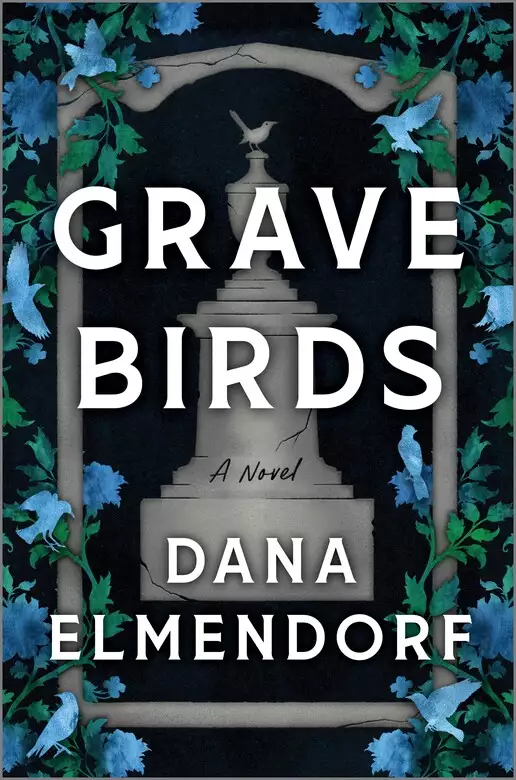
A ghost bird, I had first thought when I saw it. Until I looked around and found there were many, many more in the cemetery.
It was a grave bird.
I swallowed hard and pretended I didn’t know what Mr. Gentry was talking about. “No, sir. I don’t see nothing,” I said as I continued to stare at the phantom.
He gave me a scrutinizing look. He saw the lie in my eyes. But he let it go, for the now anyways.
I was only eleven; I didn’t want to admit I was different. But I knew I was whether I liked it or not and would always be.
I had never so much as uttered a hello to Mr. Gentry until five days before. He’s the one who pulled me from the freezing river and brought me back to life. Not by means of magic or a miracle, but with science: medical resuscitation for thirty-two minutes.
But a miracle happened all the same.
The adults stood around my grandaddy’s grave, murmuring their condolences to my granny and my momma. It was that awkward moment after a funeral is finished where everyone seemed lost about what to do next, but we all knew we were going back to Granny’s house to a slew of casseroles and desserts that would barely get eaten. Two of my distant cousins, bored from the bother of my grandfather dying, kicked around a fallen pine cone over an even more distant relative’s nearby grave. Mrs. Yancey, our neighbor up the road, had just taken my twin brothers home since they were squalling something terrible, confused as to why we would trap Grandaddy in the ground. I watched as Mr. Gentry talked closely to Mrs. Belmont’s son, who was visiting from New York City, but his flirting, normally an immersed habit, was on autopilot as he watched me watching the grave bird. Could Mr. Gentry see it, too?
Mr. Gentry was a Southern gentleman, who put a great deal of care into perfecting the standard. His suits were custom-made from a tailor in Charleston, who drove up just to measure him, then hand-delivered the pieces when they were finished. It didn’t matter your standing in society, Mr. Gentry treated the most common among us as his equal.
He lived a lush lifestyle, filled with grand parties attended by foreign dignitaries, congressmen and anyone powerful he could gain favor with. Several times a year he traveled across Europe, something his job as a foreign consultant required of him. His friends, just as colorful as him, lived life to the fullest
A dedicated husband once, until his wife found interest in someone half her age. His two grown daughters, who didn’t respect his choice in who to love, eventually wanted nothing to do with him. I think it left a big hole in his heart and what drew him to help our family out.
In the weeks after the funeral, Mr. Gentry began to fill the empty space in our lives where Grandaddy once stood. It started with an offer to cover the funeral costs, a gesture my granny refused at first, but it was money we didn’t have and desperately needed. Then it was the crooked porch he insisted on fixing. Rolled up his starched white sleeves and did it himself, like hard labor was something he was used to doing. The henhouse fence got mended next. A tire on the tractor that hadn’t run in a year was replaced. Then our bellies grew accustomed to feeling full on fine meals he swore were simply leftovers from his latest dinner party. They were going to be tossed, and we were doing him a favor by taking them off his hands. Beef Wellington, with its buttery crust and tender meat center, so savory I’d melt in my chair from the sheer bliss of a single bite. It felt sacrilegious to eat lobster bisque from Granny’s cracked crockery, but that didn’t stop me from slurping up every last creamy bite. And nothing yanked me out of the bed faster than the sweet buttermilk and vanilla scent of beignets. If a stomach could smile, I’m sure mine did. And often, whenever Mr. Gentry needed his fridge clear.
There’s a bond that comes with somebody saving your life. Our friendship became something built on the purest of love. Where he had stepped into my life and filled the important role my grandaddy had once represented, I helped him heal the ache from being denied the chance to be a loving father.
A few months after my grandfather was put in the ground, Uncle Royce—who he eventually became—took me back out to the church’s cemetery. He sat me down on the graveyard bench, a place you go when you want to sit a spell with the dead. The mound of dirt from my grandfather’s grave had rounded from the heavy rain, slowly melting back into the earth.
He told me what I already knew, that I would be different now after the accident. He knew because the same thing had happened to him.
“You and I share something special,” Uncle Royce started his story. We were two people who had been clinically dead then brought back to life. Lazarus syndrome he said they called it. Only months ago for me. Near forty years
for him.
He had died for twelve minutes. Knocked plum out of his shoes when a car hit him at twenty-two years old. He says he stood over himself, barefoot, watching them work on his body. He thought he was going to ascend into the bright light but instead was sucked back into his body and woke up a few days later in the hospital.
A chill shivered up my spine: it was almost exactly what I had experienced.
I had felt myself float up and away from the river; I was no longer cold and wet. Sad or scared. An aura of peace enveloped me—or rather became me.
It had seemed like I hovered there forever in that state of infinite understanding. A warmth emanated from above, a light formed from all that came before me.
From the bright light my grandfather’s voice reached out. His gentle words, simply known and not heard, urged me to go back. It wasn’t my time yet. My place was still at home.
In a swooping rush, I was vacuumed back inside myself. I spat up a gush of water. My lungs burned. My body was freezing cold again. And Mr. Gentry was smiling down on me saying, “That a girl. Get it all out.” Far off down the road an ambulance cried that it was coming.
“You know what I think they are?” Uncle Royce said now, pointing to all the birds who were trapped, defeated, most of the color leached from their feathers. I didn’t say anything, still not wanting to confirm that he was right, that I could see them. I just listened. “I think they’re a kind of representation—a manifestation—of the dead’s unresolved issues.” I didn’t know what he meant by that, but it sounded heavy and important, and that felt about right.
I could see it, in a way. Grandaddy had been mad at me before we went off the bridge. I’d stolen a gold-colored haircomb, complete with rhinestones across its curved top, as pretty as a peacock’s feathers, from Roy’s Drugstore. When Grandaddy found out, he had yanked me up by the arm, angry that the preacher’s granddaughter would shame her family in such a manner.
He was scolding me on the truck ride home when I started crying about not having pretty things like the other girls at school.
He paused his lecture for a minute, and I could tell this bothered him; I could see the way it saddened his eyes. He was the preacher at a poor
country church where shoes were often scuffed, clothes mended instead of replaced, and a good meal was something scarce. Family and Jesus were what was important. I found I felt small next to all the wealthy girls who attended the big, fancy church with their new shoes, their starched dresses, the silk ribbons in their hair. It made my poverty stand out, and I didn’t like it.
Then Grandaddy said envy was one of the seven deadly sins, and I was setting myself up for a lifetime of grief by wanting others to love me for what I had instead of who I was. Shame welled over me, whether he intended it to or not.
I was crying something fierce, but I knew he was right. But hard lessons aren’t easy to accept. Instead of apologizing or even letting him know I understood, I told him I hated him. Screamed it as loud as my young lungs could. Couldn’t say who it shocked more, him or me. I wished those words back into my mouth as soon as they were out.
But it was too late.
A construction truck crossed the road on our right, not waiting long enough for other cars or paying enough attention. It smashed into the side of our truck and pushed us over the railing and off the bridge, down into the Greenie River.
“You should tell him you forgive him,” Uncle Royce said, pointing to the mound of earth under which my grandaddy now lay.
“Forgive him?” Clearly, he didn’t understand. I was the one who’d stolen something, who’d made my own grandaddy so ashamed, so disappointed. I was the one who’d spewed words of hate in our last moments together.
I had survived, and my grandaddy was dead.
If I hadn’t have stolen that comb, he never would have come to town to fetch me.
He never would have died.
“He doesn’t want you to think it’s your fault. He feels bad he scolded you so severely over stealing that haircomb.”
I turned my head slowly toward Uncle Royce. He couldn’t have known about the comb: no one did.
“How do you know about that?” I said on whispered breath, almost too faint to hear.
He looked me straight in the eye. “Because his grave bird showed me.”
Bad omens fall in seventeens, according to Granny. Today is the seventeenth of May. It has rained nonstop for seventeen days, and this year marks the return of the seventeen-year cicadas. I didn’t know hell was coming to Hawthorne, South Carolina. But sure enough, I’m sitting in the salon when the devil strolls down the middle of Main Street.
“Sweet Jesus,” Miss Delilah mumbles as she quirks her tinfoiled head to peer out the salon’s window. “Who is that tall drink of water?” Her old voice crispy, like tissue paper.
I feel the heat of him, even before I lay eyes on him.
As I turn my head and look out the window, the sun parts the rain clouds and shines its light on the man, an omen if I’ve ever seen one. Dressed in a sapphire-blue suit with a matching vest, he looks timeless and vintage all at once. His tie, dove-gray silk, hints to a vulgar wealth. A boutonniere made of game-bird feathers adorns his lapel. His face, as if carved from marble, is smooth and lean with a contoured jawline. It contrasts with his soft wavy hair. His long, assured strides eat up the ground, like a man with a purpose. He could have been born and bred from Hawthorne royalty with how he is dressed. None of us know him—though, we’ll soon find out just who and what he is.
“Damn, I’m going to need a good whiskey to quench this thirst,” Calista Franco, the salon’s owner, says after getting a good look for herself. She guides Miss Delilah back to her chair, neither one of them taking their eyes off the man.
As he walks farther down the street, all the white dogwood blooms start to weep bloodred drops onto the sidewalk as he passes. The inky color diffuses onto the rain-soaked concrete into fat blurs, disappearing as quickly as it appears.
But it isn’t the blood that scares me.
It’s the grave bird perched on the man’s shoulder. A fat little robin with a rusty-orange throat and a grayish-brown body, and it looks right at me.
“Oh shit,” Calista says and jumps back from the window.
I startle, too, wondering if she saw the bird as well.
“He’s coming this way,” she says. Then she pats her rock star–teased hair and checks herself in the mirror before returning to me and the haircut she is supposed to be giving.
I look like a drowned rat with my hair sopping wet. Brown strands stick to my cheeks as the water runs down the smock and pools in my lap.
Nadine, even though she’s freshly married, peers over the top of her Southern Living magazine, getting an eyeful. “False alarm.” She slaps her magazine shut. “He’s going into Boucher’s next door.” A premier real estate agency that specializes in grand estates.
There’s a collective sigh of disappointment. Then the ladies break into a chatter of who he could be, where he’s from, what he’s doing here. Hope for him to be single lingers in the air. Calista’s blow-dryer drowns out their voices as she styles my hair.
But my mind is still focused on the bird, filled with worry for what it means. It’s been a few years since I’ve seen one: they’re easily avoidable if you don’t go to cemeteries. And I’ve rarely seen one outside a graveyard. And never attached to a live person.
“Hollis.” Calista squeezes my shoulders, pulling me out of my daze. “What do you think?” She fluffs up my new shag cut as she eyes her work. Huge improvement. My long straight hair has served me well through college, but Calista declared a change was long overdue. “You look like you belong in the Pentecostal Church,” she’d said an hour ago with a hand on her hip, determination in her eyes, and scissors at the ready.
As one of my two best friends, she says she’s allowed to insult me, as long as it’s for my own good, and it would seem my own good requires a hefty dose from time to time.
Looking in the mirror, I turn my head to soak in
the new cut from all angles: I don’t look like myself anymore. I like it. Nor am I used to these bangs, but I love them.
“Leave it.” Calista swats my hand away when I go to play with my hair. “You want to look good for your appointment with the bank, don’t you?” I nod. “Then, don’t fuck up my masterpiece.” Her lips curl into a crooked smile, like one side got snagged on a fishing hook. It matches her style. Her curled, short-in-the-front, long-in-the-back hair. T-shirts always black, featuring some obscure band. Jeans are edgy and something she finds at thrift stores. She looks like old-school punk merged with British fashion.
Women drive all the way from Charleston and Savannah and pay ridiculous amounts of money to get a haircut by the Calista Franco from New York. (Her dad’s a restaurant owner from Upstate New York who’s rumored to cater to Mafia clientele.) Lucky for me, I can still get the friends and family discount because I live on the edge of broke and starving.
As Calista pulls free the cape draped over me, chunks of my brown hair fall to the floor. I stand, shaking out my new do, marveling at the magic Calista can manage with a pair of scissors. Maybe now I’ll look closer to my age, or older if I’m lucky. Most banks aren’t known for giving loans out to twenty-six-year-olds with sketchy credit history and inconsistent sources of income, even if they are trying to start their own company.
“Nadine?” Calista says. The way she stresses Nadine’s name—from the tone alone—I know what she’s getting at.
“What’s wrong with my outfit?” I picked out a sensible white blouse and black skirt for this meeting.
Nadine Honeycutt, best friend number two, could have been Donna Summer’s granddaughter. Just like the infamous disco queen, her fashion style is luxurious and dazzling, never mundane. Her father is one of the wealthiest Black men in the state, owning several of the most prominent funeral homes throughout the Carolinas. But that’s not the first takeaway from meeting him or her. Nadine is a sweet, gentle soul, with a heart full of kindness. She spends most of her time volunteering at the local Veterans Association, seeing as how her father served in the Gulf War: she knows what those men suffered through.
Nadine turns in the chair she’s been sitting in next to me, flicking through a magazine, her mind temporarily occupied by the latest celebrity
gossip. She takes one look at my outfit and pinches the bridge of her nose. “Are you trying to get a job as the school’s lunch lady? Because you’re hired.”
“Do they still have lunch ladies at schools?” I ask and am thoroughly ignored.
“Give me those.” Nadine points to Calista’s black pumps, which she dutifully kicks off—thankfully we wear the same size. Calista reluctantly accepts my dull tan flats in exchange. Nadine hikes my black skirt up high on my waist, shortening the length to above my knees. She pops the collar of my white blouse then untucks it, tying a knot in the front. She then orders me to swap earrings—my dinky silver hoops for her gold diamond studs. And finally, she ties the designer handkerchief from her purse (Hermès, I’m sure) around my wrist like a colorful cuff.
“Better,” she declares, stepping back to assess her work.
I look back to the mirror. It isn’t so much that I looked like a slump before, but Nadine has kicked me up a notch, that’s for sure.
“Wait.” Nadine steps back in and loosely cuffs my short sleeves so they hood over my shoulders. “Done.”
“Classic eighties chic. Nice.” Calista knuckle-bumps Nadine. “Now, go get that loan.”
I glance at the clock on the wall: twenty minutes until my appointment. Plenty of time to arrive early and take a few minutes to look over my paperwork in the lobby.
“Right. Here I go!” I say as I back out of there with their good lucks and goodbyes.
As I turn around, I smack into someone and immediately flail backward, losing my step. An arm swiftly wraps around my waist to catch me.
Trying to right myself, my hands instinctually grab ahold of the lapels of his blue suit directly in front of me. I glance up and into a pair of dark, malevolent eyes. There’s a pause where I seem to be caught in midair, fully absorbed in the man’s gaze, the din of the salon having faded away.
“Oh” is all I manage to say before the grave bird on his shoulder tweets.
We both yank our attention to the tiny bird. I watch as it hops off the man’s shoulder and onto mine.
And then—my body is pulled backward out of the present, like I’m falling somewhere into the past.
A day. A decade. A century.
The heady smell of rich earth grounds me as I run through the lush green palms. The sweet taste of banana lingers on my tongue. Bright sunlight flickers through the tree canopy high above, reminding me of the punctured tin lantern that fractures candlelight against my bedroom walls as it spins.
Playful foreign words from the woman chasing me enliven my steps. Joy fills my belly with giddy bursts of laughter, and I run faster. Large fern fronds tickle my legs as I rush through them.
Until I fall off the edge of nothing and into the burning smoke.
I land on a pile of giant silkworm cocoons, larger than my little body. They wiggle and writhe underneath. I, too, am a mummy, wrapped in white muslin sheets, squirming to get free. Their chrysalides split open, and out pops a bird from each one. Hundreds of them. Of every color and kind.
Their tiny wings flap with might, and yet the ground will not set them free. They push me up, lift me higher than the flames, giving me my own wings. Chirping I must go. To hurry, hurry and fly away home.
Eventually I do.
Let the earth rattle from the devil’s arrival. And the skies darken when death rains its wings upon them. When the flames descend from the sky, they shall know their end is near. Their seed will be laid bare for they are not worthy of their name. The heavens will disappear with a roar. Into the lake of fire the guilty will be cast.
Vengeance will be mine.
“Hey, dickhead!” I hear Calista yell. “Excuse me is the polite thing to say,” she hollers after the man as he hurries off down the sidewalk—the bird no longer on his shoulder and now no longer in sight.
Nadine rushes out. “Are you okay, Hollis?” she asks, helping me pick up my papers off the ground.
“Oh dear,” Miss Delilah says, as she watches from the doorway. Over me falling or Calista’s colorful language, I’m not sure.
My head whirs from the moment in time the grave bird wanted me to see. So visceral I felt as if I was there. Breathing the smoky air. Hearing the sounds. Feeling the fear. A walk through the dead’s past. When and where I have no idea.
But it wasn’t all the past, was it? It seemed as if something dark stepped in, there at the end, with a warning. Almost biblical in nature. How is that possible?
“You sure you’re okay?” Calista asks, pulling me to my feet, tugging me from my spiraling thoughts. “You look a little peaked.”
I only realize now that I’d fallen over, that he must have let go of me. I feel swimmy, like I’ve been on a boat all day, and now that I’m back on land I have sea legs. How did that man pick up someone’s grave bird? He had to have seen it, too. He must have.
I shake my head, shrugging off the million questions I have—about the man, about the bird, about the vision.
About the devil coming to Hawthorne.
I look the direction where he disappeared.
I knead a cold ache cramping my right shoulder. “Yeah. Just dazed is all.” I take from her the last of my paperwork. Miss Delilah asks if I take meds for low blood sugar. “No, ma’am. I’m not diabetic.” Then I catch a glimpse of the time on my cell phone. “Shit, I’m going to be late.”
First South Bank has sat in the same spot since it was built in the seventies, a stone’s throw from the courthouse. Hints of its dated past sneak through, showing its age. The brass chandelier’s patina has dulled to a brownish green, its glass globe ribboned with a harvest-gold band of flowers. Original knotty-pine wood paneling bleeds through the cream paint slapped on after the last makeover two decades ago. Even a scalloped magnolia wallpaper border running along the top of the wall screams of an era long since passed.
Three years I’ve worked to build my event planning business. It started with helping the local schools with their fundraisers, then it grew to include children’s birthday parties and baby showers. Until I’ve finally impressed the upper echelon of Hawthorne enough, they’re seeking me out to plan their anniversaries and holiday parties and even their weddings. This loan is what will take me to the next level.
Through the office windows I watch as my loan officer, Lizzy Biggins, talks with the bank manager about my file. This is the third time this month I’ve had to come in to sign the loan documents, as one small issue after another has held up everything being finalized. I’m starting to think we have another Grady Owens situation on our hands.
Grady was a cantankerous old man. He lived at the end of Hennessey Lane where the road disappeared into a dirt path. About another hundred yards or so later and you’d find Grady’s place. A rickety shack that stood on stilts high above an old marsh that had long since dried up when they put in the levee so they could build the new subdivision.
Grady didn’t like children. Or the government. Or people in general. But there was one thing he did love: his land. Selling it was not an option.
Some say Grady got his money during moonshine days. ...
We hope you are enjoying the book so far. To continue reading...
Copyright © 2026 All Rights Reserved

 Please log in to recommend or discuss...
