"A raw and compelling exploration of grief and rebuilding, Gracie Harris left me full of hope and with a renewed faith in second chances."—Annabel Monaghan, nationally bestselling author of Summer Romance
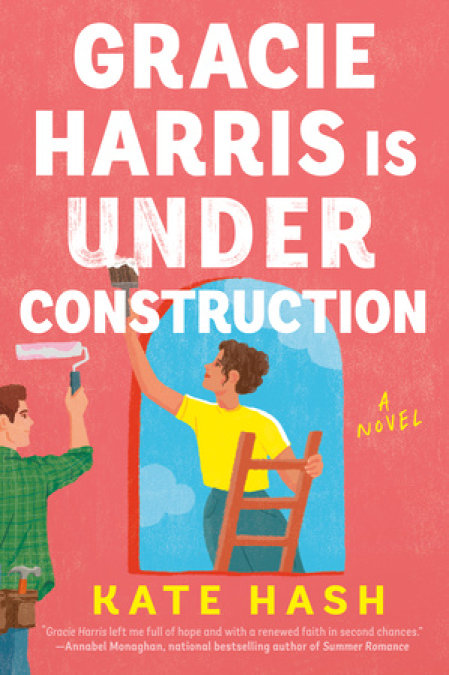
In this resplendent debut novel, a beautiful love story unfolds for tenderhearted Gracie Harris—a mom of two and recent widow—as she navigates the unexpected curveballs that adulthood throws and takes her second chance to find love.
Gracie Harris never intended to become the queen of grief. But when an essay she writes the night of her husband Ben’s memorial goes viral, she lands a popular column on love and loss and an impressive book deal.
Now, the biggest tragedy of her life is the center of her world. With a looming book deadline and her kids at summer camp, Gracie escapes for a summer of solitude to the ramshackle mountain house she and Ben bought for their family before his death. When charming contractor Josh arrives on her doorstep to help renovate the home, Gracie discovers an unexpected connection that is energizing . . . and surprisingly flirtatious.
As her feelings and resilience grow, Gracie must decide whether she’s ready to embrace a new version of her life. Gracie’s first Happily Ever After didn’t last as long as she’d expected. Now she has to wonder: Could Josh be her chance for a second great love story?
Release date:
July 29, 2025
Publisher:
Dutton
Print pages:
368
* BingeBooks earns revenue from qualifying purchases as an Amazon Associate as well as from other retail partners.
In fact, until a minute ago, when Maisy Miller referred to me as such, it never dawned on me that I could be the queen of anything. Yes, women sometimes stop me on the street and call me an inspiration. They usually ask if we can be friends, tell me they follow me on social media, or say that they have read everything I've ever written. And, yes, sometimes they cry as they spill their own sad stories. But I'm not anyone's guru or spiritual guide, and I'm sure as hell not anyone's queen.
Now, however, is not the time to work through my ongoing identity crisis-not with Maisy Miller, the biggest name in daytime television, and her studio audience staring at me. Maisy's perfectly curled, long red hair and deep-green eyes are captivating as she waits for me to speak, but I need to stay focused.
"I love that people relate to my writing so much," I say, grabbing a little tighter onto the edge of the velvet armchair on stage, "but I hope they also see in my words that I'm still trying to figure out how to navigate life after loss just like they are. I'm no different."
The audience lets out a collective murmur of appreciation. Maisy purses her lips, nods, and gives that rehearsed look of understanding that her on-screen personality has mastered.
"That's the humble Gracie Harris your readers have come to love over the last year," she says, reaching across the table between us and placing her perfectly manicured hand on mine. "A year ago, you wrote an essay that went absolutely viral. I'm wondering if you might tell us a bit about the night you wrote it and what you were feeling."
On the night of Ben's memorial service, I was unbearably lonely. The kids were finally asleep, and the house was quiet. I had spent the day receiving more affection than I could possibly absorb. A few times, as someone new leaned in for a hug, I thought I heard Ben's ghost laughing from the front pew, watching me embrace the hundreds of people who had shown up to support me and remember him.
There had been awkward huggers, sincere huggers, people who held on for far too long, and those blessed few who provided the momentary relief of a graceful side hug. It was obvious who, like Ben, thrived on physical touch. Everyone assumed I did, too, or that I would appreciate some extra love that day. My true and old friends knew to grab my hand for a quick squeeze or to put a gentle palm on my back.
The essay that changed my life took shape that night through eyes too tired to cry and a mind too overstimulated to think twice about the words that filled the screen. It took me just forty-five minutes to write the one thousand words that would change everything.
When I woke up the next day, the laptop was by my side. I popped it open and read the essay once. Then twice. Everything I felt in the aftermath of Ben's death and the overwhelm of the days that followed was captured in those words. Without a second thought, I pulled up the submission form for Modern Love.
This is a story I've told a million times to friends but never in public. I'm grateful for all of the prep work that my publicist, Lucia, and I did to prepare for this moment because, of course, I still don't feel brave enough to share all this with the world. It's still too raw, even a year later. I need to separate my public persona from my private one to get through the days, let alone the rest of the segment. Instead of the whole truth, I give Maisy and the audience an abbreviated story full of platitudes before succinctly wrapping things up.
"I copied and pasted my essay into that form and hit Submit," I say, with a nervous smile. "And then everything changed."
Again, the audience takes a big joint sigh, and for a moment my anxiety drifts a bit from the surface. Writing essays for people from afar has an air of anonymity, even after all this time. Talking to this live audience is an entirely different thing-but I can do this.
"Gracie, I love the way you talk so openly about grief and loss. Your willingness to share your journey has inspired and comforted so many people. One thing I've never heard you share is the story of the day you lost your husband. Would you be willing to open up to us about this?"
We knew this line of questioning was inevitable. I take a deep breath to maintain my composure and will my brain to remember the answer Lucia and I practiced over the phone just last night.
"Up until the moment it became the worst day of my life, it had been a completely normal day," I tell her, staring into her eyes, fighting every instinct to run right off this stage. "I took the kids to school, went to work, had lunch with a friend, and then went out to a business dinner. The most normal day, albeit a little busier than usual.
"That's the thing about losses like mine," I say, before turning to the audience and gesturing toward them, "and like so many of those that y'all have faced. Sometimes we get to plan for a loss or at least a long goodbye, but sometimes they are sudden-so painfully sudden-that it feels like from that moment on there is only the before and the after. That day felt like the end of one life and not just Ben's. I've had to completely reimagine what my life was supposed to look like. I'm honestly still working through that, as my readers are well aware."
Maisy smiles and puts her hand to her heart as the audience claps in approval. I've given them an answer without giving them anything of value. Not a single material detail about Ben's death. As rehearsed, as practiced.
"You and Ben have two children, is that right?" Maisy asks.
"That's right-I have a son and a daughter," I answer nervously. We kindly requested that my kids be kept off the discussion list, but an acknowledged request isn't the same as a promise.
That's when Maisy unleashes. Her questions come fast and hard. What are you doing to support them? What have you gotten wrong along the way?
I stammer through the answers as best as I can, but quickly my right leg starts to vibrate. At first, it's a manageable rattle, but soon it transforms into the telltale rapid shake. I discreetly spread out my long dress, hoping to hide the tic that has plagued me for months.
It also quickly becomes the least of my worries because Maisy doesn't relent. Are the kids in therapy? Are you in therapy? What's been the hardest thing for them about losing their dad? What are your greatest fears about raising them without Ben?
Maisy's questions about the kids strip away my ability to perform a safe version of grief. She has adeptly wrested control from my carefully prepared hands. And once she has it, I lose myself completely.
The edges of my vision begin to blur as I talk about my kids' mental health. Breathe, I think. You have to breathe. I struggle to fill my lungs as I talk about holiday concerts and family dinners always being one person short. Before I can answer the last question, however, I feel the room start to spin and voices drift away.
"Maisy," I say in a low, desperate voice. "I need a minute."
Over the last year, grief has taught me that it's rarely the obvious things that send you over the edge. It's not the anniversaries or the birthdays or even the missed soccer games. Today, on this stage, it's divulging how the single empty chair at the dining table breaks my heart in two every night. Sharing this delicate detail with a room of strangers was all it took to send my stress, nerves, and sadness over the edge.
The other truth about grief-deep, visceral, unrelenting grief-is that it puts observers into their own state of shock. Maisy is staring at me with a lethal cocktail of horror, pity, and fascination.
I put my head in my hands, close my eyes, and simply try to breathe. In through the nose, out through the mouth. Maisy tries to speak and I put my hand up and gently shake my head. Minutes feel like an eternity. Quiet whispers passed between audience members become white noise.
Finally, I sit up and open my eyes. I've regained my composure, but if the goal was to keep my dignity, I'm fairly certain that's off the table. Nobody stops a Maisy interview with the cameras rolling.
"I'm sorry. I'm not used to talking about these things," I say, rubbing my clammy palms into one another. "Maybe that's why I'm a writer."
A soft, nervous laughter travels around the studio. Maisy squints, recognizing she's only got one question left to ask. The audience might turn on her if she attempts to go for round two. I also sense a hint of disappointment that I didn't actually keel over, although this is still certain to be a thing when the episode airs.
"Do you ever regret going down this path . . . sharing so much with the world?" she asks.
"Regret is a strong word, but I do sometimes wonder if I've taken on more than I can handle," I say. "I guess only time will tell."
"Well, we wish you the best of luck," she says, before turning to look directly into the camera. "Don't forget-in addition to reading Gracie's essays twice a month, you can now preorder her memoir!"
I force a smile, just in time for Maisy to turn to me one last time and add with a smirk, "Maybe this will make the book?"
I quickly remove my mic and rush backstage to safety.
#
“That was a complete disaster,” I say to Jenny once the door to the greenroom closes behind me. The wide eyes of every production assistant that I passed on the thirty-second walk between the stage and my best friend’s arms told me all I need to know. Total. Disaster.
"You stayed strong," Jenny whispers in my ear. "Even when it looked like things were going bad, you stayed tough."
I don't feel strong. In fact, I feel quite literally on the verge of collapse. The weight of my head on her shoulder makes that clear. Why did I agree to fly to Nashville on short notice? And why did I assume Maisy would be nice to me? I should've known better.
Jenny guides me to the leather armchairs a few feet away, loudly dragging one to fully face the other. My hands instinctively find hers as we both sit, our foreheads pressed to one another.
"What happened out there, Gracie? It was going so great-really, it was-and then suddenly . . . it wasn't."
"Everyone just assumed I'd be a natural at this part. I'm good with words on paper, not this," I say angrily, not answering her question. Instead, I pose one of my own. "Why couldn't she just stick to the script?"
"Those were very personal questions-borderline inappropriate, to be sure-but I've never, ever seen that happen to you in the thirty years we've known each other. What happened?"
Her emphasis on those last couple of words lets me know she is not going to let this go. Jenny's concern is clear from the wobble of her voice and the way her hand is now softly stroking my arm.
"Anxiety attack? Pure panic? Good old-fashioned exhaustion?" I answer, trying to be funny but failing to conjure any humor. It all comes out flat. "Or maybe it's just that I'm a mess and trying so damn hard to pretend that I'm not."
"I need you to be very honest with me," Jenny begins, tilting her head to make eye contact with me. "Has this happened before? Is this something we need to worry about?"
This isn't the first time I've had an unexpected meltdown-just the first time so many other people have witnessed it. Usually, I can muster the strength to wait until I'm home, or in my office, or safely tucked in a bathroom stall. Not today. Maisy is probably proud of herself for cracking me in such a public way.
Still . . . almost blacking out? This part is new.
"No, it's not normal," I finally tell her. "Usually, the worst of it is whatever the stress tic of the month is, which goes on for an hour or two, and then I move on. This was not normal. Not at all."
The air between us sits still for a moment. We've supported one another through the best and worst life has to offer. She stood beside me when I said "I do" to Ben and again, nearly twenty years later, in that same church to mourn him. The ways that she has met me in the dark corners of life over the last year feel as impossible as they do miraculous.
"We need to revisit last night's conversation," she says, breaking the silence. I feel her hand squeeze mine tighter than ever. "You need to go."
"Can we please not do this now?"
"We absolutely are going to do this now-this is exactly the right time. You almost blacked out on television. This is not you, Gracie. Something needs to change, and there is an easy option staring you right in the face."
"You really think a change of scenery is the answer? You think it's that simple?" I ask. "What if I get there and it's all the same problems just mixed with a bunch of new ones? That doesn't seem like an Easy Button. It seems like a recipe for more disaster."
"When will you ever have this chance again? A break from work. Kids safe. Long hours to write and figure yourself the hell out?"
"And I can't do that at home?"
"No, I don't think you can. What you've been doing hasn't worked-it's time to try something new. Your body and mind are begging you for a change."
We hope you are enjoying the book so far. To continue reading...

 Please log in to recommend or discuss...
