
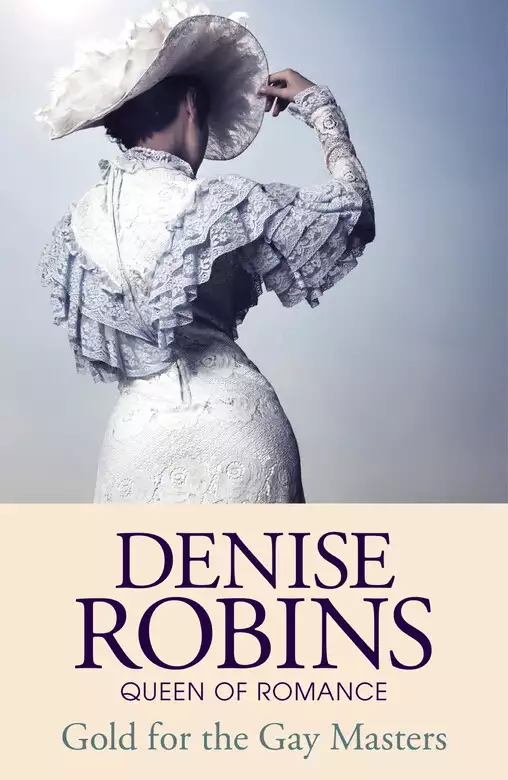
Gold for the Gay Masters
- eBook
- Paperback
- Hardcover
- Book info
- Sample
- Media
- Author updates
- Lists
Synopsis
A captivating love story from the 100-million-copy bestselling Queen of Romance, first published in 1954, and available now for the first time in eBook. Which tastes sweeter - yearned-for love, or revenge that has waited a lifetime? Sold into slavery as a young girl, the exquisitely beautiful Fauna is eventually rescued by noted dandy, Lord Pumphret. Sure her life is set to improve, Fauna is smuggled from Africa to Georgian England - only to become the plaything and victim of those who make up Pumphret's circle... That is, until she meets noble Frenchman, the Marquis de Charteller. As Madame la Marquise, Fauna dazzles the society of Regency London, but nothing eases the searing pain in her heart - nothing but revenge for the terrible way she was once used and vengeance on the only man she has ever loved...
Release date: December 12, 2013
Publisher: Hodder & Stoughton
Print pages: 288
* BingeBooks earns revenue from qualifying purchases as an Amazon Associate as well as from other retail partners.
Reader buzz
 Please log in to recommend or discuss...
Author updates
Gold for the Gay Masters
Denise Robins
From midday until now, eight o’clock at night, Captain Humbleby had consumed vast quantities of liquor. In the mucky, foetid atmosphere of The Three Spaniards on the quayside, he had tried to shut out the devils that danced in his imagination; the horrid thought that seventy-five, per cent of his appalling human cargo had died before The Nauticas ever reached the West Indies.
The sweet, heavy wine that Captain Humbleby had poured down his throat had for the first hour or two made him a cheerful and rollicking figure whom none would recognize as the tough gentleman who terrorized his crew and kept law and order with the whip lash or a pair of cocked pistols. A man who walked perpetually with the stench of death in his nostrils and in his ears the unholy music composed of the groans and screams of the tortured slaves. A merry gentleman for a time this Samuel Humbleby with his rollicking laugh, a wench under each arm, and a huge appetite which a half-Spanish, half-native landlord had willingly satisfied. These seafaring men who put in at the West Indies had money to burn and it burned merrily and with many an obscene jest inside the four walls of The Three Spaniards this day.
But by nightfall Captain Humbleby was not so merry. He had thrust the half-naked wenches from him and lapsed into sullen silence. He had one blind eye. The good one, fierce and yellow with jaundice, glared so malevolently at those who endeavoured to rouse him from his stupor that he had been left severely alone.
The trouble was that Humbleby had a conscience. Only a small one but there were moments when it jabbed at him and reminded him that there was a Life Hereafter and an Almighty to be reckoned with. Someone who might not approve of Captain Samuel Humbleby’s methods of moneymaking. Fortunately for him that conscience only awoke when he was very drunk indeed. The owner of The Nauticas and of several other trading vessels was a millionaire. For fifteen years Captain Humbleby had sailed ships for that very exclusive company. During those years over one hundred thousand Negroes had been exported from Africa and brought in The Nauticas alone to the West Indies.
As a younger man, Humbleby had disliked the methods of procuring these slaves, although with the years he had toughened and paid small heed to the cruelty and suffering. The pay was excellent. Mr. Rufus Panjaw, ship owner of Bristol, was to be relied upon. Captain Humbleby had had no need to complain of his treatment while he was with the firm.
But things were not like they were, and just now Captain Humbleby regarded his profession somewhat uneasily. Back in England, six years ago in fact, ever since Mr. Wilberforce introduced the Bill to put an end to the importation of slaves, there had been a growing feeling against slave trading in the country. There was Mr. Fox with his precious party of Whigs, labouring for the Bill even now. Captain Humbleby did not like it. He did not like it at all. And most of all he disliked the conditions under which he had been forced to sail when he brought this last load to Jamaica from the African coast.
He could ease his conscience by the fact that he had told Mr. Panjaw that the ‘damned black creatures’ had no stamina and they could not stand the hellish heat in the holds. The long weeks of the sweltering confinement. The sickness and the misery. And Panjaw’s orders were ‘Carry on’. What could Samuel Humbleby do but obey his employer?
Nevertheless the animal noises issuing from the bowels of The Nauticas had begun to unnerve Captain Humbleby and this time, horrid fact—seventy-five per cent of the wretches had died.
Captain Humbleby staggered along the quayside. His straight greasy locks hung, like a Mexican’s, in strands to his neck. He was indescribably dirty, his uniform stained with spilt drink and food. He held his tricorn hat under his arm, and he swore and growled under his breath as he made his way back to his ship on this hot humid night.
Through the vapours, the stars looked down upon Captain Humbleby like large reproachful eyes and he avoided looking back at them. He was suffering from lumbago. And he had had a tussle with one of those yellow-skinned saucy wenches which had caused a lot of laughter in the tavern, but increased Captain Humbleby’s physical discomforts. To the devil with women! He would give up wenching. He would give up the sea and slave trading. He would return to Bristol and live quietly with Emily, his wife. A good woman Emily. Albeit she had a sharp tongue and was scarce the kind a man craved to tumble in his bed.
Captain Humbleby endeavoured to raise his drooping spirits by singing:
‘God Save Our Gracious King. …’
Alas, poor King George III—tainted with madness. A terrible thing, madness, reflected Captain Humbleby. He had visited one of the houses where they confined the dismal wretches and heard their screaming and squawking.
Fearfully, his good eye made out a blurred outline of ships. He listened a moment to the yelling of a group of half-naked seamen hanging around a pile of timber waiting to be shipped to England. Maybe he would go mad, he reflected, if he continued with this poisonous trading of black men and this drinking.
He sniffed and spat. A nauseous odour drifted from the docks. A beautiful, poisonous place, Jamaica. He hated it. The sea was a dark purple. The coco palms were pencilled black against the sky. The miasma in Captain Humbleby’s brain cleared a little and he fell to thinking of something strange—very strange—that had just happened on The Nauticas. A discovery made by one of the officers serving under him shortly before they sighted land this morning.
The First Mate was an Irishman and a Papist. Captain Humbleby was not partial to Papists, but Larry O’Sullivan was good at his job and loyal, and a man was in need of loyalty in these days of threatened mutiny.
Up to the Captain’s cabin had come O’Sullivan with his eyes popping out of his head, saying:
‘By all that’s holy, Captain, these two blue eyes have just witnessed that which Larry O’Sullivan never expected to see on this devil-ship or any other ship that sails the ocean waves.’
‘And what might that be, dammit?’ Captain Humbleby had asked.
O’Sullivan had taken him along to his cabin. There crouching on the bunk was a sight which the Master of The Nauticas had found astonishing, albeit he had long since thought himself incapable of being surprised.
There in the stuffy cabin on dirty blankets sat a child. A girl of ten or eleven years old maybe, very small and thin, and wearing a yard or two of blue cotton material swathed like a cummerbund about her. It revealed a good deal of her slender immaturity; her long fine legs and arms, her naked shoulders. But what staggered Captain Humbleby was the face of this apparition. For although it was streaked with tears and dirty, with curls in a wild tangle and verminous, the face was of such fabulous beauty that even he who had no great appreciation of such things, could not fail to be impressed. Her eyes were enormous—native eyes black, with immensely long lashes and full of that melancholy that Captain Humbleby had seen a thousand times before in the faces of most of the female slaves from Africa. Eyes full of suffering and sorrow, mutely appealing against the indignities imposed upon ebony flesh by white traders who broke up their villages and pillaged their homes for the sake of gold. The kind of eyes that haunted Captain Humbleby when he was in a state of intoxication.
But at this moment when O’Sullivan took him to see this extraordinary and unexpected passenger, Captain Humbleby was quite sober. His one jaundiced eye stared, flabbergasted, at the little girl—flabbergasted because her skin was not black as one would have expected with such eyes but ivory pale. And the hair was fair. Those filthy tangled curls were a bright red-gold. Her wrists and ankles were as delicate and fine as those belonging to any lady whom Captain Humbleby had ever seen back home in England.
He uttered an oath:
‘Who the devil is she? Where did she come from?’ he demanded.
O’Sullivan—a huge man yellow-haired and bearded and a man of religion, despite the fact that he was one of a crew on a vessel bound on barbarous trade—crossed himself.
‘The Holy Mother knows I only came upon her by chance less than an hour ago.’
‘Explain 1’ roared Captain Humbleby.
Hurriedly O’Sullivan told his tale. Soon after sighting land, and when he had been making a round in the hold with one of the sentries who guarded the gang of slaves, he had come upon an old dying man. A fine-looking Negro of aristocratic mien, with iron-grey curls. O’Sullivan was not quite sure how so old a fellow came to be included among the hundreds of stronger and younger ones that they had taken on board at Freetown. Perhaps because he spoke English which they had thought might increase his value. And because he had with him what appeared to be his grandson—a boy with a flute-like voice whom the old man had begged to be allowed to bring with him.
‘Sell him along with me, Massa,’ he had appealed when he was first brought aboard. The tears had rolled down his cheeks. He seemed devoted to the little boy and anxious not to be parted from him.
O’Sullivan had taken notice. A small boy with a singing voice might fetch a high price and make a pretty slave for some fine lady. Here in the Colonies or in England, small black slave boys had recently become the rage. Ladies of wealth and fashion paid a high price for them.
‘I left the two chained together and thought nothing of it, Captain, sir,’ continued O’Sullivan.
Humbleby interrupted, bawling at him:
‘What has a black boy to do with this?’ pointing to the apparition on the bunk.
The girl crouched in the corner in an attitude of abject terror, showing the whites of her eyes which she rolled between the two fierce-looking men. She shook like a small jelly, and had a cold and forlorn air about her.
O’Sullivan hurried on with his tale. The Captain would remember how many slaves had taken ill and died and been chucked overboard. Well, the Negro grandfather himself fell sick forty-eight hours ago. Fever and starvation—the barbarous treatment handed out to the unhappy captives on this or any other slave ship sailing the high seas in the year 1797—had finished him. He had suffered appallingly at the hands of those directly attending to him, but something about O’Sullivan had won his confidence. Just before he died he had pushed the weeping little black ‘boy’ into O’Sullivan’s arms and bidden him take care of her.
The boy was a girl. The old man, fearing that she might come to harm because of her sex, had hidden the fact—keeping ‘him’ clothed as a male slave, and never allowing ‘him’ out of sight. But now the truth had to be told.
‘But hell take it, this child is white!’ roared the Captain.
O’Sullivan scratched his head.
‘’Tis true,’ he said. ‘The cunning old man stained the little girl’s skin with an unguent before we sailed.’
That was one of the troubles, he added. The child was a quadroon. And now the history which the old man had confided to the First Mate, unique and absorbing, was repeated to Captain Humbleby. The old Negro was headman of a good tribe and had been like a king in his own village. Thirty years back this village had been visited by a missionary. The missionary had had an Italian wife. After the sudden death from smallpox of her husband, this Italian woman decided to remain in Freetown. She became wife to the head tribesman. Of that marriage sprang a daughter—a beautiful half-caste—who in turn was married to a renegade Irishman who came from County Donegal (O’Sullivan’s own county). The Irishman had been of decent birth (but the dying Negro had been unable to remember his son-in-law’s name) he had dropped this name years back and ‘gone native’, and lived in the African village until ten years ago when his daughter had been born. In giving birth, the mother had died. Almost immediately after, the Irishman, who had always been a heavy drinker, drank himself to death.
This quadroon girl was the strange result of that unattractive union. Half Irish, quarter Italian, quarter African. A ‘throw-back’ to the father’s race, with those red-gold curls, to the grandmother’s maybe with that pale fine skin and those delicate limbs. Only her magnificent eyes and lashes were a legacy from her grandfather—a reminder of the dark blood that flowed in her veins.
‘God’s teeth!’ muttered Captain Humbleby and stared at the little quadroon. In all his twenty years on the sea he had never seen the like. It was just one of those things that did not happen. And he listened while his First Mate told how the old grandfather had turned up his toes and been thrown to the sharks with the rest of them, and how he, O’Sullivan, had put the child, screaming and protesting, into a bath and with water and soap exposed the little one for what she was—a girl child who might pass anywhere for a European.
‘If her eyes had been blue she would have been a true Irish beauty,’ O’Sullivan concluded and wiped his nose with the back of his hand: ‘Begorra, I have seen the spit of her in County Donegal, with hair of flame and a skin like milk, Captain Humbleby, sir.’
Such poetical allusions coming from the coarse lips of his First Mate reduced Captain Humbleby to bawdy laughter, but the laughter broke off abruptly. He advanced farther upon the shivering little figure swathed in the folds of blue cotton which were nothing more than rags.
At once she screamed and put up both her hands to cover her face. Well-formed little hands with slender fingers. Humbleby put out a hand to touch her and then drew it back. He sweated. Never before did he remember hesitating to touch female flesh. Wherefore now had he become squeamish? Maybe because this was such white flesh, and this girl was a child. Captain Humbleby had children of his own. All the same, the quadroon was a female, and her strange beauty held a definite menace on board a ship full of women-hungry men. Men with less conscience or humanity than O’Sullivan.
Humbleby scowled and drew back from the trembling captive. There was only one thing to do.
‘Blacken her face and put her back in boy’s garments,’ he said. ‘I do not care if you haven’t any. Sew her up in something and keep her in it until we get to Bristol. Confine that hair in a cap and sew that up too. Keep her here with you and see that she comes to no harm.’
O’Sullivan stared.
‘Holy Saints,’ he began to stutter.
‘Argue and I’ll break every bone in your body,’ roared the Captain.
‘Aye aye, sir,’ muttered O’Sullivan and pulled his beard and glowered out of the corners of his eyes at the little girl. She was sobbing under her breath. She looked pathetic enough, but O’Sullivan had had a taste of the spirit that lived in that thin fragile young body. Washing her in his locked cabin, away from prying eyes, he had treated her with a rough kindliness such as he would have meted out to one of his own children, for he, like the Captain, was a family man. But she had bitten his hand through so fiercely as to draw blood. He had had to smack her hard to stop her fighting. To be saddled with that for the rest of the long voyage back to England held small appeal for O’Sullivan. Nevertheless, he saw the sagacity of the Captain’s suggestion.
He did not mean to leave her here in Jamaica the Captain added, he could get a better price for her in Bristol. In fact, he would hand her personally over to Mr. Panjaw. She was the ship’s prize. The thing to do was to feed her up, fatten her, and teach her a few words of English. At this point Mr. O’Sullivan as proudly as though he were the adoptive parent of his discovery announced that the quadroon could already speak English. The old headman, her grandfather, had taught it to her, proud of the fact that she was three-quarters white.
The Captain smacked his lips. Better and better. She might fetch a very fine price indeed. True, there was little or no slavery at home. Well enough did the Captain remember that in the year 1772 when his lordship, the great Mansfield, was in office, he had stated that ‘as soon as a slave sets foot on English soil, it shall be free’. But there were a great many (and Mr. Panjaw among them) who took little notice of that dictum. Anyhow Mr. Fox had not yet carried through the Anti-Slave Bill. The quadroon with the red-gold hair would sell—by God she would!
‘Has she a name?’ he rapped out at O’Sullivan.
The First Mate pulled his beard and looked embarrassed.
‘Holy Saints, but ’tis a strange one. So far the little imp has not spoken except to snarl at me, but the grandfather called her Fauna.’
The Captain spat.
‘That is no name.’
‘All the same—it is hers.’
‘Spell it!’
‘F.A.U.N.A.’
‘What manner of name is it?’
O’Sullivan shrugged his shoulders.
‘Something to do with the Italian. I have not learned the Latin tongue, but the old nigger had instruction from the missionaries, Captain, sir. He mumbled to me that the name was of Latin origin.’
The Captain brooded upon it. Fauna. Strange … not unbeautiful. But ungodly. He turned on his heel.
‘Forget it. It is a boy for the rest of the voyage and damn my eyes see to it, or you’ll swing before you ever look at the goodly sight of Bristol harbour again.’
‘Aye, aye, sir,’ said O’Sullivan.
‘Look well after her—him,’ added Captain Humbleby. ‘Keep “him” locked in here whensoever you leave your cabin. Nobody else must get at “him”, understand?’
‘Aye aye, sir.’
Then Captain Humbleby had left the quadroon with the First Mate. Standing outside the cabin door to light a cheroot, he had heard O’Sullivan’s voice cajoling but firm.
‘Now, my pretty—now then, come along. No nonsense. You’re going to be given a black face again my pretty dear, and if you’re good I’ll treat you daicently and feed you well. Come along now, or I’ll beat the liver out of you—’
Then the sound of tears and a hoarse young voice repeating:
‘Grandfather … my grandfather … my grandfather!’
It was that cry that Captain Humbleby remembered tonight as he staggered blindly back to his ship.
Before God, finding this girl Fauna had been like finding a jewel amid the black dust on The Nauticas. And he was going to get a pretty price from Panjaw in addition to what had already been paid him. He’d see to that. But the girl was white. Like his own little Martha, except for those native eyes. Dammit—it would be like selling a brat of one’s own nationality. All the more reason for him to give up this hell’s job of sailing a trade ship and of finishing with the whole nauseous trade.
On 15th June The Nauticas floated down the brown swollen waters of the river and docked in Bristol Harbour.
It had been raining. High on Brandon Hill low-lying mists obscured the stone-built houses. Samuel Humbleby, sober as a judge this morning, brought his ship in with loving care for the timbers, dropped anchor, and the gang-plank went down.
A crowd, including women and children waving kerchiefs to the men who were returning to them, lent some colour to an otherwise grey day. A warm summer’s day. The sun straining to break through those banks of cloud under which the fields and trees looked very green to the eyes of the sailors who had been at sea for long tedious months.
A soberly but fashionably dressed man, about forty-five, peruked and wearing long soft leather boots, was the first to go aboard. The people of Bristol who recognized him fell back respectfully. He was well known was Rufus Panjaw; one of the wealthiest ship owners in the city.
Behind the respectful salutations and curtseys of the fisher-women, the townsfolk, and the half-naked sweating dockers, lay a certain antagonism, for Mr. Panjaw was not popular. He was as mean as he was rich, and the poorer and more godly the people, the less they liked Mr. Panjaw, well aware that his fortune was obtained from slave trading. But with his Russian leather portfolio under one arm and a cane under the other, his pale narrow face disdainful like his hooked Jewish nose, Mr. Panjaw walked stiffly aboard The Nauticas to be greeted by the First Mate and taken direct to the Captain’s quarters.
Just before this, in O’Sullivan’s cabin, the quadroon girl, Fauna, stood peering out of the porthole with eyes growing bigger every moment with astonishment as she looked for the first time upon Bristol.
To her, the busy port presented a bewildering spectacle. The smoke pouring out of tall factory chimneys must come, in her childish imagination, from a Devil’s cauldron. And all these people in their queer clothes were devils, bustling and shouting and streaming along the quayside. She saw the big Shire horses straining under the lash of a driver’s whip to pull loads too heavy for them. The sight of their rolling eyes and streaming flanks and the sound of the cracking whips mingling with the oaths and curses of the men, reminded Fauna all too painfully of the day when she and her grandfather had been torn from their home. Not so long ago, although it seemed to her that it had been in another life and that she now existed alone and defenceless in a new world. A terrible world which brought to her new fears and new cause for sorrow with every dawn that had broken since they sailed from the African coast.
The continuous crack of whips sent shudders through Fauna. In such a way the whip had curled around the shoulders of her grandfather and his proud ebony body had strained and flinched like the bodies of those horses. In such a way he and she had been driven on to the ghastly slave ship, chained together. Grandfather had not uttered one sound, for he was too proud, but the younger captives had howled and moaned, the women had torn their hair and beaten their breasts with loud lamentations.
The little girl dreamed almost nightly of that fearful morning just before daybreak when the slave traders had rounded them up, burnt down their kraals, not sparing even grandfather’s more civilized dwelling which was built of wood like a hut, and had been furnished crudely by her Irish father.
Fauna, motherless from birth, did not remember much of her father, although in the dim recess of memory she recalled herself at the age of three being hoisted on to the shoulder of a red-headed man who danced drunkenly with her round a native fire then seated her upon his knee and wept maudlin tears over her until she slept. But that was very long ago. Her more recent and most vivid memories were of grandfather, and of his third wife, Nunu—a young ebony-skinned woman with shining white teeth and woolly pate of amiable disposition, who had taken care of Fauna’s bodily needs, and treated her like a little princess. She had been the princess to them all out there in Africa. Her nostalgia was for those dark primeval forests, for the jungles, the animals, the chanting songs of the African tribesmen, the feasting, the hunting, and the long hot languorous days under a baking sun.
It was grandfather who had ordained that Fauna should be set apart from the rest of the tribe and given great due because of her white blood—blood of a great civilized people—that ran in her veins. The Italian strain he had fostered because it had belonged to Flora, his beautiful half-caste daughter; the Irish blood because it came from his red-headed son-in-law who although he drank heavily and had been banished from his own land as a ne’er-do-well—had been an educated man. Born of good parents; sole issue of an elderly father, who had in his time been a scholar—a professor of entomology. It was the Irishman who had ordered that his baby daughter should be called ‘Fauna’. Swaying beside the grave of the woman whom he had married in Freetown and lost so soon, he had raised his infant daughter aloft and said: ‘She shall be Fauna—child of Flora. From the Latin Favore which means the bestower of fruitfulness. My father, your Irish grandfather, studied the fauna and loved it till he died. Fauna, my child, you shall be.’
Grandfather had told her that story many times. Every day he read to her from the only two English books that had not fallen to pieces rotted by the damp heat, or eaten by insects. Her maternal grandmother’s Bible and a volume of Irish folk tales which her father had kept in an old trunk among the relics of his past.
By the time she was nine, Fauna was able to read a little. She spoke English slowly, carefully. Only in the native tongue was she really fluent, and from Nunu she had learned of spells and incantations and witch-doctoring. With childish nimble fingers she could weave a mat and thread beads into crude yet cunning designs. She had grown to love violent colours and was used to the violent, savage customs of grandfather’s tribe. She looked upon birth and marriage and death with indifference, accepting these mysteries as she accepted food and drink; all part of the pattern of living. Like the other children of her age, she knew of the existence of sex and accepted that, also, without fear. In her step-mother’s tribe, virginity was important and to be preserved by a young maiden for her marriage day. If Fauna had continued to live out there in Africa, it might have been difficult to find a suitable husband for her because of the pale skin and red-gold hair which kept her apart from the others. No man had ever dared cast an eye in her direction. She had been regarded as sacred. In any case a marriage would not have been considered for her for at least another two years. And if she had ever thought about it, it was only with faint curiosity, with a childish knowledge of animal life and of the coupling of beasts which was a daily occurrence. Part of the native ritual with which she had grown up. But she herself remained quite innocent.
Much of that innocence had been sadly troubled since the ghastly change wrought in her young life after the murder and rapine perpetrated by those who looted her village. While she remained physically intact, her grandfather had repeatedly warned her against the brutish assaults that might be made on her by these men who had so fearfully disillusioned him. Men of the great race of English, of whose blood he had been so proud. Now that very blood, mingling in the blood of his grand-daughter, cried aloud to Heaven for vengeance.
‘Protect yourself with tooth and nail; fight always for your honour, my grand-daughter,’ he had besought her even as he died, ‘and may the God of your father and your mother grant that you may be permitted to avenge me and my people.’
On the missionary’s old Bible and on the more crude emblem of one of grandfather’s old gods—for he had never really embraced the Christian faith—the child had sworn it.
Now every instinct in her bade her beware of the white men and their clutching hands and the grotesque manner in which they behaved when they drank the liquid fire of their distilling.
She had had no cause for anxiety in the care of the First Mate, O’Sullivan. The huge bearded man had proved gentle enough despite the fact that he had beaten her twice for biting his flesh. She had only bitten him because she was afraid—like a wild thing when it is first captured.
But he had fed her well, with faithful obedience to the Captain’s orders, and given her sweetmeats which he had found in his locker—French bon-bons coloured and deliciously flavoured such as Fauna had never before tasted. They fascinated her. She ate them greedily, every one, which fact had made O’Sullivan guffaw with laughter.
‘Begorra, the little varmint, but she knows what she likes!’
He had not beaten her again and she had learned that it was wise to behave with a certain docility, and that if she did so, he would not touch her. The man whom he called ‘Captain’ she did not like so much. That one yellow inflamed eye of his, goggling at her, filled her with loathing and disgust. But he had only come to see her once or twice since they sailed from the West Indies, and then she had been glad that the bearded man had blackened her face and kept her covered from head to foot so that none could see her body. She need not fear another shameful exposure such as she had endured when she was first stripped and bathed.
For most of the voyage Fauna had lain prostrate, seasick and sorry for herself. She had, indeed, been seasick ever since they left Jamaica and ran into poor weather. She had no stomach for the sea. She had almost died down there in the stinking, suffocating hold of the ship. It had been a living horror to her to see her grandfather’s body thrown without ceremony into the deep blue waters. But day after day, all the way from Jamaica to Bristol, she fretted alone here in her prison—for it was still prison even though luxurious compared with that hell below. She had fretted, and even when she felt less nauseated, and could eat, the good food had not put much flesh on her fragile bones. Her face grew pinched and whiter than ever with the lack of air and exercise. She missed the sunshine, the freedom of her form
We hope you are enjoying the book so far. To continue reading...
