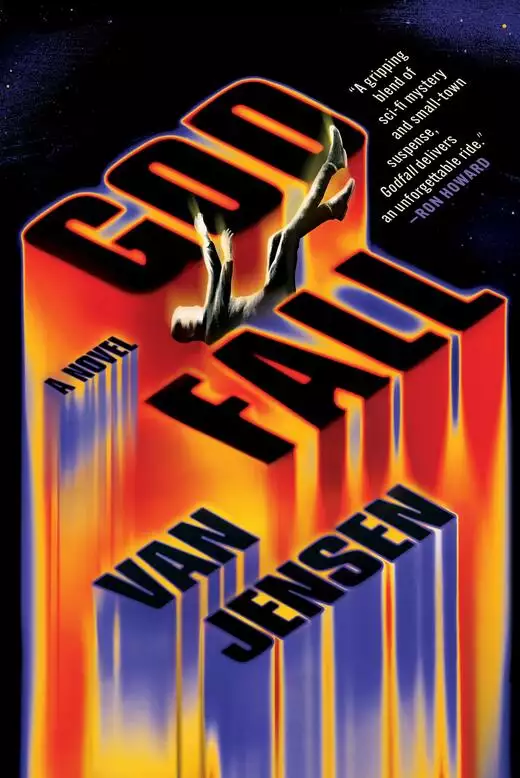
When a massive asteroid hurtles toward Earth, humanity braces for annihilation—but the end doesn’t come. In fact, it isn’t an asteroid but a three-mile-tall alien that drops down, seemingly dead, outside Little Springs, Nebraska. Dubbed “the giant,” its arrival transforms the red-state farm town into a top-secret government research site and major metropolitan area, flooded with soldiers, scientists, bureaucrats, spies, criminals, conspiracy theorists—and a murderer.
As the sheriff of Little Springs, David Blunt thought he’d be keeping the peace among the same people he’d known all his life, not breaking up chanting crowds of conspiracy theorists in tiger masks or struggling to control a town hall meeting about the construction of a mosque. As a series of brutal, bizarre murders strikes close to home, Blunt throws himself into the hunt for a killer who seems connected to the Giant. With bodies piling up and tensions in Little Springs mounting, he realizes that in order to find the answers he needs, he must first reconcile his old worldview with the town he now lives in—before it’s too late.
Release date:
January 13, 2026
Publisher:
Grand Central Publishing
Print pages:
320
* BingeBooks earns revenue from qualifying purchases as an Amazon Associate as well as from other retail partners.
Under the moonlight, the pool of blood shone black. David squatted, peering into the yard-wide void rent into the dirt and scrub brush. It seemed deep, like he could fall in and tumble through the earth, spit out in China, Australia. Wherever the hell is as far away from Nebraska as a man can get.
“Sheriff. Which way you figure she went?”
David stood on a knee that stiffened when the weather turned frigid, a reminder of a torn meniscus suffered during a high school football game a decade and change earlier. His muscular build made itself known even under his thick, brown coat, which had the words Sheriff’s Department stenciled in yellow across the back. He stood an inch shy of six feet, though the black Stetson on his head made him seem taller. He wore blue jeans, as he always did. The wind lashed at him, needles against his face. Just his goddamned luck that someone would do this on a night so cold.
He clicked on his flashlight and the pool of blood burned to life. To the side, Gentry Luwendyke stood with his arms crossed against a sheepskin coat. A puff of exhalation issued from below his unruly mustache, whisked away by the punishing February wind.
David carved slow arcs with the flashlight. Some ten yards away, the light caught a smear of red.
“This way, it looks like,” David said.
He led the way from one spatter to the next, each splash of blood smaller than the last, moving in a mostly straight line toward the dark rim of trees along the field’s western edge. Frost clung to the grass and prairie sage, which crunched like broken glass beneath their boots. By the time they reached a copse of cedars and Russian olives, the blood trail had diminished to single drops.
A rage was building in David’s stomach, combusting until he felt its heat beneath his coat; he was sweating, despite the cold. Someone did this. Someone would have to pay. He clenched the flashlight.
No. Not now, he told himself. He could be angry later. Now he needed to focus on the task at hand. Where had she gone?
He came around a cedar, its needles shining with frost, and into a small glade.
“There.”
David saw her first, lying on her side amid a clearing. The cow seemed dead, until her chest swelled and deflated, and a ghostly plume rose from her nostrils. He leaned over her, careful not to step in the blood running across the ground. David set the flashlight in the grass facing her and pulled off his gloves.
“Sons of bitches,” Gentry hissed.
“Rifle shot. Hit her here,” David said, running his hands along the soft hair of the cow’s abdomen.
Into her intestines. God knows what organs it hit; she was fading fast.
“Sons of bitches,” Gentry repeated, louder.
Suddenly the heifer snorted and spasmed. Her legs thrashed to find a footing. David fell backward and scrambled away as she pounded her hooves, almost righting herself. Then she stumbled and collapsed.
They inched back closer.
“She don’t need to suffer no more,” Gentry said.
“She doesn’t,” David agreed.
“I’ll do it. My cow.”
Gentry’s eyes were on the Glock 9-millimeter pistol holstered on David’s right hip. David clicked open the leather strap and drew the weapon, cold as hell in his bare hand.
“No. I can’t have anyone else using my firearm. Regulations.”
He stepped over the cow’s head. She was breathing hard, a froth of mucus and blood bubbling from her nose and mouth. Her obsidian eyes pleaded with him, uncomprehending of the cause of the pain inside her, the chaos of the world, the horror of life and the even greater horror of whatever lies beyond it. David had no answers. He rested the barrel against her temple and fired.
The truck rumbled over the rutted dirt road. Under the moon’s glow, David could just as well leave his headlights off. These country roads ran mostly straight east-west, north-south, a grid carved into the flat farmland. He’d spent most all of his thirty years here and knew every washout, every curve, every blind lane. And since being elected sheriff three years prior, he knew far too much about what happened inside the farmhouses at the end of those lanes.
As David drove, the anger started to build again, his hands gripping the steering wheel hard enough to make his knuckles groan. He shook his head, trying to free himself from the rage. It wouldn’t do him any good. Not when there was a case to solve.
He walked through what he knew. Gentry had heard rifle shots. He’d gone outside, looked up north into his pasture and saw a truck with a spotlight. Then Gentry had found the blood. He swore someone did it on purpose, a neighbor with an old grudge. Whether there were people in Little Springs who despised Gentry Luwendyke was not in question. That any of those people would gut-shoot a cow, David found unlikely.
More plausible, someone had been out with a case of Pabst or Old Milwaukee sliding around the floorboards, trespassing, searching with the spotlight, hoping a doe or buck might spook. David had done it himself when he was young and dumb. Drink enough beers, a distant cow could look like a deer.
There were six trucks in town with a spotlight. Four belonged to people who didn’t have the capacity for such shitheadedness. The fifth belonged to the Johnsons, and their boy might have it in him, but the family was off visiting grandparents in the Ozarks. That left one truck, and David knew where he’d find it.
He pulled onto the two-lane highway, which ran east and west. Running parallel to it on the north was the Union Pacific railroad, and parallel to it a couple of miles to the south was the Platte River. Ahead, the lights of town twinkled. On the western edge of town, he passed the diner and a green marker declaring: LITTLE SPRINGS POP. 731. Every decade after the census, there would be a new sign, the population ticking lower and lower.
The town was one of so many that had sprung up as a waypoint for the wagon trains fulfilling Manifest Destiny, taking people to Oregon and California. It had begun with a post office and a single resident before slowly but steadily growing. A landing point for those who couldn’t afford to make it to the West Coast. People who plowed through the sod and planted wheat and corn, who braved winters and raised cattle and carved out a place that was theirs.
By the 1950s, Little Springs had more than a thousand people, with schools, a small hospital, a grocery, four churches, and two gas stations. Main Street with two-story brick buildings, shops, and a couple of bars, as well as an Elks club and a VFW. The town grew to about a square mile, with simple homes, Foursquare or Craftsman or ranches.
The highway and railroad bisected the town, both running right to the feet of a row of towering grain elevators, tall and white with the town’s name painted across them in black block letters.
David turned off the highway onto Main Street, a stretch of cracked pavement wide enough for six lanes, made to accommodate the horse-drawn wagons that, a century back, rolled into town each weekend bringing farmers and their crops. On either side, the brick storefronts mostly had windows covered with plywood. At the far end, a water tower rose up. Years back, the village board had decided to paint it for every season, something to bring a little cheer. But they abandoned the effort soon after, leaving the tower as a massive, leering jack-o’-lantern.
One storefront remained open this night, its neon sign glowing: VIC’S. David scanned the vehicles parked at an angle against the curb.
There. A blue Dodge jacked up on oversized tires, a roll bar above the cab with a spotlight attached. He rolled in beside it and peered through the truck’s window. Crushed beer cans on the floor. A rifle on a rack in the rear window. He tested the door handle. Open.
David reached a hand below the bench seat and fished out a box of Remington 30-06 ammunition. A few rounds were missing. He took one bullet, dropped it in his pocket, and headed inside.
Vic’s was one room straight back. Bar on the right. A few booths on the left. Two pool tables. Neon beer advertisements and pendant fixtures with mismatched bulbs cast a cacophony of color across the clouds of cigarette smoke. The usual crowd. Overalls and denim, people mostly heavyset, their skin parched and cracked, either from nicotine or the constant wind, or both. At the center of the bar, a thickly built man with close-cropped blond hair looked up at the sound of David entering and spun on the stool toward him.
“Hey hey! A beer for our sheriff!”
“Hey, cousin,” David answered, easing up to the bar beside Jason.
David and Jason had been thick as thieves as long as they could remember. There were family photos of them in diapers, playing and wrestling. They’d done damn near everything together. Raced dirt bikes and broke bones in dumb ways and played sports and snuck their first beers.
In a different town, David might have been the alpha male of his age group. He’d been a good athlete, average in size but strong and fast. But Little Springs belonged to Jason. It always had.
Jason was a few months older, and he’d always been bigger. Even as far back as grade school, he was built like some demigod: an inch or two taller than David, and arms so muscular Jason had to snip his T-shirt sleeves along the seams so they would fit his biceps. Jason’s personality was bigger, too. Whereas David tended to drift into his own thoughts, Jason lived every second fully in the present, a joke always ready on his lips.
Like David, Jason had gone off for a couple of years of college, then come back to Little Springs. Jason followed in his dad’s footsteps, helping run the town bank and taking over the village board. It had always seemed like Jason’s town, and now it was.
On the far side of Jason sat a man who was the same age as Jason and David, though he looked a few years older, his black hair poking out beneath a Nebraska Huskers ballcap, thick stubble dotting his ashen face. Spady’s family had moved to town when he was eight, and he’d fallen into their group—pulled into Jason’s wake, truthfully. He wasn’t kin, but they’d all grown up so close that he might as well have been.
It was them more than anyone who helped David make it through when he was twelve and the tornado came, turning his family’s house into a nest of debris and sucking his parents into the sky, never to be seen alive again. He figured in fifty years the three of them would still be here, drinking beers and trading stories.
Spady puffed at a Marlboro held in his left hand, then balanced it on an ashtray before using the same hand to lift his bottle of Bud. His right shirt sleeve was pinned at the elbow, where his arm ended. He’d worked railroad crew since high school until the accident, and now nothing but disability pay stretched out before him.
Vic, the bartender, pushed forward a bottle of Bud Light and a shot glass of whiskey before David could wave him off.
“I’m still on duty.”
“Big doings out there?” Spady asked.
Spady’s wife, Brooke, was David’s only deputy. It was her night off, which meant the situation with the cow was entirely his to handle.
David looked down and realized his hand was still shaking from firing his pistol. He smiled and shook his head.
“Nothing much.”
“Fair enough,” Jason said, grinning his usual shit-eating grin. “Well, if you aren’t going to imbibe…”
He reached for the beer and shot, but David grabbed his wrist.
“Give me a minute. I might just wrap this case up right quick.”
David looked to the far side of the bar. There, three young men huddled in a booth. They’d been eyeing him from the moment he stepped inside. David stood from the stool and approached them, looming in the way that only those who wear a badge can. They were local kids—well, adults now. One of them watched David as he came over. This was Derrick Mews. He was his generation’s Jason, a kid with some money and looks and athleticism, though there had always been a dark edge to his charisma. The kind of kid who’d smash toads with rocks, tie firecrackers to cats’ tails, and spray-paint dicks all across the old river bridge. The blue Dodge was his, a fancy truck for a rich kid.
The other two—Andy Watkins and Tyrell Taylor—stared, unblinking, into their phones.
“Sheriff Blunt,” Derrick said. “Need to check my license? I’m legal. No more minor-in-possession citations.”
“I know how old you all are, Derrick. Old enough to be charged as adults.”
He let that line sit a long moment, then asked, “How long have you been here?”
“A while.” Derrick shrugged.
All at once, David opened the door that kept his rage at bay and pounded his fist on the table hard enough to rattle glasses and earn stares from across the bar.
It wasn’t just that he was mad about what they did. It was what the act meant. Little Springs was just barely holding itself together; every year another store shuttered, a few more people died off or moved away. An incident like this could have whole families at war, everyone taking sides, till the whole damn town splintered.
“Jesus,” Tyrell said, looking up from his phone. “What?”
“I asked how long you’ve been here. And ‘a while’ isn’t half specific enough,” David warned.
Andy had already fallen back into staring at his phone.
“What does it matter?” he almost whispered. “We’re all gonna die anyway.”
“The hell is he talking about?”
“Nothing,” Derrick said. “This bullshit on the internet. Some weird asteroid is going to hit and kill us all. They think everything on Reddit is real.”
“It isn’t bullshit,” Andy muttered.
The young man thrust the phone forward at David, insistent. David had no interest in getting caught in whatever bullshit argument they were having, but then his eye caught on the image—a gray and grainy form against the black of space. A form that didn’t look so much like a rock but instead had the rough contours of a body. He waved it off; that didn’t matter. He needed to put this situation to bed. Tonight.
“I don’t give a shit,” he said. “The only thing I care about is that some dumb sons of bitches drove onto Luwendyke’s land to hunt deer. Except these dumb sons of bitches were too drunk or too dumb to know better, so instead of a deer, they shot one of Gentry’s heifers. It died.”
Derrick glanced nervously at his friends, then recovered.
“That is a sad story, Sheriff.”
David retrieved the rifle cartridge and placed it carefully on the table so that it pointed up, an obelisk in miniature.
“See, these dumb sons of bitches don’t understand ballistics, which really isn’t much of a surprise. I can fish the rifle round out of that cow’s guts in the morning and compare it to any rifle belonging to anyone in town who happens to own a truck with a spotlight. Now, I find a match and we’re looking at trespassing, animal cruelty, poaching…”
All at once, Derrick’s slick veneer broke, and his eyes turned misty.
“Whoa. Okay. Listen…”
Every bone in David’s body wanted to throw the full weight of justice at the kid. For the simple fact that he was the oldest child of Harold and Donna Mews, owners of the town’s feed lot and what passed for rich in the county, Derrick had skated each and every time he’d gotten into trouble. Now, this was David’s chance. Knock the prick right off the pedestal that his folks made for him. Make him suffer some actual consequences.
No. He couldn’t go that way. If David brought the hammer down on Derrick, his parents would swing all their influence around town, and then old Gentry would be on the warpath, making everyone’s lives miserable. David’s real job wasn’t closing cases, meting out punishment as proscribed by the law. His real job was protecting the town. And he thought he saw a path forward.
David gathered himself, then leaned within an inch of Derrick’s face.
“You listen, shithead. Tomorrow morning, I’m going to have Gentry load that cow up and deliver it to your folks’ shop. You’re going to tell them to pay him the full worth, plus a thousand for his trouble. Should be enough to stop him from pressing charges. And should you ever trespass on his land again, I bet Gentry will have a rifle ready. And I’m not sure I could be bothered to arrest a man for defending his property. Understood?”
Derrick stared down at the table and nodded.
“Good. Enjoy the year’s worth of beef.”
David strode back over to the bar.
“Fine work there, Sheriff,” Spady said.
“You heard?” David asked.
“Oh, I think the whole bar enjoyed hearing those boys shit bricks,” Spady laughed.
“Well? You clocked out now?” Jason asked.
The beer and the shot stood where they’d been left.
“Indeed I am.”
David downed the shot, set the glass upside down on the counter, then pounded the beer in a single go.
In the small house at the edge of town, David opened and closed the door as quietly as he could. In the breezeway, he took off his gun first, locked it in the safe by the door. Then he took off his radio, hung his belt up by a peg, and sat so he could pry free his boots. Last, the Stetson went on a peg of its own.
As he padded into the house, he caught a glimpse of Tabby in the living room, curled up on the couch. The TV was tuned to the news. He angled for the bathroom so that he could have a swig of mouthwash before she smelled alcohol on him and knew the real reason he was so late, and another fight started up between them.
“Sorry, honey. It ended up being a hell of a night. You won’t believe what that damned Mews kid did—”
“David.”
He knew that timbre of her voice; his wife was crying. He wondered what he’d done this time. Or not done. What he’d said or not said.
They’d started dating in high school, and it was always so easy. Like they were destined to spend their lives together. Over the past few years, every day it seemed a little more like work. A job that he didn’t understand and never understood any better no matter how he tried.
“David. Come here.”
He swallowed and stepped into the living room. As he came to her, she didn’t look up at him, didn’t pull her eyes from the screen. He followed her gaze there and saw it. The same image he had seen on the phone in the bar. Gray and grainy amid the black of space.
The news anchor on TV was speaking in an almost reverent tone.
“… minutes ago came the stunning confirmation from NASA that it is real. This image of the object was first captured by scientists at the Allen Telescope Array.”
Not an asteroid, this thing filling the television screen. A head, arms, torso, legs. Not quite human in proportions, but unmistakable. A body, hurtling through space.
“We don’t know what it is. We don’t…” The anchor halted, seemingly having run out of anything else to say.
David felt Tabby take his hand. He didn’t remember moving onto the couch beside her. A pang gripped his intestines. It couldn’t be real. But there the image was, a chyron below declaring, UNIDENTIFIED OBJECT ON COLLISION COURSE WITH EARTH. Then all at once the screen cut to black and reappeared inside the Oval Office. The president stepped into view and sat at the desk. He wore none of his usual makeup and so he looked older, but more human, than he ever had before.
He spoke haltingly, glancing down to his notes and up to someone off-screen, searching. No one knew where the thing came from. What it was. How it remained unseen for so long. Only that it was three miles long, head to toe. If it didn’t change course, in six days and twenty-two hours it would make landfall in the United States. Models were forecasting somewhere in the prairie lands. Kansas. Nebraska. At the speed it was going, it would strike the earth like a bullet. An extinction-level event, he called it.
The president was saying something about prayer. David looked back to Tabby. Tears ran down her face. He put his arms around her quaking body. They went outside. His feet were bare, but he didn’t feel the cold.
There were no streetlights here, at the edge of town. The flat horizon made the heavens feel limitless. Stars and planets shone all around the moon. David searched the sky. Was that it? That bright one, winking in and out?
All that he had done. All that he had fought for, to protect not just these people, his neighbors, his family and friends. But to protect this town. To save it from the inexorable decay of time. And now. Now, God was coming down himself to wipe it from the face of the earth.
Then, in the near distance, he heard it. Shouting. Followed by screaming from somewhere farther off. His eyes tracked movement at the periphery: Their next-door neighbor came out of his house carrying a shotgun, his eyes wide and wild.
Panic. It was gripping everyone else as surely as it was David. His friends and neighbors—everyone—would lose their minds. By the time that… thing smashed into the ground, it would all be over. The town would be lost in chaos, fractured.
David walked away from Tabby, back into the house, and pulled on his uniform, his belt and gun.
He wouldn’t let the town die. Not so long as he was sheriff.
All he wanted was to sleep. He’d been on duty since three o’clock the previous morning—twenty-seven hours straight running from one crisis to the next. A home burglary. A domestic dispute that had turned violent. Cars vandalized. Nonstop “shots fired” calls coming into dispatch. Though, thankfully, no bodies. Not yet. David tapped his knuckles against the dashboard, as if it might bring him luck.
He had hoped the chaos would finally burn away with the first morning light, but no such luck. Next up, some kid was stoned out of his mind, stumbling around, scaring folks.
David had just pulled into Old Town when the call came; he’d been planning to do one last all’s-well circuit of Main Street before calling it and catching a few hours of rest.
A sense of something like déjà vu struck David as he guided his truck past the flagpole, Vic’s, the post office, the bank. For a moment or two, it could feel like everything was the same as it had always been. The town looked just as it had since he was a kid, tooling around with his cousins and Spady on their bikes. Wood-framed houses. Sprawling yards of dead grass and broken-down appliances left to rust.
There were a few changes. Some of the storefronts had reopened. Not a single house was empty. The cracked pavement had been repaved—though the water tower remained a jack-o’-lantern. It was comfortable, familiar, this little stretch. Unlike everything that had sprung up around it.
As David rounded a corner, he saw them. A procession of maybe sixty people in black robes that hung low enough to drag on the ground, moving with slow, unified steps, as if they were a monastic order. He drove past, idling close to them, and their faces came into view. Not their actual faces, but the plastic masks they wore over them. Tiger masks, eyes wide and ferocious, mouths frozen mid-roar. None glanced at David or made a sound. They never did. “Tonys,” the locals called them. Like the tiger from the cereal. Every morning, the Tonys did this. March to the old park. Bow down, pray to the west—to it—then stand and march back to the old theater building, which they’d somehow acquired in the chaos that followed landfall.
“You have a permit?” David hollered through his open window.
No response. He drove on, swearing under his breath.
He continued down Main Street to the highway and turned east, then north. All at once it rose up before him. “New Town,” as the locals called it.
It looked as if a whole city had dropped out of the sky overnight, surrounding the original Little Springs. Office towers and apartments and strip malls stretching miles to the north and east.
Every day, it seemed that Little Springs spilled farther out into the countryside, like a flooding river swelling its bank. Far up into what once was unbroken farmland, there now stood housing developments and condominiums and little shopping centers, and a new school complex. Construction cranes rose up all over, punctuating the flat horizon. Used to be there wasn’t a single stoplight in the whole county. Now there were more than David could count. Crews raced to pave roads fast enough to keep ahead of the new developments and condos.
All of this, because every day more people arrived. Two years ago, Little Springs had been the middle of nowhere. Now it was the most important city on earth. It used to be said with a grin that the largest city in Nebraska was Omaha; the second largest was the state capital, Lincoln; and the third largest was Memorial Stadium during a Nebraska Cornhuskers game. Now Little Springs had more people than Lincoln. Though, until the next census brought more government funding, the county still had to make do with the same resources it had had before. Which meant all of Little Springs—old and new—still only had its volunteer fire department and David and his one deputy to keep the peace.
All of this because of it. Him.
Idling at a red light, David turned and looked out his side window and saw him. If you caught it out of the corner of your eye, you would think it was a small mountain range a few miles west of town, blocking out the horizon.
It was not a mountain. It was the giant, prostrate on his back, his body looming over everything around him.
The giant’s beetle-like abdomen rose from the ground as straight as a cliff face, maybe a thousand feet. Its arms—two on this side of it, two on the other—were thin relative to the torso but still each a mile and a quarter long and thicker than a house, ending in stubby, four-fingered hands. To the south, its thin legs with oddly spaced joints and a row of barbs along them stretched all the way into the river, which had swelled its bank to carve a new path around the massive four-toed feet. Between those legs, a massive appendage stretched out. Scientists had said that because the giant is of an unknown species, its biology likely wouldn’t match our own. But the thing dangling between its legs sure looked like a building-sized phallus. And to the north, its shoulders continued to a head with no neck. Its face lolled to the east, toward town, staring over them. Staring right at David from under a massive brow with clusters of unblinking, lifeless, insectoid eyes.
Looking now, he could see that the surface of the giant was carved with deep ridges that formed curving patterns that repeated, growing ever smaller and more intricate. Fractals, David had heard them called. Its skin seemed reflective, though not quite. Like the opalescent mica stones David found on hiking trips to the Rocky Mountains as a kid, it bent and swirled light. So, it changed color through the day along with the sky. Pastel blue and pink in the morning. Blue and white during the day. Gray during storms. Indigo and orange at dusk.
In that week before landfall, everyone had thought the object—that was how they referred to it then—would crash into the earth and unleash cataclysm. Or that it might alight and stand before them like a conquering god. Instead, neither happened.
David could still close his eyes and see that final night. By that point, Tabby had already kicked David out, telling him he’d chosen the pointless task of protecting the town over spending the last week of existence with her. He had gone alone to the town cemetery and sat, his back against the cool granite of his parents’ headstone. Clouds shrouded the sky. All at once, they glowed electric blue. And then it appeared, this humanoid figure the size of a city, the patterns in its skin lit up neon blue. Instead of rocketing down, it descended slowly, gently, like an old man settling into a bath. It stretched out onto its back just west of town, and so far, it had never moved again.
It was dead. Murdered. At least so it seemed.
Because right where its abdomen met the plate of its chest, a spire emerged, rising up some three thousand feet. A tower jutting into the sky. It looked like a spear, broken off at the top. Massive beyond comprehension. Stabbed right through the giant. Right in the spot where David had been trained to shoot people—center mass.
The spire, as everyone came to call it, was unmistakably something altogether different from the giant. It was gun-metal black and shimmered an effervescent red whenever sunlight caught it. David had never seen it up close, but he imagined it looking like obsidian.
Where did the giant come from? What killed it? How had it landed without ripping a hole in the earth? And why, out of a whole universe, did it arrive here, right on David’s doorstep? If any of the scientists or government officials had answers to those or a million other questions about the giant, they weren’t saying.
There were theories, of course. That it wasn’t an alien at all, but a spaceship built in organic form. That it was all an elaborate government hoax to unite humanity. That it was an elder god, returning to earth to fulfill some prophesy—that was what the Tonys believed.
For his part, David tried to think of it as little as he could. Tried not to even look at it. He had been damn content to live in the middle of nowhere all the rest of his days. Now he had to deal with all of this. All because of the giant. There were times when David would catch a stray glance of its massive, prostrate body, and he’d be overwhelmed all over again, his stomach dropping and knees weakening, and he thought he might fa
We hope you are enjoying the book so far. To continue reading...

 Please log in to recommend or discuss...