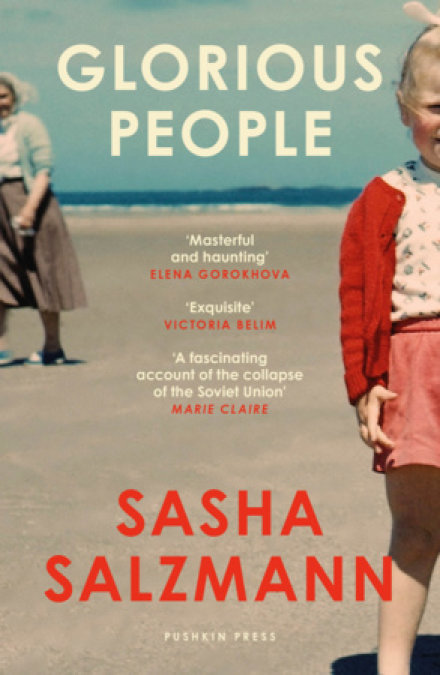
A BEST BOOK OF THE YEAR (MARIE CLAIRE): A sweeping historical fiction novel about the fall of the Soviet Union, told through the eyes of Ukrainian mothers and daughters over 4 decades
“An astute, deeply empathic portrayal of the dislocation of first-generation immigrants and intergenerational trauma” — Financial Times
In this stunning work of political historical fiction, loaded with “vibrancy and humour”, the collapse of the Soviet Union reverberates throughout multiple generations of 2 families—presaging and foreshadowing conflicts in Russia's Ukraine War (TLS).
As a child, Lena longs to pick hazelnuts in the woods with her grandmother. Instead, she is raised to be a good socialist: sent to Pioneer summer camps where she's taught to worship Lenin and sing songs in praise of the glorious Soviet Union. But perestroika is coming. Lena's corner of the USSR is now Ukraine, and corruption and patronage are the only ways to get by—to secure a place at university, an apartment, treatment for a sick baby.
For Tatjana, the shock of the new means the first McDonald's in the Soviet Union and certified foreign whisky, but no food in the shops; it means terrible choices about how to love. Eventually both women must decide whether to stay or to emigrate, but the trauma they carry is handed down to their daughters, who struggle to make sense of their own identities.
Engrossing, rich in detail, and full of unforgettable characters, this is a captivating love letter to mothers and daughters from one of Europe’s most powerful voices in political fiction.
Release date:
June 3, 2025
Publisher:
Pushkin Press
Print pages:
288
* BingeBooks earns revenue from qualifying purchases as an Amazon Associate as well as from other retail partners.
Of course I wanted to know what had happened, what exactly took place before Edi was beaten up in the yard. She was lying on the grass, her hair all pale and dirty. My mother was kneeling beside her, Auntie Lena was yelling at them both, and all three were waving their arms around like they were casting out evil spirits. When they saw me they started to cry, one after the other, like a Russian doll, the tears of one turning into the tears of the next, and so on. First my mum let rip, then the others joined in, as if they were singing a howling, wailing round. I couldn’t make head or tail of it.
OK, so it wasn’t hard to guess why my mum came over all misty-eyed when she saw me standing there after the long radio silence—but Lena and Edi? They seemed to have some score to settle. Mother and daughter, one of them lying on the ground like the other’s shadow, or the other way round: one of them growing up out of the other’s feet, like a shrub with broken branches. Auntie Lena was wearing a green trouser suit that hung loosely on her body; I almost didn’t recognize her. I’d worn her daughter’s babygros, sat at her kitchen table revising for tests and exams, rung her doorbell in the middle of the night when things got too much at home—but that was a long time ago and for a moment I wasn’t sure it was really Lena, standing there yelling at her cowering daughter: ‘Why were you hanging around out here? What were you doing?’
Edi looked the worse for wear but not drunk, though she claimed in all seriousness that she’d seen a giraffe in the yard, wandering around between the tower blocks, nibbling at the grass, peering in at windows. This may be the former East, but as far as I know we’ve no giraffes round here. You don’t get them in these parts.
She hadn’t been here long; you only had to look at her hair and clothes to know that—especially her clothes. I’d never seen much of Edi, even when she still lived with her parents and I did my homework at their kitchen table. I was too young for her, and anyway she never came in to make herself a sandwich or a cup of tea when I was around. The door to her room had a milky glass panel, and through this I could see her switch her light on and off for no apparent reason, day and night. On and off, on and off. Once, the glass was broken; only a few jagged shards stuck out from the frame. No one mentioned it and I asked no questions and soon there was a new pane of glass, as if nothing had happened. Edi was pretty unobtrusive back then—black hair, black jeans, black top. If I saw her on the street I’d walk right past her, she dresses so brightly now. I only recognized her because her mum was standing next to her, shouting at her. And because it was my mum trying to make the peace. Over and over they launched into the same string of reproaches, Auntie Lena saying furiously to my mother, ‘Why didn’t you tell me—?’ and my mother retorting, ‘It’s nobody’s business if I’m dying.’
Not a good moment for me to enter the fray; she was mid- sentence when she caught sight of me and she stiffened, as if time had sprung a crack. snAP. She looks at me, I look at her. Her hair’s gone grey and she had a crushed look to her, though she’d clearly made an effort with her appearance. She dyes her hair—has done for a while—and I dare say it had started out the evening neatly styled, but now it was straggly and dishevelled, and you could see the silver roots. The skin under her eyes sagged—but maybe that was because I was standing over her; everyone looks weird from that angle. She seemed small. Looking past the crown of her head, I could see her hands; there was dirt in the creases of her palms. She must have tried to pull Edi up on to her feet.
I wasn’t surprised she was in town. Uncle Lev had told me she’d be at the party at the Jewish Community Centre—in fact, he’d paid me an official visit to inform me and to demand a family reconciliation, a big reunion. He came in a clean shirt, his nostrils flaring; he had the best intentions, but I had to disappoint him. When he saw that he wasn’t getting anywhere, he tried to guilt-trip me—you can’t break with your own mother; you have to love her no matter what—but I don’t think I’m obliged either to love or not to love her; she’s my mother and that’s all there is to it. Things are what they are.
I’d gone out just because I felt like it that evening—wandered around, watched the evening strollers, nothing special. The streets smell different at dusk, sourer, and I like that, but this particular night I smelt burnt sugar and heard shouts, and I thought I’d go and investigate. At first I was glad it wasn’t my mother lying beaten up on the ground—then I realized that was the extent of what I felt. Live. Leave me in peace.
It looked as if there had been a small fire here a short while ago; we were standing next to a heap of charred paper—crinkly, soot-coated bundles tied up with string—rather beautiful, actually. I seem to remember the smell of Coke and bitter caramel; it tickled our noses and made Auntie Lena sneeze. Whoever had tried to have a little picnic here between the tower blocks had either been driven away or had to leave in a hurry, but none of the women would tell me how Edi fitted in, or why half the Jewish community mishpochawere hanging out of the second-floor windows gawping at us. The women were crying, but they didn’t want to seem weak. That’s socialist manners for you—flaunt your wounded emotions, but try to keep a grip on yourself.
All around us were balconies with identical flags fluttering at their railings, as if the people who lived there would forget where they were if they didn’t have that little bit of cloth flapping in the wind. The funny thing is that for many of the residents—the ones I know, anyway—that flag has nothing to do with the emblems on their passports.
None of the women wanted to return to the party, but they couldn’t be left out in the yard either, Edi dirty and bleached and battered, Lena with her eyes puffy from crying, and my dishevelled mother who’d just announced that it was nobody’s business if she was dying. I asked them if they’d like to go back with me to freshen up and have a cup of tea. It seemed the right thing to do, to offer them a sit-down at my kitchen table. We walked quickly, without speaking, as if afraid of being followed. I could hear the rubbery squeak of my soles on the asphalt.
When we arrived, Auntie Lena made straight for the sink, held a flannel under the cold water and pressed it to Edi’s forehead. I flicked the switch on the kettle, ignoring my mum’s greedy looks, the way she stared at the sofa, taking in every crevice, as if to commit it all to memory. It was her first time here; she even looked lovingly at the open bags of crisps on the floor. I ignored, too, the hissing voice in my head telling me that the flat was small and dingy and dirty. The only free wall was covered by a massive Path of Exile poster with a dark, forbidding sky and spurts of blood. There was a smell of barbecue sauce from the box of chicken wings next to my keyboard. The curtains were drawn, the computer was on, battling nations zapped each other on the screen. The roar of the fan filled my lungs.
We said nothing for a while. I could tell that Mum’s hands were trembling because the tea in her cup was rippled, as if tiny stones were skipping across the surface, but her face was calm and her eyes big and round, as if she couldn’t believe she was seeing me. I couldn’t believe it either. You shouldn’t criticize people for not being heroes, she had said the last time we’d argued—or maybe it wasn’t the last time; our arguing had neither beginning nor end, it was an unbroken chain of resentful mutterings. They weren’t even reproaches; they were just noise. But when I asked her why, if that was the case, she expected me to be someone I couldn’t be, she had no answer. She wouldn’t—or couldn’t—answer any of my questions. And she had no questions for me—still doesn’t.
She sat there with her silvery copper-beech hair alongside bleached Edi and her emerald-green mother, all three of them rocking their heads, ever so gently, almost imperceptibly, as if waves were coursing through their shoulders, as if electricity were running up their necks. The little stones continued to skip over the surface of the cooling tea, faster or slower, depending on their size—hop, hop, hop, sink.
We made an effort, talked a bit, exchanged coordinates—ten- tative words, clumsy dance steps. But not bad, considering.
We hope you are enjoying the book so far. To continue reading...

 Please log in to recommend or discuss...
