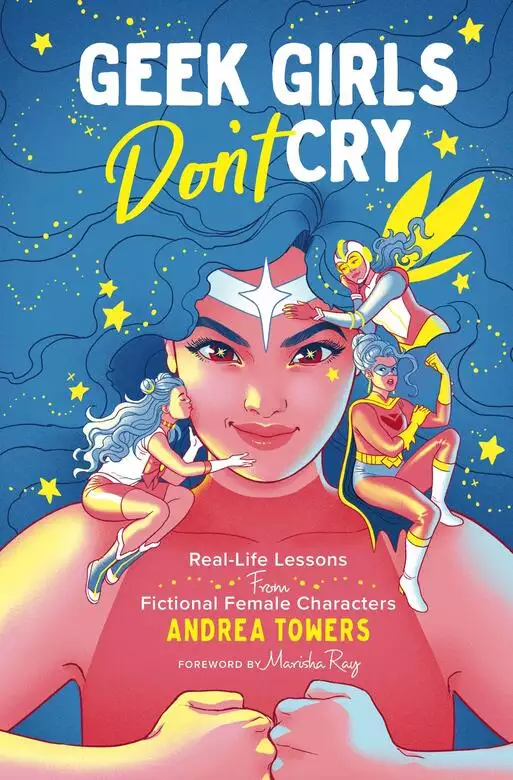
Geek girls don’t cry . . . they get strong! Using examples from both real life and pop culture, entertainment writer Andrea Towers provides powerful tips on how women can overcome obstacles.
“An enjoyable read for anyone interested in pop culture, with particular relevance to those working to overcome struggles.” —Booklist (Starred review)
What does it mean for a woman to be strong—especially in a world where our conception of a “hero” is still so heavily influenced by male characters like Batman, Spider-Man, and Superman? Geek Girls Don’t Cry explores the subject, offering advice tailor-made for fans of any age. Andrea Towers, who works in public relations at Marvel Entertainment and has written about superheroines for outlets such as Entertainment Weekly, outlines some of the primary traits heroic women can call upon, like resilience, self-acceptance, and bravery, pulling in stories from real-life women as well as figures from the pop-culture pantheon. She also interviews the creators of our favorite fictional heroines, who discuss how they drew from their own experiences to develop these protagonists and how, conversely, their own creations continue to inspire them.
Release date:
April 2, 2019
Publisher:
Union Square & Co.
Print pages:
208
* BingeBooks earns revenue from qualifying purchases as an Amazon Associate as well as from other retail partners.
For as long as I can remember, whenever I proudly brag about the women that I’m so lucky to have around me, I always end on the same boastful statement: “I only keep badass women in my life.” Of course, that doesn’t narrow down the candidates much, does it? Every woman is her own unique variety of fighter. This perception was always my brand of veneration toward our global sisterhood. The more that time passes, the more I realize that from struggle comes wisdom, and I haven’t met a single woman that isn’t a sage in her own way and doesn’t have a message in the story of their lives.
From the moms we call “Wonder Women,” giving a moniker to their strength and compassion, to the brilliant young women paving the way in traditionally male dominated fields with a tenacity and resolve reminiscent of Princess Leia, these fictional heroines give us tangible lexicons of comparison to the people we’re surrounded by. As a fellow Geek Girl, whenever I’m reading a fantasy novel or watching a Marvel® summer blockbuster, the magnanimous virtues and qualities of these fictional characters always manifests the image of a loved one in the back of my head. Not only are we inspired by the strength and empathy of these pop culture icons, but they also highlight the heroes we have standing next to us.
Now, for me to limit these incredible stories and characters to mere tools of comparison would be a huge disservice on many levels. I’ve been an actor and producer in the entertainment industry for nearly fifteen years now. Over the course of that time, I’ve had manydiscussions on storytelling with numerous creatives, ranging from comic book writers to Hollywood directors. A common theme often presents itself: inspiration demands fuel, and as they say in the biz, “Write what you know.”
As trite as the old adage may be that “art imitates life” and vice versa, it’s deeply true. When you see Katniss Everdeen overcome tyranny or watch Jessica Jones struggle with guilt, that’s the result of inspiration from a myriad of creators’ personal influences. What these fictional conflicts tell us is a culmination of the best (and sometimes worst) parts of the human experience. How could you not feel emboldened by Storm? She herself is an amalgamation of generations of powerful women!
As you progress through this book, keep that thought in the back of your mind: behind every incredible character are incredible people. This includes the author of Geek Girls Don’t Cry, the very book you are currently reading! (That’s right, I’m psychic.) When I first met Andrea, I felt an immediate kinship in that we are both women working in male-dominated industries. However, she caught my attention far earlier via social media with her evaluations of my Dungeons & Dragons character, Keyleth. Andrea’s introspection and insight into my character’s thought process showed how intelligent she is, as well as her observant empathy. What I’m trying to say is, Andrea is a badass, and as I previously stated, those are the only women with whom I consistently associate.
I am deeply honored to not only have a character I created included in this menagerie of matriarchs, but also to write the foreword for this book. As a fellow believer in learning the lessons stories can teach you, I hope you read with an open mind and heart. And let Andrea guide you on how to look at characters critically and from multiple perspectives. Get the most out of storytelling, because the stories that help inform who you are will stick with you for a lifetime.
Happy reading,
Marisha Ray is an accomplished voice actor, producer, host, and performer whose credits include video games such as Persona 3, Final Fantasy XV, and Star Wars: Battlefront. She has worked as the Creative Director for Geek and Sundry, where she co-created and produced popular shows on gaming, comics, and pop culture. She currently works as the Creative Director for Critical Role, the smash entertainment sensation featuring popular voice actors who take on epic Dungeons & Dragons adventures.
Marisha lives in Los Angeles with her husband, fellow voice actor and Critical Role Dungeon Master Matthew Mercer.
“This isn’t a question of what I’m not.This is a question of who I could be.”
—CAPTAIN MARVEL
As a woman, I often find myself thinking about what it means when we say a female character is “strong.” Does it mean she can kick butt, like Black Widow’s introduction in The Avengers? Does it mean we can be super, like Buffy Summers and her consistent saving-of-the-world (not to mention consistent tackling-of-homework) in Buffy the Vampire Slayer? Or maybe it means women who are deemed “strong” should be celebrated—not because they fight bad guys, but because in the face of issues like post-traumatic stress disorder, anxiety, and depression, they’ve still managed to show us how powerful and inspirational they are.
Just because some of the most inspirational women in the world are fictional doesn’t mean they don’t deal with the same issues we face in real life. “There is sufficient evidence to show us those connections we have with these characters, whether it’s identification or relatability, are pretty strong,”i Andrea Letamendi, a clinical psychologist working at UCLA, told me during an interview. “There’s a lot of work that has gone into measuring the strengths of those relationships, better understanding the intensity of those relationships, and even finding a considerable amount of distress when there’s a break, when there’s a disruption with our relationship in these fictional characters. When we see loss and grieving and disruption in relationships in fiction, it does allow us to be able to process those emotions, to be able to be a little more equipped to handle those emotions. There’s a healthy aspect to that.”
When I tell people that fictional characters have helped me through some of the hardest periods of my life or have inspired me not to give up on my dreams or goals, I often receive an eye roll or dismissal. It is, unfortunately, a common response—people who aren’t familiar with the nuances of pop culture just don’t understand why I am able to identify so strongly with a fictional character. But what I wish I could say on more than one occasion is that it’s not just about liking an actress that plays the character or feeling like I know that character because I spend my time watching television, playing video games, or reading comics. It’s about seeing what she went through—her addictions, her fears, her traumas, her struggles—and applying how she worked through those issues to my own life.
Dana Scully? She helped me become a better student in school, thanks to her choice of profession. Black Widow? She helped me realize I don’t have to be defined by the regrets I thought I’d carry around forever. Wonder Woman? She helps me speak up in workspaces and situations where I’m usually the only female in the room, giving me a chance to make my voice heard among the patriarchy. Hermione Granger? She helps me feel confident, allowing me to understand that my “quirky” interests aren’t a waste of time and energy but instead are parts of me that are unique and special.
Regardless of what you’re going through or what you’re feeling, you should never feel devalued because the person who exhibits traits, experiences, or a lifestyle that resonates with you is a fictional character. After all, how is identifying with Katniss Everdeen or Okoye from Black Panther different than identifying with a historical figure or author or athlete? More importantly—why are the struggles of these characters swept under the rug? Why do we know about the depression Batman experiences after losing his parents but not about Princess Leia Organa’s grief after unexpectedly losing her home planet of Alderaan? Why do we know about the alienation Superman experienced after being sent away from his home planet of Krypton but not about Supergirl’s trauma, which came from the same experience? Why do we know about Peter Parker’s search for purpose after the death of his Uncle Ben but not about Scarlet Witch’s struggle with self-esteem in the wake of growing up an orphan?
There has been progress when it comes to embracing women and their accomplishments, but there’s still a sharp dichotomy that exists when we talk about female characters as opposed to male characters. That’s because it’s easy for us to look at men and understand, on the surface, where their issues come from—especially if, like Batman and Superman and Spider-Man, they’ve been part of our pop culture narrative for decades. But we rarely stop to consider how women deal with concerns like loss and tragedy and depression, because they’re so often seen as footnotes in our stories.
Sure, women are seen as “strong” . . . when they’re displaying strength in an action-oriented way. That’s why we should look beyond a woman’s physical prowess and instead focus on the qualities that truly make her strong: her courage in the face of her biggest fear, her will to overcome an obstacle despite being held back by her life experiences, her ability to help others despite her own mental health demons. No matter what we go through in life, and no matter how much our world changes, we need these amazing females and their stories to inspire us, to remind us to keep fighting, to help us through our darkest days.
In this book, you’ll read about some truly awesome female characters from all areas of pop culture. You’ll learn about their lives and accomplishments, but you’ll also see how each character’s biggest fight wasn’t against an alien or a monster; it was against issues like depression, substance abuse, isolation, and anxiety. You’ll gain insight from psychologists who have dedicated their professional lives to helping patients find light through mutants, goddesses, and superheroes. You’ll find personal anecdotes and advice from courageous real-life women involved in all facets of pop culture—many of whom credit the characters they work with for helping them through hard times. And, it goes without saying, since these are in-depth analyses of characters and their stories . . . beware of spoilers.
You are important, and your fight matters. You can overcome your fears and your traumas and your anxieties. You can write your own story, no matter who you are or what you struggle with. You can be strong without being a cliché.
But first, you have to believe it.
In different ways, trauma attempts to become a dominant fixture in our lives. The lifestyles or moments we experience in our formative years and even afterward stay with us long after we have learned to conquer them, hiding in the shadows of our mind. But undergoing trauma doesn’t necessarily mean that we need to be forced into a life where we are defined by what’s held us back.
RETCON:
In works of fiction, this is a word used to describe a change in a character’s history or to describe a different interpretation of previous events important to the character’s story.
Like many popular comic book characters, Marvel’s® Natasha Romanoff (Black Widow) is a beloved and inspirational hero. Natasha has undergone dozens of retcons since her introduction in the 1960s, including her translation to the big screen—the portrayal that she’s most commonly known for. But changing her history doesn’t change the fact that she’s a survivor. And if the world is going to place her on a pedestal, then her personal struggles are important enough to know about.
Natasha was taken from her family when she was just a little girl. She spent her early years in a program known as the Red Room, a Soviet fa. . .
We hope you are enjoying the book so far. To continue reading...

 Please log in to recommend or discuss...
