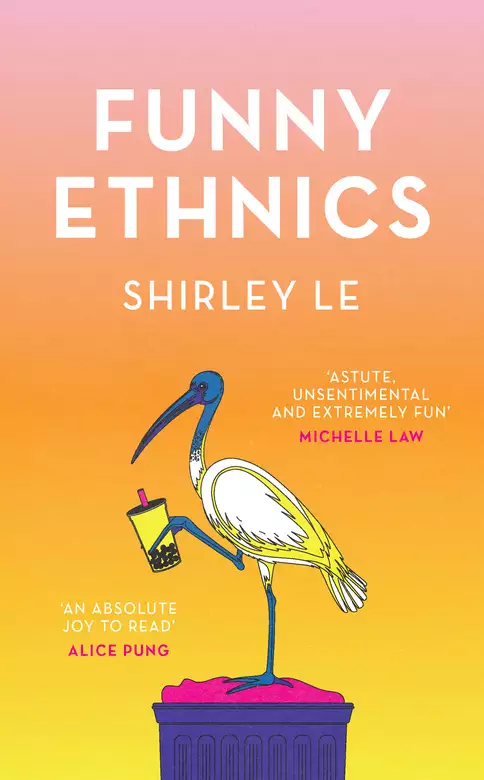
I looked at the streets of Yagoona through eyes stinging with melted Maybelline liquid liner. Yagoona looked back at me, the wannabe hipster who dreamed of moving to a share house in the inner west, and cackled. Funny Ethnics catapults readers into the sprawling city-within-a-city that is Western Sydney and the world of Sylvia Nguyen: only child of Vietnamese refugee parents, unexceptional student, exceptional self-doubter. It's a place where migrants from across the world converge, and identity is a slippery, ever-shifting beast. Jumping through snapshots of Sylvia's life - from childhood to something resembling adulthood - this novel is about square pegs and round holes, those who belong and those on the fringes. It's a funhouse mirror held up to modern Australia revealing suburban fortune tellers, train-carriage preachers, crumbling friendships and bad stand-up comedy. In Funny Ethnics, Shirley Le uses a coming-of-age tale to reveal a side of Australia so ordinary that it's entirely bizarre.
Release date:
February 28, 2023
Publisher:
Affirm Press
Print pages:
272
* BingeBooks earns revenue from qualifying purchases as an Amazon Associate as well as from other retail partners.
The round marble table in our kitchen was the most precious thing in my parents’ home, cool and smooth as an ice rink. We ate dinner there every night, and piled our plates, bowls and chopsticks on top of cork coasters of all shapes and sizes from Kmart. Ba even took off his watch and Mẹ took off her jade bangle before sitting at the table. Anything to avoid scratching that perfect, glossy surface.
I invited Ba, Mẹ and Cousin Đức to the table. I had an important announcement to make. Earlier, I had cleared away the bowl of kiwi fruit and the napkin dispenser, as well as the matching cork coasters. Just in case things became physical. I thought I was being strategic by arranging our meeting at this particular location. The fossil table was Ba’s prized possession. He had swapped out our old kitchen table from Vinnies with the plastic cover after he got a promotion at work. When his cousin from France came to stay with us, he spent thirty minutes explaining to her that the table was forty thousand years old and watched as she traced her fingers over the little crustaceans that had curled up and died in the slabs of beige stone. ‘C’est magnifique,’ she murmured, her fingers stopping at the reflection of Ba’s beaming moon face. After she retreated to our guestroom, Ba polished the table with a squeegee and a triple spritz of Ajax.
Ba, Mẹ and Cousin Đức followed me to the table, their foam slides clacking along the tiles. I tried praying but it felt futile. Buddha probably wouldn’t be on my side for this.
‘Nói đi.’ Ba thrummed his thick brown fingers against the table and Mẹ’s uneven lips clamped together. I looked to Cousin Đức. His eyes read, Is this dumbass pregnant?
The announcement came out like this:
‘Dad, Mum, Anh Đức, I’ve been thinking a lot about my future.’ I concentrated on the curtains behind them and suddenly remembered the time when I’d removed the curtain material so I could have a dress like the one Julie Andrews had on in The Sound of Music. ‘I’ve decided to drop out of my law degree to concentrate on becoming a writer.’
Different things started happening at the same time.
Ba sighed and dropped his liver-spotted head into his liver-spotted hands. Mẹ decided it was a good time to communicate to Buddha. ‘Trời ơi, trời ơi.’ She gazed up at the ceiling where a daddy-long-legs had once dropped into her permed curls and got its legs tangled up in the coarse black strands of hairspray-lacquered hair.
Cousin Đức leaned back, ran his fingers through his jarhead cut and said, ‘I don’t have time for this crap.’ He scooped up his BlackBerry and left Ba, Mẹ and me sitting there. We listened to his yellow RX with the red leather seats backing out of the driveway.
I should’ve known that Cousin Đức wouldn’t get it. He was a Birrong Boy who could go through his school photos and point out who’d been ‘bashed, stabbed or shot’, was now a banker who walked along Kent Street in his real leather Hugo Boss jacket that cost $1800. Why wouldn’t his cousin, educated at a prestigious selective girls’ school, be able to stick it through law school?
‘You want to know why no Vietnamese people become artists? Because we’re not idiots!’ Ba scoffed across the table while Mẹ pleaded to the ceramic figure of Phật Bà to save me from my own stupidity.
As I sat there taking shit from my parents, I thought about Chú Sáu, my father’s youngest brother who lived in Saigon and the only artist I was related to. I had seen only one photo of him. He was a younger version of my father except his thick hair and eyebrows were completely silver. His cheekbones sat high on his face, unlike my father’s, which sank beneath his fleshy cheeks. During the war, Chú Sáu had been a soldier for the South Vietnamese army. After a bullet grazed his spine, he was unable to walk for a whole year. When he regained the strength in his legs, he had a limp where his right leg shook and lagged a second after his left leg. In the years after Saigon fell, he was unable to find a job because of his gammy leg and because he had fought for the ‘wrong side’. Chú Sáu started carving objects out of wood discarded by local carpenters and sold his sculptures down at Chợ Lớn for pennies. One Christmas, he sent over a wooden Minnie Mouse wall hanging that he had made. My parents told me that Chú Sáu had to become an artist as a means of survival. Now I wondered whether that was true. What if Chú Sáu wanted to create intricate sculptures of ships, buffalos and flowers after being paralysed for a year? Everything I knew about Việt Nam – the place, its people, its culture – was filtered through my parents.
In the week leading up to my grand announcement, I had written and rehearsed a monologue in Vietnamese and English. I planned to deliver the piece in both languages. Vietnamese for my ba and mẹ. English for Cousin Đức.
I typed the following into Google Translate:
Dad, Mum and whoever else is here for moral support (that’s you, Đức), I have thought a lot about this and have decided to drop my law degree. I will still continue with my arts degree so I can graduate sooner and focus on becoming a writer. I know you are all going to be very disappointed in me because you think I’m going to mooch off you and be a burden on you for the rest of your lives. Don’t freak out. I’ve submitted forty job applications and have a few interviews lined up in the coming weeks. I will prioritise finding a full-time job. I just cannot survive in a classroom for another three years.
I practised this monologue in my room, in front of the mirror, holding a hairbrush like a teen hero in Lizzie McGuire or Degrassi. As I practised each line out loud, I watched my face closely. My square jaw, shaped like my father’s, clenched after every sentence for emphasis. When I got to the ‘Don’t freak out’ bit, I noticed my uneven lips, flat on the left side and angled upwards on the right, just like my mother’s, twitch slightly as if I was being sarcastic. I kept practising those three words, trying to suppress my mother’s anxious twitch.
That night after my grand announcement, I sat on my bed with my laptop propped up on a pillow, clicking refresh on my emails, hoping for more job interviews to come through. At 1am, a new email appeared. A promotional deal from Domino’s. Three pizzas and a garlic bread for thirty bucks. I shut down my laptop and reached for Nam Lê’s The Boat.
When Nam Lê won the Prime Minister’s Literary Award, Bác Lan had come over to our place with a bag of chokos. ‘Did you hear about that Vietnamese kid down in Melbourne who won an award for his book? He’s my friend’s son. I’ll get you a signed copy. He won a hundred thousand dollars.’
Bác Lan gave Cousin Đức an autographed copy of The Boat but Đức claimed that he ‘didn’t have time for literature’, so the book stayed behind in Yagoona.
I flipped to the first story, ‘Love and Honour and Pity and Pride and Compassion and Sacrifice’, and read about a Vietnamese protagonist quitting his lawyer life to go to the Iowa Writers’ Workshop. The protagonist’s father asks, ‘How far does an empty stomach drag you?’ and the protagonist replies, ‘A scholar is a blessing for all his relatives.’ I knew how the rest of the story went – I’d read it again and again after rehearsing my monologue throughout the week. I opened up my phone and looked up Nam Lê on Wikipedia. I wasn’t sure what to believe. Was he really a professional gambler now? Was poker more lucrative than writing? I googled ‘Nam Lê gambling’ and found an article in The Australian reporting that he’d earned US$200,000 in World Series of Poker tournaments. I was trying to convert US$200,000 to Australian dollars when I heard a fist hit the door of my room.
‘Mở ra!’ Mẹ yelled. Were my parents about to beat me up? At 2am? They used to tell me they were too soft on me and that Koreans hired people to smack their kids if they got bad grades. Apparently, that’s why all their kids got into James Ruse and ended up as surgeons or investment bankers.
I slid my phone into my pocket and opened the door, careful to keep it at arm’s length.
Mẹ’s face was grey, covered with a film of sweat.
‘It’s Ba!’ She grabbed the sleeve of my pyjamas and pulled me towards their bedroom next door. The lights were on and I winced as my eyes adjusted to the brightness.
Ba was crouched on the floor beside the double bed, his hands hovering over his nose and mouth. Holy fucking shit, I never knew he was that small. Deep red ribbons of blood streamed from his nostrils and through his fingertips. The bedsheets were covered in tissues soaked in blood, some of which had oxidised into an eggplant purple.
‘He’s been bleeding for hours. Nothing will stop it.’
Mẹ wanted me to call an ambulance and our cousin Anh Cường. Anh Cường was technically my cousin-in-law and a GP too. His main ailment was ‘sợ vợ’, which literally translates to ‘scared of wife’, aka pussy-whipped. He lived a couple of streets away and came over to our place whenever his wife (my cousin) Chị Hồng was giving him the shits. The visits had been most frequent during their first year of marriage, which happened when I was still in primary school. Even though Hồng was our blood relative, we were Team Anh Cường. Ba always made time to listen to Anh Cường’s gripes about ‘coming home to a mountain lion’. Anh Cường gave us doctor’s certificates whenever we needed them.
The lowest point was when we were getting ready to go to the Easter Show one year. Anh Cường had dragged his sorry ass over to bitch about Hồng after she had turned up at his Fairfield clinic because he wasn’t picking up her calls. He’d locked himself in his office and she’d thrown a children’s stool from the waiting room through the door. Because divorce was one of the most face-losing things that could happen in the Vietnamese community, my ba helped Anh Cường to plan an elaborate strategy. Anh Cường was to tell Hồng that two weeks’ worth of her pay as a pharmacist was going to be used to fix the door. Then he had to threaten to close down the clinic and quit being a doctor. Chị Hồng would be so spooked about not having the title of ‘doctor’s wife’ that she’d have to stop turning up at the clinic. We missed the whole Easter Show because Anh Cường stayed past nine. Instead of watching the fireworks at the Showground in Homebush, I slunk into my bedroom and rolled my eyes as Anh Cường sobbed into our living room couch. Ba’s advice seemed to ‘work’. The next decade of Anh Cường and Chị Hồng’s marriage was slightly better. They didn’t get into as many punch-ups.
Anh Cường arrived at our house at the same time as the ambos. Mẹ went with Ba in the back of the ambo to the Bankstown Hospital ER. I went with Anh Cường in his $400 bomb-of-a-vehicle. Inside I sat among babies’ toys that stank of vomit and saliva. A deflated beach ball and a broken baby carrier were strewn across the back seat. Both of his kids were now over three and Hồng the Mountain Lion drove their 4WD. There was no excuse for Anh Cường to keep this much junk.
It puzzled me why he didn’t buy himself a Mercedes with his doctor dollars. When I asked him one time, he had frowned, the middle part of his hairline hunching forward. ‘My practice is in Fairfield. It’s dangerous to let people there know you have money.’
We trailed behind the ambo on Church Road. I didn’t understand why the sirens were going when the only thing on the street was a smoky blue haze – a hangover from the doughnuts the local bros had been doing. As Anh Cường’s car swerved onto the roundabout on Auburn Road, he said in his high squawky voice, ‘Don’t worry, one of Uncle’s major blood vessels must’ve popped. That’s why there’s so much blood. Might be due to stress. Did anything major happen in the last twenty-four hours?’
I chewed on the insides of my cheeks before responding. ‘Ah, yeh, I told him and Mẹ I’m dropping law.’ I propped an elbow up on the car window and glanced at Anh Cường. He pressed an old Nike shoe against the brake and the car rolled to a stop at a traffic light. The red circle of the light above us was reflected in his circular steel-framed glasses. The light turned green and he pressed on the accelerator.
‘I didn’t want to be a doctor,’ he said. ‘I wanted to be a professional chess player.’ I believed him. He had the haircut for it.
He continued, ‘I hated every single goddamn day of that med degree but let me tell you something, Sylvia: when I became a GP, I realised it’s not about the money’ – Cường paused and I waited for him to tell me it was about helping people – ‘it’s about the respect. You know how hard it is for us to get some respect ’round here? I know you’re a smart kid who likes to read and your arts degree probably teaches you to have a lot of opinions, but no one’s going to listen to you if you’re not doing something decent with your life. Our community doesn’t need artists just as much as we don’t need drug dealers. We need lawyers, we need doctors, we need a bit of respect, Sylvia. When you feel respected, you feel human.’
He eased into a parking spot inside the hospital gates. I got out and slammed the door, hoping the car would collapse from the force. The sky was burnt toast. My ankles were cold. Inside the hospital, we sat in the waiting room next to a gangster wog who was jiggling one leg while his other leg was propped up on one of the hard plastic chairs. His Lonsdale tracksuit was rolled up to his thigh and fresh blood trickled from his knee and all down his shinbone. Ba was bleeding more so the nurses prioritised him. I watched him being wheeled into the ER on a stretcher. Mẹ followed behind, clutching tissues soaked in blood. I looked up at the yellow numbers on the digital clock on top of the TV in the waiting area. 3:00AM. My eyeballs were so dry it felt like they were coated in chicken salt.
Anh Cường clapped a hand on my shoulder. ‘Don’t be selfish, okay? Growing up is about taking responsibility and sometimes doing stuff you don’t like, kiddo,’ he said in his wobbly kookaburra voice. I felt the cold silver wedding band on his finger through my pyjama top, digging into my flesh.
1
AFAIK
‘One cell in our body can contain the whole universe, can contain all our former generations and our ancestors.’ A tender voice crackled through the speakers of Mẹ’s Sony CD player in the kitchen, the nutty, amber smell of sesame oil floating behind it. It was her favourite prayer CD, narrated by Thầy Thích Nhất Hạnh, a Vietnamese monk who spoke both Viet and English. This was the most intriguing line in his lecture. I imagined the spirits of my ancestors floating around in their own version of the Magic School Bus, just like the bright yellow one in my favourite cartoon that could shrink itself to the size of an atom and squeeze through a cut in the skin. Magic busloads of old Viets cheering yeehaw as they rode through waves of blood cells shaped like Babybel cheese. Surely this wasn’t what Thầy Thích Nhất Hạnh actually meant? I asked Mẹ for some clarification and she said, ‘If you are not good to your family, you will return in the next life as a cockroach. Go and do your homework.’
Some things were as easy as one plus one equals window. If Mẹ and Ba had spent four days and three nights spewing their guts on a fisherman’s boat, paddling away from pirates while escaping commies, the least I could do to repay the favour of being born in a democratic nation was to get into a selective high school. I was starting Year 5 and the Department of Education had just introduced a creative writing component to the selective school test. When the change was announced in the Sydney Morning Herald, Ba rattled the paper in his fists at the dinner table.
‘These bastards just want less Asians in the best schools,’ he thundered. ‘Kids who make up ridiculous stories in their head grow up to be serial killers or, worse, politicians.’
‘Trời ơi, don’t swear in front of Phật Bà,’ Mẹ cried, fanning the air above her as if she was trying to stop the word ‘bastards’ from wafting up to Phật Bà’s ears. She was referring to the ceramic figure of a rosy-cheeked East Asian woman rising from a pink lotus and cloaked in a white robe with golden lining at the lapels and sleeves. She was the bodhisattva of compassion, perched on top of a cabinet that displayed family photos and our collection of ‘sculptures’ – blocks of glass with 3D laser engravings of the Harbour Bridge, Opera House, Eiffel Tower, Statue of Liberty and Taj Mahal. There had been a 30 per cent off sale at the stall in Paddy’s Markets when my parents were shopping for Australian souvenirs to take to Việt Nam. Ba thought the sculpture collection made us look ‘cultured’. Mẹ thought they cheapened our spiritual shrine to Phật Bà and often hid them behind the canisters of plastic lighters and incense sticks.
~
On the eve of Tết, our family visited Phước Huệ Temple in Wetherill Park. It was the most Buddhist thing we did all year. A queue of sedans full of Viet Buddhists blocked Victoria Street outside the temple. Ba’s face went pale when the council rangers directing the stream of traffic pointed towards the nearby ‘nature reserve’ for parking spots. Our car wobbled down a grassy hill and through puddles of mud. By the time we entered the gates of the temple, my sandals were covered in dirt and the red silk of the áo dài I wore pinched into the flesh of my underarms. Mẹ’s curls lay damp and deflated against her scalp. Ba wiped a handkerchief across the back of his neck. The sculptures of green dragons with pink tongues and curled whiskers made me giggle.
Viets gathered in the courtyard behind the temple where the ba. . .
We hope you are enjoying the book so far. To continue reading...

 Please log in to recommend or discuss...
