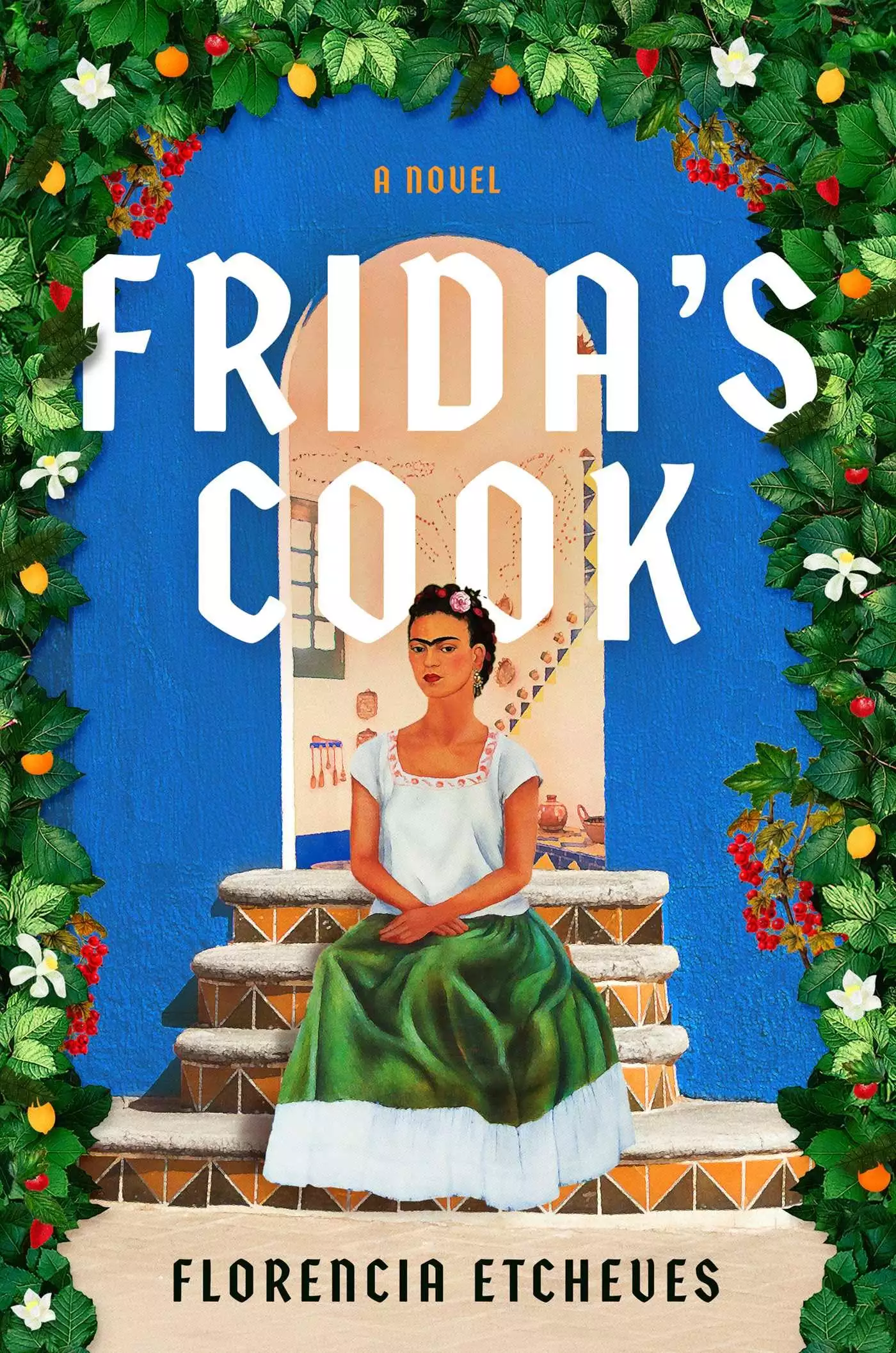
This colorful, emotive historical debut whisks us to the home of Frida Kahlo, where food, art, and love weave together an unforgettable story of friendship and loyalty, with a bright Coyoacán as a vivid background.
A hidden painting. A buried past. A legacy waiting to be uncovered.
Mexico City, 1939: Young and determined Nayeli Cruz flees from her Oaxaca home to arrive in Mexico City with neither friends nor prospects. Alone and armed only with her sharp wit and extraordinary talent in the kitchen, she finds herself in front of La Caza Azul, the home of Frida Kahlo. As she begins work as the artist’s cook, Nayeli is pulled into Frida’s world of pain, passion, and defiance. But it isn’t long before amid the vibrant tapestry of flavors, scents, and colors, the two women form a deep bond—one that will shape the course of Nayeli’s life and leave behind a secret buried in art.
Buenos Aires, Present Day: Paloma, Nayeli’s granddaughter, stumbles upon a mysterious painting depicting her grandmother as a young woman. The artist’s identity is unknown, but the artwork’s existence threatens to unravel long-held family secrets. As Paloma delves into her grandmother’s past, she uncovers a tale of passion, betrayal, and resilience that challenges everything she thought she knew about the one woman who raised her.
A lyrical and timeless portrait of the human side of one of the world’s most famous painters, Frida’s Cook celebrates the power of female friendship, art, and love.
Release date:
March 10, 2026
Publisher:
Atria/Primero Sueno Press
Print pages:
368
* BingeBooks earns revenue from qualifying purchases as an Amazon Associate as well as from other retail partners.
My grandmother was an expert on other people’s deaths. Mexicans have an intimate, almost carnal relationship with the art of dying, and that made her something of an authority on the subject. As though hoping to offend it or drive it away, she gave death mocking nicknames that turned it into a skeletal, hairless old crone: La Huesuda, La Parca, La Chingada, La Pelona. But no amount of defiance could hold off the inevitable.
“The party’s going on without me, mi niña,” she murmured as I rested my hand on hers. The powerful torrent of her voice had weakened to barely a trickle. “La Huesuda is close by; I’ve seen her. Can’t you smell her?”
On the nightstand, a glass jar with water and slices of orange and ginger filled the room with the smell of citrus, an aroma that took me back to childhood afternoons, those hours sitting at my grandmother’s kitchen table following her precise instructions: cut limes and grapefruits into nice thin slices, combine rosemary, bay, thyme, and mint in piles no bigger than my palm, and crush vanilla pods and cinnamon sticks in the stone mortar until you have a powder like fine sand. The alchemist who had taught me to make natural room fragrances was lying in bed, slumped back against the white pillowcases, swaddled up to her chest in one of those dark purple woolen blankets that make every geriatric bed look the same.
“I hope the exit is joyful, and I hope never to return,” she declared.
I didn’t know how to reply, so I made do with squeezing that bony hand, which time had worn down to the size of a child’s, and eyed a pot of cream sitting next to the orange aromatizer. Opening it carefully, I sank my fingers into the gloopy white concoction; with my free hand, I pulled off the purple blanket and slowly slid back her nightdress.
My grandmother’s legs still held their shape and tone. She had always claimed to have a ballerina’s legs, and no one had ever dared refute it. The years had discolored her brown skin; any veins that were once hidden had started to show themselves, forming a pattern resembling a map scored by thin rivers that stretched from her ankles to her thighs, crossing her knees at either side. I followed those blue lines, depositing small dabs of moisturizing cream as I went. When her legs were covered in white dots, I used my palms to massage them, slowly but firmly. Every muscle, every pore, every inch. I paused at the birthmark on the side of her right thigh, just above the knee: a complete oval the size of a coin. My grandmother tended to wear skirts long enough to cover the spot but short enough to show off the perfect curves of her calves. But on hot summer nights, her thin muslin nightdresses allowed me a glimpse of that mark that, to my child’s eyes, made her special.
As I stroked the dark chocolate-colored outline with my index finger, I remembered her reaction when I asked how she got the mark. She had swiftly smoothed down her dress, as though I had caught her doing something wrong. Staring at the floor, she told me in a whisper that many years ago, in her native Oaxaca, a group of hunters had stopped to rest by a huge rock on a hill. On that rock, they found a silhouette drawing of a naked woman with long, long braids and a mark on her thigh. Nearby, they found vast amounts of lead ore. Without hesitation, thinking of all the bullets they could make, the hunters filled their bags. Most of those men were never seen again. The locals swore that at night they could hear their terrified cries. Only one returned and, with a panicked look in his eyes, claimed repeatedly that the naked woman with the braids and the mark on her leg had the demon in her. My grandmother swore that she was a direct descendant of that Indigenous woman. And I was so convinced that for a long time I used to draw the birthmark on my own leg with a brown pen. It was the only way I could feel like I truly belonged to my grandmother’s lineage. A rather ineffectual way that vanished every night with soap and water.
“That’s it, Paloma. It’s time to let her go. She has to follow her path,” said one of the nurses, placing a warm hand on my shoulder.
Nayeli Cruz, my grandmother, the magical Mexican, died at the age of ninety-two, before I could finish rubbing cream into her ballerina legs.
We hope you are enjoying the book so far. To continue reading...

 Please log in to recommend or discuss...
 1
1  Buenos Aires, August 2018