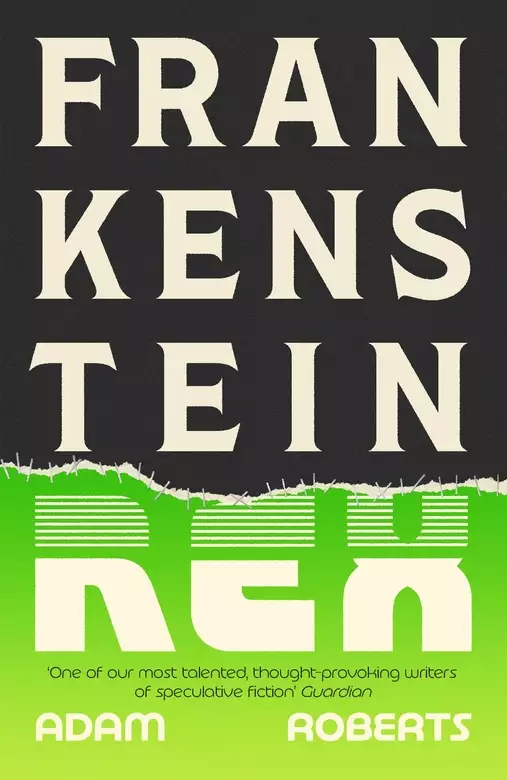
Frankenstein is the name of the maker, but we always think of the monster...
And what a monster he is. Frankenstein is a splendid creature, in almost every respect superior to humanity: smarter, stronger, and able to endure extremes of heat and cold that would kill a normal person. He is also effectively immortal.
Such a being, released into our world, would sooner or later come to rule it. Welcome to FRANKENSTEIN REX.
The monster's ugliness is a positive advantage: his towering height and ghastly face scream power; and people, who understand that power is never pretty, that it is brute and unpleasant and that our best chance is to have it on our side rather than set against us, flock to follow him. In a few years the monster conquers Europe, and in a matter of decades he rules the whole world.
But although generations come and go believing their world-dictator to be immortal, the creature himself now understands that he is dying. The creature re-opens Frankenstein's original research, to re-discover those lost skills and techniques and so to create for himself an heir.
Frankenstein Rex is a meditation on the nature of power. It is a conventional position to consider the tyrant as a monster - to think of Hitler, or Mao, or Stalin as monstrous aberrations from the human norm. By making the monster the tyrant, Roberts invites us to think about how ordinary and how conventional such figures actually are.
Release date:
October 15, 2026
Publisher:
Orion
Print pages:
288
* BingeBooks earns revenue from qualifying purchases as an Amazon Associate as well as from other retail partners.
Two policemen sat at a table outside a city café. A bright, brisk June day in Nalchik: the sky the colour of blueberries, the sun yellow-molten and intensely bright, clouds like eggshells. The men were each drinking a tall glass of Narzan sour water, together with small glasses of Kuban schnapps, red as a ruby. They were talking about nothing very much. A fine, sunny day, summer sweetness in the air, and the mountain towering over everything.
‘Officers?’
A small man had approached them. He was holding his cap in his hands.
‘Citizen?’
‘It is my duty to report suspicions concerning that individual.’ He gestured with his cap.
A young fellow – tall, dressed in expensive outdoor wear – was sitting alone at a table on the other side of the café’s patio. A glass of white wine stood on the table before him. He had with him a high-velocity rifle, hung by its strap from the back of his chair. The stock and barrel of this weapon had been painted white. A backpack, with a rolled-up tent tied on top, sat on the pavement beside his chair. He was looking up at the slope and immense twin pinnacles of Elbrus on the horizon.
‘He is English,’ said the citizen, leaning in confidentially. ‘Or else Yankee, or perhaps Australian. I heard him speaking on his phone. I recognised the language.’ One of the policemen inclined his head slightly. ‘I am,’ the man explained, ‘a teacher. I teach languages in the Victor School on Rue de Châtiments, and so I was able to understand what this individual was saying.’
‘My son is studying English,’ said the second policeman, an officer called Kalmykov. ‘I do not understand why. Learn Chinese, I said to him. Much more useful. Says he wants to be able to read Shakespeare in the original. But why? He is perfectly serviceable in French!’
‘I thought he was French,’ said the first. ‘If not, why is his name Pierre?’
‘It is my duty to report,’ said the citizen, ‘that this Englishman has come to Nalchik to kill the king.’
‘I see,’ said Officer Kalmykov. He lifted his blood-scarlet drink and took a sip. ‘Has he said as much? Did he say so directly?’
‘I overheard him.’
‘You overheard him say I will kill the king?’
‘I did not hear that precise phrase,’ said the schoolteacher stiffly. ‘But he was consulting with another, on his phone, about ascending the mountain. And as you can see, he has a gun.’
‘Thank you, citizen,’ said Kalmykov. The officer pushed back his chair and stood up, putting his glass down on the table. His colleague, Feododsidi, drained his schnapps, took a swig of sour water, and only then got up. Kalmykov unbuttoned the flap of his holster.
The two policemen made their way across to the foreigner’s table. ‘Excuse me, citizen,’ said Kalmykov.
‘Yes? Yes? What do you want? I am a traveller, a tourist.’ The fellow spoke French clumsily, and with a sliding accent, but at least he spoke it. ‘I am here to hunt, therefore the rifle. I have a permit to hunt.’
Kalmykov sat down. Feododsidi remained standing, his hand on the stock of his holstered pistol.
‘You were overheard talking on your phone,’ said the policeman. ‘It so happened that the citizen understands the language of England, which you were, he says, speaking. Accordingly, the burden of your conversation was comprehended.’
The foreigner looked across to where the schoolteacher was still standing. ‘It is not illegal to talk in English.’
‘Indeed not. You are English?’
‘I am a citizen of the world,’ the man replied, ‘as is everyone.’
‘Indeed, but I am speaking provincially. You might be Yankee.’
‘I am from Somers Town, which is in London,’ said the man.
‘London, England?’
‘Yes.’
‘And will you furnish us with your name?’
‘My name?’ The man looked about him. ‘My name?’
‘We have reason to believe,’ Feododsidi put in, ‘that you have travelled here with the intention of assassinating the king.’
The man stiffened. His left hand slipped over the armrest and fell against the rifle, hanging from the back of the chair.
‘It is an absurd accusation,’ he said. ‘There’s no proof of this thing. There is here never crime.’ He looked from one to the other and tried again. ‘There is here no crime.’
‘Mister English,’ said Kalmykov easily. ‘Please remove your hand from the rifle. We have not approached you to arrest you.’
‘Arrest me?’ said the Englishman. ‘Not arrest me?’
‘What would be the point?’ Kalmykov said. ‘Do you have any idea how often people turn up here, intending to reach the king? Intending to kill him, or petition him, or marry him? They never succeed.’
The stranger’s gaze drifted to the mountain. ‘You are saying he cannot be reached? Because of the elevation? The altitude? Therefore?’
‘He can certainly be reached,’ said Kalmykov. ‘Elbrus is high, but it is not an impossible climb. Or it is possible to find a way up the funicular, and then the elevator that services the Upper Palace – the site needs servants and technicians, handymen and repairmen, and there are very often performances, concerts, balls. To say nothing of the parliamentarians and their aides and secretaries, the court, councillors and their staff, journalists. What with one thing and another there is a great deal of traffic up and down the mountain. It is not beyond the wit of man to insinuate himself, or herself, into that flow. And the palace is not so very heavily guarded. No, he can be reached. But he cannot be killed. You think a bullet will end his life?’
The stranger looked at his drink, on the table before him. ‘He breathes,’ he said cautiously. ‘A heart pumps blood around his body – if you can call it blood. He eats and drinks, he shits and pisses.’
‘You are being juvenile,’ said Kalmykov.
The foreigner looked appraisingly at the two policemen, one seated, one standing, as if calculating the odds of being able to unhook his rifle from the back of the chair, level it and fire before the two of them drew their sidearms. Then he withdrew his hand from where it was touching his gun and dropped it in his lap. With his right hand he reached forward and took hold of his wine glass, lifted it. ‘Tyrannicide,’ he said, as it sat at his lips, ‘is not a crime.’
And he drank.
Kalmykov smiled. ‘Such would be your legal defence?’ he asked.
The foreigner replaced the glass on the table in front of him. ‘It is a great truth.’
‘But it is not the law. No court would accept such a defence. Not that it matters, since you cannot be tried for killing the king, on account of you not being able to kill the king. He cannot be killed.’
‘It is almost as if you are encouraging me to try,’ the stranger said with a smile.
‘Mister English, on the contrary. We are intervening, and we are doing so with your safety in mind. The king cannot be killed, but you certainly can. You are a traveller, and we have a duty of hospitality, of care, towards you.’
‘You will not arrest me?’
‘What would be the point? What you are proposing is not a crime – not because of what you said about tyrannicide, but because it is impossible. We might as well make it against the law to jump in one leap to the moon.’
‘Officers,’ said the foreigner. Then he said something in English, which neither man understood. ‘Forgive me,’ he said, in French. ‘I am free to go?’
‘If you are determined upon this act of attempted assassination,’ said Kalmykov, ‘you are in effect declaring your intention to commit suicide.’ He smiled. ‘We have a legal duty of care to prevent such self-murder.’
‘Stop toying with him, Pietr,’ said Feododsidi. ‘Stand up, Mister English.’
‘What’s that?’
Feododsidi took out his sidearm. ‘Stand up and step away from your rifle. I am arresting you on suspicion of high treason and conspiracy.’
‘But he said,’ exclaimed the foreigner, gesturing at Kalmykov, his strange accent growing more pronounced. ‘He has said, he was saying, that I is not to arrest!’
‘I said, what would be the point in arresting you?’ said the seated policeman, smiling. ‘But sometimes pointless things do happen.’
‘I am innocent!’ the Englishman declared. Feododsidi brought his gun level with the fellow’s face. The fellow scrambled to his feet, the chair squealing back across the stone tiles as he did so. ‘I am an innocent!’
‘Tyrannicide is not a crime: hardly the words of an innocent man, as he sits with a high-powered rifle at the foot of the palace from which the king rules the world.’ Feododsidi kept his sidearm aimed at the Englishman, and Kalmykov got to his feet. As he unhooked handcuffs from his belt, he said, ‘It was arrogant to sit here, in public, discussing your crime openly on your phone. But I suppose you did not expect anyone around you to speak English.’
‘I am innocent,’ said the Englishman as the cuffs went snicker-snack. ‘This is – it is – I am rights! That’s to say, I have rights.’
‘Indeed,’ said Kalmykov. ‘Thank you for reminding me. I am to say to you, you have legal rights, including the right to fair trial and legal representation; if you do not have your own legal representation, a lawyer will be provided for you. Do you understand these rights as they have been explained to you?’
The schoolteacher, observing the arrest, came over. ‘Will you need my details, officers?’ He sounded excited. ‘Perhaps I will have to testify in court?’
‘My colleague will take your details,’ Kalmykov said, leading the Englishman over to the car, parked twenty metres away.
They put the Englishman in a white cell on the lower basement level of Nalchik Central Police Station. Bright ceiling lights, tiles on the wall like so many freshly scrubbed teeth. A mosaic of hard whiteness, too many tiles to count. The Englishman tried, though; after a day, or maybe more, of constant light and no stimulation, the boredom became a heavier burden even than the hunger. He started at the bottom, the layer of tiles nearest the floor, to the right of the door, and began counting along, wall by wall. He lost count somewhere around the door-jamb and started again. This time he got most of the way up the wall to his right when the lock growled like a dog and the door swung open.
An officer stood in the doorway. ‘Name?’ he demanded.
‘I am entitled to legal representation,’ said the Englishman. His mouth was dry: thirst, not fear. He had been in this bright cell without anything to drink for a long time.
‘It will be provided. Details first.’
‘I will provide my details and explain the justice of my situation to a judge.’
‘Name?’
‘To a judge only.’
The officer grunted and dropped something to the tiled floor. It landed with such a clang, like an untuned bell being loudly struck, that the Englishman jumped – he actually bounced his cul a little up from the wooden bench on which it was sitting.
The door groaned shut and the Englishman could see that the item was a metal water flask. He picked it up, opened it and drank greedily. The water tasted of chlorine, or perhaps ammonia, but it went down and he did not sick it back up.
He went back to counting the tiles. This, his third attempt at the task, was abandoned somewhere near the bottom of the second wall, because he was tired.
He lay on the bench. It was not long enough for his 1.9-metre body. The cell itself couldn’t have been more than a 1.8-metre square. He tried lying along the diagonal of the floor, but the tiles were cold and hard. The bench was not so chilling and a little less uncomfortable. But it was still uncomfortable.
He slept uneasily, light seeping through his closed eyelids, and woke repeatedly, hearing things, or imagining that he did: the door opening – but no, it was still closed. He closed his eyes again and tried to sleep. Shouts and screams through the walls: or a dream of such things.
He woke into a kind of stupor. Then he came to fuller consciousness, sat up, took another draught of water. He was conscious of the need to urinate, but there were no facilities in the tiny cell. Should he piss on the floor? A dirty protest. Then he looked at the flask in his hand, drained it, and slotted his penis into its mouth. As he emptied his bladder, he thought of the slightly ammoniac flavour of what he had just drunk and then decided not to think of that any more.
He screwed the flask lid back on, put the bottle in the corner, and began his fourth attempt at counting all the tiny white tiles on the wall.
He lost count of the number of times he lost count of the number of tiles on the wall. Sometimes his sight would grow hazy, and he would fall asleep sitting up, a micro-nap from which he jolted awake – a clonic jerk. Sometimes he got bored with his strategy to alleviate the boredom and just gave up counting. He tried not to think too closely about his situation, legal, personal, or his prospects. I have, as yet, he told himself, broken no law, committed no crime. Once my legal representation arrives, they will surely arrange for me to be paroled. If the terms of my parole permit me to return to England, I will; if not, I will wait out the time here. They have no evidence. They know of no other names – not even mine.
Of course, he was aware that the king had the power to disregard any law. He, the monster on the mountain, was the living embodiment of the state of exception. This fact meant that agents acting on the royal behalf could disregard any law. They could keep him locked up here indefinitely, with or without evidence.
What he didn’t want to think was that they had evidence. They had his rifle, and more to the point, his ammunition. If they were clever enough to decode it, to determine of what those cartridges consisted, then he would indeed be in trouble. In which case, the guillotine was a swift death. They also had his phone. Here, the Englishman could only hope that his comrades were able to dispose of their own devices, to ditch their identities, to go to ground. He did not doubt the contacts list could be accessed, and the pseudonyms deciphered. But there was nothing he could do about that.
He thought back to the two policemen accosting him in the Café Liberté yesterday – or the day before, he wasn’t sure. One had been serious, focused, primed for engagement; the other (he could not recall either of their names) seemed to treat the encounter as a joke, approaching it with sardonic levity. A strange coupling.
He sighed, curled himself up on the bench and tried to sleep again.
He succeeded so well that he didn’t hear the door open a second time and had to be awoken by a hand grasping his shoulder and shaking him.
They handcuffed him again and took him along a dark corridor. After so long in the diamond brightness of the first cell, the dimness came upon his eyes as a complete blackness. But by the time they had bundled him up a flight of stairs, him cracking his shin against the first step, he was starting to make out shapes in the murk. A man standing by a door that opened onto a room, a large space judging by the acoustics his footsteps and panting breath made. They pressed him into a chair and then a light was turned on: a single shaft of brightness washing the table before him in illumination. On the far side of the table was a figure, also seated. The Englishman couldn’t make out his face, but there was a bulk to his silhouette, a heft across the shoulders.
‘The clichés of interrogation,’ the Englishman said, in his native tongue. ‘It’s disappointing to see such lack of originality. Still, what can one expect from the slaves of a tyrant?’
‘It is only through the absolute governance of the king,’ the interrogator replied, also in English, though heavily accented, ‘that we can be free. It is you that are the slave, my friend: the serfdom of rebellion, the fanaticism of terrorism, the unfreedom of death. Come, unburden yourself – your name, your cadre, the names of your co-conspirators; give it all up and become free.’
‘Well,’ said the Englishman, surprised. ‘Quite the opening gambit! I must admire your fluency in my language, sir, and if our purpose here is to engage in a discussion of the nature of freedom and the destiny of governance, then I am happy.’
‘Do you think we are here to have a pleasant, civilised conversation?’ asked the interrogator lightly. ‘But this English language is a barbarous one. If we are to continue conversing in it, we must adopt a different approach. I must bruise your heel.’
The interrogator tapped the table, and two men stepped up from behind the Englishman, dragged him from his chair and threw him to the floor. The ground was rough, scattered with hard particulates, and smelt of cement. As the Englishman tried to get up, one of the guards knocked him down again onto his side. The other raised his booted foot and stamped down hard on the Englishman’s ankle. He wasn’t expecting this, and the pain was immense, appalling, a savagery of sensation that made him wheeze. He screamed, and the guard stomped again, aiming for the other ankle. The Englishman whipped this out of the way of the boot, but the guards were methodical.
Ah! Ah!’ the prisoner yelped. ‘No! no! Please!’ Then, in French: ‘Please, I beg of you!’ But one guard held the leg and the other crashed down once, and then twice, and then a third time, on the bruised ankle. The pain was worse this time, a splintered, acidic agony, and as the guards pulled him up by his armpits and deposited him back in his chair, the Englishman was sobbing, gasping and struggling to breathe. He wanted to reach down, to feel his ankles, to get a sense of the damage to his tender flesh, but the guards pushed his manacled hands onto the tabletop and secured the chain.
The interrogator was talking again, but the Englishman could not understand the words, because the pain was throbbing and shrieking from his feet up his legs. He writhed in the chair, and slid off, which made the pain worse. His hands were fixed to the tabletop and the guards picked him up and put him back in the chair. The interrogator was still talking. It occurred to the Englishman that he was saying something in English – something about barbarity and civilisation – and he grasped, with sudden insight, what he had to do.
‘I apologise,’ he said, in French. ‘I beg of you, please to continue your questioning in a civilised language.’
The interrogator grunted. ‘Very well,’ he said, and with a lift of his finger the two guards stepped back. ‘Speak to me: your name, your address, your purpose in being here, and most especially, the names of your co-conspirators.’
‘I am here,’ said the Englishman in French, his voice catching as sparks and hot bubbles of pain boiled upwards from his agonised ankles. There was a throbbing pattern of intensification and retreat with the pain: waves of horror lapping against the shore of his being. Tears streamed from his eyes. It was difficult to breathe. It took effort not to slide from the chair. ‘I am here on a hunting holiday.’
‘You are hunting big game on the lower slopes of Elbrus?’
‘No, not upon the mountain itself, of course – ah! – of course I know that’s, that’s, I know that it is out of – what is the word? I know it is un-permitted. Forbidden. And there is no game above the snowline anyway. I came here to hunt the forests. Bears, lions. Wolves. On the forests. In the forests. I have permit!’
‘You do? Show me.’
The Englishman was momentarily confused. He thought of asking to have his hands released so he could reach into his pocket and bring the permit out, but then he remembered, through the fog of pain, his actual situation. ‘But you have – you have –’ What was the word? ‘You have taken, you have taken.’ The word came to him: ‘You have confiscated all my possessions. The permit must already be in your possession. My possessions in your possession, and the permit also.’
‘Indeed. It is made out to the name of William Goodwinson, of London, England. Is that your name?’
‘Yes, yes,’ the Englishman sobbed. Pain was pouring up through his whole body, a sheath of sandpaper scraping along every nerve from ankles to hips, his torso flooding with sympathetic and feverish agony.
‘I do not believe you,’ said the interrogator. ‘I do not think an individual takes out a hunting permit in his own name, when his real intention is the assassination of the king of the world. No, no, this is a false name, your actual name is something else.’
‘William, William,’ said the Englishman, trying to rub his face against his shoulder to clear the tears. And then, because he feared that pronouncing the name in the English fashion might lead to more violence, he gasped, and panted, and said, ‘Guillaume, it’s me.’
‘No,’ said the interrogator. ‘But it matters less. What of your seven co-conspirators?’
‘I don’t know … I don’t know anything about …’
‘Indeed you do. We have your phone and have opened it. There are seven contacts, each with the name of a different month. No, that’s not correct; two are allotted the same month, so I assume two of your co-conspirators happened to be born in the same month. June 1 and June 2, not dates but differentiations. This is a crude attempt to anonymise real people. We will uncover their identities, and we will arrest them all. You could save us a lot of trouble by simply telling us their names.’ The interrogator chuckled. ‘You won’t.’
‘I don’t know the names,’ said the Englishman. Then, as if this simple enough statement had betrayed him, he added rapidly, ‘I don’t know anything about any of this. I am an innocent tourist, with a licence to hunt in—’
‘I can believe you don’t have access to their actual names,’ the interrogator interrupted. ‘But you have information about each and every one of them, from your, I do not doubt, many interactions, and that information will help us identify and apprehend them.’
The Englishman gave way to a flash of irritation. He said, ‘I don’t know much about interrogation, but I’m sure I’ve read that the questioner shouldn’t interrupt the subject. Let him talk. To talk, he may say something useful.’
The interrogator laughed again. ‘Good. You want to play. That will make the whole experience much more interesting.’
‘I do not wish to play.’
‘Let us, then, discuss. You wish to kill Frankenstein. To murder the king. Tyrannicide is not a crime, you said.’
‘Because I said so does not mean that I in actuality sought to kill him.’
‘It does mean that you consider him a tyrant. The king is widely beloved across the whole world he rules so well.’
‘Not everyone would agree.’
‘The king’s rule is benign. He has brought an end to war.’
‘Of course he hasn’t. There is still war.’
‘No, by definition. Wars happen between rival states or countries. He has brought about a singular world-state, and so there can no longer be war. I suppose we might encounter an alien species – perhaps some tentacular creatures inhabiting Mars, who might attack us, and then there would be a war. A war, we might say, of the worlds. But as we are, Frankenstein has effected a complete cessation of war. When you consider the belligerence of human history, how completely addicted to war humanity has always been – to death and destruction, killing human beings, smashing infrastructure, swallowing wealth – the king putting an end to that is remarkable. Only he could have done it. Democracies weren’t able to do it; monarchies, dictatorships, oligarchies, none of these governmental systems were able to do it. Only he could, because he is not like them.’
A sharp twinge from his left ankle made the Englishman suck air through his teeth. ‘But war has not been abolished. There i. . .
We hope you are enjoying the book so far. To continue reading...

 Please log in to recommend or discuss...
