
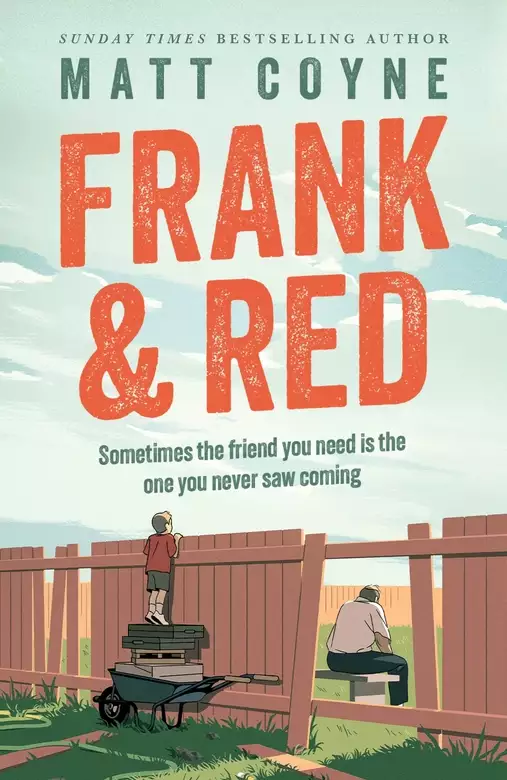
Frank and Red
- eBook
- Audiobook
- Book info
- Sample
- Media
- Author updates
- Lists
Synopsis
The brilliant, heart-warming debut novel from the Sunday Times best-selling author of Dummy and Man vs Toddler
Frank is a miserable old curmudgeon. An agoraphobic recluse and widower whose only company is the 'ghost' of his wife, Marcie. He is estranged from friends and family and is entirely cut off from the rest of the world.
That is until he meets Red.
Red is six years old. He's a funny, imaginative, and kind little boy who - following the separation of his parents - moves in next door. Red is fascinated by his new neighbour and seemingly oblivious to Frank's grumpy demeanour and strange ways.
What on Earth will come of this unlikely friendship? Only time will tell...
Praise for Matt Coyne:
'A hero for dads everywhere' Daily Mirror
'Very, very funny' Phillip Schofield, This Morning
'Hilarious but accurate account of finding your feet as a parent . . . Matt Coyne's post has struck a chord with parents from all over the world' Daily Mail
'Brutally honest rant on the reality of parenthood has taken the internet by storm' Sunday Telegraph
(P)2024 Headline Publishing Group Ltd
Publisher: Headline
Print pages: 288
* BingeBooks earns revenue from qualifying purchases as an Amazon Associate as well as from other retail partners.
Reader buzz
 Please log in to recommend or discuss...
Author updates
Frank and Red
Matt Coyne
Skreewoing.
Skreewoing.
Skreewoing.
It was the most annoying sound he had ever heard. It sounded like a squeaky toy being dry-humped by a donkey.
Apparently, the new kid next door owned a trampoline.
The only reason Frank was sitting in the back garden at all was to avoid the noise of the removal men at the front of the house. The day he’d dreaded since Mrs Palmer-Machin had moved out had finally arrived, and he had awoken to the sound of new neighbours.
Mrs Palmer-Machin had been the perfect neighbour. She had spoken only to say ‘Good morning,’ and often not even that. She rarely made any noise, and the only sound that could be heard through their shared wall was her TV, the volume of which had increased ever so slightly as her hearing began to fail.
But one evening, last December, there had been a commotion next door – the sound of something being knocked over – and Frank had looked from an upstairs window to see the old woman standing in the street in her underwear. He had gone outside, gently guided her back into her house, and found a number for her daughter tacked to the fridge. Within hours, she was spirited away to live in Cleethorpes or Skegness, or some other disintegrating seaside dump where fun and the elderly go to die.
Since that day, the only signs of life from number 32 had come a few weeks later, when Mrs Palmer-Machin’s daughter and son-in-law had arrived and begun emptying the woman’s life into bin liners, and then their car. The son-in-law, as he departed, insisted to Frank that the seaside was the perfect place for the old lady to enjoy her final years.
Of course, Frank thought, the Victorians swore by the sea air – and there was something vaguely poetic about a person seeing out their days in a place where the land runs out. But he was annoyed by the son-in-law’s cheeriness about the whole thing, and so he had replied that yeah, he was sure Mrs Palmer-Machin would be thrilled to spend her twilight years in some ‘crumbling shithole where dirt meets water’.
‘Shoot me first,’ he’d grumbled. And his old neighbour’s son-in-law had walked back to the car with a look that suggested he would quite enjoy doing exactly that.
That had been over ten months ago, and the house had stood empty since. A fact that suited Frank perfectly. Empty, that is, until today, when the sound of boxes and furniture being delivered and scraped around the house next door echoed within the walls of his own.
By 10am, Frank’s teeth began to itch with every thud and thump. And so, with a sense of weary anxiety and dread, feeling he could take no more, he’d decided – with a mug of tea and newspaper in hand – to escape into the weed forest and testicles-high grass of his back garden.
Of course, it would have made more sense to escape entirely for a few hours, to head to a local pub or coffee shop, but the thought never occurred to him. That was, after all, ‘beyond the gate’. The back garden would have to do.
Frank shielded his face as he stepped out of the back door, as though he was a vampire expecting to burst into flames. It felt alien to venture outside and into the glare of the sun, and as his eyes adjusted to the light, it came as a vague surprise to find the garden in quite such a state of disarray.
What had once been his neat vegetable patch was now a twisted mess of roots and garden canes. Ivy and wisteria battled against fence panels on either side of a narrow lawn that was now a meadow. And their old wooden greenhouse at the top of the garden leaned drunkenly, its glass pierced by brown tomato plants and prickly fruit trees.
‘Mmh.’
Casting his eyes around, Frank spotted a plastic chair on the patio behind him. It was painted green with algae, unfolded and facing the garden, as though someone had been sitting there, the entire time, a spectator to the ruin. He put his newspaper under one arm, picked up the chair and dropped it into the middle of his once carefully tended lawn. Balancing his mug of tea on the chair’s arm, he sat down with a groan.
With something approaching satisfaction, he noted how quiet it was.
Opening the newspaper to a random page, Frank’s moment of satisfaction died as he found a full-page advertisement for ‘Black Friday Deals!’ and a picture of an impossibly perfect couple standing side by side, wearing just their pants, smiling widely, having won something called Love Island. He grunted again. ‘Mmh.’
Everybody seemed to be in their pants these days. In magazines and newspapers and on TV. Always half-naked. Or worse. He had turned on the telly last night to find a programme in which people chose who to date by looking at bits of each other. He had turned over quickly, just as some over-excited young woman was choosing a possible mate based solely on a view of his pale legs and his weird bits, which dangled between them like a wonky turnip.
That was Channel 4 for you.
Turning a page and then another, it soon occurred to Frank that he had no real desire to read, particularly about celebrity nonsense and stuff he didn’t really understand, especially with the distraction of what was unfolding next door. But he continued the pretence of reading anyway, as it felt odd to just sit there, as though he himself was simply waiting to die or be carted off to Cleethorpes.
So there Frank stewed, staring at words and pictures on a page and silently cursing the turn of events that meant that the house next door would no longer be unoccupied. He was dismayed at the piss-awful idea that the new neighbour might turn out to be ‘friendly’ or, God-forbid, ‘chatty’.
This dismay now turned to horror at the thought of a family moving in, especially one with a young kid.
And especially one with a bloody trampoline.
Skreewoing.
Skreewoing.
Skreewoing.
Skreewoing.
‘Well, what do you think?’
Red stood on the path in front of the new house, his lip curled. This was not what he had imagined. In his mind’s eye, he had pictured something a bit more castle-like, with big gates. Not necessarily a drawbridge and a moat, but turrets and flags, and a garden the size of a park.
Clearly, his imagination had run away with him again.
His old teacher, Mrs Rennie, used to say this all the time. ‘You mustn’t let your imagination run away with you, Red,’ she’d say. But that just made him imagine the word as a cartoon with arms and legs, holding his hand as the pair of them ran down the street.
Yes, this time his imagination had definitely run away with him. Because what he was staring at now . . . was disappointment.
This looked boringly like an ordinary house. The smallest house in the middle of a row of small houses. And staring up at the red-brick mid-terrace confirmed something Red already knew. That the decision to leave behind their house at Stanhope Gardens had been a terrible one, and if anyone had bothered to ask him, he would have told them so.
He had never wanted to move in the first place, never wanted to leave behind the house where they had lived with Dad. And just because Dad had now gone to live with ‘Tits-and-Teeth’, Red saw no good reason why they had to move to the other side of London – and to this.
But Mum had insisted. She said the new house would be ‘cool’. She said it would be ‘amazing’.
It was not cool. It was not amazing.
When Red didn’t answer, his mum asked again: ‘So, what do you think?’ She rubbed his hand in hers. ‘It’s really nice inside. And there’s three bedrooms, so we can set up a playroom with a den in one of them. It’ll be great.’
Great. Amazing. Cool. Red was beginning to wonder if his mum knew what any of these words actually meant.
‘Well?’ she said, yet again.
It was only a tiny word, but this time Red caught something of the hope in it, the beat of sadness at his reaction, and he suddenly felt guilty.
He didn’t understand everything that had happened in the last six months. In fact, he didn’t understand anything that had happened in the last six months, but he knew his mum had cried a lot, and recently she had stopped doing that quite so much. The last thing he wanted was to make her start again. So, he closed his eyes hard, rearranged his face to look happy, turned his frown butt-side down, and tried his best to see the good.
He tilted his head and closed one eye so that he could just see the house and those on either side. ‘It looks like it’s in a sandwich.’
His mum tilted her head too. ‘Yeah, I suppose it does.’
The metal gate whined as she pushed it open. It clattered against the wall that divided their house from next door, and the two of them hopped up the three steps to a tiny front yard of empty pots, flagstones and patches of grey gravel. For the first time, Red really took note of the neighbouring houses, and he stopped before they got to the front door to get a better look.
The house to the right was a rampage of colour: hanging baskets fireworked at each side of its front door, and flowering roses bordered its edges. It looked like a garden centre, and it made Red’s nose itch.
The house to the left was its opposite, its evil twin. This house peered out from behind hedging. Its windows were dark. It was as though this house was hiding. Red liked it. It was, at least, interesting. A place where you might need a sword, or a lightsaber to—
‘Red, you’re blocking the way.’
He turned around to find one of the burly removal men standing behind him on the path, holding a huge box and smiling impatiently. Red quickly half-moonwalked aside. As the man grunted through the front door, he followed his mum into the hallway.
Inside, it smelled like biscuits, and was a bit more promising.
The door opened on to a checkerboard floor and steep, purpley-carpeted stairs with a wooden banister, which looked like it might be fun to slide down. The walls were white, decorated with that wallpaper with bits in it that you could pick at. And at the end of the hallway, beyond piled-high cardboard boxes, he could see daylight pouring into a small kitchen.
Another removal man entered, and Red’s mum tugged him to one side again.
‘So, do you want to see your room, Reddy?’
‘Yeah-huh,’ he said, not really listening. He was busy running his fingers up the banister to check for slidey-ness. It was about a six. The banister at Stanhope Gardens had been an eight.
‘Come on then, slow-mo.’
He followed her up the stairs, taking them two at a time to keep up, and arrived at the top to find the Vimto-coloured stair carpet spilling on to a small landing.
Upstairs, it smelled less like biscuits and more like Great Grandma Irene before she ‘went to a better place’ (which turned out to be heaven and not – as Red had first thought – Laser Quest).
There were four doors, and his mum opened the first with a theatrical flourish. ‘Bathroom,’ she said, allowing them both to peer inside the first door, ‘with a bath!’
They had not moved to this new house directly from the one at Stanhope Gardens, but had been staying at Auntie Steph’s flat for three months while ‘some money stuff’ was sorted. Auntie Steph’s flat only had a shower.
‘A bath! Can you believe it?!’
Yes, he could believe it.
‘And this one is my room.’ His mum opened the door opposite. Again, they put their heads through the opening, this time to see an entirely empty double room. It had exposed floorboards, scarred with old flecks of paint, and a window that overlooked the front yard and road.
‘And you, sunshine, can take your pick from the other two.’
Red looked behind him at the two closed doors and debated which one to try first. He had once read a book about a boy who was faced with the same dilemma. Behind one door had been a dragon, and behind the other had been a room full of sweets and gold, so he took his time, eeny-meenied in his head, and selected the one on the left.
No treasure. No dragon.
Just a small, dark boxroom, again with exposed floorboards, and a tiny window that was covered with yellowed newspaper. It was about the size of the food cupboard back . . .
(Home.)
The other room, though, was much bigger, with a patterned carpet underfoot and built-in mirrored wardrobes, which made it look like two rooms. It was just as dark as the tiny room next door, but this was because of the curtains that were drawn against a large bay window.
His mum peered in over his shoulder. ‘Yeah, I think this one looks best.’
‘Why?’
‘Well, it’s a lot bigger for a start. You can’t swing a cat in the other one.’
Red looked up, horrified. ‘Why would you want to swing a cat?!’
‘It’s just an expression, Red. It just means it’s not very big.’
‘Well, I don’t see why that’s the cat’s fault.’
‘Wha . . .? Just – just – never mind. Look, we can paint the walls whatever colour you want. New carpet, your Captain America lamp can go in the corner. Get some posters up on the walls; it’ll be amazing. There’s even enough room for friends to stay over, if you want.’
Amazing. That word again.
Red was unconvinced. Not just by the house and the room, but by the idea of friends staying over. He only had one really good friend, and Noah Conway now lived on the other side of the city, two doors down from the house they had deserted.
His mum gave his shoulder a squeeze as though she’d said something wrong. ‘Listen, it’s a fresh start, all this. New school will mean lots of new pals. We might need to get you bunk beds.’
‘Bunk beds?’ A brief excitement fizzed and then died. ‘Noah’s got bunk beds.’
‘I know.’
An uncomfortable silence.
‘There is something else.’ She grinned, bouncing on her toes, and clapped her hands together once. ‘Open the curtains.’
Red eyed her suspiciously. ‘These curtains?’
‘Yeah. Look in the back garden.’
He walked over to the window. A cobweb passed across his face, and he spluttered as he pulled it away. He tugged one of the curtains back, then the other, and on tiptoes, peered down into the garden below.
And then he saw it.
‘A trampoline!’
His mum laughed. ‘Yep, I had it delivered here so that you’d—’
‘A trampoline!’ he shouted again. This time, it was a battle cry as he barged past her. ‘A trampo—’ Arriving back out on the landing, Red stopped suddenly. If this had been one of his cartoons, there would’ve been the sound of screeching brakes. He turned around, ran back to his mum, hugged her legs fiercely and then set off again, half-falling down the stairs before clambering over boxes.
From somewhere above, Red heard her shouting, ‘Be careful!’ as he emerged into the garden, where, with his usual coordination, he face-planted into the lawn.
‘A trampoline!’
Skreewoing.
Skreewoing.
He tried his best to ignore it. But it was less a noise and more like his skull was being punched repeatedly from the inside.
Skreewoing.
Skreewoing.
After a few minutes, Frank noticed something from the corner of his eye. Periodically, in time with this satanic noise, a mop of blond hair would appear just above the height of the fence and then, an instant later, disappear from view once more.
Skreewoing.
Skreewoing.
He looked up and accidentally caught the attention of the owner of this mop.
‘Hi,’ the kid said.
Frank ignored him and stared at his blank crossword.
Receiving no response, the boy continued, saying a single word each time he reached the height of his bounce and could momentarily see over the fence:
‘What?’
Skreewoing.
‘Are?’
Skreewoing.
‘You?’
Skreewoing.
‘Doing?’
Skreewoing.
Frank continued to pretend the boy did not exist. It was a tactic he had discovered worked surprisingly well when you wanted people to just sod off. With adults, at least.
‘Hi,’ the kid said again.
Skreewoing.
‘I’ve got a trampoline.’
Skreewoing.
‘You don’t say?’ Frank muttered to himself.
Skreewoing.
‘Yes, I do say.’
Skreewoing.
‘It’s new.’
The annoyance mercifully stopped bouncing and disappeared from view.
Frank exhaled with relief, and he recommitted himself, for the tenth time, to seven across: ‘Wild horse’s emotion’.
This brief interlude was cut short by a clattering noise, and then the boy’s face appeared once again, this time in full view, peering over the fence. It seemed he had found an upturned wheelbarrow on which to stand and continue this apparently fascinating and vital conversation.
‘What’s your name? . . . Mister? . . . My name’s Red. Well . . . everyone calls me Red.’ He sniffed. ‘It’s not really my name. My real name is Leonard, but I didn’t like it, and so, when I was little, I pretended not to be able to hear it and my mum let me choose my own name, and I really like Red. What’s your name? I bet I can guess. I bet it’s something funny, like Connor or Bob or something. I used to have a hamster called Bob.’ The boy frowned. ‘But it died because I took it out on my bike and then dropped it, and I ran it over and it was all dead and bloody and I cried, so we went for a KFC. . . ‘I like your house. It looks old. Like it might fall down. This is my house.’ He pointed behind him. ‘It’s new and looks like a sandwich.’
A pause for breath.
‘What’s your name?’
Frank continued to stare pointlessly at the newspaper, hoping against hope that the kid would get bored and disappear – or, more ideally, be hit by a meteor, leaving behind only smoking shoes.
‘What’s your name?’ the kid persisted in the same bright tone. ‘Mister? Mister?’
Finally, Frank turned the paper over and placed it face down on his lap. ‘Look . . . kid.’
‘Red,’ the boy corrected.
Frank glanced up, as much as anything to see if the boy was deliberately trying to antagonise him.
He looked about five or six, red-faced, snot glistening on his upper lip. His bottom lip was sticking out like that of a pipe-smoker as he unsuccessfully tried to blow his straw fringe out of his eyes. He stopped blowing and smiled broadly.
‘Look, kid,’ Frank repeated. ‘Didn’t your parents ever tell you not to speak to strangers? I’m a stranger. Okay? I’ – he pointed a finger at his own chest – ‘am a stranger.’
The boy drummed his fingers on the top of the fence. Frank turned the newspaper back over.
Twenty seconds passed.
‘What are you reading?’
Frank closed his eyes and breathed through his nose like a bull pestered by a horsefly. He took a long sip from his cold mug of tea.
‘Are you a Beedyphile?’
‘Jesus Christ!’ Frank spluttered tea on to his shirt.
‘You said you were a stranger. Noah Conway’s brother says you have to be careful of strangers, because they could be Beedyphiles,’ the boy said, matter-of-factly.
Frank was patting dry his shirt. ‘For God’s sake. No, I’m not a bloody . . .’
A woman’s voice called from behind the kid, from the direction of the house. ‘Reddy, who are you talking to?’
The old man tried one final time to return to his newspaper.
‘I’m just talking to the mister next door!’ the kid shouted back. ‘It’s okay, though . . . HE’S NOT A BEEDYPHILE!’
‘Unbelievable.’ Frank shook his head. He was hastily gathering his things to go inside when the eyes and nose of the boy’s mum appeared over the fence, next to those of her son.
‘Hi,’ she said.
Dear Christ. What have I done to deserve this?
Frank nodded once with paper-thin enthusiasm as he folded the patio chair and retrieved his mug from the long grass.
‘Sorry if Reddy was bothering you. He’s a bit . . . excitable. New house. First time he’s been on a trampoline. I’m Sarah.’
With an aggressively polite, tight smile, Frank continued to make his way inside, as his two new neighbours carried on peering over the fence.
‘Bye, then,’ the boy’s mum said sarcastically, as she ruffled her son’s hair. ‘Come on, Reddy, you can help me with . . .’
Something made Frank stop.
Something in her voice or her face, or maybe an alchemy of both, made him pause.
‘I know you,’ he said, turning to face her.
For a moment, she looked mildly confused – and then her eyes softened as she recognised him in return. She smiled gently and nodded. ‘Yeah.’ She thumbed vaguely behind her. ‘St John’s, I’m a nurse up there—’
‘The hospice,’ he interrupted.
‘Yeah.’
‘You were one of the nurses.’
‘Yeah.’
‘. . . with Marcie.’
‘Yeah.’
Frank nodded. He attempted something like a smile. But it felt uncomfortable, and instead he found himself grimacing in a way that made his face ache and feel odd. ‘Okay,’ he managed. He wasn’t entirely sure what he meant by ‘Okay,’ but he had nothing else.
And as he continued inside, he could hear the kid behind him.
‘Mummy . . . who’s Marcie?
‘Who’s Marcie, Mummy?
‘Who’s Marcie?
‘Who is Marcie?’
‘I see you charmed the new neighbours, then?’ Marcie was looking out of the window and into the garden as he came through the back door and threw the newspaper on to the kitchen side. ‘Quite exciting,’ she continued. ‘It’s been empty next door for way too long. “There’s no such thing as haunted houses, just empty ones” . . . Who said that?’
‘It’s an absolute disaster is what it is. Listen to that noise already.’ Frank paused for a second and tilted his head, listening. After a long silence, there was a distant, barely audible scraping sound. ‘It’s like a herd of wildebeest charging up and down the hall.’
She rolled her eyes. ‘Frank, it’s just the removal men.’
‘I miss Mrs Palmer-Machin. Mrs Palmer-Machin didn’t make this racket’.
‘You miss Mrs Palmer-Machin? Ha! You used to say she gave you the creeps. Remember that time her milk sat on the doorstep all day and I was worried something had happened to her? I asked you to go round, and you said to just leave it a week and we’d know by the smell.’ Marcie shook her head and returned to looking out of the window, craning her neck to see if the boy and his mother were still out there. ‘Can’t believe our new neighbour is one of the girls from St John’s. What are the chances? Do you remember her, Frank? I remember her. Really kind. And her little boy’s so cute. He reminds me of Mikey – you remember him at that age? All snot and jabber.’
Frank grunted at the mention of their son and poured his unfinished mug of tea down the sink. ‘Yeah, well, excuse my lack of enthusiasm. Some noisy kid and a constant reminder of that bloody place is just what I need next door. I don’t think.’
Marcie shook her head again and gave him a withering look.
But for Frank, it was true. A kid was bad enough, but the last thing he needed was a constant reminder of St John’s living next door. He did not need reminding of those weeks, those days. When he had told Marcie that he didn’t want her to die. And those final moments, when Marcie had whispered back, ‘Everybody dies, Frankie.’
And he had replied, ‘Not you, Mar. Not today.’
And then she had.
No, he did not need reminding of that, at all.
Like all things catastrophic, it began in the most mundane of ways. Just an ordinary evening.
They were sitting at their corner table in The Fairfield, the pub that had become their second home since they’d planted their feet in London from Dublin, nearly forty years earlier.
The place had remained almost entirely unchanged over that time. Burgundy velvet-backed seats and cig-burned stools scattered around varnished tables. The ancient patterned carpet, worn away in a six-foot strip before an old dartboard and in a black puddle around two fruit machines. The Fairfield had resisted the age of food and big-screen TVs. And the soul of the place was perfectly captured by a framed picture that hung behind the bar: an enlarged print-out of a TripAdvisor review that read simply: ‘The pub that time forgot. Total shithole. One star.’ It hung laughably askew.
For Frank and Marcie, though, it was a place where New Year’s Eves were counted down to zero, where birthdays were marked, and friends were furniture. A place they affectionately called The Flea.
It was a Wednesday, a quiz night. They sat around a table of half-finished drinks and torn-open crisp packets with Sal, her husband Jonny, and Frank’s oldest friend, ‘Fat Ken’. Collectively, they were the quiz team that regulars of The Flea knew as ‘The Clueless’. The name wasn’t entirely fair. But they were a team that didn’t take Wednesday nights seriously; occasionally they won, more usually they didn’t. But they were happy to be ‘The Clueless’ rather than one of the half-pint super-quizzers like ‘Universally Challenged’ or ‘The Likely Lads’ (two accountants and a bloke who worked at DFS, who would nurse half a pint for hours and agonise over the capital of Botswana as though anyone really gave a shit).
Just another Wednesday night.
Until it wasn’t.
Marcie had been sitting across from Frank, facing the bar, her back to The Fairfield’s huge opaque window. She was scribing the quiz answers on a sheet, laughing and drinking, and enthusiastically ribbing Fat Ken about his latest bargain: a polo shirt he’d bought in a charity shop. It was flesh-coloured, with a blue paisley design, and it was two sizes too small, so tight it looked as though the pattern was painted on his belly.
‘Honestly, Ken, I thought you were naked when you first walked in.’ She wiped away a tear of laughter with the palm of her hand as she caught her breath. ‘I didn’t know where to put my eyes, I was—’
She was interrupted by the speaker above her head:
‘Question number eight! Music! In which 1964 Chuck Berry hit did a boy called Pierre marry a lovely mademoiselle?’
(There was general amusement at the landlord’s French pronunciation – via Peckham. Mademoiselle came out Madam Moyzel.)
The question was repeated, and this time Frank began to sing loudly, swaying in his seat, to groans and heckles from the opposing teams as they accused him of giving away the answer. Frank didn’t care. ‘Ah, piss off!’ he heckled back, laughing loudly before descending into a coughing fit.
He couldn’t not sing the words. This was a song that he and Marcie used to dance to in the kitchen of their basement flat, their first home together in Wood Green. The memory came back with vivid clarity: the song on the radio, Marcie heavily pregnant. Frank singing as he spun her around and held her in his arms. And as she spun away, laughing at her lack of rhythm and coordination and marvelling at how little she cared. How entirely in the moment she could be.
As the clamour faded and the next question was asked, he smiled at Marcie across the table, winked and began to take a sip of his pint. And then stopped.
Rather than returning his smile, Marcie looked confused – bewildered, even. She was staring at the paper on the table in front of her, and at the words she had written there. And Frank saw that they spidered over the page. They were nonsensical, outsized and jagged, as though written by a toddler.
Her pen hovered over the paper, and she looked up at Frank. He could see that she was afraid.
‘Frank?’ she said.
The next eight months were like falling.
It was Saturday morning, the end of their first week in the new house, and Red sat at the kitchen table, spooning Cheerios into his mouth enthusiastically. He had been awake since 6am, when he’d wandered into his mum’s room, one bleary eye open, to tell her he couldn’t sleep. She had allowed him into her bed, lifting back the duvet to let him in while insisting that he close his eyes for ‘another hour at least’. But after lying in the darkness for two long minutes, Red broke the silence with a tiny whisper.
‘Mummy.’
Silence.
‘Mummy.’
‘Yes, Red?’ she groaned.
‘Are you awake?’
‘No. Go back to sleep.’
‘But I need to ask you something.’
‘Ask me later.’ Her voice was thick.
‘I need to ask you now.’
Silence.
‘Mummy.
‘Mummy.
‘Muuuummy.’ A little louder.
‘What is it, Red?!’
‘. . . What would win in a fight? A shark or a gorilla wearing some armour?’
‘Aaand, I’m up,’ she said, swinging her legs out from beneath the quilt, the upper half of her body joining the effort a few seconds later. She rubbed her eyes, snapped on the bedside lamp, reached for her glasses and a bobble from the side table and scraped her blond hair back into a bun.
Red began bouncing on the bed, and she looked up at him, blowing out her cheek. . .
We hope you are enjoying the book so far. To continue reading...
