Day One March 31, 2020
CALL ME 1A. I’M THE SUPER OF A BUILDING ON RIVINGTON STREET ON THE Lower East Side of New York City. It’s a six-floor walk-up with the farcical name of the Fernsby Arms, a decaying crapshack tenement that should have been torn down long ago. It’s certainly not keeping up with the glorious yuppification of the neighborhood. As far as I know, nobody famous has ever lived here; there have been no serial killers, subversive graffiti artists, notorious drunken poets, radical feminists, or Broadway song pluggers commuting to Tin Pan Alley. There might have been a murder or two—the building looks it—but nothing that made the New York Times. I hardly know the tenants at all. I’m new here—got the job a few weeks ago, around the time the city was shut down by Covid. The apartment came with the job. Its number, 1A, sounded like it was on the first floor. But when I got here—and it was too late to back out—I found it was actually in the basement and as dark as the broom closet of Hades and a cell phone dead zone to match. The basement in this building is the first floor, the second floor is the real first floor, and so on up to six. A con.
The pay in the Fernsby Arms is rotten, but I was desperate, and it kept me from winding up on the street. My father came here from Romania as a teenager, married, and worked like a dog as the super of a building in Queens. And then I was born. When I was eight, my mom left. I tagged along as Dad fixed leaky faucets, changed lightbulbs, and dispensed wisdom. I was pretty adorable as a kid, and he brought me along to increase his tips. (I’m still adorable, thank you very much.) He was one of those supers people liked to confide in. While he was plunging a shit-blocked toilet or setting out roach motels, the tenants liked to pour out their troubles. He’d sympathize, offering benediction and reassurance. He always had an old Romanian saying to comfort them, or some tidbit of ancient wisdom from the Carpathian Mountains—that plus his Romanian accent made him sound wiser than he really was. They loved him. At least some of them did. I loved him, too, because none of this was for show; it’s how he really was, a warm, wise, loving, faux-stern kind of dad—his one drawback being that he was too Old World to realize how much his ass was being mowed every day by Life in America. Suffice to say, I did not inherit his kindly, forgiving nature.
Dad wanted a different life for me, far away from having to fix other people’s shit. He saved like mad so I could go to college; I got a basketball scholarship to SUNY and planned to be a sportscaster. We argued about that—Dad wanted me to be an engineer ever since I won the First Lego League robotics prize in fifth grade. College didn’t work out. I got kicked off the college basketball team when I tested positive for weed. And then I dropped out, leaving my dad $30,000 in debt. It wasn’t $30,000 in the beginning; it started out as a small loan to supplement my scholarship, but the vig grew like a tumor. After leaving school, I moved to Vermont for a bit and lived off a lover’s generosity, but a bad thing happened, and I moved back in with my dad, waiting tables at Red Lobster in Queens Place Mall. When Dad started going downhill from Alzheimer’s, I covered up for him as best I could in the building, fixing stuff in the mornings before going to work. But eventually, a miserable toad in the building reported us to the landlord, and he was forced to retire. (Using my master key, I flushed a bag of my Legos down her toilet as a thank-you.) I had to move him to a home. We had no money, so the state put him in a memory care center in New Rochelle. Evergreen Manor. What a name. Evergreen. The only thing green about it are the walls—vomit-puss-asylum green, you know the color. Come for the lifestyle. Stay for a lifetime. The day I moved him in, he threw a plate of fettuccini Alfredo at me. Up until the lockdown, I’d been visiting him when I could, which hasn’t been much because of my asthma and the ongoing shit-saster known as My Life.
All these bills started pouring in related to Dad’s care and treatment, even though I thought Medicare was supposed to pay. But no, they don’t. Just you wait until you’re old and sick. You should have seen the two-inch stack I burned in a wastebasket, setting off the fire alarms. That was in January. The building hired a new super—they didn’t want me because I’m a woman, even though I know that building better than anyone—and I was given thirty days to move out. I got fired from Red Lobster because I missed too many days taking care of my dad. The stress of no job and looming homelessness brought on another asthma attack, and they raced me to the ER at Presbyterian and stuck me full of tubes. When I got out of the hospital, all my shit had been taken from the apartment—everything, Dad’s stuff, too. I still had my phone, and there was an offer in my email for this Fernsby job, with an allegedly furnished apartment, so I jumped on it.
Everything happened so quickly. One day the coronavirus was something going on in Wu-the-hell-knows-where-han, and the next thing you know, we’re in a global pandemic right here in the US of A. I had been planning to visit Dad as soon as I’d moved into a new place, but in the meantime I’d been FaceTiming him at Pukegreen Manor almost every day with the help of a nurse’s aide. Then all of a sudden, they called out the National Guard to surround New Rochelle, and Dad was at ground zero, blocked off from the rest of the world. Worse, I suddenly couldn’t get anyone on the phone up there, not the reception desk or the nurse’s cell or Dad’s own phone. I called and called. First it just rang, endlessly, or someone took the phone off the hook and it was busy forever, or I got a computer voice asking me to leave a message. In March, the city got shut down because of Covid, and I found myself in the aforesaid basement apartment full of weird junk in a ramshackle building with a bunch of random tenants I didn’t know.
I was a little nervous because most people don’t expect the super to be a woman, but I’m six feet tall, strong as heck, and capable of anything. My dad always said I was strălucitor, which means radiant in Romanian, which would be such a dad thing to say, except it happens to be true. I get a lot of attention from men—unwanted, obviously, since I don’t swing that way—but they don’t worry me. Let’s just say I’ve handled my share of fuckwad men in the past, and they’re not going to forget it any time soon, so trust me, I can handle whatever this super job throws at me. I mean, Dracula was my great-grandfather thirteen times removed, or so Dad claims. Not Dracula the dumbass Hollywood vampire, but Vlad Dracula III, king of Walachia, also known as Vlad the Impaler—of Saxons and Ottomans. I can figure out and fix anything. I can divide in my head a five-digit number by a two-digit number, and I once memorized the first forty digits of pi and can still recite them. (What can I say: I like numbers.) I don’t expect to be in the Fernsby Arms forever, but for the moment, I can tough it out. It’s not like Dad’s in a position to be disappointed in me anymore.
When I started this job, the retiring super was already gone. Guess not every building wipes out all the super’s stuff when they leave, ’cause the apartment was packed with his junk and, man, the guy was a hoarder. I could hardly move around, so the first thing I did, I went through it all and made two piles—one for eBay and the other for trash. Most of it was crap, but some if it was worth good money, and there were a few items I had hopes might be valuable. Did I mention I need money?
To give you an idea of what I found, here’s a random list: six Elvis 45s tied in a dirty ribbon, glass prayer hands, a jar of old subway tokens, a velvet painting of Vesuvius, a plague mask with a big curved beak, an accordion file stuffed with papers, a blue butterfly pinned in a box, a lorgnette with fake diamonds, a wad of old Greek paper money. Most wonderful of all was a pewter urn full of ashes and engraved Wilbur P. Worthington III, RIP. Wilbur was a dog, I assume, though he could have been a pet python or wombat, for all I know. No matter how hard I looked, I couldn’t find anything personal about the old super, even his name. So I’ve come to think of him as Wilbur, too. I picture him as an old man with a harrumphing, what-do-we-have-here manner, unshaven, evaluating a broken windowshade with his wet lips sticking out pensively, making little grunts. Wilbur P. Worthington III, Superintendent, The Fernsby Arms.
Eventually, in the closet I found a hoard of something far more to my liking: a rainbow array of half-empty liquor bottles, spirits, and mixers crowding every shelf from top to bottom.
The accordion file intrigued me. Inside were a bunch of miscellaneous papers. They were not the super’s scribblings, for sure—these were documents he’d collected from somewhere. Some were old, typed with a manual typewriter, some printed by computer, and a few handwritten. Most of them seemed to be first-person narratives, incomprehensible, rambling stories with no beginning or end, no plot, and no bylines—random splinters and scraps of lives. Many were missing pages, the narratives beginning and ending in the middle of sentences. There were also some long letters in there, too, and unintelligible legal documents. All this stuff was mine, I supposed, and I was sick when I thought of how this alien trash was all I had in the world, replacing everything I used to own that my dad’s building had thrown out.
But among the stuff in the apartment was a fat binder, sitting all by itself on a wooden desk with peeling veneer, a chewed Bic pen resting on top of it. When I say “chewed,” I mean half-eaten, my mysterious predecessor having gnawed off at least an inch from the top. The desktop was about the only neatly organized place in the apartment. The handmade book immediately intrigued me. Its title was on the cover, drawn in Gothic script: The Fernsby Bible. On the first page, the old super had clipped a note to the new super—that is, me—explaining that he was an amateur psychologist and trenchant observer of human nature, and that these were his research notes, collected on the residents. They were extensive. I paged through it, amazed at the thoroughness and density of the work. And then at the end of the binder, he had added a mass of blank pages, with the heading “Notes and Observations.” And then he’d added a small note at the bottom: “(For the Next Superintendent to Fill In.)”
I looked at those blank pages and thought to myself that the old super was crazy to think his successor—or anyone, for that matter—would want to fill them up. Little did I know the magical allure that a half-eaten pen and blank paper would have on me.
I turned back to the super’s writings. He was prolific, filling pages and pages of accounts of the tenants in the building, penned in a fanatically neat hand—with sharp comments on their histories, quirks and foibles, what to watch out for, and all-important descriptions of their tipping habits. It was packed with stories and anecdotes, asides and riddles, factoids, flatulences, and quips. He had given everyone a nickname. They were funny and cryptic at the same time. “She is the Lady with the Rings,” he wrote of the tenant in 2D. “She will have rings and things and fine array.” Or the tenant in 6C: “She is La Cocinera, sous-chef to fallen angels.” 5C: “He is Eurovision, a man who refuses to be what he isn’t.” Or 3A: “He is Wurly, whose tears become notes.” A lot of his nicknames and notes were like these—riddles. Wilbur must’ve been a champion procrastinaut, writing in this book instead of fixing leaky faucets and broken windows in this shithole of a building.
As I read through those bound pages I was transfixed. Aside from the strangeness of it all, they were pure gold to this newbie super. I set out to memorize every tenant, nickname, and apartment number. It’s my essential reading. Ridiculous as it is, I’d be lost without The Fernsby Bible. The building’s a shambles, and he apologized about that, explaining that the absentee landlord didn’t respond to requests, won’t pay for anything, won’t even answer the damn phone—the bastard is totally AWOL. “You’ll be frustrated and miserable,” he wrote, “until you realize: You’re on your own.”
On the back cover of the bible, he scotch-taped a key with a note: “Check it out.”
I thought it was a master key to the apartments, but I tested it and found out it wasn’t. It was a strangely shaped key that didn’t even fit into the many locks I tried it on. I became intrigued and, as soon as I could, I started going through the building methodically, testing it in every lock, to no avail. I was about to give up when, at the end of the sixth-floor hall, I found a narrow staircase to the roof. At the top was a padlocked door—and lo and behold, the key slipped right into that padlock! I opened the door, stepped out, and looked around.
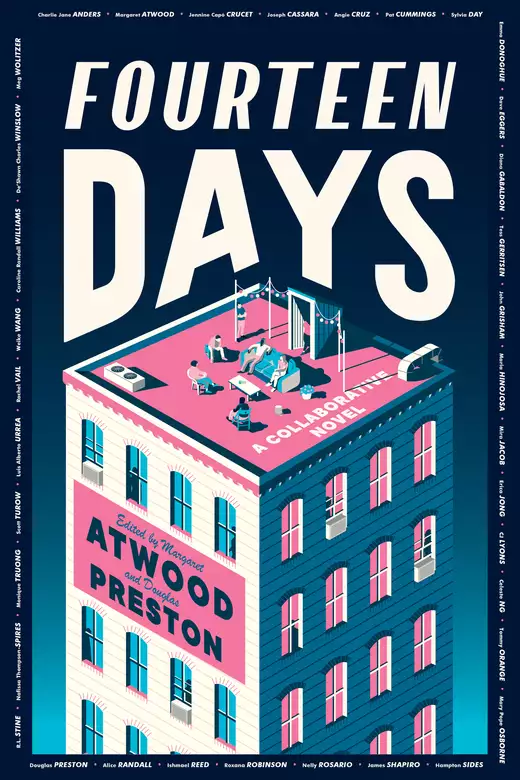
I was stunned. The rooftop was damn near paradise, never mind the spiders and pigeon shit, and loose flapping tar paper. It was big, and the panorama was stupendous. The tenements on either side of the Fernsby Arms had recently been torn down by developers, and the building stood alone in a field of rubble—with drop-dead views up and down the Bowery and all the way to the Brooklyn Bridge, the Williamsburg Bridge, and the downtown and midtown skyscrapers. It was evening, and the whole city was tinged with pinkish light, a lone jet contrail crossing overhead in a streak of brilliant orange. I yanked my phone out of my pocket—five bars. As I looked around, I thought, What the hell? I could finally call Dad from up here, hopefully reach him at last, if it was just a reception problem keeping me from getting through at Upchuck Manor. It was certainly illegal to be up on the roof, but the landlord sure wasn’t going to be coming into the Covid-ridden city to check on his properties. With the lockdown now stretching almost two weeks, this rooftop was the only place a body could get fresh air and sun that felt halfway safe anymore. One day the developers would put up hipster glass towers, burying the Fernsby Arms in permanent shadow. Till then, though, why shouldn’t it be mine? Obviously, good old Wilbur P. Worthington III had felt the same way, and he wasn’t even here for lockdown.
As I scoped the place out, I immediately noted a big lumpy thing sitting out in the open, covered with a plastic tarp. I yanked it off, revealing an old mouse-chewed fainting couch in soiled red velvet—the old super’s hangout, for sure. As I eased down on it to test its comfort, I thought, God bless Wilbur P. Worthington the Third!
I began to come to the roof every evening, at sunset, with a thermos of margaritas or some other exotic cocktail I’d scrounged up from my rainbow room of liquor, and I stretched out on my couch and watched the sun set over Lower Manhattan while I dialed Dad’s number over and over again. I still couldn’t reach him, but at least I got a good buzz on while trying.
My solitary paradise, such as it was, didn’t last long. A couple of days ago, in this last week in March, as Covid was setting the city on fire, one of the tenants cut the lock off the door and put a plastic patio chair up there, with a tea table and a potted geranium. I was seriously cheezed. Good old Wilbur had kept a collection of locks along with his other junk, so I picked up a monstrous, case-hardened, chrome-and-steel padlock, heavy enough to split the skull of a moose, and clapped it on the door. It was guaranteed not to be cut or three times your money back. But I guess they wanted their freedom as much as I did, because someone took a crowbar to the lock and hasp and wrenched them off, cracking the door in the process. There was no locking it after that. Try buying a new door during Covid.
I’m pretty sure I know who did it. When I stepped out onto the roof after finding the busted door, there was the culprit, curled up in a “cave chair”—one of those seat things shaped like an egg covered in faux-fur that you crawl into—vaping and reading a book. It must have been hell schlepping that chair all the way up to the roof. I recognized her as the young tenant in 5B, the one Wilbur called Hello Kitty in his bible because she wore sweaters and hoodies with that cartoon character on it. She gave me a cool look, as if challenging me to accuse her of busting the door. I didn’t say anything. What was I gonna say? Besides, I had to respect her a little for that. She reminded me of myself. And it’s not like we had to talk to each other—she seemed as keen to ignore me as I was in ignoring her. So I kept my distance.
After that, though, other tenants began discovering the rooftop, a few at a time. They dragged their ugliest chairs up the narrow stairs and parked themselves at sunset, everyone staying “socially distanced,” the new phrase du jour. I did try to stop them. I posted a sign saying that it was illegal (technically true!), that nobody was supposed to be up there, that someone could trip and fall off the low parapets. But at this point, we’d been under lockdown for what already felt like a lifetime, and people would not be barred from fresh air and a view. I can’t blame them. The building is dark, cold, and drafty; the hallways have weird smells; and there are cracked and broken windows everywhere. Besides, the rooftop feels big enough still—everyone is careful not to touch, talk loudly, or even blow their noses, and we’re all keeping six feet apart. Too bad you can’t find any hand sanitizer in this damn city, or I’d park a jeroboam of it at the door. As it is, I bleach the doorknobs once a day. And I’m not worried for myself—I’m only thirty, young enough that they say the virus won’t come for me, except for my asthma.
Still, I missed my private domain.
Meanwhile, Covid was hitting the city hard. On March 9, the mayor announced that there were sixteen cases in the city; by March 13, as I mentioned, the National Guard was surrounding New Rochelle; and on March 20, New York was shut down, just in time for everyone to binge-watch Tiger King. A week later, infections surpassed twenty-seven thousand, with hundreds dying every day and cases soaring. I pored over the statistics and then, fatefully, I guess, began recording them in the blank pages in the back of Wilbur’s book, his so-called Fernsby Bible.
Naturally, anyone who could had already left New York. The wealthy and professional classes fled the city like rats from a sinking ship, skittering and squeaking out to the Hamptons, Connecticut, the Berkshires, Cape Cod, Maine—anywhere but New Covid City. We were the left-behinds. As the super, it’s my job—or so I assume—to make sure Covid doesn’t get in here and kill the tenants at the Fernsby Arms. (Except the rent-controlled ones—ha ha, no need to bleach their doorknobs, I’m sure the landlord would have told me.) I circulated a notice laying out the rules: no outside people allowed in the building, everybody six feet apart in common areas, no congregating in stairways. And so on and so forth. Just like Dad would have done. No guidance yet from the powers that be about masks, since there aren’t enough for the healthcare workers, anyway. We are pretty much stuck in the building for the duration—locked down.
So every evening, the tenants who had discovered the roof came up and hung out. There were six of us at first. I looked them all up in The Fernsby Bible. There was Vinegar from 2B, Eurovision from 5C, the Lady with the Rings from 2D, the Therapist from 6D, Florida from 3C, and Hello Kitty from 5B. A couple of days ago, New Yorkers started doing this thing of cheering the doctors and other frontline workers at seven o’clock, around sunset. It felt good to do something, and to break up the routine. So people got in the habit of gathering on the roof right before seven, and when the time rolled around, we all clapped and cheered from our rooftop along with the rest of the city, and we banged on pots and whistled. That was the start of the evening. I brought up a cracked lantern I found in Wilbur’s junk, which held a candle. Others carried up lanterns and candle holders with hurricane shields—enough to create a small lighted area. Eurovision had an antique brass kerosene lantern with a decorated glass shade.
In the beginning, no one talked, and that was just fine with me. Having seen the way my dad got treated by the folks he’d lived with and helped for years, I didn’t want to get to know them. I wouldn’t even be here with them except it had been myspace first. A super who thinks she can make friends in her building is asking for trouble. Even in a merde shed like this, everyone considers themselves above the super. So my motto is, Keep your distance. And they clearly didn’t want to know me, either. Good.
Since I was new, everyone up there was a stranger. They spent their time flicking at their phones, pounding down beers or glasses of wine, reading books, smoking weed, or messing with a laptop. Hello Kitty sat herself downwind in that chair and vaped almost nonstop. I once caught a whiff of her vape smoke, and it was some sickly sweet watermelon smell. She sucked on that thing literally nonstop, like breathing. A wonder she wasn’t dead. With the stories coming out of Italy of folks on ventilators, even if it’s mostly old people, I wanted to smack that shit out of her hand. But we’re all entitled to our vices, I guess, and besides, who’s going to listen to the super? Eurovision brought up one of those miniature Bose Bluetooth speakers, where it sat next to his chair playing soft Europop. Nobody in our building ever seemed to go out, as far as I could tell, even for groceries or toilet paper. We were in full lockdown mode.
Meanwhile, because we were so close to Presbyterian Downtown Hospital, the ambulances howled up and down the Bowery, their sirens getting louder as they approached and then sinking into a dying wail as they went by. All these unmarked refrigerated trucks started showing up. We soon learned they were carrying the dead bodies of Covid victims, and they rumbled through the streets like the plague carts of old, day and night, stopping all too frequently to pick up shrouded cargo.
Tuesday, March 31—today—was a sort of milestone for me, because it was the day I started writing things down in this book. I was originally planning to just record numbers and statistics, but it got away from me and grew into a bigger project. Today’s numbers were a kind of milestone: the New York Times reported that the city had surpassed a thousand Covid deaths. There were 43,139 cases in the city, and 75,795 in the state. In the five boroughs, Queens and Brooklyn were being trashed the most by Covid, with 13,869 and 11,160 cases, respectively; the Bronx had 7,814, Manhattan 6,539, and Staten Island 2,354. Recording the numbers seemed to domesticate them, make them less scary.
It rained in the afternoon. I got up on the rooftop as usual, about fifteen minutes before sunset. The evening light cast long shadows down the rain-slicked Bowery. In between the sirens, the city was empty and silent. It was strange and oddly peaceful. There were no cars, no horns, no pedestrians surging home along the sidewalks, no drone of planes overhead. The air was washed and clean, full of dark beauty and magical portent. Without the fumes from cars, it smelled fresh, reminding me of my short happy life in Vermont, before . . . well, anyway. The usual tenants gathered on the rooftop as the streets slipped into dusk. When seven o’clock came around, and we heard the first whoops and bangs from the surrounding buildings, we heaved ourselves out of our chairs and did the usual whistling, clapping, cheering thing—all except the tenant in 2B. She just sat there trying to get her phone to work. Wilbur had warned me about her: she was the regal type who called to get a lightbulb changed, but at least she tipped like royalty. “She is pure native New York vinegar,” he wrote, and added one of his riddles: “The best wine doth make the sharpest vinegar.” Whatever that means. I figured she was in her fifties—dressed in all black, with a black T-shirt and faded black skinny jeans. The dribbles and splatters of paint on her well-worn Doc Martens were the only color on her. She was, I figured, an artist.
The woman in 3C, given the name of Florida in the book, called out Vinegar. “Aren’t you going to join us?” I immediately sensed from her tone that there was history between them. Florida—the old super had not explained the origin of the name, maybe that was just how she was known—was a large, big-breasted woman who managed to convey a restless energy, age about fifty, with perfect salon hair and a sequined shirt covered with a shimmering golden shawl. The bible described her as a gossip, with the quip: “Gossip is chatter about the human race by lovers of the same.”
Vinegar returned Florida’s look with a frosty one of her own. “No.”
“What you mean, no?”
“I’m tired of shouting ineffectually at the universe, thank you.”
“We’re cheering the frontline workers—the people out there risking their lives.”
“Well, aren’t you the high and holy one,” said Vinegar. “How’s yelling going to help them?”
Florida stared at Vinegar. “There’s no logic to it. Esto es una mierda, and we’re trying to show support.”
“So you think banging on a pot is going to make a difference? ...
We hope you are enjoying the book so far. To continue reading...
Copyright © 2026 All Rights Reserved

 Please log in to recommend or discuss...
