Joshua Glenn
Do we really know science fiction? There were the scientific romance years that stretched from the mid-nineteenth century to circa 1900. And there was the genre’s so-called golden age, from circa 1935 through the early 1960s. But between those periods, and overshadowed by them, was an era that has bequeathed us such tropes as the robot (berserk or benevolent), the tyrannical superman, the dystopia, the unfathomable extraterrestrial, the sinister telepath, and the eco-catastrophe. In 2009, writing for the sf blog io9.com at the invitation of Annalee Newitz and Charlie Jane Anders, I became fascinated with the period during which the sf genre as we know it emerged. Inspired by the exactly contemporaneous career of Marie Curie, who shared a Nobel Prize for her discovery of radium in 1903, only to die of radiation-induced leukemia in 1934, I eventually dubbed this three-decade interregnum the “Radium Age.”
Curie’s development of the theory of radioactivity, which led to the extraordinary, terrifying, awe-inspiring insight that the atom is, at least in part, a state of energy constantly in movement, is an apt metaphor for the twentieth century’s first three decades. These years were marked by rising sociocultural strife across various fronts: the founding of the women’s suffrage movement, the National Association for the Advancement of Colored People, socialist currents within the labor movement, anticolonial and revolutionary upheaval around the world . . . as well as the associated strengthening of reactionary movements that supported, for example, racial segregation, immigration restriction, eugenics, and sexist policies.
Science—as a system of knowledge, a mode of experimenting, and a method of reasoning—accelerated the pace of change during these years in ways simultaneously liberating and terrifying. As sf author and historian Brian Stableford points out in his 1989 essay “The Plausibility of the Impossible,” the universe we discovered by means of the scientific method in the early twentieth century defies common sense: “We are haunted by a sense of the impossibility of ultimately making sense of things.” By playing host to certain far-out notions—time travel, faster-than-light travel, and ESP, for example—that we have every reason to judge impossible, science fiction serves as an “instrument of negotiation,” Stableford suggests, with which we strive to accomplish “the difficult diplomacy of existence in a scientifically knowable but essentially unimaginable world.” This is no less true today than during the Radium Age.
The social, cultural, political, and technological upheavals of the 1900–1935 period are reflected in the proto-sf writings of authors such as Olaf Stapledon, William Hope Hodgson, Muriel Jaeger, Karel Čapek, G. K. Chesterton, Cicely Hamilton, W. E. B. Du Bois, Yevgeny Zamyatin, E. V. Odle, Arthur Conan Doyle, Mikhail Bulgakov, Pauline Hopkins, Stanisław Ignacy Witkiewicz, Aldous Huxley, Gustave Le Rouge, A. Merritt, Rudyard Kipling, Rose Macaulay, J. D. Beresford, J. J. Connington, S. Fowler Wright, Jack London, Thea von Harbou, and Edgar Rice Burroughs, not to mention the late-period but still incredibly prolific H. G. Wells himself. More cynical than its Victorian precursor yet less hard-boiled than the sf that followed, in the writings of these visionaries we find acerbic social commentary, shock tactics, and also a sense of frustrated idealism—and reactionary cynicism, too—regarding humankind’s trajectory.
The MIT Press’s Radium Age series represents a much-needed evolution of my own efforts to champion the best proto-sf novels and stories from 1900 to 1935 among scholars already engaged in the fields of utopian and speculative fiction studies, as well as general readers interested in science, technology, history, and thrills and chills. By reissuing literary productions from a time period that hasn’t received sufficient attention for its contribution to the emergence of science fiction as a recognizable form—one that exists and has meaning in relation to its own traditions and innovations, as well as within a broader ecosystem of literary genres, each of which, as John Rieder notes in Science Fiction and the Mass Cultural Genre System (2017), is itself a product of overlapping “communities of practice”—we hope not only to
draw attention to key overlooked works but perhaps also to influence the way scholars and sf fans alike think about this crucial yet neglected and misunderstood moment in the emergence of the sf genre.
John W. Campbell and other Cold War–era sf editors and propagandists dubbed a select group of writers and story types from the pulp era to be the golden age of science fiction. In doing so, they helped fix in the popular imagination a too-narrow understanding of what the sf genre can offer. (In his introduction to the 1974 collection Before the Golden Age, for example, Isaac Asimov notes that although it may have possessed a certain exuberance, in general sf from before the mid-1930s moment when Campbell assumed editorship of Astounding Stories “seems, to anyone who has experienced the Campbell Revolution, to be clumsy, primitive, naive.”) By returning to an international tradition of scientific speculation via fiction from after the Poe–Verne–Wells era and before sf’s Golden Age, the Radium Age series will demonstrate—contra Asimov et al.—the breadth, richness, and diversity of the literary works that were responding to a vertiginous historical period, and how they helped innovate a nascent genre (which wouldn’t be named until the mid-1920s, by Hugo Gernsback, founder of Amazing Stories and namesake of the Hugo Awards) as a mode of speculative imagining.
The MIT Press’s Noah J. Springer and I are grateful to the sf writers and scholars who have agreed to serve as this series’ advisory board. Aided by their guidance, we’ll endeavor to surface a rich variety of texts, along with introductions by a diverse group of sf scholars, sf writers, and others that will situate these remarkable, entertaining, forgotten works within their own social, political, and scientific contexts, while drawing out contemporary parallels.
We hope that reading Radium Age writings, published in times as volatile as our own, will serve to remind us that our own era’s seemingly natural, eternal, and inevitable social, economic, and cultural forms and norms are—like Madame Curie’s atom—forever in flux.
Alexander B. Joy
Psychological science once broke ground in asserting that there were physical, material reasons behind the processes of the mind. Until Wilhelm Wundt began to teach scientific psychology in the 1860s, psychology was regarded as merely a branch of philosophy, but psychologists worldwide would follow Wundt in setting up laboratories for the scientific study of mind and behavior. By the 1890s, the decade at the end of which the stories collected in this volume were first published, it was becoming widely accepted that the brain and its chemistry governs our movements, emotions, thoughts, and mental states. From out of this seismic theoretical shift emerges Flaxman Low, the hero of these stories.
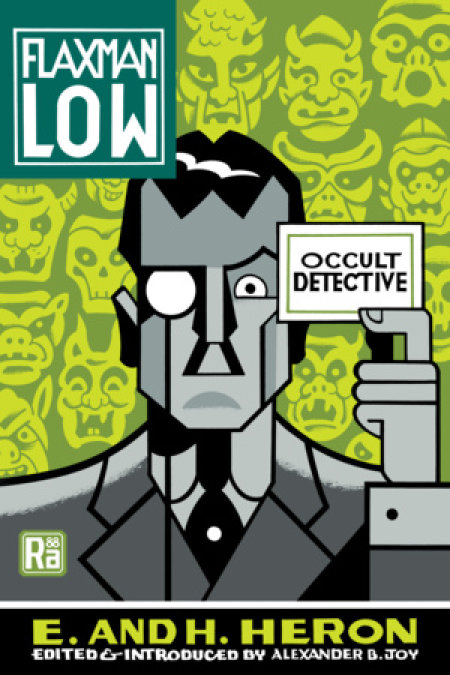
“Flaxman Low” is the pseudonym of a gentlemanly, athletic psychological researcher with an unusual specialty: ghosts and the paranormal. Beleaguered petitioners seek him out to diagnose all kinds of odd and troubling occurrences; his unflappable competence in the presence of ghostly terrors makes him seem as if he may already have one foot in the spirit world. Low represents perhaps the first truly modern “occult detective,” an archetypal weird fiction figure who investigates, and sometimes eradicates, seemingly supernatural or mystical phenomena—though only after establishing a scientific basis for their occurrence.
Up until Low, occult mysteries either reject the paranormal outright, or else they embrace a paranormal completely untethered from physical laws. Sherlock Holmes, for example, never entertains supernatural prospects: “The world is big enough for us. No ghosts need apply,” he quips in the 1924 adventure “The Sussex Vampire.” L.T. Meade’s and John Eustace’s John Bell (protagonist of an 1896 story collection, A Master of Mysteries) offers an earlier example of ghost-themed mysteries, but his quests involve disproving the supernatural. And while Sheridan Le Fanu’s Dr. Hesselius (from the 1872 collection In a Glass Darkly) also researches the paranormal, the causes and cures he turns up are typically fantastical.
What distinguishes Low from conventional detectives and credulous proto-occult detectives alike, and what makes him a pioneer who paved the way for Algernon Blackwood’s John Silence, William Hope Hodgson’s Thomas Carnacki, and many other occult detectives since, is a willingness to ascribe supernatural occurrences to psychological causes—and therefore to consider such causes fair game as possible solutions to a number of mysteries.
The furtherance of psychological science furnishes both the ethos and the high concept behind Low’s adventures. “We [scientific psychologists] stand to-day on the frontier of an unknown world,” he declares in his first outing, “and progress is the result of individual effort; each solution of difficult phenomena forms a step towards the solution of the next problem.” Low’s stories use the still-nascent discipline as a springboard for a series of speculative mystery and horror stories, exploring the peculiarities of the human mind as our hero probes real and imagined ghost sightings, stress- and chemical-induced hallucinations, mental projections that occupy space (or take over other beings), and consciousness that persists after death.
These adventures make for entertaining reads on their own merits. Their evocative settings range from picturesque English mansions to sweeping Old World countrysides to the coast of Calais. Their psychological (sub)text often rivals the depth and disquiet of Henry James’s ghost stories. (As in James’s 1898 gothic horror novella The Turn of the Screw, for example, the specter of molestation tacitly hangs over “The Story of Medhans Lea.”) Low’s exploits also feature a number of memorably bizarre set pieces, including a disinterred earth demon that inherits a cough from the terminally ill person that it unwittingly consumes, an Egyptian mummy piloted by a vampire, and a preserved human body that has morphed into a phosphorescent mushroom mannequin after a mycological revenge scheme gone awry.
If this sounds less like science fiction than “weird fiction,” that’s because the former genre developed to some extent out of the latter
during science fiction’s emergent Radium Age (c. 1900–1935). The boundary between the genres was permeable; what helped differentiate science fiction was a certain empirical, inductive approach to knowledge-making. Emily Alder, editor of the journal Gothic Studies, places the Flaxman Low stories in the latter grouping in her 2020 study Weird Fiction and Science at the Fin de Siècle: “Low’s explanations arguably contain and neutralise weirdness,” i.e., by fixing what is otherwise unexplainable within a tractable, intelligible framework—and dispensing with its threats accordingly. As Low himself summarizes the stories’ driving philosophy: “You know I hold that there is no such thing as the supernatural; all is natural.”
“Flaxman Low” was the brainchild of British author Kate O’Brien Prichard and her son Hesketh Hesketh-Prichard. Under the collective pseudonym “E. and H. Heron,” they published the adventures collected here in two series in Pearson’s Magazine in 1898 and 1899; these were then collected in book form, in 1899, as Ghosts: Being the Experiences of Flaxman Low.
Hesketh, nicknamed “Hex,” led a fascinating if brief life in which he played cricket at a professional level, overhauled the standard training regimen for British Army snipers, and traveled the world as a newspaper correspondent. Kate, daughter of a notable military family, was also a great traveler, often joining Hex on his assignments. (The Rio Caterina, in what is now Argentina’s Parque Nacional Los Glaciares, is named for her.) The Prichards wrote a number of popular, well-received novels and stories, including A Modern Mercenary (1898), The Chronicles of Don Q (1904), and Don Q’s Love Story (1909); the latter would be adapted into the 1925 Douglas Fairbanks vehicle Don Q, Son of Zorro.
Regarding the Flaxman Low tales, the Prichards’ exact division of labor is disputed. The science fiction and fantasy scholar Everett F. Bleiler credits Hesketh as “the major partner in their collaborations,” whereas Eric Parker, in his 1924 memoir about Hesketh, hints that Kate may have exerted directorial influence. Hesketh himself gives Kate considerable deference in a Pearson’s introduction to his work from July 1903: “I owe everything [. . .] to my mother. She has helped me with all that I have written, and without her I should probably have written nothing.” Stylistic variations among the Flaxman Low stories may suggest that a single Prichard took the lead in writing each story, though the series overall can be attributed more or less equally to both Prichards.
The Prichards were acquainted with many major figures of their day, including J. M. Barrie and Arthur Conan Doyle. If Flaxman Low was one of many fictional detectives rushed into print to fill the Sherlock-shaped void after Conan Doyle’s “The Final Problem” (1893) seemingly offed the author’s wildly popular creation, ...
We hope you are enjoying the book so far. To continue reading...
Copyright © 2026 All Rights Reserved

 Please log in to recommend or discuss...
