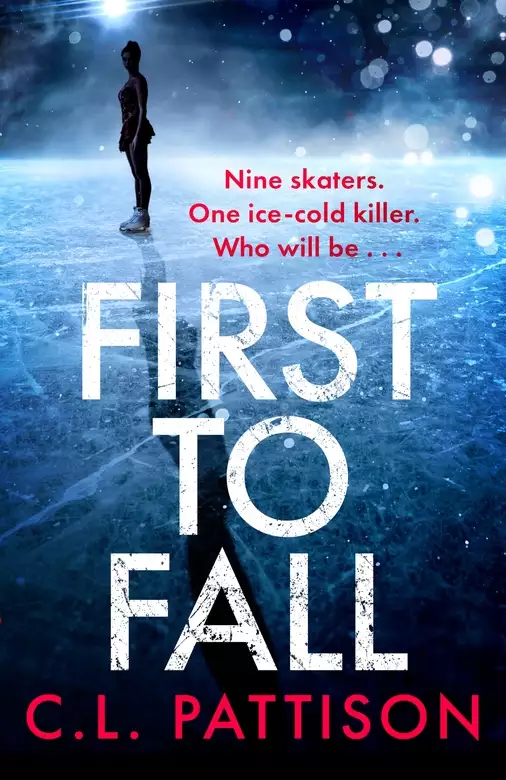
Libby Allen receives an almost too-good-to-be-true invitation to join an elite group of figure skaters participating in an experimental training programme, deep in the Bavarian Forest.
Masterminded by reclusive ex-Olympian Lukas Wolff, the programme sees the skaters competing against each other to learn one of the most difficult and dangerous moves the sport has ever seen. The process is gruelling, but promises fame and limitless opportunities for whoever is the last skater standing.
Lukas is notorious for his controversial teaching methods, but his abrasive personality and increasingly erratic behaviour soon has the contestants questioning his motives.
And then one of the skaters dies in a mysterious accident during training.
With a blizzard raging and communications down, the group is cut off from the outside world. When a second skater perishes in harrowing circumstances, the remaining trainees find themselves ensnared in a deadly game of 'survival of the fittest'.
As more lives are lost, Libby is in a race against time to uncover the truth about the ice-cold killer in their midst.
Release date:
January 30, 2025
Publisher:
Headline
Print pages:
352
* BingeBooks earns revenue from qualifying purchases as an Amazon Associate as well as from other retail partners.
My first visit to an ice rink was a disaster. It was the beginning of the summer holidays; a classmate’s eleventh birthday party. As one of the least popular girls in my year group, I’d been surprised to receive an invitation. I found out later I was a last-minute substitute, a way of making up the numbers because half the first-choice guests were abroad with their parents. My family never went on holiday. For one thing, we couldn’t afford it; for another, Mum was barely capable of organising a packed lunch, never mind a week on the Costa Brava.
The memory of that day is burned indelibly on my brain. After being kitted out with my boots, I took to the rink feeling reasonably confident. It was only frozen water, for heaven’s sake. How hard could putting one foot in front of the other be?
I’d barely managed two wobbly circuits when a teenaged boy, skating too fast, caught me with his elbow, sending me flying. My classmate’s mother helped me up, compounding my humiliation as she roughly dusted the ice from my bottom. Worse was to come when I complained that my wrist was hurting. Sighing in a way that left me in no doubt what a massive inconvenience I was being, she helped me off the ice. Nothing broken, just a slight sprain, the rink’s designated first-aider declared as he handed me an ice pack. Probably best if I sit out the remainder of the session.
Not wanting my friends (and I use the term loosely) to witness my disappointment, I made my way to the far end of the rink, where a group of kids was having a private lesson in a cordoned-off area. I leaned on the guardrail to watch them, marvelling at their balance and poise. One girl in particular caught my eye. She was three or four years older than me, long-limbed and graceful, with silky blonde hair tied in a high pony.
After a little while, she broke off from the rest of the group and began practising on her own, directly in front of where I was standing. I watched, mesmerised, as she launched effortlessly into an upright spin, arms pressed close to her body. It was one of the most beautiful things I’d ever seen. I’d watched figure skating on the TV, but this was different. This felt as if it was just for me.
All too soon, the girl was flinging out her arms, an action I noted with keen interest had the effect of slowing her rotations. As she came to a dead stop, I couldn’t contain my emotions any longer and burst into applause.
‘That was amazing!’ I gushed as the girl looked over at me and smiled. ‘Is it as difficult as it looks?’
‘Not really, it just takes a bit of practice,’ she said, coming over to me. ‘How come you’re not skating?’
I held out my arm, the ice pack still pressed to it. ‘I fell over and sprained my wrist.’
‘Ouch,’ she said with a grimace.
‘It’s my first time at the rink as well,’ I added, in a bid to garner more sympathy.
‘That’s bad luck,’ she said. ‘But don’t let it put you off. As soon as your wrist’s better, you should get back on the ice; that way, you won’t have a chance to develop a phobia.’
‘Yeah, I’ll do that,’ I told her, even though I seriously doubted anyone would ever invite me to the rink again.
‘You should think about taking some lessons; it’ll help build your confidence.’ She jerked her thumb towards an older woman in a fur gilet, who was clearly the group’s teacher. ‘My coach runs a beginners’ session on Saturday mornings. She’ll have you whizzing round the rink like a pro in no time.’
‘Really?’ I said disbelievingly.
‘For sure – and all the other kids in the class are really nice. Even if you decide skating’s not for you, at least you’ll have made some new friends.’
‘OK,’ I said, nodding eagerly. ‘I’ll ask my mum when I get home.’
I sometimes think of that moment, combing it for insight, for thought, for some sort of intuition. But I never find it. All I see is an unhappy girl, unwilling to admit how lonely she was, grabbing at something bright and colourful as it floated by.
At first, Mum was reluctant. Being a single parent, who flitted from one poorly paid job to another, she didn’t have much spare cash. But when Gran offered to chip in, she agreed to sign me up for lessons. Gran had been a surrogate parent to me my whole life. Her son, my dad, had died in a motorbike crash two months before I was born. She’d stepped in to save the day more times than I could remember and it terrified me to think what my life would’ve been like without her in it.
Despite my inauspicious start, I took to skating immediately, quickly mastering the basics: how to skate forwards and backwards, how to do a snowplough stop, a bunny hop, a ballet jump, a two-footed spin. My first coach, the woman in the gilet, was wonderful. A perceptive and nurturing woman, she saw in me a child with promise, a rare determination and a desperate need for stability.
At eleven and a half, I was a relative latecomer to the sport. Most of the other kids who trained at the rink had been skating since the age of four or five. But, according to my coach, I had an advantage.
‘You’re a natural,’ she used to tell me. ‘Your build, your arm span, your leg strength, your single-mindedness – everything about you is perfect for skating.’
I was fearless too. If my coach asked me to try something new, I wouldn’t think about it long enough to get scared, I’d give it a go straight away. I’d usually fall the first time, but, unlike a lot of the other kids, I wouldn’t whinge about it; I’d get straight back up and try again. And I’d keep trying until I had it down.
I discovered that I wasn’t afraid of pain. Quite the opposite – I felt a perverse satisfaction in my ability to make myself suffer. On any given day, my knees, hips and shoulders would be various shades of blue and green, but I was proud of my bruises. They were a badge of honour; evidence of my bravery; proof that I was somebody worthwhile.
For me, the rink was a place of freedom, an escape from the chaos of my home life. Gliding across the frictionless ice with the wind in my face felt almost like flying. And I adored the classical music my coach liked to play in our training sessions. The sensation of it was physical, like warm water being washed over a gaping, bloody wound, agonising and cleansing and curative all at the same time.
Keen to progress, I worked harder than any of the others in my class. After training, I always stayed behind to practise. Sometimes, I’d sit in on the advanced classes, watching from the sidelines and sucking up every bit of knowledge I could. Back at home, I watched endless YouTube videos of all the greats: Boitano, Hanyu, Kwan, Witt, picking apart their routines and trying to work out what it was that made them special.
On the advice of my coach, I took up running to build my cardiovascular fitness and bought some second-hand weights to improve my muscle strength. Within six months, I had been promoted to the intermediate class; another nine months and I had joined the advanced skaters.
Eventually, my coach felt I’d outgrown the group classes and told me I needed more specialist tuition. She recommended me to another coach she knew called Eva, who, once she’d seen me skate, agreed to give me weekly training sessions for half her usual fee. Eva was a lot tougher than my previous coach and sometimes we clashed, but her methods paid off and soon I was knocking out double toe-loops with ease.
Before long, Eva began encouraging me to enter competitions. I refused at first; I was too self-conscious. To me, skating was a private act and not something to be shared with others. Eventually I gave in, lured by the promise of a bejewelled costume and the possibility of prize money.
To my surprise, I found that I enjoyed performing in public. I loved everything about it: the applause at the end of my routine; the judges’ praise; the smile on Eva’s face when I placed in the top ten; the warmth of her hug when I was top five.
At first, the competitions were regional ones, but soon I was making a name for myself at national events, winning a junior bronze medal at the British Championships and placing fifth in the seniors’ competition a couple of years later. I had never competed internationally, however, even though Eva said I was good enough. It wasn’t the lack of desire, but the expense. Ice skates weren’t free. Neither were costumes. Coaches, choreographers, physical therapy – they all cost money; money that Mum and Gran could ill afford.
With more financial investment, I knew I could’ve gone further. I wasn’t bitter though, far from it. I had already achieved more than I ever thought was possible for someone like me. But now that I had finished full-time education I’d decided, albeit reluctantly, it was time for skating to take a back seat. Mum had been supporting me for long enough; I needed to start giving back.
When I told Gran I was hanging up my boots, she tried to talk me out of it, insisting it would be ‘a waste of a God-given talent’. She even offered to cash in her Premium Bonds, saying it would be enough to fund another half year of coaching. I refused her kind offer; she had made so many sacrifices for me already.
Career-wise, my options were limited. I would have loved a backstage job in the performing arts – stage design, or theatre management – but with two very average A levels and a diploma in business administration, I knew I didn’t stand a chance. Instead, I applied for dozens of entry-level office jobs. After a handful of interviews, one employer made me an offer. I would be starting in two days’ time: customer services trainee at the city council. The thought of wearing a headset all day and listening to people complain about their bins not being emptied didn’t exactly fill me with joy, but what choice did I have?
In readiness for my new job, I’d spent the afternoon shopping for suitable business attire. My budget was modest and I was feeling pleased that I’d managed to find everything I needed in a single, purposeful pillage of our local charity store.
Mum was on a late shift at the warehouse where she worked in order fulfilment, so the house was empty when I got home. There was a pile of mail on the doormat, mostly junk by the look of it. Stepping over it, I went to the kitchen, dropping my shoulder bag and my two reusable totes on the floor. As I filled the kettle at the sink, I heard the sound of a key in the front door. I smiled when a voice that was as familiar as my own called out, ‘It’s only me!’
Gran’s flat was three streets away and our place was like a second home to her. She used to have a lovely house, not far from the sea, but soon after I started primary school, she moved to be nearer to Mum and me. That way, she’d be able to keep an eye on things; make sure Mum was holding the fragile edifice of our home life together.
‘Hi, gorgeous,’ she said as she appeared in the doorway. She put a stack of post on the table. ‘These were lying on the mat.’
‘Thanks, Gran, I would’ve picked them up myself, but my hands were full.’ I opened the fridge and took out the milk. ‘Tea?’
‘Ooh, yes, please.’ She pulled out a chair and sat down at the table. ‘Did you find what you wanted at the shops?’
‘I think so.’ I bent down to open one of the totes and pulled out a pair of navy trousers to show her.
‘Very smart,’ said Gran, reaching out to stroke the material. ‘So, how are you feeling about your new job?’
‘A bit nervous, to be honest. There are a bunch of us trainees starting on the same day, so at least I won’t be the only one who doesn’t have a clue what they’re doing.’
The lines on Gran’s forehead pinched together. ‘You know, I never imagined you working in an office, Libby.’
I tossed the trousers over the back of a chair. ‘You’re not the only one.’
‘Are you sure this is what you want, love?’
I felt a dull ache in the pit of my stomach. ‘I just think it’s the right thing to do.’
Gran’s face remained immobile. I could sense her disappointment. Ever since I started skating, she had been my number one fan. She’d travelled to every competition, stayed up half the night sewing Swarovski crystals onto my costumes, kept a scrapbook of clippings that contained every local newspaper article that had ever mentioned my name. ‘I just think it’s such a shame to give up skating when you’ve put so much hard work into it.’
‘I’ll still skate,’ I said, opening a cupboard and taking out two mugs. ‘I just won’t be having lessons, or competing.’ Even as I said it, I knew it wasn’t true. I wouldn’t be going back to the rink. Ever. It held too many memories; too many painful reminders of what might have been. At the same time, I knew a fragment of it would always be embedded in my heart, like an icicle, prodding me painfully at certain moments when I least expected it.
As I dropped teabags into the mugs, Gran started telling me about a recent trip to the vet’s with Betty, her Siamese cat, who had just been diagnosed with cataracts. I sensed that she wanted to say more about my big life decision, but, recognising my discomfort, she had tactfully decided to change the subject.
As I set a mug of tea and a half-open packet of biscuits in front of her, she got up from the table. ‘Just nipping to the loo,’ she said. ‘Back in a mo.’
I sat down with my own drink and began to riffle half-heartedly through the pile of mail that Gran had picked up. Amidst the pizza flyers and the final reminders, one item stood out: a thick cream envelope that felt expensive to the touch. Even more curiously, it was addressed to me.
It was probably from the council, I thought to myself as I eased my finger under the flap; another HR form that needed filling out. Nothing to get excited about.
By the time I heard Gran’s footsteps coming back down the stairs, I was in a state of shock. I could feel the blood dancing in my veins, the hundred-beats-per-minute drum-beat in my chest. My face must’ve been white as a sheet because the first thing Gran said to me was: ‘Is everything all right? You look as if you’ve seen a ghost.’
My mouth suddenly felt very dry. I took a gulp of tea. ‘Have you heard of Lukas Wolff, Gran?’
She sat down and helped herself to a chocolate digestive.
‘The Olympic figure skater? Of course. He used to have that signature trick, didn’t he? What was it called again?’
‘The Grim Reaper.’
‘That’s it,’ she said as she dunked the biscuit in her tea. ‘I remember watching it on the telly. I’d never seen anything like it before.’
I pushed my mug aside. All my nerve endings were tingling. I felt like a catapult pulled right back. ‘No one had,’ I told her. ‘And you’ll probably never see anything like it again.’
Over the years, plenty of skaters had tried to replicate the Grim Reaper, but, to date, no one had managed to pull off the sequence in its entirety – at least not in competition. A Serbian skater had come closest at one of the Winter Olympics, I forgot which year – but he messed up the penultimate jump and landed awkwardly, breaking his tibia and a handful of ribs.
I cast my mind back to when I was twelve or thirteen, remembering all the skaters I used to idolise, Lukas Wolff among them. ‘I used to have a poster of Lukas on my bedroom wall, right above my bed. Do you remember?’
Gran smiled. ‘Your bedroom was covered in posters; I never knew who was who.’ She took a sip of tea. ‘Why are we talking about Lukas Wolff now anyway?’
I straightened my shoulders; took a deep breath. ‘Because he’s invited me to train with him in Germany.’
She gave a little chuckle. ‘Course he has.’
‘I’m serious, Gran. He’s written to me; the letter was in that pile of post you brought in. I opened it while you were upstairs.’ My voice quivered; I could scarcely believe it myself.
I pushed the sheet of watermarked paper across the table. At the top was an eye-catching graphic of a castle; it looked like something out of Grimm’s Fairy Tales. Underneath it, the words Schloss Eis were printed in a stylised font, although I had no idea what they meant.
Gran’s lips trembled. ‘I haven’t got my glasses; you’ll have to read it out to me.’
I cleared my throat. ‘Dear Libby, I trust my name is familiar to you. Although we’ve never met, I know that you are a uniquely talented skater who, to date, has failed to fulfil her true potential. In an attempt to rectify that, I should like to extend a one-time offer: eight weeks of personal tuition at my home in Bavaria. All coaching sessions, accommodation and food will be provided at my expense for the duration of your stay. The dates provided below are non-negotiable. I appreciate this leaves you with little time to clear your schedule, but that is intentional on my part. If you know anything about me, you will know that I demand nothing less than full commitment, and the kind of student I am looking for is one who is willing to make themselves available at short notice.’
I looked up. Gran was staring at me, her mouth wide open. Then she broke into a smile.
‘So, when does he want you to go?’
I scanned the page. I hadn’t bothered to read down that far; I was still struggling to process the fact that an Olympic champion had reached out to me. ‘Wow. When he said short notice, he wasn’t kidding. I have to be there a week on Friday.’ I read the final sentence aloud. ‘Kindly confirm your acceptance or rejection of this invitation via the email address provided.’
I laid the letter back down on the table and ran my fingers over the handwritten signature: Lukas Wolff. As far as I knew, he hadn’t been involved in the sport for several years; I actually thought he’d retired. It begged the question why? Why would Lukas Wolff make such a generous overture to a virtual unknown? How did he even know I existed?
‘I guess you’d better start packing then,’ said Gran.
I blinked hard several times. I had my future all mapped out; there was no room on the blueprint for a self-indulgent trip overseas. ‘But I’m not going. I’m about to start a new job, remember? If I don’t show up on Monday, the council won’t hold the position open for me.’
A furrow appeared between Gran’s brows. ‘Don’t tell me you’re going to prioritise a minimum-wage job over the chance of one-on-one coaching with a sporting legend. Think what this could do for your skating career.’
‘I don’t have a skating career, Gran. It’s over. Finito. I’ve moved on.’ As I said the words I felt a slight clutching of my solar plexus.
She rested a hand on my forearm. ‘There’s nothing stopping you changing your mind, sweetheart.’
‘I’m not denying it’s a very flattering offer, but it’s come too late – and anyway, the letter might not even be genuine.’
‘It seems kosher to me, and who would want to play a trick like this on you?’
I gave a heavy sigh. ‘Even if it is legit, what about the cost of this little jaunt to Germany?’
‘Lukas has offered you free bed and board, hasn’t he?’
‘Yes, but there’s still my travel expenses.’
‘A flight to Germany can’t be that much and I’d be more than happy to make a contribution, you know I would.’
I looked down at the tablecloth; picked up a few spilled grains of sugar on the end of my finger.
Her voice softened. ‘Come on, Libby, I can read you like a book. What is it you’re not telling me?’ When I didn’t reply straight away, she added, ‘It’s your Mum, isn’t it?’
Gran was right; she usually was.
‘If I leave her on her own, I’m worried she’ll relapse.’
Mum hadn’t had a drink for almost four years – her longest stretch of sobriety to date. She was what you might call a high-functioning alcoholic. Even when she was at her worst, she was always able to care for me (just) and hold down a job (albeit a pretty undemanding one). That wasn’t to say that living with her was easy and when I was growing up, life at home could be chaotic; unpredictable. The smell of booze was part of the fabric of my childhood. Mum used to hide bottles of vodka around the house – inside cereal boxes, between towels in the airing cupboard, behind the toilet cistern. Whenever I found one, I’d pour the vodka away, fill the bottle with water and then return the bottle to its hiding place. She must’ve noticed, but she never said anything.
At school, I always felt different to the other kids. I still feel that way, if I’m honest. Keeping Mum’s addiction a secret was all-consuming. Gran was the only person who knew. I didn’t breathe a word to anyone else – not the few friends I had, or the teachers, or my skating coach. I was terrified that if social services found out, they’d take me away. I wasn’t scared for myself, I was scared for Mum and what would happen if I wasn’t there to protect her.
When Mum was sober, she was amazing. Kind and loving and fun. When she was drunk, it was like living with a different person. She’d get very emotional, tell me that she just wanted to be loved and list all the bad things that had ever happened in her life. It was true that she’d been through a lot – her own parents had died, of breast cancer and a heart attack, three years apart when she was only in her twenties. Then there was the tragic death of my father, a man she always described as the love of her life, when she was pregnant with me. Bringing up a newborn baby on her own was tough and she did her best, but it wasn’t long before alcohol became a crutch.
Mum’s binges always ended with her either falling asleep or passing out. Even if it was really late and I had school the next day, I’d force myself to stay awake so I could keep watch over her. Every hour or so, I’d hold a small mirror up to her face, just to check she was still breathing.
She tried to kick the booze numerous times. Sometimes she went months without a drink. But no matter how many stints in rehab she had (most of them funded by Gran, using the rapidly dwindling proceeds from the sale of her house), she couldn’t seem to chase away the demons that led her to self-medicate. And each time she relapsed, it was as if she took with her a layer of my skin, leaving me frightened; anxious; vulnerable.
The turning point came when I was fifteen. Mum got arrested for drink-driving on the way to work. She usually caught the bus, but that day she was running late and she stupidly decided to take a chance. She knocked someone down on a pedestrian crossing, although thankfully they only sustained minor injuries. The magistrate had some har. . .
We hope you are enjoying the book so far. To continue reading...

 Please log in to recommend or discuss...
