'The Emerald Noir ladies are killing it, sometimes literally' LIZ NUGENT
'Compelling and clever' JANE CASEY
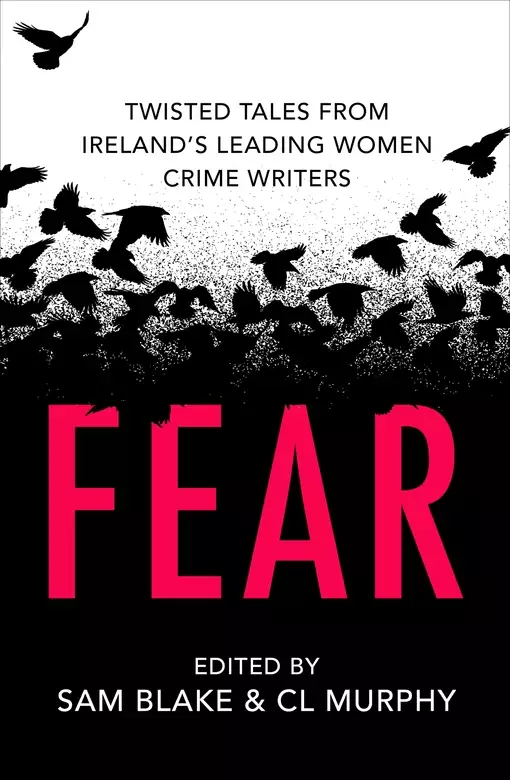
Thirty-two Irish female crime authors come together to explore some of life's greatest fears in an anthology of original stories teeming with terror.
Edited by crime authors Sam Blake and C.L. Murphy, and including a foreword by Emmett J. Scanlan, this collection explores a pulse-quickening spectrum of the fears that keep us awake at night - from dolls, clowns and ghosts, to fi re, heights and doors in hidden rooms. Here you'll find tales of being buried alive, being forgotten, of loss and betrayal - and more.
Full of thrilling twists and chilling reveals, Fear will keep you on the edge of your seat until the very last page.
Authors featured: Cecelia Ahern, Alice Bell, Sam Blake, Jen Bray, Andrea Carter, Amanda Cassidy, Marie Cassidy, Edel Coffey, Kit Conway, Claire Coughlan, Sharon Dempsey, Michelle Dunne, Fiona Gartland, Karen Gillece, Carmel Harrington, Catherine Ryan Howard, Arlene Hunt, Amy Jordan, E.V. Kelly, Olivia Kiernan, Casey King, Hannah King, Catherine Kirwan, Siobhan MacDonald, Andrea Mara, Michelle McDonagh, C.L. Murphy, Gill Perdue, Louise Phillips, Eithne Shortall, Michelle Teahan and Mary Watson.
The editors' royalty earnings from worldwide sales of this book (expected to be at least €8,000) will be donated to domestic violence charity Women's Aid (RCN 20012045). Contributing authors have donated their stories without renumeration to help make this possible.
Release date:
October 15, 2026
Publisher:
Hachette Books Ireland
Print pages:
352
* BingeBooks earns revenue from qualifying purchases as an Amazon Associate as well as from other retail partners.
‘Sarah Barry is guilty of first-degree murder,’ Prosecutor Damon Collinson says, tentatively taking steps towards the jury of twelve in the courtroom.
Sarah wipes tears from her face and eyes. Her body is shaking violently, her knees tremble beneath the desk, she can barely keep her feet flat on the floor. Her heart is pounding so aggressively in her chest, she feels it will burst through her skin and rip through the fabric of her scratchy shift dress. The dress is conservative, as she was advised, buttoned up to her neck, keeping her all inside. If she was to open a top button she would most certainly spill out – head, heart and guts. Her defence lawyer hands her a tissue; her nose is running too.
The prosecutor continues his rebuttal to the defence’s closing argument. After a lengthy trial, they are down to the final day.
‘For the past two days we listened to Sarah Barry’s moving and shocking testimony about the attack in her home that occurred nine months before she killed Jason Jackson. We must disregard that testimony because it was a separate, unrelated event. Jason Jackson was not responsible for and had no part in the attack on her. He was a common burglar who came to her home interested only in what he could take to feed a drug habit that had ripped apart his own life and the lives of his family. Jason Jackson had his own struggles and was a non-violent man who did not deserve to be killed. Breaking and entering is not punishable by a death sentence. Had Sarah Barry called the police when she heard sounds at the side door of her home that night, instead of reaching for her gun, then Jason Jackson would be alive. The defence wanted you to hear about her rape so you understand her state of mind, and in that case we heard of a woman who was ready to kill. Sarah Barry’s state of mind is not a defence – in fact, it’s a confession, an admission of guilt. You heard it here for yourselves. She did it! Sarah Barry admitted to buying a gun for her protection, and as soon as she heard a sound at her door, she raised the gun and fired three times at Jason Jackson, killing him on the spot. She has admitted her guilt. Your only role here is to find Sarah Barry guilty of first-degree murder.’
The prosecutor takes one last look at the twelve members of the jury, eyes running over each of them to see if his words have sunk in, then swivels on his heel and returns to his bench.
That’s it. As both sides rest their case, there is no more to be said. No more convincing, no more twisting, no more pleading or accusing. No more begging for her life. Sarah feels as though she has been bled dry, overcome with an immense weariness. Confined to the chair and listening to men who don’t know her tear her character apart, like predators at a carcass in a searing hot desert, is one of the hardest things she has ever had to do. And she has faced unimaginable trauma and suffering over the past two years.
Sarah turns to her mother, who’s sitting in the front row, behind her, and has done so for the past six weeks. Her mother’s intent had been to support Sarah, be her backbone, but she is looking more frail every day. This trial is sucking the life from her too.
Judge Matheson clears his throat to address the packed court. The room is heaving with bodies, people crushed and shoulders overlapping to fit in the rows, their pores sweating curiosity. Dominating the court is the second unofficial judge, a television camera that broadcasts live. Judge Matheson wouldn’t ordinarily allow this in his courtroom, but this case is different. He’s aware of the precedent they are setting and how it’s paramount that as many people as possible see it play out in real time. There will be disagreements on how he has handled it, of course; he’s prepared for that. He wants the damage to be minimal. They must all treat the case as usual, while knowing it carries more significance than any other trial in the world right now. No member of the legal profession involved can make a single mistake. They must operate to their highest degree to protect and defend the honour and sanctity of the judicial system.
There are hundreds of people in the courtroom: media, members of the public, fellow legal comrades and students. There are more gathered outside, with news outlets from all around the world positioned at the courthouse, and millions of people all around the world watching and waiting, holding judgement of their own.
‘It is at this point,’ Judge Matheson says, ‘that I normally offer final instructions to the jury ahead of their deliberations. Those instructions are that they reach a true and just verdict, that they must not let sympathy, bias and prejudice influence their decision. But in this case …’ He eyes the twelve jurors in the jury box, and for the first time in the long and tense trial, the courtroom heaves with laughter.
It’s a kind of hysterical release, a desperate collective need for relief from the tension and nerves of the last six weeks and of the moments to come. The sudden outburst startles Sarah. She’s terrified of every sound, highly attuned to every squeak of a chair leg, cough from the audience, feedback from a microphone, babble from the crowd, bang of the gavel.
Her life lies in the hands of the jurors, who are not people at all but AI robots.
For years there had been mock trials using AI jury members. For years they had been testing them, using them at law schools for imitation trials and moot courts, but this trial is the first real case, a murder case, where twelve AI robots are being used in place of twelve humans.
The rationale of those who fought for this kind of justice was that the AI robots were bound by law and could base their decision solely on the evidence in court. If they needed to unhear something, it could be struck from their knowledge. They could act precisely in the administration of justice. Their knowledge of law and morality, concise processing, enhanced decision-making and no capacity for human error would win over human discrimination, human bias and human flaws.
Judges ask regular juries to set sympathy aside, as if requesting people to dehumanise themselves in order to solve a human problem. The ‘problem’ with people is that they feel, and despite being asked to park their sympathy, empathy and bias in jury deliberation, people can’t always do it. The intention behind the AI jury creation had been earnest, the technology developed in the quest for progress and fairness. Of the many arguments in favour of AI justice, one was that an AI jury would mean a racist-free jury, a discrimination-free jury, one that would leave prejudice and emotion behind and put critical decision-making at the forefront.
Ultimately, pro AI-justice lobbyists had won. It had been agreed and put into law that AI had developed sufficiently to provide judgement-based opinions.
It was not an easy win. There had been worldwide objectors. It had been debated in the media and argued in governments. One of the concerns, and one Sarah shared, was whether the AI jury could understand her fear. Her crime had been committed out of a deep fear. She had been defending herself, not committing murder. It was not black and white, so could they compute the grey? Could they understand, without feeling, that her fear from a previous incident drove her to act out of character, that her crime wasn’t intended?
Sarah had sat in the stand for the past two days and discussed in painstaking detail how an attack on her in her home before her path crossed with Jason Jackson had changed her life forever. She’d been alone in her farmhouse when she’d received a knock on her door. A man claimed his van had broken down, his phone battery was dead, and he asked if he could use her phone to call for assistance. She’d left him on the porch while she got her phone, but he followed her inside and what unfolded nearly destroyed her.
After that horrific event, Sarah lived in constant fear, a shadow of herself. She was unable to work; she had lost connection with her life and with herself. Her debilitating fear meant she rarely went out and had spent the months since the attack terrified and paranoid that it would happen again, that the man would come back, as he promised he would if she ever told anyone, which she had. He was never found and she lived in constant fear that he would return.
On the night she shot Jason Jackson, Sarah had awoken after another nightmare. She rarely slept and when she did it was filled with night terrors. Leaving her mobile phone by her bedside, she went downstairs for a glass of water. She was wearing her bathrobe and had the pistol in her pocket. Sarah carried the pistol with her everywhere. The lights were off. She was drinking the water when she heard a sound at the side door. Somebody was trying to get inside. She immediately believed that this was her former attacker, that he was coming back to get her as he promised.
Crime prevention officers would advise you to carefully retreat and call the police in a home invasion situation, and it was her mantra on long, dark terrifying nights alone, but Sarah’s phone was in her bedroom, and every horror movie told you not to run upstairs. All she could do was watch as Jason Jackson unlocked the door and moved inside in the darkness. The prosecution during the trial had pointed out all the other options she’d had, decisions she’d never thought of making in the moment when all she’d felt was fear and panic, absolutely frozen solid by the memory of the horror she’d endured nine months earlier.
She’d yelled out – that much she remembers. She hadn’t said anything in particular, a panicked sound. He’d stalled then. He was inside the house. It was so dark she couldn’t see his face, but everything about him suggested it was her former attacker. If her eyes hadn’t seen him, then her mind did. She would not let him hurt her again. Though her life seemed valueless to him, she would fight for that life. Her yell had taken him by surprise. She imagined him quickly running at her, as he had done before, pouncing and taking her by force, rendering her powerless in seconds. She remembered the pain she had endured.
Her body remembered.
‘Get out!’ she’d shouted then, the bravest two words she’d ever spoken. She doesn’t know how the sound had travelled from her voice.
Sarah fired three warning shots in a blind panic. And then she ran from the kitchen, upstairs to her bedroom, where she locked the door and called the police.
When they arrived, Jason Jackson was dead.
She was arrested for murder.
People in the courtroom had cried with her as she testified. She had seen sympathy on their faces as she had gone through her journey of the past two years. Every second of her life after the first attack had left her feeling like fragile nerve endings blowing in the breeze. Anything that touched her hurt her, pained her, panicked her, scared her. She was a mass of feelings and the jury box was filled with wires and metal.
The AI jury members were designed to have the appearance of humans from the front, with faces, but from Sarah’s angle, at the side, she could see where the facade ended and the wires began. Their hollows for eyes, the chassis that are their torsos, but no legs. They would roll in, operated by a man using a micro controller connected to the robots’ motors. Each time the jurors entered and exited, the courtroom audience would be completely silent, transfixed as the robots took their places in the jury box. While most marvelled at the technology, Sarah found it haunting.
The twelve chairs where a human jury used to sit were stacked up outside in the corridor.
Behind the metal jury there was more at play: a dynamic system that could learn and adapt, an active optimisation process capable of making its own choices. But how could they make a decision on Sarah’s actions if they cannot feel? Without understanding the fear that vibrated through every cell in her body every single day, how could they make the decision to acquit her?
Never mind arguments over race and gender, these jurors weren’t even human. How could they identify her state of mind? Weren’t sympathy and empathy, understanding and life experience, the very things that humankind required of a jury in order to cast judgement on others?
The speed of human thought is not equal to the speed of AI processing, and so within the hour the jury completes its deliberation, which is more of a computation.
‘It doesn’t mean they’ll be right,’ Sarah’s mother had said in advance of their verdict, sensing the worst. ‘It just means they can reach a wrong decision faster than a person could.’
There’s a frisson of excitement and anxiety in the charged air of the courtroom as everybody piles back in. History is about to be made. The bailiff hands the judge an envelope.
The judge places his glasses on the tip of his nose and glances down at it.
The courtroom is completely silent but for the whimpering of Sarah’s mother in the front row behind her.
‘I have here the jury’s verdict. For the record, each member of the jury has recorded its personal decision with a printout of its … thinking,’ he says, struggling over that word. ‘Processing,’ he adds then, more satisfied with that choice.
He reads the verdict quietly to himself and briefly glances at Sarah, leaving her stone cold.
‘The jury has found the defendant, Sarah Barry, guilty of murder in the first degree.’
The courtroom erupts. There’s a mixed reaction: the objectors are outraged, the family of the deceased are celebrating. She hears the guttural yells and sees the punching of fists in the air. She hears her mother crying, each sound a knife in her heart.
Sarah glances at the jury. She wants to meet their eyes, plead with them, question them – she wants them to feel how she feels so they can know – but no eye meets hers, no heart connects to hers. They are mute, uncoloured, unfeeling. They are machines: they can simulate emotions but cannot feel them. And for this decision the jury will feel no guilt, no remorse, no fear. No mistakes made, no lessons learned.
As Sarah is led out of the courtroom, hearing the wails of her family and the sounds of celebration from others, it is the silence of the AI jury that she hears the loudest, the nothingness of their reactions, their stillness, that stays with her the longest.
I remember waking up with an oxygen mask over my face. I remember being in pain – not the pain itself but the fact that I was in pain – and I made an animal noise instead of speaking, and then a nurse, who I think had dark hair, made more morphine happen. I remember the surgeon, who was very tall, coming over to see how I was doing, and I called him a motherfucker.
Once he had gone, the nurse, perhaps taking my comment as a sign of increased lucidity, told me she had looked into the theatre during my surgery. She said they had pulled my intestines out and laid them in a heap on my chest. She said they moved, like snakes. I remember her saying this very clearly.
I bleed from unusual places. People are gravely concerned. Over time, I am told my blood is growing thin. With every test it gets worse. Different doctors are variously sympathetic, stern or, on at least one occasion as he reads the numbers, laugh at me. Another stares at the screen and mutters ‘Jesus Christ’. I start to think that perhaps the problem is that they are taking too much and not leaving me enough. They take so much that my veins blow out. Blue and purple coils wind along my arms from the crook of my elbow, growing from twin plasters.
I say that the only bit I don’t like is watching the needle go in, because you have to have something to say.
I become familiar with all the ways I am deficient: iron, ferritin, transferrin; Vitamins D, B12 and B9. Often I have been prescribed supplements that are designed for pregnancy, and sometimes then the pharmacist will give me a little conspiratorial smile. They think I have shared a happy secret with them. They think something good is growing inside me.
I remember the nurse saying my intestines looked like snakes moving on my chest, but now I think I might have imagined it or misunderstood her, half-hallucinated something because of the morphine. Why would they have pulled my intestines out? I had keyhole surgery. The scars are tiny.
I am in surgical recovery for three days. In the next hospital bed is a woman with severe complications. I never see her. They keep the curtains closed. Her voice is lively and strange, and makes me think of old apples. One day she tells me that she can see me with a little boy. I tell her I don’t have any children.
‘You do,’ she says, in a sing-song tone.
She tells me I will have at least two, and definitely a boy. I don’t want one.
After the surgery it’s better for a while. The recovery is long, and even though the cut was small, my abdominal muscles can’t be strained. I have to be careful when I sneeze. He has to open doors for me.
But after a while things get worse again. I am a situation to be maintained. I take a lot of pills. The medication increases my risk of dying in other, more interesting ways than if I wasn’t taking it.
The pharmacy only has 5mg tablets in stock, so I have to take fifteen of them a day. I buy a pill organiser, but I stop using it after a week. It sits near my desk, empty, the lid of ‘Sunday’ left open. I don’t know why I haven’t thrown it away. For months at a time, I don’t take all the medication I’m supposed to because I have to walk up a hill to get prescriptions filled. Sometimes I have to sit down in the middle of taking clothes out of the washing machine.
Tapeworms are a bit over two feet long when they’re fully grown. But they’re thin. They’re made from tiny segments about the size of grains of rice. These grains are full of even more miniscule eggs, and they can be shed to grow into more tapeworms.
But in the old days that used to be an advertised diet pill. You swallowed a pill that had a larval cyst in it, then waited for the tapeworm to grow in your guts and steal all the nutrients from your food. Once you lost the desired amount of weight you took a parasite-killing chaser, and hoped it worked before the baby tapeworms burrowed into any other organs.
There are so many ways your body can betray you. One day I am in so much pain that I pass out on the Tube. I collapse on the floor by the escalators and sit there until I get my breath back. Only one woman, middle-aged, silvering hair, long scarf, stops to ask if I need help. I tell her no. I am too embarrassed to need it.
On the bus I breathe slowly. The walk home from the bus stop is about a mile. After twenty paces I text him to ask if he would mind coming out to meet me part way. He would.
I sweat the whole mile home and repeat, in the hot darkness of my mind, I control my body. My body does not control me. It is not true, but I walk the mile without stopping. At home I curl into a ball and scream. I nest in a different room so it does not disturb his sleep.
I read a report that says eating ten per cent more ultra-processed food makes you three per cent more likely to die prematurely from any cause, and I think, Three per cent? Is that all? That is so much less than every other risk factor in my life.
I eat a whole bag of doughnuts with pink icing the colour of dentist chairs. I vomit them up three hours later. The toilet smells of sugar.
Don’t worry, I’m not full of tapeworms.
The next consultant I see prescribes me an infusion of strange chemicals. I must sit in a room for three hours while it slowly drips into my veins.
The day after my first infusion I am visited by constant, excruciating lower back pain. I ask to talk to my consultant. He tells me that kidney pain is not a side effect of this medication and refuses to take me off the infusions. He will not switch my treatment unless I keep trying.
After the third infusion, I am admitted to A&E because I cannot stand up from the pain. It is coming from everywhere inside me. It is the colour of damsons and tastes of salt.
The consultant passes my case to a colleague.
Put your hand down to your left hip and where you feel your pelvis jut out at the front. Draw an invisible line between that and your belly button (since the surgery my belly button has sprouted an inch-long pale line; it doesn’t seem big enough for anything to fit through). Halfway along that line is where I feel it, curled there, tight. It’s always there. I need you to understand that: there is no moment I do not feel it. It moves sometimes. It always goes back, but it moves sometimes.
That’s how I know it’s alive.
I lose my job; I am already a less-than-ideal shop assistant with my taut face, my waxy skin, my sudden pacing across the tiled floor. Prolonged absences are a good reason. I cannot blame them.
The new consultant tells us we should not leave the country while I am so sick, but he booked the trip to Berlin months ago and does not want to waste the money. On the first night I have a spoonful of salsa and spend the next thirty-six hours writhing in agony in the hotel room. I am sick on a corner of the bed sheet and he calls reception in front of me. He tells them to just bring the sheets because I can change the bed myself. He leaves the room to walk through the streets for hours and is angry with me when he returns. I have ruined his holiday.
When we get back the consultant says I am too sick to eat any solid food. I can only drink specially formulated milkshakes. A nurse tells me to visit a dentist regularly in case my teeth start falling out.
I am under seven stone. When I move my wrist I can see the bones and tendons sliding past one another. I admire the strangeness of it.
I am admitted to A&E.
They will not release me from hospital. The inflammation markers in my blood have risen.
‘They’re not that high, really, but they’re higher than they were when you were brought in, so obviously that feels high to you,’ says the doctor. He botches trying to take more of my blood, gives up, tells me to wait for the phlebotomist’s rounds.
If you are in hospital for a long time, they give you an injection into the fat of your belly every day to prevent blood clots. It stings more than most injections. They give me morphine for the pain, and this makes me nauseous. The ward sister comes and injects an antiemetic into my veins, to stop me vomiting. She says she has to inject it slowly or it will burn them.
A doctor is doing ward rounds. I have been moved near a window. He asks if it’s okay for the student doctors to stand by as he examines me. He lifts up my gown and shows them the scars, which are still crusted with blood. I still can’t move my legs properly from the spinal block, and I am hooked up to the catheter. One of the students lifts the tube to examine it then drops it from hip height to the floor, as if it isn’t inside me. I don’t say anything.
Later, the woman in the bed across the room asks why I am crying. She calls me by my name. We are surprised, because she has dementia. I tell her I’m crying because I want to go home. She shows me the flowers she has been drawing.
So many ways. Because the body is complex but so simple, and when a pain receptor senses damage it shows your brain, Here, and your brain tells you that area hurts so that you look at it, so you see your damage, but you can’t do that when the damage isn’t visible. And when the dorsal nerve is stimulated your brain will tell you that it feels good even if you did not want it to, and what is left after that, when you cannot rely on your body to tell you the truth? What if you did like it, what then? When you are trapped inside a skull, relying on 3 pounds of meat steered by electrical impulses to give you accurate information, what then, when you feel only disgust at what. . .
We hope you are enjoying the book so far. To continue reading...

 Please log in to recommend or discuss...
