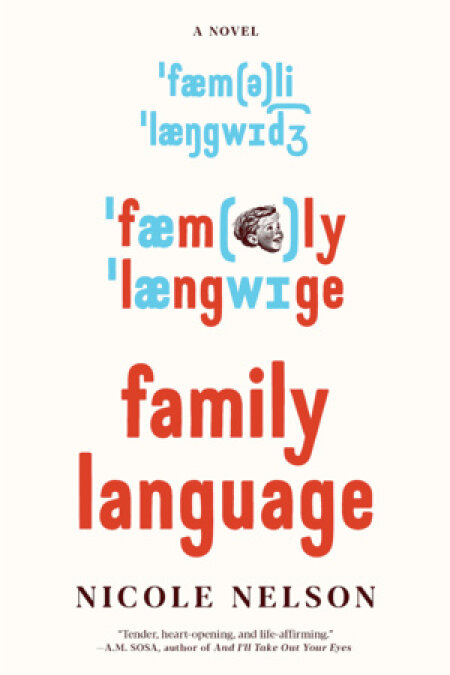
In this striking debut, an ambitious academic faces new and unwanted choices when she is confronted with overnight motherhood...
Dr. Mona Melamed is a happily married, purposefully childfree linguist at a top Southern California university. Her days are spent researching and stressing about finally, finally securing tenure. That is, until her brother-in-law and his wife die, leaving their six-year-old son orphaned.
Everyone in Mona's orbit expects her to take the lead in caring for the child, including—to some extent—Mona herself. Motherhood is not something she wanted–it is still not something she wants. And yet, she finds herself negotiating a temporary leave to start looking after the boy. Along the way, as the gender expectations thrust upon Mona intensify, her tenure becomes threatened.
FAMILY LANGUAGE confronts that age old question–Can women really have it all?--and uncovers the misogyny behind it. As Mona tries to balance her new responsibilities as a mother, she has to ask herself how hard is she willing to fight for the career she’s earned, and is it fair that she even has to?
Release date:
November 10, 2026
Publisher:
Melville House
Print pages:
336
* BingeBooks earns revenue from qualifying purchases as an Amazon Associate as well as from other retail partners.
CHAPTER ONE The atrium at the center of the medical building might have been airlifted from a rainforest. Such lushness was not found in the wild in Southern California, at least not in this age. The soothing green and extra oxygen smelled like manipulation: Forget drought-resistant landscapes and lawns made of plastic. Here were some dense, vibrant, not-fake plants—visuals of stable, lavish, thriving life to calm your nerves. And yet, my breath slowed. Superior air entered my chest, crowding out some of the anxiety. If the appointment went well, freedom from monthly period pain and any future concerns about pregnancy could be mine. My anemia would disappear. With my energy restored, I could work even harder.
I was trying yet another doctor, this one recommended by an acquaintance in the French department. Danielle had said this doctor was “friendly and female”—which struck me as an alarmingly modest baseline. Still, I filled out the form for a records transfer and a chance at a third opinion.
Individually wrapped lemon drops offered in a bright-pink dish made me suspicious. From my past experience in doctors’ waiting rooms, I took those as an unspoken apology for when patients were made to wait. I signed the sheet at the front desk and picked a stiff loveseat.
Matte shades of cream surrounded me. A burbling rock fountain, whose motor noises dominated the water sounds, ran accompanied by background music with sustained tones that made my organs sympathetically resonate. Black-and-white pho- tographs of newborns accented the walls. Facing me, a framed infant lay curled like a comma, naked, in enormous disembodied hands that cradled its dreaming body.
As the minutes passed, I flipped through a new photocopied article about nicknames in Italian. I scanned the patterns and made research notes on a fresh legal pad. Then my mother-in-law’s voice looped: When Mona changes her mind; You’ll understand once you have a baby; Tommy will make a good father. Esther had been gone almost a year. But her statements, her opinions, her expectations—they somehow loomed larger in her absence. She believed that women universally, on some level, desired to have children. And neglecting to have them was to deny my husband the joys of fatherhood—a crime even my disfavored sister-in-law had not committed.
As a woman who did not want to have children, I had been called: selfish, willfully immature, ignorant of my own desires. I had been told that I would lament my neglect to birth a baby once I’d waited too long. Society assured me with movie subplots, greeting card jokes, and comments by strangers that my hormones would kick in, and one day I would realize that I craved children like I seemed to crave solitude. Didn’t I want to freeze my eggs so that when that day came, they would not be severely suboptimal?
What drove people to judge like this? Some must have wanted to rationalize their own choices; others, to self-soothe for having made decisions that they deemed “better” than mine. Sometimes it offended people’s understanding about the meaning of life, if a woman chose to let her bloodline end.
Who will take care of you when you’re older? Don’t you like kids? What about Tommy?
I had requested the appointment to plan for a hysterectomy.
We hope you are enjoying the book so far. To continue reading...

 Please log in to recommend or discuss...
