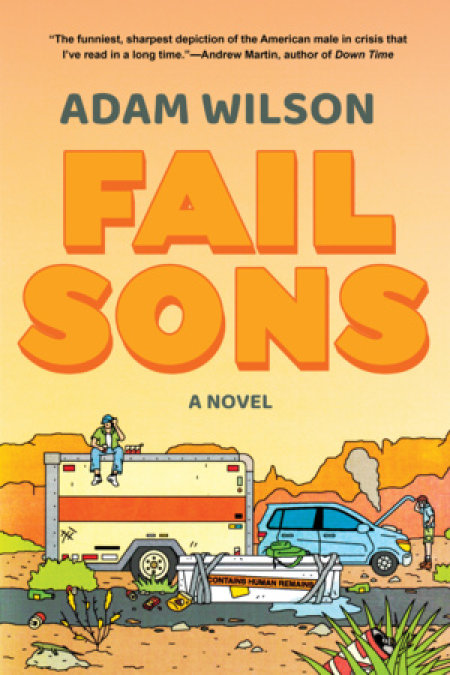
A pair of estranged brothers drive their father’s cryonically frozen body across a divided America to its final resting place in this darkly comic novel about masculinity and grief—a 21st century update of As I Lay Dying—from the author of Flatscreen.
When Scott Platt’s brother, Nick, calls to ask him to fly to Arizona and retrieve their father’s body from the Cryo Center where it’s been frozen since the nineties, the timing couldn’t be worse: He’s forty, unemployed, and spiraling as he and his wife await the birth of their first child. Nick’s as tightly wound as Scott is adrift, and the brothers have never gotten along. But the Cryo Center’s shutting down, and they’ve got six days to haul their father’s frozen body to a new facility in Massachusetts—without letting it thaw past –109°. And Scott needs to get back home to New York before his wife goes into labor.
It’s the summer of 2022. The country’s still reeling from the pandemic. And driving a corpse cross-country in a U-Haul through Red State America proves predictably chaotic. Nick insists on wearing a KN95 the entire time. They pass through deserts, mountains, and plains, encountering Aryan cops, ex-Mormon hitchhikers, a Gen Z commune, and MAGA-hat-wearing Walmart clerks. They play blackjack, take shrooms, and swim under the stars—all while trying to keep the body frozen and their relationship from melting down.
Fail Sons is a brilliant exploration of masculinity, grief, and the ways we carry the dead—and each other—across a divided America.
Release date:
October 6, 2026
Publisher:
Soho Press
Print pages:
240
* BingeBooks earns revenue from qualifying purchases as an Amazon Associate as well as from other retail partners.
We drive north through Arizona in something like silence. No cell service, and I didn’t think to download music. There’s coughing. There’s radio static. Minimal small talk. The slurp of iced coffee, the rattle of ice cubes, the clang of the trailer hitched to our rental that carries our dad.
— The small talk includes my remarks on the landscape: red rock formations and enveloping dusk that pinks and then rusts as we move toward evening. A faint waxing moon in one corner of sky. All I can muster is, “Wow, pretty.” It includes Nick asking if I might sip my coffee in a silenter manner. It includes a discussion of the car’s ideal climate, a matter about which we disagree. I perspire above 68°, while my cold-blooded brother considers sub-75° sweater weather.
— Occasionally something breaks through the static: a snippet of song, a bubbling ad.
“It’s crazy that there are still airwaves,” I say.
Nick nods.
“You know, because everything’s digital now.”
Nick nods.
“People still broadcast.”
Nick uses his thumbnail to pick a pumpkin seed from his teeth. He’s younger than I am, but for a long time I’ve been the sibling pursuing approval.
— We settle on 72°, mutual discomfort. I wait for the ice to melt before swallowing the rest of my room-temperature coffee. I roll and reroll and reposition the hoodie I’m using for lumbar support. When I shift positions, there’s pain. An MRI has confirmed that the disc slotted between my L2 and L3 vertebrae has bulged from its column. Dr. Sophie Apostalokis, my Spine and Pain Management Intervention Specialist, thinks the disc may be impinging a nerve.
— The MRI was done back in New York. I took a lorazepam to combat claustrophobia. A tech gave me earplugs and noise-canceling headphones to muffle the contraption’s vibrating coils. I tried to lie still and sync my breathing to their rhythm, which resembled some kind of industrial techno. The sound felt distant, and the medication dulled the panic signals in my brain. Air from a floor vent lifted my gown and ran cool over my legs. This could be death, I thought, a gentle purgatory. Fixed in the cross-stream of superconductive magnets. A human shimmer on the precipice of sleep.
—
To clarify: I don’t want to die. I fear death. A benzodiazepine-induced semi-paralytic coma, on the other hand, doesn’t sound like the worst thing in the world.
— My wife is due with our first child four weeks from today.
— I’ve never been to this part of the country before. I’d seen the relevant cinema: Butch and Sundance in the flaxen dust swirl, John Ford’s technicolor skies. But only in person is the scale apparent, its humbling magnitude.
— We pee in succession in a Chevron restroom. I go first and flush with my foot, a habit I picked up during the uncertain early days of the pandemic. Nick, for his part, still wears a KN95. He would not be alone on the New York subways, but here in Arizona, I worry that his mask identifies us as blue-pilled soft boys out to repo their assault rifles, raise the capital gains tax, and put Joe Rogan in a public stockade where he’ll be injected with phase 1 trial mRNA vaccines and forced to watch highlights of trans athletes competing in NCAA pole-vaulting tournaments.
— While I’m waiting for Nick, I buy a half-dozen scratch cards and bust.
“Not your day,” says the clerk, who doesn’t look as if it’s ever been his day. His camouflage cap advertises service in a war that I watched on TV in my youth. His T-shirt advertises a disdain for napkins.
“Not my century,” I say.
“Me neither,” the man says. “But I’m Navajo. We haven’t had a good century in years.”
I don’t know how to respond so I just say, “I’m sorry.”
“Sorry for what?”
“I don’t know,” I say. “I’m Jewish. So really, it’s not even my ancestors’ fault.”
“Tell that to the West Bank,” says the clerk.
And here’s Nick, buckling his belt. He brings six bottles of water to the counter.
— It appears that my brother has purchased a pair of plastic sunglasses, the arms of which are imprinted with the NASCAR logo.
— I add a photo to my Instagram Story: Chevron at dusk. I try different fonts for the caption, but “Typewriter” is try-hard, “Modern” is retro, and “Neon” is ugly. I end up back at the default. I don’t add any .GIF stickers. I’ve decided that the tenor of my Stories on this journey will be artful, or ironically faux-artful. I use a saturation filter. I’m going for a William Eggleston thing.
— Now the sun’s a shapeless blur, black-eye purple at horizon’s edge. Golden arches can be seen in the distance, and they grow as we approach, a trick of light sending shadows off the M’s sloped legs and imbuing the logo with a greenish and extraterrestrial glow.
—
I’m hungry. I should have stocked up at Chevron. Nick’s one of those dudes who sprinkles powdered casein on his protein yogurt, works eleven-hour days at a standing desk, snacks on dried seaweed and unsalted almonds, rarely poops.
— I haven’t vaped since we got in the car, and Nick and I have hardly talked about Dad. Now I take the Juul from my pocket. I say, “I guess this is like that movie Speed.”
— I crack my window, a vestigial courtesy of analog times. Air rushes in, whips around my ears. It lifts Nick’s chestnut locks. He slaps a hand on his head to thwart potential muss. I shut the window and the air goes still. According to the app on my phone, our dad’s temperature is currently −324°. — “You know, that movie with Keanu Reeves and Sandra Bullock where they’re on that bus?”
“Yup.”
“Don’t you think this is like that?”
“Nope.”
“But, don’t you think . . . ?”
“Nope.”
I crack the window again and bring the Juul to my lips. Attempt to exhale my vape-stream straight through the crack. A side-eye from Nick.
“What?” I say. “The window’s open.”
He speaks my name in the manner of a disappointed father: “Scott.”
— I’m not ashamed of my nicotine habit per se, but I am ashamed of vaping, which is a bad look on a man of my age. Or maybe it’s the total impression of the vape plus my outfit: wide-leg jeans paired with white Samba sneakers, camp collar bowling shirt open over white “wife-pleaser” tank, tiny hoop earring, ovular sunglasses, a Mets cap pulled low. I had the same look in seventh grade when these items were popular the first time around.
— Now I’m forty years old. The SSRIs that I take for depression have left a small ring of fat around the middle of my body, like I’m permanently wearing a flotation device. A series of minor medical setbacks—culminating with the bulging disc—has curtailed my exercise routine. The muscles I cultivated through my thirties have begun to deflate, leaving pockets of loose flesh where my biceps, triceps, and pecs used to be. My tattoos (sun, David Berman lyric, red-tailed hawk) have faded, and the tensile fluctuation of my skin has further warped them.
— Last week, I interviewed for a copywriting gig at a men’s cosmetics brand. It was clear that I wasn’t what they call a culture fit.
“Cool ’toos,” the interviewer said.
“Oh,” I said. “In my day we called them ‘tats.’”
“What, like back in the aughts?”
“Yeah.”
“I was joking. Really, the aughts?”
I gave a split-fingered heavy metal salute.
“You don’t exfoliate, do you?” he said.
“Is that a job requirement?”
It was.
— Whereas thirty-six-year-old Nick can hold a plank for three minutes. I know because I’ve seen it on Instagram: #plankchallenge, #fitdadsofinstagram, #corestrength, #abs. He makes more money in a year than I’ve made over the last five. He wears a poly-blend golf shirt—a “tech polo” in catalog parlance—and a smartwatch that pings every hour with updated coordinates for his geotagged kids.
— “You know, because in Speed, if the bus goes under fifty miles per hour then it will explode.”
“I know the plot of the film.”
“But this is just like that. If Dad gets above −109 degrees . . .”
“He’ll explode?”
— Our father will be eighty if and when he’s revived, at least according to the timeline that Revivify has offered. A big “if.” Little information about the company’s research into human reanimation is available online, and even within the life extension community—a community notorious for horse-blindered optimism—Revivify’s claims have been met with skepticism. The company is HQ’d in Springfield, Massachusetts, an economically depressed industrial city where I once attended a warehouse rave in the early 2000s. That’s where Nick and I are heading.
“He’ll thaw,” I say.
“That he will.”
— By which we mean that our father’s cryo-preserved brain—a brain that has supposedly spent the last twenty-four years in the same pristine state it was in when Dad died (the Cryo Center’s patented vitrification process allegedly having protected the delicate brain-matter from the formation of ice crystals that might compromise its cellular integrity)—would begin to decay. As would the body to which it’s attached.
We hope you are enjoying the book so far. To continue reading...

 Please log in to recommend or discuss...
