
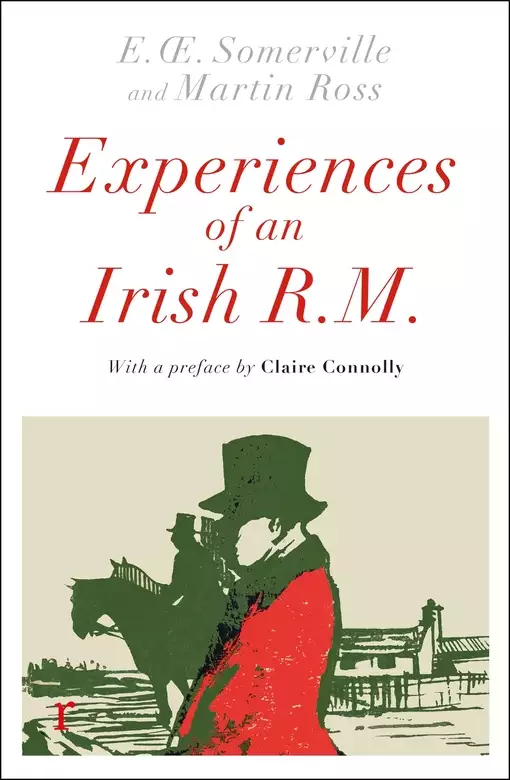
Experiences of an Irish R. M.
- eBook
- Paperback
- Hardcover
- Book info
- Sample
- Media
- Author updates
- Lists
Synopsis
'The stories are rich in dialogue - indeed on many pages there is only dialogue - while the quick exchange of words beats out the rhythm of history on the move' CLAIRE CONNOLLY from her preface to The Experiences of an Irish R. M.
The stories in Experiences of an Irish R. M. are almost entirely concerned with the doings of Skebawn in south-western Ireland and its surroundings. At the centre is the figure of Major Yeates, the Irish Resident Magistrate, who muddles through life as best he can and whose adventures always tell worse against himself. Each short tale offers a dazzling succession of incidents, quickfire dialogue and turnabouts of fate. They contain linguistic verve, dense social detail and what was termed by a contemporary, 'demoniac energy'.
The tough, roving humour of these sharply observed stories brought Edith Somerville and Martin Ross financial security and critical success.
Release date: March 25, 2015
Publisher: Quercus Publishing
Print pages: 446
* BingeBooks earns revenue from qualifying purchases as an Amazon Associate as well as from other retail partners.
Reader buzz
 Please log in to recommend or discuss...
Author updates
Experiences of an Irish R. M.
Martin Ross
Both knew the rigid codes of an elite Anglo-Irish world while living its unsettled future. Their contemporary, Stephen Gwynn, described the Irish society that they knew as a ‘false’ one, arranged according to a hollow and useless hierarchy whereby charming and useless aristocrats relied upon the ability of ‘marvellous’ peasants to pay their rents. The only real money that flowed to the landlords came from remittances sent home to their tenants by American emigrants, said Gwynn, and all shared in the miserable business ‘of rolling the pitiless stone up the never-ending hill’. Historians might wish to nuance this account of the varied strata of Irish society at the end of the nineteenth century, and would certainly query its elision of the violent, intense and prolonged conflicts of the Land War, but it is wholly and recognizably a description of the world imagined in Somerville and Ross’s great creation, The Irish R.M. The stories are almost entirely concerned with the doings of Skebawn in south-western Ireland and its surroundings but America is the next parish. In ‘A Misdeal’, a poor farmer named McCarthy has ‘three fine lumps of daughters in America paying his rent for him’, while even the redoubtable Mrs Cadogan, the housekeeper, has been to America (and presumably back) by ocean liner.
Some pleasures might of course be enjoyed while rolling the stone up the hill. In The Irish R.M., these take the form of horses, fox hunting, drink, picnics, money-making schemes, long yarns and frequent practical jokes. At the centre is the figure of the Irish Resident Magistrate himself, Major Yeates, and the first joke comes when the authors borrow the surname of the most poised, mystical and cerebral poet of the age for a man who muddles through life as best he can and whose adventures always tell worst against himself.
These adventures unfold in successive episodes, originally published monthly in the Badminton Magazine from 1898 (alongside stories about golf, rugby, fishing and shooting) and subsequently in books from 1899. Each successive short tale offers a dazzling succession of incidents, quickfire dialogue and sudden turnabouts of fortune. The cast of characters is vast, but perennially present is Major Yeates’s all too often unreliable adviser in local matters, Flurry Knox. His long-suffering wife, Philippa, provides an active foil to Yeates’s seemingly stoic sufferance of local life by learning Irish, taking photographs, hosting parties and proving an excellent horsewoman. At various points, there are wrangles with tinkers, ballad-singers, cooks, publicans, gombeen men and smugglers. Just as funny are the English characters who arrive in Ireland. In ‘Lisheen Races, Second-Hand’, an ‘earnest young Radical’, the Honourable Basil Leigh Kelway, undertakes a tour and collects statistics related to alcohol, only to encounter a brimming social world that overspills his efforts to record it.
In 1901, Edith Somerville wrote to Martin Ross to say that she had heard of ‘a very smart lady going to Ireland for the first time’ who thought that the book provided a guide as to ‘how one should talk to the Irish’. They thought the idea hilarious because for them the point was not to talk but rather to pay attention. Somerville and Ross had, as the Irish nationalist critic B. G. McCarthy said, ‘a genius for listening’. A stern critic of their class outlook and ‘garrison’ mentality, McCarthy could not help but admire the linguistic verve, dense social detail and ‘demoniac energy’ of the Irish R.M. stories. In particular, she liked their plain way of making Irish speech seem familiar on the printed page and the avoidance of phonetic spelling. Somerville and Ross themselves deplored the earlier fictions of William Carleton for his mangling of dialect on the page. But they were probably also uneasy in the face of the authority of a writer who was born the son of poor Catholic tenants and who could claim to represent the people as they really were. Still, Somerville and Ross did their best to stay aside of the fierce debates about authenticity in Irish culture that raged during their lifetimes. Edith Somerville turned down Douglas Hyde’s request that she collect and compile folklore among the peasantry of Munster in 1897 and Martin Ross meanwhile said no when asked by Lady Gregory if the pair would write a ‘shoneen’ play for the Abbey Theatre, one that would dramatize and make fun of ‘middle-class vulgarity’. They had other plans, and in any case their interest in the curiosities of language had begun not with their tenants but among their own class and with their families.
Somerville and Ross’s first collaboration was an informal glossary of Anglo-Irish terms that they called ‘the Buddh dictionary’. ‘Buddh’ referred to the ‘Buddha-like’ complacency and self-satisfaction of their widespread family, whose shared codes were described by Edith Somerville as:
the froth on the surface of some two hundred years of the conversation of a clan of inventive, violent Anglo-Irish people who, generation after generation, found themselves faced with situations in which the English language failed to provide sufficient intensity, and they either snatched at alternatives from other tongues or invented them.
Froth is impermanent, the passing product of agitation below the surface. A family document, the Buddh dictionary was never intended for publication but its interest in documenting a shared culture that needs to be written down before it disappears overflowed into the Irish R.M. stories. So too did the desire not only to record but to query prejudices made precarious by changing times.
That sense of shifting horizons informs a fussy attention to linguistic usage that continued through their lives: Edith Somerville despaired of people who referred to chrysanthemums as ‘mums’ (‘a term of horrid familiarity’) while the family laughed at locals who referred to the nearby settlement of Skibbereen, rendered as Skebawn in the stories, as ‘town’ – a locution reserved for London. The snobbery was allayed by their acute ear for registers of speech and by their scrupulous practice of conversation as method. The stories are rich in dialogue – indeed on many pages there is only dialogue – while the quick exchange of words beats out the rhythm of history on the move. Like Maria Edgeworth’s unreliable narrator Thady Quirke whose own words incriminate him at every turn, Major Yeates often shows more than he tells. The emergence of the Gaelic Athletic Association as a major force for popular democracy is registered in Yeates’s off-hand observation of the ‘wild, guerrilla species’ of football played locally, ‘blended in some inextricable way with Home Rule’ as he observes (‘Occasional Licences’). Where Thady Quirke, though, represents the untrustworthy voice of the native Irish, Yeates is the Irish-born, English-educated representative of the British state. His mild manners express a gentle toleration of all he encounters but also register the wavering, faltering reach of colonial justice.
For Somerville and Ross, the stories brought financial security and commercial success. At the outset of writing The Irish R.M., they signed with literary agent James B. Pinker, who counted Joseph Conrad, Rebecca West and Katherine Mansfield among his other clients. Pinker praised, advised and supported them and encouraged their talents to run in a comic channel. But the shaded social energies of The Real Charlotte, their novel of 1894, remained in the background.
‘Let us take Carbery and grind its bones to make our bread . . . we will serve it up to the spectator so that its own mother wouldn’t know it!’ wrote Martin to Somerville, referring to her cousin’s corner of west Cork. The successive short fictions that make up this book do indeed pulverize a culture to small, fine pieces and combine them to create something palatable to English audiences. The easy reference to Jack and the Beanstalk, a fairy tale that had become popular in the second half of the nineteenth century, brings with it a casual violence that pervades the stories and saturates the world in which they were first read. A cousin of Edith Somerville’s, recently returned from the South African War, told her that, when a copy of The Irish R.M. was found on the body of a dead Boer, the British troops concluded that ‘he died of laughter’. and adopted the stories as ‘the camp bible’. The later stories see Flurry Knox go to fight in that same conflict and, on his return, the dense social ironies of Skebawn life begin to run on darker lines. A final story, ‘The Whiteboys’, borrows a name resonant with an earlier history of Irish rural resistance for a pack of bloodthirsty white hounds that run wild across the countryside, ‘roaring and screeching’ and killing sheep. When Major Yeates attempts to figure out the eventual fate of the dogs, he is answered by a few non-committal words from Flurry Knox, who looks at him ‘with an eye that was like a stone wall with broken glass on the top’. It is not a bad characterization of the tough, roving humour of these sharply observed stories.
Claire Connolly
A RESIDENT MAGISTRACY in Ireland is not an easy thing to come by nowadays; neither is it a very attractive job; yet on the evening when I first propounded the idea to the young lady who had recently consented to become Mrs Sinclair Yeates, it seemed glittering with possibilities. There was, on that occasion, a sunset, and a string band playing ‘The Gondoliers’, and there was also an ingenuous belief in the omnipotence of a godfather of Philippa’s (Philippa was the young lady) who had once been a member of the Government.
I was then climbing the steep ascent of the Captains towards my Majority. I have no fault to find with Philippa’s godfather; he did all and more than even Philippa had expected; nevertheless, I had attained to the dignity of mud major, and had spent a good deal on postage stamps, and on railway fares to interview people of influence, before I found myself in the hotel at Skebawn, opening long envelopes addressed to ‘Major Yeates, R.M.’
My most immediate concern, as anyone who has spent nine weeks at Mrs Raverty’s hotel will readily believe, was to leave it at the earliest opportunity; but in those nine weeks I had learned, amongst other painful things, a little, a very little, of the methods of the artisan in the west of Ireland. Finding a house had been easy enough. I had had my choice of several, each with some hundreds of acres of shooting, thoroughly poached, and a considerable portion of the roof intact. I had selected one; the one that had the largest extent of roof in proportion to the shooting, and had been assured by my landlord that in a fortnight or so it would be fit for occupation.
‘There’s a few little odd things to be done,’ he said easily; ‘a lick of paint here and there, and a slap of plaster—’
I am short-sighted; I am also of Irish extraction; both facts that make for toleration – but even I thought he was understating the case. So did the contractor.
At the end of three weeks the latter reported progress, which mainly consisted of the facts that the plumber had accused the carpenter of stealing sixteen feet of his inch-pipe to run a bell wire through, and that the carpenter had replied that he wished the devil might run the plumber through a wran’s quill. The plumber having reflected upon the carpenter’s parentage, the work of renovation had merged in battle, and at the next Petty Sessions I was reluctantly compelled to allot to each combatant seven days, without the option of a fine.
These and kindred difficulties extended in an unbroken chain through the summer months, until a certain wet and windy day in October, when, with my baggage, I drove over to establish myself at Shreelane. It was a tall, ugly house of three storeys high, its walls faced with weather-beaten slates, its windows staring, narrow, and vacant. Round the house ran an area, in which grew some laurustinus and holly bushes among ash heaps, and nettles, and broken bottles. I stood on the steps, waiting for the door to be opened, while the rain sluiced upon me from a broken eaveshoot that had, amongst many other things, escaped the notice of my landlord. I thought of Philippa, and of her plan, broached in today’s letter, of having the hall done up as a sitting-room.
The door opened, and revealed the hall. It struck me that I had perhaps overestimated its possibilities. Among them I had certainly not included a flagged floor, sweating with damp, and a reek of cabbage from the adjacent kitchen stairs. A large elderly woman, with a red face, and a cap worn helmet-wise on her forehead, swept me a magnificent curtsy as I crossed the threshold.
‘Your honour’s welcome—’ she began, and then every door in the house slammed in obedience to the gust that drove through it. With something that sounded like ‘Mend ye for a back door!’ Mrs Cadogan abandoned her opening speech and made for the kitchen stairs. (Improbable as it may appear, my housekeeper was called Cadogan, a name made locally possible by being pronounced Caydogawn.)
Only those who have been through a similar experience can know what manner of afternoon I spent. I am a martyr to colds in the head, and I felt one coming on. I made a laager in front of the dining-room fire, with a tattered leather screen and the dinner-table, and gradually, with cigarettes and strong tea, baffled the smell of must and cats, and fervently trusted that the rain might avert a threatened visit from my landlord. I was then but superficially acquainted with Mr Florence McCarthy Knox and his habits.
At about 4.30, when the room had warmed up, and my cold was yielding to treatment, Mrs Cadogan entered and informed me that ‘Mr Flurry’ was in the yard, and would be thankful if I’d go out to him, for he couldn’t come in. Many are the privileges of the female sex; had I been a woman I should unhesitatingly have said that I had a cold in my head.
My landlord was there on horseback, and with him there was a man standing at the head of a stout grey animal. I recognized with despair that I was about to be compelled to buy a horse.
‘Good afternoon, Major,’ said Mr Knox in his slow, sing-song brogue; ‘it’s rather soon to be paying you a visit, but I thought you might be in a hurry to see the horse I was telling you of.’
I could have laughed. As if I were ever in a hurry to see a horse! I thanked him, and suggested that it was rather wet for horse-dealing.
‘Oh, it’s nothing when you’re used to it,’ replied Mr Knox. His gloveless hands were red and wet, the rain ran down his nose, and his covert coat was soaked to a sodden brown. I thought that I did not want to become used to it. My relations with horses have been of a purely military character. I have endured the Sandhurst riding-school, I have galloped for an impetuous general, I have been steward at regimental races, but none of these feats has altered my opinion that the horse, as a means of locomotion, is obsolete. Nevertheless, the man who accepts a resident magistracy in the south-west of Ireland voluntarily retires into the prehistoric age; to institute a stable became inevitable.
‘You ought to throw a leg over him,’ said Mr Knox, ‘and you’re welcome to take him over a fence or two if you like. He’s a nice flippant jumper.’
Even to my unexacting eye the grey horse did not seem to promise flippancy, nor did I at all desire to find that quality in him. I explained that I wanted something to drive, and not to ride.
‘Well, that’s a fine raking horse in harness,’ said Mr Knox, looking at me with his serious grey eyes, ‘and you’d drive him with a sop of hay in his mouth. Bring him up here, Michael.’
Michael abandoned his efforts to kick the grey horse’s forelegs into a becoming position, and led him up to me.
I regarded him from under my umbrella with a quite unreasonable disfavour. He had the dreadful beauty of a horse in a toy-shop, as chubby, as wooden, and as conscientiously dappled, but it was unreasonable to urge this as an objection, and I was incapable of finding any more technical drawbacks. Yielding to circumstance, I ‘threw my leg’ over the brute, and after pacing gravely round the quadrangle that formed the yard, and jolting to my entrance gate and back, I decided that as he had neither fallen down nor kicked me off, it was worth paying twenty-five pounds for him, if only to get in out of the rain.
Mr Knox accompanied me into the house and had a drink. He was a fair, spare young man, who looked like a stable-boy among gentlemen, and a gentleman among stable-boys. He belonged to a clan that cropped up in every grade of society in the county, from Sir Valentine Knox of Castle Knox down to the auctioneer Knox, who bore the attractive title of Larry the Liar. So far as I could judge, Florence McCarthy of that ilk occupied a shifting position about midway in the tribe. I had met him at dinner at Sir Valentine’s, I had heard of him at an illicit auction, held by Larry the Liar, of brandy stolen from a wreck. They were ‘Black Protestants’, all of them, in virtue of their descent from a godly soldier of Cromwell, and all were prepared at any moment of the day or night to sell a horse.
‘You’ll be apt to find this place a bit lonesome after the hotel,’ remarked Mr Flurry, sympathetically, as he placed his foot in its steaming boot on the hob, ‘but it’s a fine sound house anyway, and lots of rooms in it, though indeed, to tell you the truth, I never was through the whole of them since the time my great-uncle, Denis McCarthy, died here. The dear knows I had enough of it that time.’ He paused, and lit a cigarette – one of my best, and quite thrown away upon him. ‘Those top floors, now,’ he resumed, ‘I wouldn’t make too free with them. There’s some of them would jump under you like a spring bed. Many’s the night I was in and out of those attics, following my poor uncle when he had a bad turn on him – the horrors, y’ know – there were nights he never stopped walking through the house. Good Lord! will I ever forget the morning he said he saw the devil coming up the avenue! “Look at the two horns on him,” says he, and he out with his gun and shot him, and, begad, it was his own donkey!’
Mr Knox gave a couple of short laughs. He seldom laughed, having in unusual perfection the gravity of manner that is bred by horse-dealing, probably from the habitual repression of all emotion save disparagement.
The autumn evening, grey with rain, was darkening in the tall windows, and the wind was beginning to make bullying rushes among the shrubs in the area; a shower of soot rattled down the chimney and fell on the hearthrug.
‘More rain coming,’ said Mr Knox, rising composedly; ‘you’ll have to put a goose down these chimneys some day soon, it’s the only way in the world to clean them. Well, I’m for the road. You’ll come out on the grey next week, I hope; the hounds’ll be meeting here. Give a roar at him coming in at his jumps.’ He threw his cigarette into the fire and extended a hand to me. ‘Goodbye, Major, you’ll see plenty of me and my hounds before you’re done. There’s a power of foxes in the plantations here.’
This was scarcely reassuring for a man who hoped to shoot woodcock, and I hinted as much.
‘Oh, is it the cock?’ said Mr Flurry; ‘b’leeve me, there never was a woodcock yet that minded hounds, now, no more than they’d mind rabbits! The best shoots ever I had here, the hounds were in it the day before.’
When Mr Knox had gone, I began to picture myself going across country roaring, like a man on a fire-engine, while Philippa put the goose down the chimney; but when I sat down to write to her I did not feel equal to being humorous about it. I dilated ponderously on my cold, my hard work, and my loneliness, and eventually went to bed at ten o’clock full of cold shivers and hot whisky-and-water.
After a couple of hours of feverish dozing, I began to understand what had driven Great-Uncle McCarthy to perambulate the house by night. Mrs Cadogan had assured me that the Pope of Rome hadn’t a betther bed undher him than myself; wasn’t I down on the new flog mattherass the old masther bought in Father Scanlan’s auction? By the smell I recognized that ‘flog’ meant flock, otherwise I should have said my couch was stuffed with old boots. I have seldom spent a more wretched night. The rain drummed with soft fingers on my window panes; the house was full of noises. I seemed to see Great-Uncle McCarthy ranging the passages with Flurry at his heels; several times I thought I heard him. Whisperings seemed borne on the wind through my keyhole, boards creaked in the room overhead, and once I could have sworn that a hand passed, groping, over the panels of my door. I am, I may admit, a believer in ghosts; I even take in a paper that deals with their culture, but I cannot pretend that on that night I looked forward to a manifestation of Great-Uncle McCarthy with any enthusiasm.
The morning broke stormily, and I woke to find Mrs Cadogan’s understudy, a grimy nephew of about eighteen, standing by my bedside, with a black bottle in his hand.
‘There’s no bath in the house, sir,’ was his reply to my command; ‘but me a’nt said, would ye like a taggeen?’
This alternative proved to be a glass of raw whisky. I declined it.
I look back to that first week of housekeeping at Shreelane as to a comedy excessively badly staged, and striped with lurid melodrama. Towards its close I was positively home-sick for Mrs Raverty’s, and I had not a single clean pair of boots. I am not one of those who hold the convention that in Ireland the rain never ceases, day or night, but I must say that my first November at Shreelane was composed of weather of which my friend Flurry Knox remarked that you wouldn’t meet a Christian out of doors, unless it was a snipe or a dispensary doctor. To this lamentable category might be added a resident magistrate. Daily, shrouded in mackintosh, I set forth for the Petty Sessions Courts of my wide district; daily, in the inevitable atmosphere of wet frieze and perjury, I listened to indictments of old women who plucked geese alive, of publicans whose hospitality to their friends broke forth uncontrollably on Sunday afternoons, of ‘parties’ who, in the language of the police sergeant, were subtly defined as ‘not to say dhrunk, but in good fighting thrim’.
I got used to it all in time – I suppose one can get used to anything – I even became callous to the surprises of Mrs Cadogan’s cooking. As the weather hardened and the woodcock came in, and one by one I discovered and nailed up the rat holes, I began to find life endurable, and even to feel some remote sensation of home-coming when the grey horse turned in at the gate of Shreelane.
The one feature of my establishment to which I could not become inured was the pervading subpresence of some thing or things which, for my own convenience, I summarized as Great-Uncle McCarthy. There were nights on which I was certain that I heard the inebriate shuffle of his foot overhead, the touch of his fumbling hand against the walls. There were dark times before the dawn when sounds went to and fro, the moving of weights, the creaking of doors, a far-away rapping in which was a workmanlike suggestion of the undertaker, a rumble of wheels on the avenue. Once I was impelled to the perhaps imprudent measure of cross-examining Mrs Cadogan. Mrs Cadogan, taking the preliminary precaution of crossing herself, asked me fatefully what day of the week it was.
‘Friday!’ she repeated after me. ‘Friday! The Lord save us! ’Twas a Friday the old masther was buried!’
At this point a saucepan opportunely boiled over, and Mrs Cadogan fled with it to the scullery, and was seen no more.
In the process of time I brought Great-Uncle McCarthy down to a fine point. On Friday nights he made coffins and drove hearses; during the rest of the week he rarely did more than patter and shuffle in the attics over my head.
One night, about the middle of December, I awoke, suddenly aware that some noise had fallen like a heavy stone into my dreams. As I felt for the matches it came again, the long, grudging groan and the uncompromising bang of the cross door at the head of the kitchen stairs. I told myself that it was a draught that had done it, but it was a perfectly still night. Even as I listened, a sound of wheels on the avenue shook the stillness. The thing was getting past a joke. In a few minutes I was stealthily groping my way down my own staircase, with a box of matches in my hand, enforced by scientific curiosity, but none the less armed with a stick. I stood in the dark at the top of the back stairs and listened; the snores of Mrs Cadogan and her nephew Peter rose tranquilly from their respective lairs. I descended to the kitchen and lit a candle; there was nothing unusual there, except a great portion of the Cadogan wearing apparel, which was arranged at the fire, and was being serenaded by two crickets. Whatever had opened the door, my household was blameless.
The kitchen was not attractive, yet I felt indisposed to leave it. None the less, it appeared to be my duty to inspect the yard. I put the candle on the table and went forth into the outer darkness. Not a sound was to be heard. The night was very cold, and so dark that I could scarcely distinguish the roofs of the stables against the sky; the house loomed tall and oppressive above me; I was conscious of how lonely it stood in the dumb and barren country. Spirits were certainly futile creatures, childish in their manifestations, stupidly content with the old machinery of raps and rumbles. I thought how fine a scene might be played on a stage like this; if I were a ghost, how bluely I would glimmer at the windows, how whimperingly chatter in the wind. Something whirled out of the darkness above me, and fell with a flop on the ground, just at my feet. I jumped backwards, in point of fact I made for the kitchen door, and, with my hand on the latch, stood still and waited. Nothing further happened; the thing that lay there did not stir. I struck a match. The moment of tension turned to pathos as the light flickered on nothing more fateful than a dead crow.
Dead it certainly was. I could have told that without looking at it; but why should it, at some considerable period after its death, fall from the clouds at my feet. But did it fall from the clouds? I struck another match, and stared up at the impenetrable face of the house. There was no hint of solution in the dark windows, but I determined to go up and search the rooms that gave upon the yard.
How cold it was! I can feel now the frozen musty air of those attics, with their rat-eaten floors and wall-papers furred with damp. I went softly from one to another, feeling like a burglar in my own house, and found nothing in elucidation of the mystery. The windows were hermetically shut, and sealed with cobwebs. There was no furniture, except in the end room, where a wardrobe without doors stood in a corner, empty save for the solemn presence of a monstrous tall hat. I went back to bed, cursing those powers of darkness that had got me out of it, and heard no more.
My landlord had not failed of his promise to visit my coverts with his hounds; in fact, he fulfilled it rather more conscientiously than seemed to me quite wholesome for the cock-shooting. I maintained a silence which I felt to be magnanimous on the part of a man who cared nothing for hunting and a great deal for shooting, and wished the hounds more success in the slaughter of my foxes than seemed to be granted to them. I met them all, one red frosty evening, as I drove down the long hill to my demesne gates, Flurry at their head, in his shabby pink coat and dingy breeches, the hounds trailing deject
We hope you are enjoying the book so far. To continue reading...
