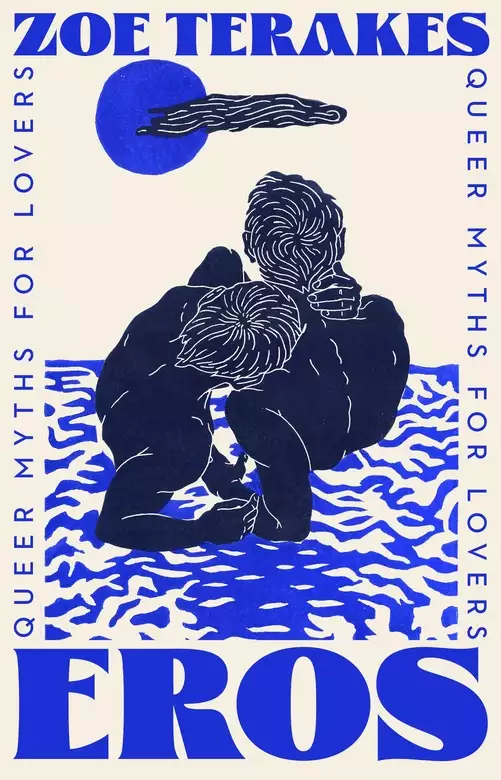
A sexy modern take on ancient Greek myths that embraces the history and endurance of queer love, from an exciting Australian writer.
She keeps her eyes on me while she lights the end of my cigarette. I stare back at her. Something in the pills and in her eyes is opening up my muscles like hands parting from prayer, like trees breathing.
Eros is a stunning collection of short stories, grounded in truth and coloured with dazzling imagination and alluring unpredictable mystery. Revealing how queerness, nature and myth have been intertwined for eternity, these are stories of gods and goddesses: of Zeus, of Aphrodite, of Hermaphroditus, of Icarus before he flew into the sun. Stories of queer life, lust, revenge, wrath, passion and sex. Of yearning, love, loss. Some stories span across a life, and others, an evening. Perspectives will shift. Houses will burn. Lovers will learn their fate.
Zoe Terakes has skilfully blended myth and modernity to illuminate the complex and enduring truth of trans lives, resisting a history of erasure and delivering a sexy, soul-touching book to read to your lover . . . or yourself.
Release date:
October 28, 2025
Publisher:
Hachette Australia
Print pages:
352
* BingeBooks earns revenue from qualifying purchases as an Amazon Associate as well as from other retail partners.
I know everything now. I know the pieces that have been sewn together. I know the tapestry of my childhood; the stories we are told as children that we only uncover as adults. The million ways people tried to protect us, and did the very opposite. I understand that love is all there is.
Love is our only means to get free. Love is the act of freeing one another. Love promises freedom and runs headlong toward it. It doesn’t draw breath. Love, at its best, beats like wings beneath you, taking root in your body and connecting you to something so much larger.
I am so lucky to have known this love.
I am alive because I have known this love.
This love is everywhere. It’s in our mothers, our lovers, our children, our friends, our teachers, our trees, our water, our land, our air, our stars, our sun, our moon, our gods. This love is everywhere. If our hearts are listening, they will hear it.
I was born in love. My birth was an act of love. My first breaths were because of love.
•
My mother felt my feet press the edges of her insides. She tells me that if she really listened, she could hear my heartbeat. Always a loud heart, she says.
My father, Ligdus, was not a generous man, in silver or in spirit. He loved my mother, his Telethusa, like a soldier loves his country – theoretically and with entitlement. He cared for her aimlessly and without intention. His hands were cold, his touch thoughtless. He didn’t care to learn her, to study her body or the pattern of her breath. But he needed her all the same.
I wasn’t supposed to happen. I spent the better part of my youth living in the shadow of what was supposed to happen. How I was supposed to exist.
When my mother was pregnant with me, my dad told her of his two wishes:
1. For her birth to be painless.
2. For the baby to be killed if it was a girl.
She pleaded with him. She screamed at him. She cried. He cried too. Or at least, that’s what she told me.
They could not afford a girl, he said. Girls were expensive. Girls required a dowry and were no help working the field. Their hands were too small, their arms too weak.
So, if I was born a girl, I would be killed. Though devastating, this is common. This is not a unique tragedy, nor one specific to my family. This is Crete.
I continued growing in my mother’s belly like the rolling of a dice. She held me within her, knowing it might be the only chance she got. She wrapped her arms around me. Placed her hands on my feet when I pressed them to the walls of her womb. She sang to me. She prayed for me. Oh man, she prayed for me. She prayed like a storm. She prayed on her knees with her hands beating against her chest. She prayed like it was the only thing left for her to do.
She begged the Fates for answers. Heads, he lives; tails, she dies.
I could feel her love even then. I swear, I remember it in my body. I could feel the love she gave me even before I was born. Before I drew breath. That’s how strong her love was.
My mother went into labour while my father was out working in the field. It was just her and a midwife in a small, ramshackle room. My mother was laid down on a low, hard bed lined with sea sponges and wool bandages. The midwife lay cloths soaked in warm olive oil over her stomach and hips. She kept fragrant herbs around her neck in case my mother fainted.
Sweat stung my mother’s eyes. She could not find her breath. She was a woman of her body, but panic was ripping her away from it.
Blackness.
That was all she saw.
Just blackness. This is the bottom of the ocean, she thought.
Only the bottom of the ocean could be this dark.
There was no midwife. No olive oil or wool.
She wondered if she had died. If even death could be as dark as this.
She began to see colours in the distance. Like splodges. Like when you press against your eyes too hard for too long and strange grainy puddles of colour begin to move in the darkness.
Blue and brown and gold. Moving toward her. Brighter and brighter, the closer they got.
Isis, Osiris, Anubis, Bastet and Apis came to her bedside.
My mum. A poor lady from Phaistos with a wicked sense of humour, whose greatest wealth was the feeling of saltwater on her skin. My mother. In the company of gods.
She sat upright as her tears fell, and didn’t stop falling. She wept. Not in sadness or pain, just in witness. ‘Very beautiful things can make you cry, Iphis,’ she tells me still.
All children on this island obsess over the passage of the afterlife. They stay up late, until the stars have pushed their kisses through the darkness and the sky is lit up with their loving. To a sky full of gods, the children tell the story of the soul.
They whisper of the forty-two divine judges who wait at the mouth of the afterlife, ready to determine the fate of the dead. They act out the confessions of innocence, pleading desperately against their unlived sins. Little boys bite their nails and ruffle their hair while they wait for their hearts to be weighed by the gods. The purer the heart, the lighter it would be. It is quite the performance.
Each night the children give the stars a different show. Sometimes their hearts are lighter than the feather of truth and they pass the trial, floating and blissful on their passage to the afterlife. Other nights, they drop to their knees and shake their fists at the sky as their heavy hearts are devoured by Amit – the beast with the head of a crocodile, the torso of a lion and the hind legs of a hippo. Little girls clap their hands together as he snaps his jaws and licks his lips. At the end of their shows, they bow to the stars, twinkling in their applause. Thank you for coming, you’ve been a wonderful audience, goodnight.
These gods – the ones who weighed hearts and dispensed eternal life and threw your soul to the crocodile, the celebrities of my childhood – these were the very gods who stood before my mother.
They looked like a painting, she tells me, a painting made from light. They emitted a glow that was alien to her, and also the most natural thing she had ever seen. It was as if the full moon and the midday sun were shining on their skin. Or from their skin. They eclipsed.
Through tears, her eyes adjusted to their brightness in the dark and finally, she could see them with visceral clarity. Anubis’s eyes were the first she found. They glowed pure white, and exhaled a kind of mist that caught the light streaming from his pupils. He had the head of a jackal, with pointed ears that betrayed the seriousness of his jowl. She could feel the heat of his breath from his long, wet nose. She took in the hardness of his body, all lean muscle draped in gold. Upon seeing Anubis, my mother knew she was dead.
I must have died in labour, she thought. Anubis has come to walk me to the afterlife and embalm what remains.
She tells me she wasn’t afraid. She tells me the only terror that struck her cold was the possibility that I had met the same fate.
‘Is my child dead too?’ she sputtered, wiping the snot dripping over her lips. She was surprised to find that she didn’t feel embarrassed.
Isis moved toward her.
My mother had prayed at the temple of Isis with more faith and loyalty than any other. She had sometimes fretted that the other gods might feel jealous of her devotion. She had knelt before Isis’s statue a hundred times, whispering secrets to her at dawn, at dusk. She shared more with the goddess than she did with my father, with her sister, or with me, for that matter.
My mother recalled the surrealness of seeing a face she knew so intimately, yet inanimately, in motion. Isis was larger than her statue and even more impossibly beautiful. Her skin was slick with oil and flecked with gold. Mum had to stop herself from reaching out and touching her. She was captured by Isis’s shoulders : how muscular they were ; how perfectly they framed her thick, black braids; the strength with which they held up her wings.
Her wings.
Lapis blue feathers folded into each other like hands in prayer. They looked both soft and impenetrable, the way that kites can look like shields.
‘You are not dead, Telethusa, nor is your child.’ Isis’s voice had the softness of a shoreline and the power of an earthquake. My mother felt the vibration of Isis’s words in her chest.
She clambered up and sat on her shins, her huge belly resting on her thighs, and bowed her head before the gods.
‘If I am not dead, why are you here?’ she murmured with a crack in her voice, unsure how to address the host of gods.
Isis placed three fingers beneath my mother’s chin and lifted it, raising her face to meet her gaze. It was like staring into direct sunlight. It was too beautiful. Isis was too beautiful. Her eyes were so large, so blue, so knowing, they orbited like two planets in their own solar system.
‘Do not obey your husband, Telethusa.’
Shock stole my mother’s face. Shock at the intimacy of the instruction, shock that she had never considered defiance an option.
‘Whatever the sex, you will raise this child a boy. Even if a beautiful baby girl takes breath from between your hips, you will raise this child a boy. Should there be troubles in the future, you will have my aid. I will protect him. You have my word.’
Before my mother could answer her, Isis thundered,
‘NOW PUSH.’
And she did.
‘PUSH.’
Osiris joined in.
‘PUSH.’
Then Anubis.
‘PUSH!’
To a chorus of chanting gods, my mother pushed, and heaved, and screamed. On all fours, she pushed, gripping the bed until her hands bled the stone.
And at last, from between her thighs, I emerged.
When my mother opened her eyes, the gods had left. Only the midwife stood beside her, with sage in one hand, and me in the other. My mother snatched me from the midwife. Like a wild beast, she tells me.
‘This is my son,’ my mother said quickly.
‘Telethusa, she –’
‘My son. Breathe a word otherwise and I fear what tragedy may befall you.’ It was both a threat and a warning – my mother genuinely feared what lengths the goddess would go to in order to protect her child.
The midwife stared blankly back at her, then nodded with the solemnity of an oath.
Together, they worked quickly, snipping and drying, wiping the blood from my body, wrapping me in wool, concealing all but my head. Word was sent to my father that Telethusa had delivered for him a son.
A son.
What greatness that title holds. What promise, what power, what possibility. My father held me as such. As if I had already accomplished so much just by virtue of being born. A son.
His pride temporarily relieved my mother. He wasn’t suspicious of my long, dark eyelashes. He didn’t try to remove the garments so tightly wrapped around my tiny body. So far, so good.
A colour redder than rage climbed the length of my mother’s neck and mottled her face as it dawned on her that the ‘burden’ of my girlhood would have seen me killed. That the worth he had ascribed to me was solely down to luck, was solely because of my assumed cock. The realisation made her wild. It made her hate him.
‘Iphis, we will call him. After my brave grandfather,’ Ligdus announced.
‘Iphis,’ Mum repeated.
‘Iphis,’ she whispered to me, like my name was the answer to her prayer.
A feeling of wholeness struck her in the chest the first time she heard my name. She realised she hadn’t breathed deeply since the gods had left her. Where we come from, Iphis is a genderless name, and Mum felt it captured the whole of me. The name protected me, and quietly kept my secret. Iphis would become my armour. Iphis would become my home.
Ligdus aimed a kiss at my mother’s cheek, and she flinched like she was dodging a spear. She loved me and felt more loved by me, she said, in the minutes she had known me than she had in a whole lifetime with my father. Their love seemed so fickle now, thin. Before her very eyes, a lion had shed his skin; she watched it pile around the ankles of this wiry, cruel, annoying man. With this unravelling, she saw how controlled his love was, how he dosed her up with feeling only when he needed comfort, or a quick fuck.
She tells me she didn’t know if she could ever forgive him for what he would have done to me. When she tells me this, she grows to twice her size. She becomes a mountain.
‘Tired, my sweet? Let’s get you and the boy to bed.’ For all her bigness, my father always found a way to make an ant out of her.
Both weary and coursing with adrenaline, she feigned a smile and carried me to bed.
And so, my life began.
•
I really liked being a kid. I was good at it. Early childhood felt like an open field, marked by stone fruit and olives, saltwater, a graze on the knee, constant sun, and learning. I loved people. I moved with a trust that cracked through my chest and led me forward, always forward, always toward people, always toward connection. Before I could talk, all I did was wave at people. ‘Anyone,’ my mother told me. ‘You’d wave at anyone. And they’d feel special because this beautiful baby had waved at them. Big beaming smile . . .
We hope you are enjoying the book so far. To continue reading...

 Please log in to recommend or discuss...
